Organization model rules turn Copilot costs into policy
GitHub Copilot targeted model rules move AI coding model choice from an individual picker into organization-level cost, security, and governance policy.

- What happened: GitHub opened a public preview of
targeted model rulesfor Copilot, letting enterprise owners allow specific models for specific organizations.- The feature is available to Copilot Business and Copilot Enterprise customers.
- Why it matters: Model choice is no longer just developer preference. It is becoming an operating policy for cost, security, support, and workload complexity.
- Builder impact: Enterprises can separate default allowed models from team-level exceptions, giving agentic coding workflows a finer governance layer.
- A useful policy still needs usage measurement, review rules, and data-boundary decisions around the model allowlist.
GitHub Copilot's model picker is moving out of the personal settings screen and into the administrator policy layer. On May 26, 2026, GitHub announced a public preview of targeted model rules for Copilot Business and Copilot Enterprise customers. The core idea is simple: an enterprise owner can create a rule that allows only selected Copilot models for selected organizations.
At first glance this looks like a small admin-console improvement. In the larger AI coding trend, it is more meaningful. Copilot is no longer an autocomplete product wrapped around one model. It now spans the web, IDEs, CLI surfaces, mobile, cloud agents, code review, and the Copilot app. Those surfaces can sit on top of GPT-family models, Gemini, Claude, faster mini models, long-term-support models, and automatic model selection. In that environment, "choosing a model" effectively means choosing a cost profile, security posture, reliability profile, and support policy.
Recent devlery coverage of Copilot has pointed in the same direction. The Copilot app technical preview showed a workbench that links issues, branches, verification, and pull requests. Copilot cloud agent's automatic model selection showed GitHub routing work based on task shape and system state. The move to GPT-5.3-Codex as a default model, plus the appearance of LTS model language, showed that enterprises often want operational stability as much as raw novelty. Targeted model rules ask the next question: if many models are available, should every organization inside a company have the same choices?
Why an enterprise-wide default is not enough
Early Copilot administration was mostly about enablement. Who gets a seat? Which features are enabled? How should code reference filtering and content exclusion work? Once agentic workflows expand, the problem becomes more granular. Different teams inside one enterprise need different things from AI models.
A platform engineering team may need stronger coding models for complex refactors and long-running changes. A security team may want powerful models for code review and vulnerability triage while constraining tool execution or access to sensitive repositories. A documentation or test-maintenance team may be well served by a faster, cheaper model. A research group may want to trial new models early, while a regulated customer-facing organization may need a smaller set of previously reviewed models.
One enterprise-wide default struggles to express those differences. Opening the strongest models to every organization increases cost and risk. Restricting everyone to the most conservative baseline can block the productivity gains that made the tool worth buying. The missing layer is an organization-level allowlist. GitHub's targeted model rules bring that allowlist into the Copilot administration flow.
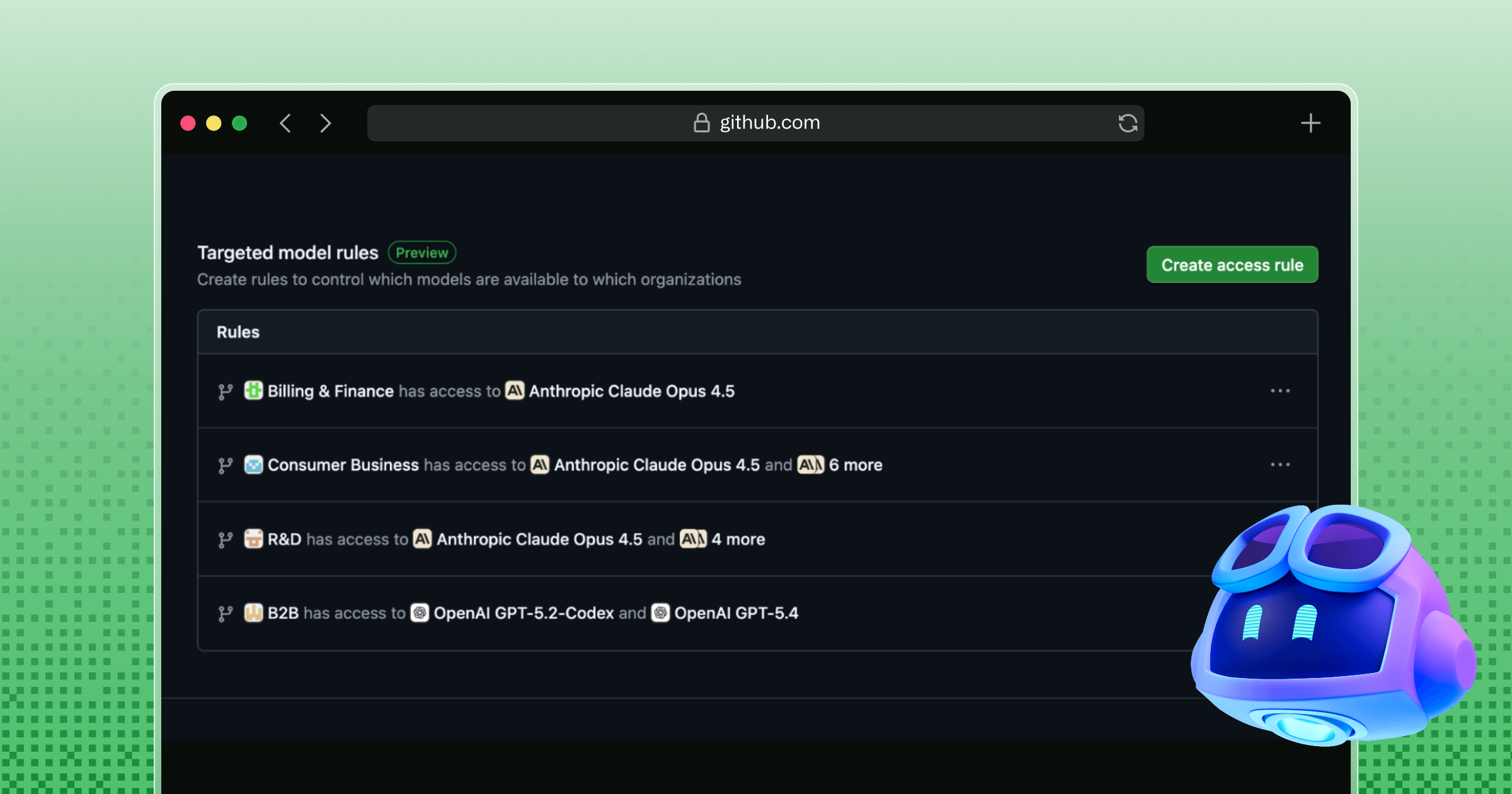
GitHub's announcement says enterprise owners can create rules that target selected organizations and allow selected Copilot models. GitHub Docs describes the workflow in more detail: go to the enterprise AI controls, open Copilot, choose Configure allowed models, create an access rule in the Targeted model rules section, choose organizations, and add the models those organizations may use.
The important detail is that targeted rules complement enterprise-wide availability settings rather than replacing them. Default model availability still exists. Admins can set models to Enabled or Optional. Enabled means the model is automatically available across the enterprise. Optional means each organization can decide whether to turn that model on. A targeted rule adds a narrower control that maps particular models to particular organizations.
| Control layer | Role | Operational meaning |
|---|---|---|
| Enabled | Turns a model on for every organization by default | Useful for broadly approved standard models |
| Optional | Lets each organization choose whether to enable a model | Keeps a central standard while preserving local autonomy |
| Targeted rule | Allows selected models for selected organizations | Separates high-cost models, experimental models, and regulated exceptions |
Model choice is now a cost policy
In AI coding tools, model choice has often been framed as a performance debate. Which model scores higher on SWE-bench? Which model handles refactoring better? Which model fixes failing tests more reliably? Those comparisons still matter. But when an enterprise rolls Copilot out broadly, the first hard question is often cost predictability.
Coding agents do not consume models like autocomplete does. Autocomplete usually means many short context windows and short outputs. Agentic workflows are different. They may search the repository, read files, generate diffs, run tests, reinterpret logs, and revise a pull request after review comments. The same request, such as "fix this bug," can produce very different usage depending on how many tool calls the agent makes and how much code or log output the model reads. A stronger model may be worth the price on hard changes. Sending every documentation edit and minor test update through the same model can quickly distort the cost curve.
GitHub has already been moving in this direction through several May 2026 updates. On May 18, it added faster, more cost-efficient models for simple tasks in Copilot cloud agent. On May 20, it said VS Code's Auto model selection routes based on task characteristics. On May 19, it made Gemini 3.5 Flash generally available for GitHub Copilot. These changes are not just a longer model menu. They show Copilot turning into a model portfolio.
Targeted model rules let enterprises divide that portfolio according to their own organization structure. A platform group can receive access to stronger models for large refactors. A documentation team can stay on faster and cheaper models. A new model that has not completed security review can be limited to a research organization. A group that handles sensitive customer data can be restricted to reviewed models, while an experimental group gets a wider Optional set.
This is not only about reducing spend. The more important issue is attribution. Enterprises need to know which organizations use which models, which types of work justify expensive models, and where agentic workloads are increasing. Without that mapping, model cost becomes a shared bill that no team can explain. An allowlist is the beginning of a budget conversation, not the end of it.
Security policy can also vary by model
Model selection also connects to security. AI coding tools touch source code, issues, pull requests, test logs, internal documentation, and dependency metadata. When an agent runs through a cloud agent or CLI surface, admins also have to consider execution privileges, network access, and the chance of exposing secrets. It is not safe to assume every model is hosted in the same place, governed by the same data processing commitments, or observable through the same audit trail.
GitHub already has separate documentation around Copilot models, hosting, FedRAMP, data residency, and enterprise AI governance. Targeted model rules do not automatically solve all of those questions. They do, however, give security teams a more realistic policy shape. Instead of choosing only between "Copilot is allowed" and "Copilot is blocked," they can define intermediate states.
For example, an organization working on regulated workloads might allow only a reviewed model set and separately limit agent access to internal tools or repositories. A mainstream product engineering organization might have broader model choices. When a new model appears, admins can expose it first to a limited organization, watch usage, quality, failure cases, and security concerns, and then expand access later. This resembles a canary release in software delivery. The difference is that the thing being rolled out is not application code. It is an AI model inside the development workflow.
Does this reduce developer freedom?
From a developer's perspective, organization-level model rules can feel restrictive. Individual builders want to choose the strongest model, the newest model, or the fastest model depending on the moment. Developers who use AI coding tools heavily can feel those model differences in real work. One model may be better at interpreting test failures. Another may be steadier on a broad refactor. A faster model may be enough for small edits.
In an enterprise, though, model freedom cannot be delegated entirely to individuals. One developer's model choice can affect the team's budget, customer-data handling, code-exfiltration policy, and security review scope. That becomes even clearer with cloud agents. While an agent reads files, runs CI, opens a pull request, and responds to review comments, usage and permissions accumulate. The chosen model is part of the execution plan.
A good policy should not simply block developer choice. It should preserve sensible choices by workload type. Small changes can default to fast models. Complex changes can be allowed to use stronger models. Experimental organizations can get early access while the enterprise-wide standard stays more conservative. If model rules prevent developers from doing real work, the policy has failed. If every model is always open and no one can explain the cost or risk, operations has failed too.
GitHub's advantage is position, not model ownership
The competitive value of this feature does not come from GitHub building every model itself. It comes from GitHub's position in the development lifecycle. GitHub already owns issues, pull requests, code review, branch protection, Actions, repository policies, organizations, and enterprise accounts. As coding agents move into production workflows, that position becomes more important.
Model companies provide strong models. IDE companies are close to the moment when developers write code. GitHub sits where code is reviewed, merged, checked, and governed. That is why Copilot model rules matter more than a standalone model picker. Deciding which organization can use which model becomes a way to define AI permissions inside the development lifecycle.
In that sense, GitHub is starting to resemble broader workplace AI governance systems such as Microsoft 365 Copilot admin controls or Google Gemini Enterprise. The difference is the unit of work. GitHub's units are not documents or email threads. They are repositories, organizations, pull requests, and CI checks. As AI takes on more development work, the governance units follow the real structure of engineering work. Enterprise, organization, repository, team, agent session, and pull request can all become policy boundaries.
Enterprise owner
Default model availability: Enabled or Optional
Targeted model rule: map organizations to allowed models
Developer model choices and agent execution paths
The open questions
Targeted model rules are still in public preview, and the operational questions matter. What priority applies when rules conflict? Is organization-level targeting enough, or will teams eventually need repository-level controls? How easily can model usage reports be joined to allow rules? When Auto model selection is enabled, how exactly do organization allowlists constrain the routing candidates? When a new model is added or an old model is deprecated, how much rule maintenance will admins inherit?
Auditability is the area administrators should watch most closely. The model allowlist matters, but the change history matters more. Enterprises need to know who opened which model to which organization, when they did it, and what happened afterward to usage, failures, and cost. Once AI coding tools become development infrastructure, changing a model is no longer a casual settings tweak. It is an operational event.
Development teams also need their own metrics. Which models are sufficient for which task types? Which changes genuinely require a stronger model, and which are fine on a fast one? Was a failed agent task caused by model capability, tool permissions, flaky tests, or missing context? Without those questions, organization-level model rules can collapse into a blunt cost-cutting mechanism. With those questions, they can become a practical way to route AI help to the work that actually needs it.
Conclusion
GitHub Copilot targeted model rules are not a flashy feature. They are not a new model, a new agent, or a new demo surface. But as coding agents enter enterprises, these management features become central. The question is no longer only "how smart is the model?" It is also "who can use which model, for what work, under which responsibility?"
Seen narrowly, this is a public preview in the Copilot admin console. Seen more broadly, it is another signal that AI coding tools are shifting from personal productivity tools into organizational operating infrastructure. Model choice still affects developer experience. Inside enterprises, it also moves with budgets, security, data boundaries, and support policies. That is why GitHub is adding organization-level model rules. In the coding-agent era, the model picker is becoming a policy table.
Sources
- GitHub Changelog: Target Copilot models to organizations with model rules
- GitHub Docs: Managing availability of default models
- GitHub Changelog: Auto model selection now routes based on your task in VS Code
- GitHub Changelog: Gemini 3.5 Flash is generally available for GitHub Copilot
- GitHub Changelog: Copilot cloud agent fast cost-efficient models for simple tasks