Kurrent Capacitor turns coding agent sessions into team memory
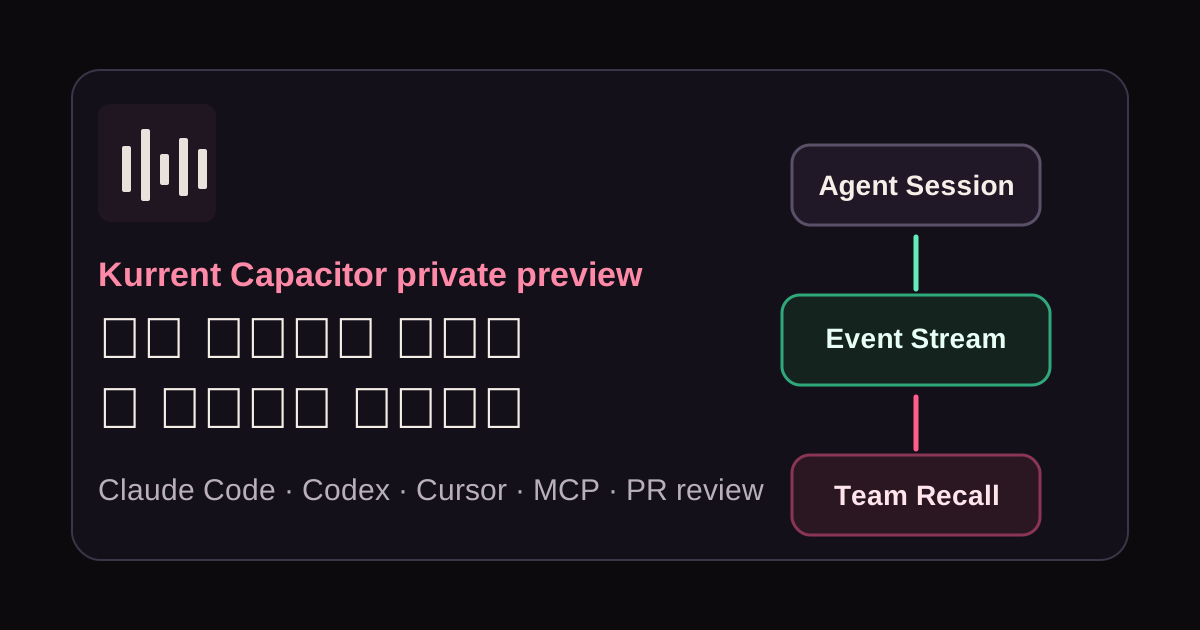
Kurrent Capacitor records Claude Code, Codex, and Cursor sessions as shared memory for PR review, recall, and agent evaluation.
- What happened: Kurrent announced a
Capacitorprivate preview for recording coding agent sessions.- The launch materials name Claude Code, Codex, and Cursor as supported agents, with free use during the preview period.
- Product scope: Capacitor stores transcripts, tool calls, token usage, repository context, branches, and pull requests as event streams.
- Why builders should care: Agent-generated diffs are easier to review when reviewers can inspect the tests, failed attempts, and decisions behind them.
- The practical question is whether session logs become reviewable team assets instead of disposable chat history.
- Watch: Capacitor is still in private preview, and public adoption signals for the CLI package and repository remain early.
Kurrent announced the private preview of Kurrent Capacitor on June 4, 2026. Capacitor records sessions from coding agents such as Claude Code, Codex, and Cursor, then makes those records available through a hosted dashboard, CLI, MCP tools, pull request review, and session evaluation. The launch materials describe free use during the preview period and position the product as "shared memory" for coding agents.
The developer problem is not another model benchmark. Pull requests already preserve the final diff, but they rarely preserve the path that produced it: which tests failed, which hypothesis was dropped, which permission request a human rejected, or why an agent chose one migration sequence over another. Kurrent frames that missing record as a team coordination problem. It is applying the event stream model behind KurrentDB to the work history of AI coding agents.
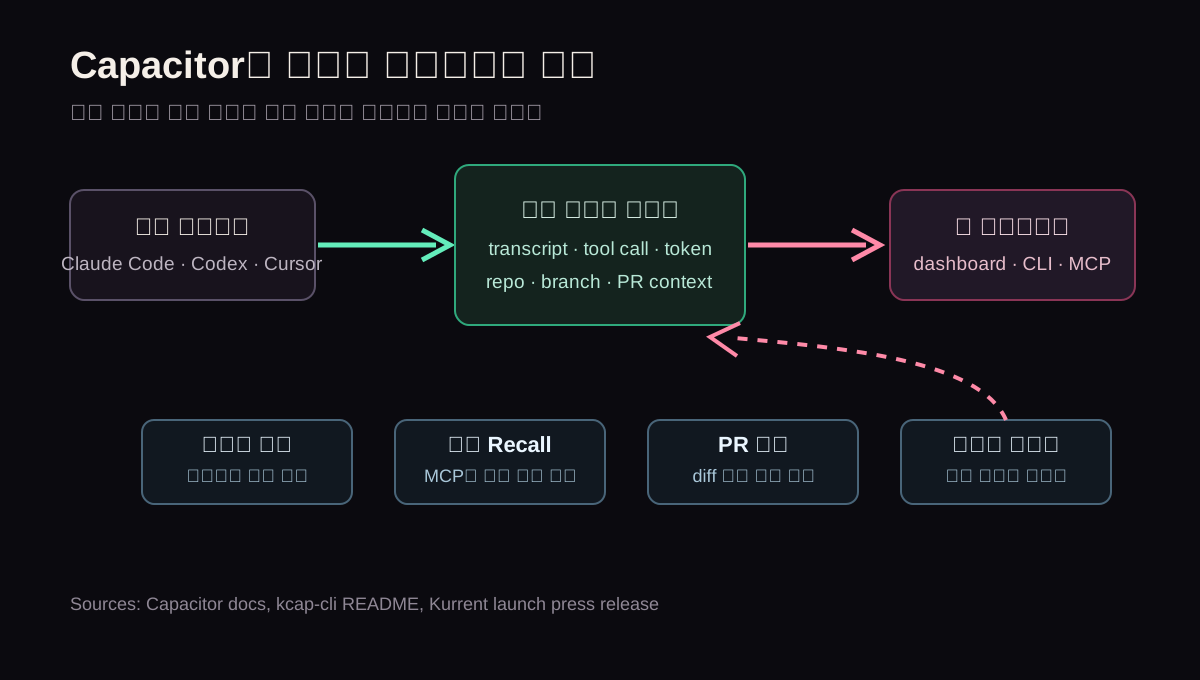
Capacitor's documentation splits the system into two main interaction points. The first is a Kurrent-hosted tenant, described with URLs like https://<your-github-org>.kcap.ai. That tenant stores events, builds dashboard projections, and serves the web UI. The second is the CLI installed with npm install -g @kurrent/kcap. The CLI installs hooks for Claude Code and Codex, streams transcripts to the tenant, and exposes commands such as kcap recap, kcap review, and kcap eval.
There is also a public implementation signal, but it is still small. The kurrent-io/kcap-cli GitHub repository describes Capacitor as full observability for Claude Code sessions. Its README lists session lifecycle, transcript data, subagent trees, tool usage, token consumption, and repository context among the recorded artifacts. The Korean research pass checked the GitHub API on June 5, 2026 and found that the repository had been created on April 8, 2026, had received a push on June 5, and showed one star and one fork. The npm package @kurrent/kcap was at version 0.6.4 and described itself as the CLI companion for Kurrent Capacitor.
The press-release claims are broader than the repository signal. Kurrent says Capacitor streams every agent turn, tool call, test run, and reasoning block to a team Capacitor server, then indexes the data for full-text search. It also connects sessions to repositories and pull requests so review tools can retrieve the implementation transcript behind a change. Kurrent CEO Kirk Dunn's launch quote frames the product as a response to the coordination layer that still remains after agents accelerate software development. That quote explains the product thesis, but it should be read as vendor positioning until preview customers and independent usage reports appear.
The first feature many development teams will understand is pull request context. When an AI coding agent opens a diff, the reviewer usually sees the output without the agent's abandoned attempts. Capacitor's kcap review <pr-url> flow points toward a different review surface: attach the session transcript, test attempts, failed logs, alternatives considered, and implementation rationale to the PR. That changes the review question from "can the reviewer infer intent from this patch?" to "can the reviewer inspect the execution record that led to this patch?"
For example, a reviewer asking why a migration changed before a seed script should not have to reconstruct the answer from file timestamps. If the agent had previously run a failing test, inspected an error trace, and changed the migration order in response, that evidence belongs near the review. A model reviewing the PR can also use that history. The review model is no longer limited to the diff and a prompt; it can ground comments in the actual session record.
The second use case is session recall. The docs describe a kcap mcp sessions stdio server that lets coding agents search previous Capacitor sessions from inside the agent environment. If a team already debugged an OAuth callback race condition in the same repository last quarter, a current agent can ask whether similar work happened before and retrieve transcript sections near the relevant turns. That is a different emphasis from repository memory tools that store conventions, architecture notes, or markdown decisions. Capacitor treats the agent run itself as the primary artifact.
This design becomes more interesting when several agent tools are used inside one organization. A team might use Claude Code for refactors, Codex for repo-wide changes, Cursor for IDE-bound edits, and GitHub review tools for PR feedback. Today those systems often start without knowing what the others tried. Kurrent's pitch is that the shared record should belong to the team instead of being trapped in one tool's internal transcript or a developer's local terminal scrollback.
The third axis is evaluation. Capacitor's docs describe LLM-as-judge evaluations for safety, plan adherence, quality, and efficiency. Findings can be grouped by repository, curated by an administrator, and reintroduced near the top of future sessions as guidelines. If the loop works, a mistake from one session can become a guardrail for the next. A finding such as "the agent created a migration but did not run the seed script" can move from a forgotten transcript into a repository-specific instruction.
Kurrent's technical differentiator is its event-native framing. The press release says agent turns, tool calls, and session lifecycle events are stored as immutable events in append-only streams. That is familiar territory for financial systems, audit trails, replay, and projections. Applied to coding agents, it treats a session as more than a chat log. A session becomes a replayable and queryable event stream that can feed dashboards, search, PR review, and evaluation.
That distinction matters because agent transcripts are messy. They contain natural-language reasoning, shell commands, tool outputs, file edits, test runs, approval decisions, and sometimes nested subagent work. Storing the final transcript blob is useful for search, but it does not automatically answer operational questions. A team may want to ask which repositories produce the most failed test loops, which agents burn the most tokens before opening a PR, which branches contain sessions with denied permissions, or which recurring eval findings correlate with review rework. Event modeling gives Kurrent a plausible way to build those projections.
The product also raises security and governance questions immediately. A transcript can contain sensitive source paths, internal architecture, command output near secrets, incident details, customer names, and human review decisions. The same record that helps a security team audit agent behavior can become a high-value data store. The current public materials use phrases such as secure session memory, but the open documents are not enough to evaluate encryption details, tenant isolation, deletion controls, SSO policy, retention settings, or audit export conditions.
Private preview status also limits adoption claims. There are no broad public customer metrics, latency measurements, retention pricing, or independently tested deployment stories in the materials used for the Korean source article. The public repository and npm package show that Kurrent is building the CLI path in the open, but the visible ecosystem signal is early. Teams should treat Capacitor as a preview of an operating model rather than as a settled category winner.
The adjacent category is already crowded. The Korean research pass found products such as memctl, Engram, Kage, and Memstate describing themselves around shared memory for AI coding agents. Some emphasize MCP recall, some local repository memory, some hosted team memory, and some organization policy. Capacitor's current distinction is the bundle: session transcript capture, PR review context, evaluation loops, and KurrentDB-style event streams in one hosted tenant plus CLI workflow. Buyers still need to separate four questions that vendors often blend together: whether memory is file-based or SaaS-hosted, whether it is semantic recall or audit trail, whether the team can own the record, and whether the agent can safely reuse the record.
The visible installation path is concrete. The README tells users to install the CLI with npm install -g @kurrent/kcap, run kcap setup, configure a server URL, authenticate through GitHub Device Flow, choose default visibility, install agent hooks, and configure the daemon. For Codex, the docs say users need to open /hooks and trust the kcap entries after installing the hook. That workflow touches terminal hooks, hosted tenancy, local daemon behavior, GitHub identity, and dashboard access. It is not just an editor extension.
For organizations already piloting coding agents, the immediate policy questions are practical. Which repositories and branches are allowed to send transcripts to a hosted tenant? Which parts of a session should reviewers see by default: commands, test output, full transcript, or a generated summary with links back to raw events? Which eval findings can be automatically injected into future prompts, and which should require human curation first? Without those decisions, shared memory can become a sensitive log archive rather than an operational asset.
Capacitor's announcement is notable because it moves the coding-agent conversation away from "which model wrote this patch?" and toward "what record did the team keep after the agent wrote it?" That is a real cost center in agentic development. When a session closes, the explanation cost often shifts to the human reviewer, the next agent, or the teammate who inherits the bug. Kurrent is trying to turn that disappearing context into event streams, MCP recall, PR review context, and eval-derived guidelines.
The launch is still early. Kurrent has a credible technical story because event streams are its home ground, and the CLI/documentation path is visible. The evidence for broad deployment is not visible yet, and the security details matter more than the slogan. For now, Capacitor is best read as one of the first attempts to make agent session history a team-owned development artifact. The harder product test will be whether teams can store less noise, expose the right review evidence, and reuse prior agent work without creating a new governance burden.