Cisco Cloud Control Embeds Codex to Build Network Operations Apps
Cisco Cloud Control puts OpenAI Codex inside App Builder, turning natural-language prompts into hosted network operations apps for its AgenticOps platform.

- What happened: Cisco announced Cloud Control at Cisco Live US on June 2, 2026, starting with US Controlled Availability.
App Builderembeds OpenAI Codex so teams can describe a Cloud Control app or workflow in natural language and publish it through the platform.
- Builder impact: A coding-agent output can become an operations app with Cisco identity, hosting, services, and marketplace distribution attached.
- Platform context:
Agent Builderemphasizes native connectors,MCP, and more than 50 third-party platforms and tools.- Cisco is positioning AgenticOps around network, security, observability, compute, and collaboration telemetry rather than a standalone IDE experience.
- Watch: Cisco notes that some Cloud Control features may still be in development, with beta, alpha, and Global Availability timelines split by capability.
Cisco announced Cisco Cloud Control on June 2, 2026 at Cisco Live US in Las Vegas. The company describes it as a management plane that brings networking, security, compute, observability, and collaboration into one environment. For AI builders, the most concrete part is not another enterprise dashboard. It is the App Builder inside Cloud Control Studio, where Cisco says OpenAI Codex is embedded directly into the product surface.
Cisco's App Builder post describes a path from a natural-language prompt to a live Cloud Control app or workflow. The generated app can use Cisco identity, services, hosting, distribution, and the Cloud Control Marketplace instead of leaving the team to move files from a coding agent into a separate deployment stack. Cisco calls the result "born deployed". That phrase is the useful signal: Codex is not being positioned only as an IDE assistant or pull-request generator. It is being used as the application-generation layer inside an operations platform.
Cloud Control began in US Controlled Availability on June 2, 2026, with Global Availability listed as a later milestone. Cisco did not put every feature under one immediate availability date. In the same announcement, the company named AWS, Linear, Microsoft, PagerDuty, ServiceNow, Slack, and Google Cloud as ecosystem connections, with Wiz referenced under the Google Cloud entry. The number developers should track is on the agent side: Cisco says Agent Builder can connect to more than 50 third-party platforms and tools through native connectors and open Model Context Protocol, or MCP, connections.
Cloud Control Studio has two related builder surfaces. Agent Builder is for creating agents aligned to operating policies and workflows. App Builder is for creating apps and workflows that run inside Cloud Control. Cisco explicitly names OpenAI Codex in the App Builder description, and says apps from Cisco, customers, and ecosystem partners can be published through Cloud Control Marketplace. The practical difference from a conventional coding-agent workflow is that the output is not just a patch, a repository branch, or a CI log. The output is meant to run inside the same environment where network and security operators already act.
| Dimension | Typical coding-agent workflow | Cisco App Builder workflow |
|---|---|---|
| Input | Repository context, issue text, commands, and local files | A description of the operations app or workflow needed in Cloud Control |
| Output | File changes, patches, pull requests, and test logs | Apps and workflows designed to run inside Cloud Control |
| Operations binding | Teams configure authentication, hosting, and deployment separately | Cisco identity, hosting, services, and distribution are part of the platform path |
| Review unit | Code diff, CI result, and pull-request discussion | Operating policy, user permissions, connector scope, and Marketplace publication |
Cisco's security framing explains why the company is moving in this direction. The Cloud Control announcement says AI compresses the time between vulnerability discovery and exploitation from "weeks to minutes." That line could be read as launch-event language, but the surrounding feature set is more specific: Cisco wants people and agents to share the same telemetry, action surface, and operational context while human operators remain in control. The product pitch is not to replace network operations with an agent. It is to put agent-generated actions inside a governed operations plane.
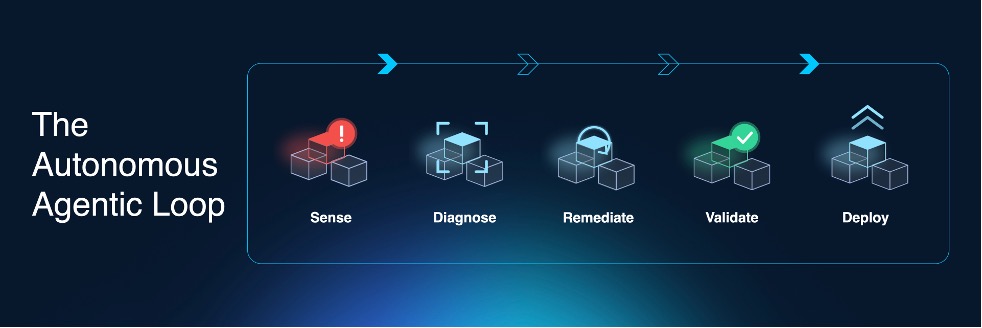
The Agentic Workplace Runs on Cisco post breaks that loop into steps: sense degradation, diagnose issues, remediate problems, validate changes, and deploy fixes. Cisco says Agentic Actions for networking enters beta in June 2026. The feature is described as a mission-control view that shows incidents, recommendations, reasoning, evidence, confidence scores, risk scores, and next steps. Expanded Experience Metrics and Deep Reasoning are also listed for June 2026 beta. Digital Twin is slated for July 2026 alpha, with device, connectivity, topology, and configuration emulation before production changes.
For developers, the immediate question is not whether Codex can write another useful script. It is who approves an operations app, which data it can access, what actions it can execute, and where the generated artifact is distributed. Cisco says App Builder uses the Codex SDK inside Cloud Control. The App Builder blog argues that a standalone coding agent does not know Cisco identity, services, hosting, or distribution by default. Inside App Builder, those platform assumptions are already present, so the result is closer to a working app than an unfinished project that still needs deployment work.
That product direction is connected to Cisco's earlier Codex usage. In January 2026, OpenAI published a Cisco case study saying Cisco was an early Codex design partner and had used Codex in AI Defense development and engineering workflows. OpenAI wrote that Cisco used Codex to analyze build logs and dependency graphs across more than 15 connected repositories, producing about a 20% build-time reduction and saving more than 1,500 hours per month. The same case study cited a 10-15x increase in C/C++ defect-remediation throughput through Codex CLI-based iteration.
Those numbers do not prove that Cloud Control App Builder will work for every customer workflow. They do explain why Cisco would trust Codex enough to move it from internal engineering into an operations product. Cisco says it gave OpenAI feedback from large repositories, compliance-heavy environments, long-running tasks, and existing development pipelines. App Builder looks like that feedback translated into a product surface where a coding agent is no longer confined to a repository. It can generate the screens and workflows network operators use.
The competitive comparison is not one-to-one with GitHub Copilot. Copilot's natural strength is repository and pull-request workflow. Microsoft Foundry and Agent 365 are tied to M365, Azure, and Microsoft security products. ServiceNow is centered on ITSM processes. Google Cloud and AWS have their own operations tooling. Cisco's differentiator is that network devices, security enforcement, observability data, ThousandEyes, and Splunk assets can become the operational context and action surface. In organizations where network and security gear are real control points, Cloud Control's authorization model and audit trail may matter as much as the code model embedded in App Builder.
Secondary coverage reaches a similar conclusion from different angles. TechTarget described Cloud Control as a convergence of previously separate tools, including AI Assistant, telemetry dashboards, third-party agent management, MCP tooling, and API support. A Reuters-distributed report framed Cisco's launch as software that helps enterprises create AI agents to defend IT infrastructure, and noted that Codex is embedded in the Cloud Control platform. Both readings put the center of gravity in agent operations rather than raw model performance.
Security teams also need to read the surrounding Cisco portfolio announcement. Cisco expanded Live Protect, which the company says is available on N9000 series switches and included with Nexus One entitlement at announcement time. Cisco says it will expand Live Protect to campus and branch smart switches, then to secure routers. The same release mentions Hybrid Mesh Firewall, AI Defense, Zero Trust for agents, Agentic SOC, Resilient Infrastructure Services, and Cisco IQ. Quantum Ready Assessments are planned for Global Availability through Cisco IQ in July 2026.
This stack creates new review work for platform teams. If App Builder can make an app "live" from a prompt, code review alone is not enough. Teams need to know which Cloud Control data the app can read, which actions it can execute, who can install it from Marketplace, and how rollback works when a workflow changes production behavior. The fact that a natural-language prompt created the artifact does not lower the audit bar. It raises the need to record the prompt, generated code, connector configuration, executed actions, and rollback path in one change history.
Operations teams have a different set of checks. If Agentic Actions displays confidence and risk scores, the source and calibration of those scores need to be inspectable. If Deep Reasoning presents competing hypotheses and supporting evidence, operators need to know which telemetry products contributed the evidence and whether stale data can enter the chain. If Digital Twin validates a change before production, the twin has to reflect topology and configuration drift closely enough to matter. These are implementation questions, but they determine whether the platform reduces incident risk or only adds another AI-labeled layer to the console.
The clearest developer change is the unit of internal tooling. Many teams currently build operations dashboards and approval workflows by gluing together Jira or Linear, Slack, GitHub, monitoring APIs, cloud-provider SDKs, and a custom web app. Cloud Control App Builder starts that work inside Cisco's environment. A network team could describe a view that combines outage alerts, device health, and a small set of approved fix actions, then have Codex generate a Cloud Control app while the platform handles identity and hosting. That is a different delivery model from asking an agent to scaffold a generic web app and then wiring it into operations later.
Three adoption checks follow from that model. First, teams should verify whether they can inspect the generated source and change history of App Builder apps. Second, they should confirm that permissions, data access, and action scope can be restricted by policy before Marketplace publication. Third, they should audit connector and MCP calls at the parameter level, not just at the allow-or-block level. Recent MCP security discussions keep showing that a coarse tool allowlist is not enough when agents can call tools with broad arguments.
Cloud Control is not yet a fully open product in every respect. Cisco's App Builder blog includes a notice that some products or features may still be in development and that availability can depend on conditions. Controlled Availability, June 2026 betas, and a July 2026 alpha sit in the same announcement cycle. Buyers and platform architects should separate what can be used immediately from what is in beta, alpha, or planned Global Availability. Otherwise the announcement reads more mature than the feature-by-feature rollout.
The direction is still clear. Coding-agent competition is moving beyond autocomplete, repository edits, and pull-request generation. Cisco is placing Codex inside the product where network and security operators build workflows and take action. That changes the question from "where does the agent run?" to "which operating system approves, hosts, distributes, audits, and rolls back the agent's output?"
For enterprises with Cisco infrastructure, Splunk, ThousandEyes, Webex, ServiceNow, and related tools already embedded in operations, this is not a small UI experiment. It is a proposal to turn AI coding from an individual productivity tool into a source of governed operational change. The success condition will not be raw generation speed. It will be whether permissions, evidence, review, and rollback can keep pace with the apps and workflows Codex can now produce inside the operations plane.