Codex reaches 5M weekly users as OpenAI pushes Sites beyond coding
OpenAI introduced Codex Sites, annotations, and six role-based plugin bundles as non-developers become 20% of Codex users.
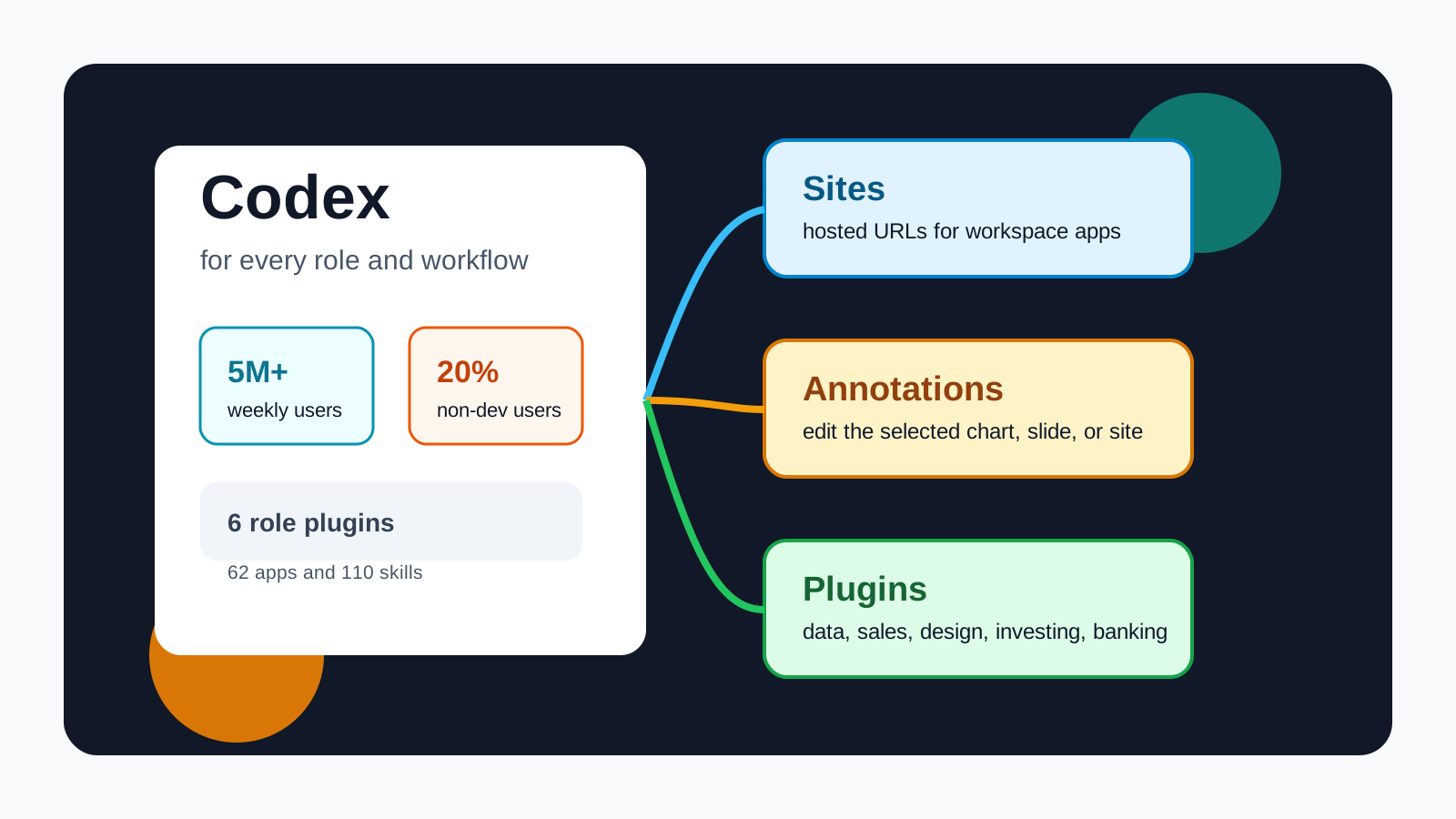
- What happened: OpenAI expanded Codex on June 2, 2026 with role-based plugins, a Sites preview, and broader annotations.
- OpenAI says Codex now has more than 5 million weekly users, and non-developers account for about 20% of that base.
- The company also says non-developer Codex usage is growing more than 3x faster than developer usage.
- Product move: Six role bundles package 62 apps and 110 skills for analytics, sales, design, investing, and banking workflows.
- New surface:
Siteslets Business and Enterprise teams generate hosted dashboards, planners, review spaces, and lightweight internal tools. - Watch: SaaS permissions, hosted URLs, source verification, cost attribution, and workspace sharing policies become part of the Codex rollout.
OpenAI’s June 2, 2026 post, Codex for every role, tool, and workflow, makes Codex harder to describe as only a coding agent. The company says Codex is now used by more than 5 million people each week. It also says non-developers make up roughly 20% of Codex users and that this group is growing more than three times faster than developers. Those numbers are the center of the announcement: OpenAI is repositioning Codex from a repository assistant into a workspace agent that can produce dashboards, planners, sites, briefs, and client-ready materials.
The release has three product pieces. The first is a set of six role-based plugin bundles: data analytics, creative production, sales, product design, public equity investing, and investment banking. The second is Sites, a Business and Enterprise preview for generating hosted interactive websites and apps that can be shared by URL inside a workspace. The third is an annotations expansion that lets users select a specific region in documents, spreadsheets, slides, websites, Markdown, or code and ask Codex to revise only that portion.
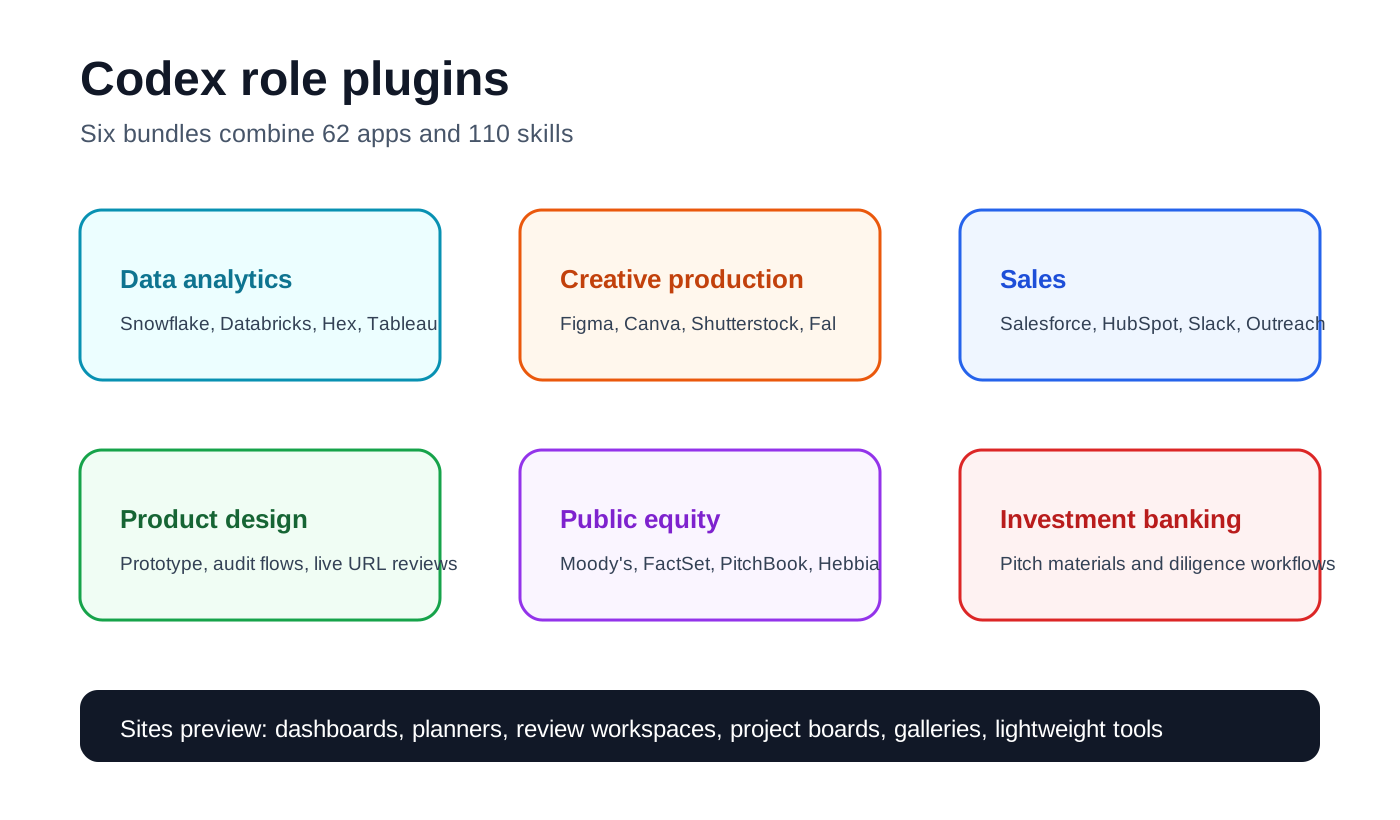
OpenAI describes plugins as bundles of relevant apps, skills, instructions, and workflows. Across the six announced roles, the company says the bundles include 62 popular apps and 110 skills. That framing matters because it is more specific than a connector catalog. Codex is not merely calling a SaaS API on demand. OpenAI is packaging repeated job tasks into role-shaped procedures that combine external context, agent instructions, and app permissions.
The data analytics plugin mentions tools such as Snowflake, Databricks Genie, Hex, and Tableau. The examples are built around investigating why a metric changed, turning product or business data into reports, and building dashboards. The creative production plugin points to Figma, Canva, Shutterstock, Picsart, and Fal, with examples such as campaign boards, display ad variations, product lifestyle shots, and ecommerce-ready image sets. The same Codex brand is now meant to cover SQL-driven analysis and campaign asset production.
The sales bundle connects Salesforce, HubSpot, Slack, Outreach, Clay, Rox, and Actively. OpenAI’s examples include finding high-priority accounts and signals, preparing for customer meetings, drafting follow-ups, updating customer records, writing close plans, and reviewing risky deals. The product design bundle aims at turning early ideas into reviewable prototypes, exploring product direction from a live URL, and making static screenshots interactive. These are not traditional IDE tasks. They are cross-SaaS workflows that usually sit between product, growth, operations, and revenue teams.
The finance-oriented bundles show how far OpenAI wants Codex to travel from its developer origin. The public equity investing plugin mentions Moody’s, Daloopa, Datasite, FactSet, LSEG, S&P, PitchBook, and Hebbia as information surfaces for earnings reviews, company comparisons, signal tracking, and investment thesis checks. The investment banking plugin targets pitch materials, comparable company and transaction analysis, diligence review, and client-ready recommendations. Codex is being positioned as an orchestration layer around specialized data providers, not as a generic chatbot that writes a memo from scratch.
| Feature | Scope in OpenAI's announcement | What teams need to verify |
|---|---|---|
| Role-based plugins | Six bundles, 62 apps, and 110 skills | SaaS connector permissions and skill execution boundaries |
| Sites | Business and Enterprise preview with shared workspace URLs | Audience, data exposure, lifecycle controls, and deletion policy |
| Annotations | Targeted edits across documents, spreadsheets, slides, websites, Markdown, and code | Source checks, change history, reviewer approval, and audit trails |
Sites is the largest surface change in the announcement. OpenAI says Business and Enterprise customers can use Codex to create interactive hosted websites and apps, then share them with workspace members by URL. The examples include a customer review site, a scenario planner based on a financial model, and a living hub for launch materials. Instead of asking a team to read a document tab or spreadsheet tab, Codex can produce a workspace URL that shows updates, open questions, usage trends, milestones, owners, and decisions in one interface.
This overlaps with the prompt-to-app market around Replit, Lovable, Base44, Vercel v0, Wix, and Webflow. OpenAI names Vercel, Wix, Base44, Replit, Lovable, Figma, Webflow, and Emergent as early partners. The difference is that Codex Sites is framed less like a public web app builder and more like a hosted internal artifact. The announcement examples are customer reviews, event operations, product launch hubs, and planning tools that sit on top of workspace context and SaaS data.
That distinction makes governance more important than generation quality alone. OpenAI says Sites can currently be shared with anyone in the workspace by URL. For a product manager, that is convenient. For a security or platform team, it becomes a checklist. Who created the site? Which SaaS data did Codex read? Does the URL remain inside the workspace boundary? Can a site expire? Who can delete it? When the site refreshes, which connector permissions are invoked again? A generated file can be reviewed as a static artifact. A hosted mini-app has lifecycle, access, and audit requirements.
Annotations target the work that happens after a first draft. Developers could already ask Codex to revise a selected section of code, Markdown, or a website. OpenAI is now extending that interaction to documents, spreadsheets, and slides. A user might select a navigation bar and ask for a font change, highlight a claim in an investment thesis and ask for supporting evidence, or select a slide chart and ask Codex to make the labels clearer.
The UX addresses a practical weakness in agentic workplace tools. First drafts can be useful and still wrong in narrow places. Regenerating an entire document can damage sections that were already acceptable. Selection-based edits turn human review into smaller execution units that an agent can act on. For factual work, the same interface needs more than convenience. If a banker highlights a diligence claim or an analyst selects a chart annotation, the system needs to preserve the source, reviewer request, agent change, and final approval.
OpenAI includes internal and customer examples in the announcement. It says non-technical OpenAI teams use Codex to create internal apps, prepare executive materials, generate dashboards, and produce creative brief outputs that respect brand and design constraints. Zapier is described as using Codex to pull knowledge from Slack, Google Docs, Coda, and similar tools into postmortems, incident response plans, and feature tickets. NVIDIA researchers are described as using Codex from research idea exploration through machine learning infrastructure scripts.
Those examples show that Codex’s competitive set is no longer limited to coding assistants inside an IDE. In analytics, it sits beside Hex and Tableau. In sales, it touches Salesforce and HubSpot. In design, it touches Figma and Canva. In finance, it touches FactSet, PitchBook, and diligence workflows. The product direction is not to replace each specialized application. It is to read context across those systems and produce the next artifact: a plan, dashboard, deck, prototype, app, or update.
Admin controls are therefore a deployment requirement, not a footnote. OpenAI says role-based plugins are rolling out through the Codex plugin directory in supported regions, and that Business and Enterprise workspace admins can manage underlying app permissions in workspace settings. Sites can also be enabled by Enterprise admins. Because these features operate on workplace data, those controls are part of the product’s adoption path. A marketing team can be excited about campaign boards, but the organization still needs rules for connectors, generated assets, review steps, and sharing.
The community reaction has focused on scope and plan availability. The Reddit r/codex product update thread included questions about whether Sites would be close to enterprise-only and how broadly role-based plugins would roll out. Japan’s Impress Watch described Sites as an app generation feature for Business and Enterprise plans that can be shared through private URLs. Secondary analysis pieces framed the release as OpenAI moving Codex from developer tooling into white-collar workflows.
For builders evaluating this release, the practical issue is not the slogan that non-developers can build apps. The practical issue is the permission model around those apps. If an analyst uses Snowflake and Tableau context to generate a site, the organization needs data classification and sharing rules. If a marketer uses Figma, Canva, Shutterstock, and Fal to produce assets, the organization needs copyright review, brand review, and approval workflows. If a banker turns diligence material into a client-ready deck, the organization needs confidentiality boundaries and source traceability.
The announcement increases both the benefit and the operational burden of Codex. The benefit is that workplace outputs can escape the limits of file formats. A launch hub, scenario planner, customer review site, or project board may be easier for a team to use than a document and spreadsheet pair. The burden is that the artifact is now a URL-backed mini-application with data dependencies and connector permissions. Compared with a file attachment, that raises the importance of lifecycle, access, audit, and deletion policy.
Cost attribution is another open question. OpenAI did not publish separate pricing for Sites or for each role-based plugin in this announcement. But a workflow that spans 62 apps and 110 skills may not be priced only through a Codex seat. Snowflake queries, Tableau dashboards, Salesforce updates, Figma assets, image generation, hosted site storage, and third-party data providers can each have their own account, quota, and billing model. Once Codex becomes the orchestrator, teams need to know which department or project owns the downstream cost of a generated workflow.
Responsibility also becomes harder to assign. If Codex drafts a sales follow-up and updates a CRM record, creates banking pitch materials with diligence recommendations, or generates a scenario planner from a financial model, the organization needs to record who made the final decision. OpenAI’s emphasis on annotations fits this problem. When a human reviewer selects a claim, chart, slide, or UI region and asks for a specific change, the agent output becomes a reviewable unit. If a generated Site continues to change, teams also need rules that separate approved versions from work-in-progress versions.
The competitive picture is now broader. Microsoft Copilot has the Microsoft 365 and Windows base for workplace documents and organizational data. Google Gemini Enterprise connects Workspace, search, and NotebookLM-like experiences. Anthropic has been expanding Claude for Work, connectors, and Claude Code. OpenAI is choosing to connect coding and knowledge work under the Codex name, using Sites and plugin bundles to turn results into URLs and SaaS-driven workflows.
That may make Codex harder for development teams to categorize. Yesterday’s Codex fixed repositories and opened pull requests. This version can also make a sales planner, investment thesis, dashboard, product launch hub, or customer review site. If developers and non-developers use Codex in the same workspace, platform and security teams need to jointly define plugin installation policy, data access boundaries, site sharing rules, and approval requirements.
The announcement should not be inflated into a claim that every job function is now automated. The verified scope is narrower: six role-based plugin bundles, 62 apps, 110 skills, a Sites preview, expanded annotations, workspace admin controls, and the usage numbers OpenAI chose to publish. Rollout regions, exact connector permissions, site hosting audit logs, partner-specific terms, and pricing details still need team-by-team verification.
Even with those limits, the direction is clear. OpenAI says Codex has more than 5 million weekly users, about 20% non-developers, and non-developer growth that is more than three times faster than developer growth. Those numbers explain why Sites and role-based plugins arrived under the Codex brand. OpenAI is betting that the same agent surface that edits code can also assemble workplace context into shareable artifacts, and that the next Codex adoption debate will happen as much in admin settings as in the IDE.
Sources: