GitHub Agentic Workflows turns Actions into an issue-triage agent runner
GitHub Agentic Workflows is now in public preview, turning Markdown automation intent into GitHub Actions runs for triage, CI analysis, docs updates, and safe agent outputs.
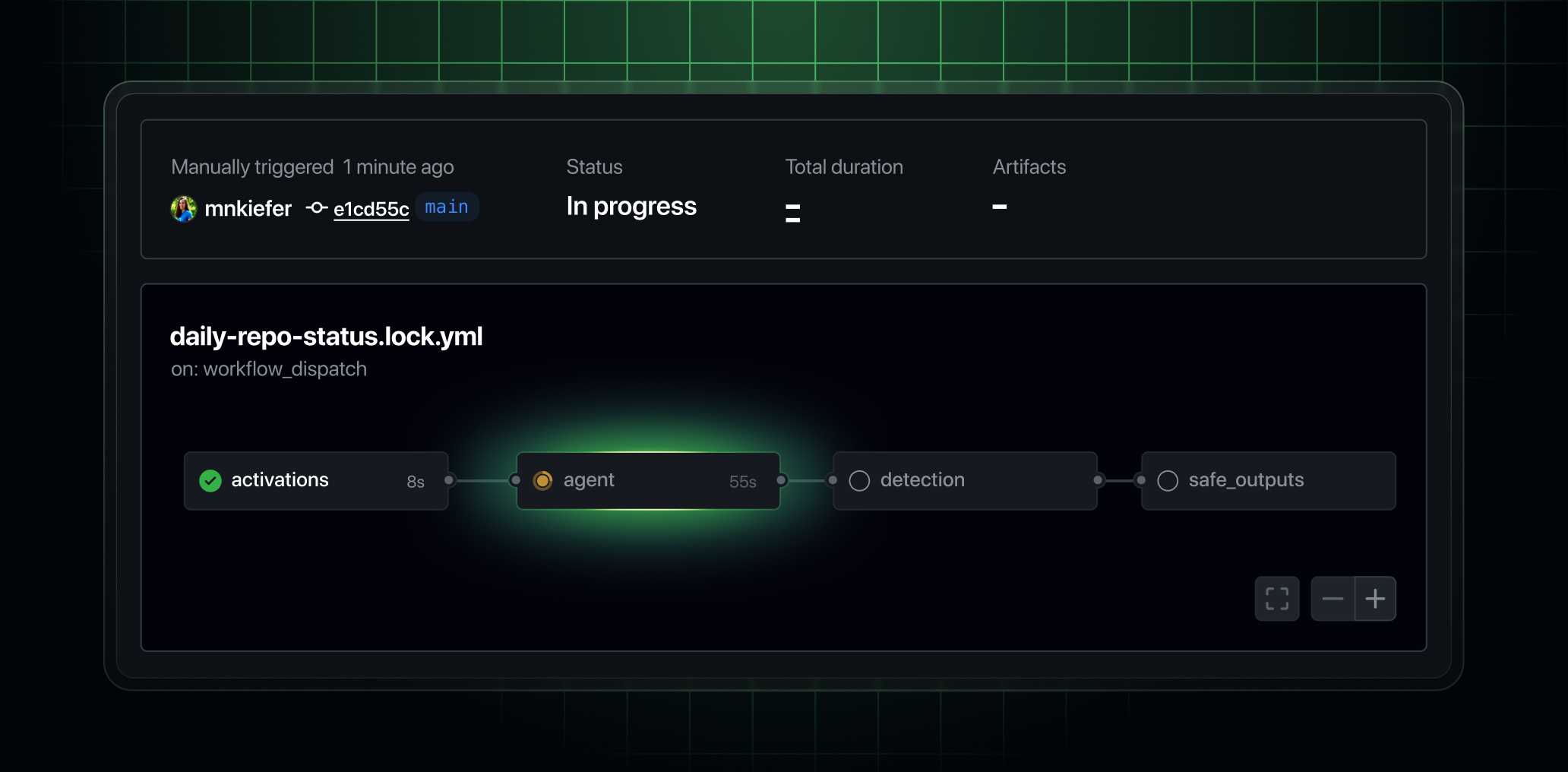
- What happened: GitHub moved
GitHub Agentic Workflowsinto public preview on June 11, 2026.- Repository work such as issue triage, CI failure analysis, and documentation updates can be described in Markdown and run through GitHub Actions.
- Execution model: Markdown intent is compiled into standard Actions YAML, while the agent runs behind sandbox, firewall, and
safe outputsboundaries. - Developer impact: the operational question moves from whether an agent can write code to permissions, spend, PR triggers, and human review.
- Watch: GitHub still labels the system as early development, and the public
gh-awrepository already carries a billing-bug upgrade warning for several preview releases.
GitHub announced Agentic Workflows public preview in its Changelog on June 11, 2026. The feature targets repository work where the output is not a single deterministic build result: issue triage, CI failure analysis, documentation updates, reports, and compliance-style review. Instead of starting with a long Actions YAML file, the user writes the automation intent in natural-language Markdown. Agentic Workflows then compiles that intent into a standard GitHub Actions workflow and runs it inside the Actions environment.
That location is the product signal. GitHub is not only adding another Copilot button to a chat pane or IDE. It is placing agent work next to CI/CD, runner groups, organization policies, workflow permissions, and pull-request rules. For a platform team, the first question is no longer only "can the AI produce a useful answer?" It is "which token does it use, which output can it create, which run pays the bill, and which human reviews the result before it changes a repository?"
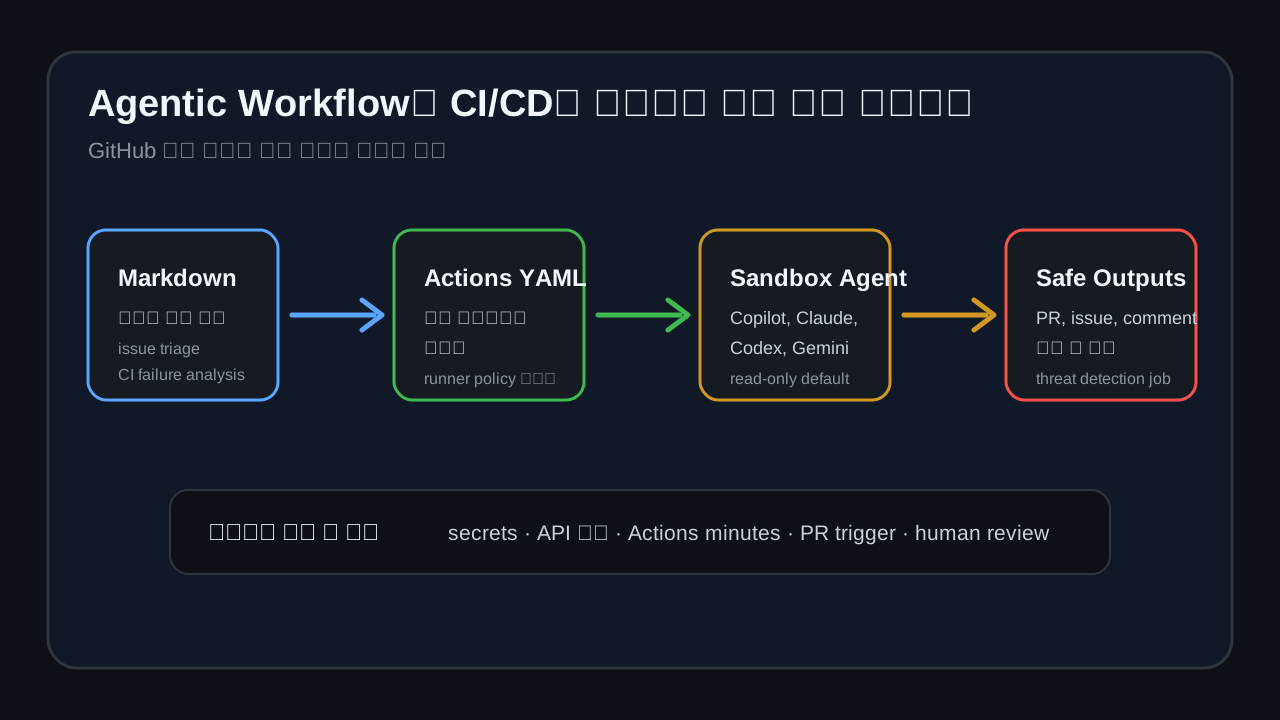
The first change is the authoring format. GitHub's documentation describes Agentic Workflows as a way to write "what should happen" in Markdown while the compiled workflow handles "how it runs" in Actions. A team can describe a daily repository status report, ask the agent to read new issues and propose labels, or have it inspect failed CI logs and summarize likely causes. The Quick Start points users to the CLI extension path with gh extension install github/gh-aw, and the sample workflow uses githubnext/agentics/daily-repo-status.
The second change is the engine boundary. The Agentic Workflows home page says users can connect GitHub Copilot, Anthropic Claude, OpenAI Codex, and Google Gemini accounts. That makes the workflow format a layer above a single model vendor. Enterprises already have different AI accounts, data-processing rules, approved-model lists, and procurement paths. Separating the workflow definition from the model account is a practical choice, because the same automation shape may need to run under different provider policies across organizations.
GitHub also defines the feature as a layer beside deterministic CI/CD, not as a replacement for it. The FAQ says existing build, test, and release pipelines remain in place. Agentic Workflows handles "Continuous AI" work such as triage, documentation drafts, dependency research, and code-improvement proposals. Tests are still tests. Deployments are still deployments. The agent sits in the gap where humans repeatedly read context, collect evidence, and suggest the next repository action.
That distinction matters because a CI job and an agent run have different failure modes. A test job returns a pass or fail code. A deployment pipeline pushes a specified artifact. An agent reads logs, forms hypotheses, edits documents, opens pull requests, or leaves issue comments. The two can appear in the same Actions UI, but one is deterministic execution and the other is non-deterministic automation wrapped in review gates. Treating them as the same kind of workflow would hide the main operational risk.
GitHub puts security controls near the front of the announcement. The Changelog says agents follow integrity filter rules when accessing GitHub content, run with read-only permissions by default, and execute inside a sandboxed container behind the Agent Workflow Firewall. Outputs go through a safe-output process, and proposed changes are scanned by a dedicated threat-detection job before they are applied. The design is closer to "separate the agent step from the application step" than to "let an agent directly mutate the repository."
Those controls do not remove the security burden. The FAQ opens by saying Agentic Workflows is in early development, that automation needs security consideration and human oversight, and that issues can still occur. Repository maintainers should read that as an operating constraint, not as boilerplate. An agent running in Actions can encounter a workflow token, a repository checkout, caches, artifacts, issue comments, pull-request branches, package registries, and external API keys. This is no longer a single prompt inside a chat product. It is an execution subject inside the organization's automation surface.
Safe outputs are the most concrete guardrail. The FAQ says an agentic workflow that wants to propose code or documentation changes should use a safe output such as create-pull-request. If an organization blocks pull-request creation from GitHub Actions, the workflow can fall back to an issue containing a branch link. That sounds like implementation detail, but it becomes the first production question: can the automation create a PR, can that PR trigger CI, and does the default GITHUB_TOKEN hit GitHub Actions' recursive-workflow protections?
Cost follows the same path. GitHub has already made Copilot usage-based billing and code-review Actions minutes part of the developer-tooling conversation this year. Agentic Workflows is not a free magic box next to Actions. It is Actions execution plus calls to an AI provider. A scheduled run that checks out a large monorepo, scans too much history, and lets an agent loop for too long can spend both Actions minutes and model API budget. The FAQ's separate entries for sparse checkout, token behavior, and CI triggering are not paperwork; they are the knobs that keep the automation usable.
The public github/gh-aw repository also exposes the preview reality. As checked on June 12, 2026, the repository showed about 4.6k stars and 418 forks, and its README warned that releases from 0.68.4 through 0.71.3 were retired because of a bug that affected billing. That line is easy to skip, but it captures the production shape of agent automation. This is a coding convenience feature and a metered execution system. A bad version, schedule, or output permission can leave a cost trail as well as a change trail.
The best first workflows are read-heavy and review-friendly. New issue component labeling, a 24-hour summary of failed workflow runs, changelog research for stale dependency PRs, release-note drafts, and issue-cluster reports are good candidates. If they fail, a human can delete a comment, close a draft PR, or ignore a recommendation. Secret rotation, production deployment, dependency auto-merge, and policy-changing work are poor preview-stage starting points because the permission boundary and blast radius are too large.
The strategic shift is that GitHub is moving agents from personal developer assistance toward repository-level automation actors. Copilot Chat answers a developer's question. A Copilot coding agent takes work from an issue or pull request. Agentic Workflows can run on schedules or repository events, observe the repo continuously, and leave triage comments, reports, documentation diffs, or improvement PRs before a human opens the page. The interface is less "ask the assistant" and more "configure a recurring agent job."
This also differs from older repository bots. Dependabot and Renovate handle a well-defined dependency-update problem. Lint bots apply fixed rules. Agentic Workflows aims at tasks such as "find last week's release blockers and summarize evidence," where rules alone are hard to encode. The tradeoff is lower determinism. That is why GitHub emphasizes safe outputs, threat detection, and human review. The value comes from letting automation handle messy human-language repository work; the risk comes from the same flexibility.
Developer community context makes the preview easier to read cautiously. On June 11, 2026, Hacker News front-page discussion around "AI agent runs amok in Fedora and elsewhere" showed how quickly agent automation can trigger concerns about account trust, maintainer fatigue, strange patch review, and traceability. The details of that separate thread need their own verification, but the concern is clear. If automated agents can propose work at scale, teams need to know which account acted, which workflow produced the output, and which human accepted it.
Product and platform teams should turn the public preview into four concrete checks. First, separate workflows that can stay read-only from workflows that need a write path. Second, decide which safe outputs are allowed: pull request, issue, comment, dispatch, or none. Third, define where AI provider keys and Actions tokens live across repositories and organizations. Fourth, set schedules, checkout scope, and model-call budgets before a recurring run starts. Without those limits, a promise to "let AI triage issues" can become a permissions problem and a spend problem.
The rollout order matters too. A first workflow belongs in an internal tools repository or sidecar repository, not on a production-critical repo with broad secrets and release privileges. The FAQ discusses private repositories, side-repository patterns, and separate PATs for cross-repository access. That is not merely a workaround. It is a way to narrow what the agent can read, which APIs it can call, and which output forms it can create before teams expand the pattern to more valuable repositories.
Auditability needs to be designed from the first run. A human pull request normally gives reviewers an author, branch, comments, and a rough decision trail. An agentic workflow needs the prompt, compiled lock file, selected engine, run URL, safe-output payload, and detection artifact to provide a comparable record. GitHub's FAQ mentions generated footers and hidden workflow markers because the audit question changes as automation grows. The key question becomes not only "who opened this PR?" but "which workflow, input, and model account generated it?"
GitHub Agentic Workflows adds another surface to the AI coding market: repository automation. The existing surfaces are IDEs, CLIs, cloud tasks, code review, and agent workspaces. Now the Actions layer can host an agent that watches events and schedules. The skill developers need is not a new prompt template first. It is execution-boundary design. When one Markdown file becomes an Actions workflow, that file needs code-review discipline: what event triggers it, what tools it can call, what data it can read, and what output it can leave.
The practical meaning of the announcement is not simply that GitHub made agent automation easier. It is that GitHub is pulling agent automation into the same cost, permission, and audit model that already governs Actions. The good part is that organizations can reuse runner policy and workflow controls they already understand. The hard part is that AI automation now has to be operated like CI. An agent may reduce repetitive repository work, but once that work becomes a workflow with repository permissions, review has to cover the automation intent as well as the code it produces.