Xcode 27 Brings MCP and Agent Choice Into Apple Development
Apple expanded Xcode 27 and Foundation Models with MCP, ACP, Gemini, Claude, OpenAI agents, and new model choices for Apple app teams.
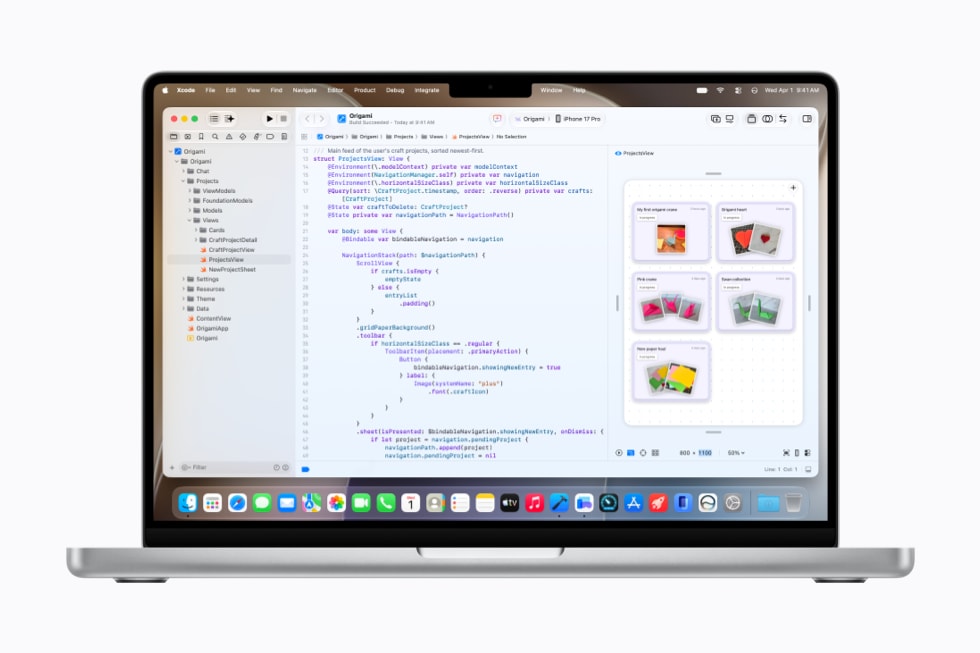
- What happened: Apple used WWDC26 on June 8, 2026 to introduce Xcode 27 agentic coding updates and a broader Foundation Models stack.
- Xcode 27 can bring Anthropic, Google, and OpenAI models or agents into the IDE, while plug-ins can connect
MCPtools andAgent Client Protocolcompatible agents.
- Xcode 27 can bring Anthropic, Google, and OpenAI models or agents into the IDE, while plug-ins can connect
- Developer impact: Apple app teams can route AI features across on-device Apple models, Private Cloud Compute, Gemini, and other providers behind a Swift-facing model surface.
- Watch: Wider model choice also means teams must govern cost, latency, privacy notices, MCP permissions, simulator validation, and CI capacity before treating the IDE integration as production-ready.
Apple's WWDC26 developer-tools announcement on June 8, 2026 bundled Xcode 27, the Foundation Models framework, Core AI, and App Intents updates into one message. The opening claim was not just that Apple had new AI features. Apple said it had "new APIs for integrating AI models" and "extended agentic coding in Xcode 27." For iOS, macOS, iPadOS, visionOS, and watchOS developers, that pairing matters because it puts app runtime intelligence and coding agents inside the same Apple platform story.
The concrete event is narrower than "Apple entered AI development tools." Xcode 27 brings Anthropic, Google, and OpenAI models and agents into the developer workflow. Apple describes an agent conversation surface that supports interactive planning, multiturn Q&A, Markdown rendering, code changes, and previews side by side. That is not a single autocomplete slot. It is an attempt to make planning, editing, review, and visual validation part of one IDE workspace.
The more durable change is the plug-in boundary. Apple says developers can attach custom skills, bring everyday tools through Model Context Protocol, and connect agents compatible with Agent Client Protocol. GitHub and Figma are named as the first seamless-installation partners. Xcode remains Apple's IDE, but the agent and tool attachment layer is being designed around protocols rather than a single Apple-only assistant.
What Xcode 27 Agents Can Validate
Apple's Xcode 27 language puts unusual weight on validation. The announcement says coding agents can write and run tests, isolate ideas in Playgrounds, use previews to verify visual changes, and interact with simulators through the new Device Hub. Each item sits after code generation. The agent is not only asked to produce Swift. It is being pulled toward the Apple-specific loop where SwiftUI actually renders, tests pass or fail, simulator state changes, and visual output can be inspected inside the IDE.
That distinction matters when comparing Xcode 27 with GitHub Copilot, Cursor, Claude Code, Codex, or JetBrains tooling. Apple-platform apps mix build settings, signing, simulators, previews, device logs, App Intents schemas, SwiftUI state, and Core ML or Foundation Models deployment. Running pnpm test in a web repository and validating an iPhone simulator flow that includes permissions, App Intents, and preview rendering are different failure modes. Xcode 27's advantage is not the brand name of any one model. It is how much of Apple's platform verification loop the agent can actually see and operate.
| Area | WWDC26 announcement | Question for app teams |
|---|---|---|
| Xcode agent | Planning, Q&A, code changes, and previews in an IDE canvas | Do reviewable diffs and preview state remain tied to one work unit? |
| Validation tools | Tests, Playgrounds, previews, and Device Hub simulator interaction | How does the agent report failed logs and simulator state? |
| External tools | Custom skills, MCP tools, and Agent Client Protocol support | Who approves access to internal tools and design files? |
| Xcode platform | Apple silicon only, 30% smaller, Xcode Cloud up to 2x faster | Do Intel Macs and CI capacity block the upgrade path? |
Apple also says Xcode 27 is Apple silicon only and 30% smaller, while Xcode Cloud adds Metal app and visionOS build support and can be up to two times faster. Those details keep the agentic-coding announcement grounded in platform logistics. A team adopting Xcode 27 should not only ask which model subscription it wants. It also needs to check developer Macs, CI runners, simulator capacity, Xcode Cloud usage, and whether old Intel-based maintenance workflows still exist.
Foundation Models Is No Longer Just One Apple Model Path
Apple's Apple Intelligence developer page describes the Foundation Models framework as a native Swift API. It lets apps use Apple Foundation Models on device and through Private Cloud Compute, and it lets other providers plug in by implementing the LanguageModel protocol. If the 2025 version felt close to "call Apple's on-device LLM from an app," the 2026 announcement moves closer to "switch model providers from a Swift API inside an Apple-platform app."
Apple's Newsroom post lists four new Foundation Models capabilities: stronger on-device models including image input, server model support, custom skills, and Dynamic Profiles. Dynamic Profiles are described as a way to adjust a session's model, tools, and instructions in real time. For product teams, the design question moves beyond prompt text. The more important question is which feature should use a local model, which should use a cloud model, which tools can be invoked, and how that routing changes during a user session.
The pricing condition is explicit. Apple says developers in the App Store Small Business Program with fewer than 2 million total first-time downloads can access next-generation Apple Foundation Models running in Private Cloud Compute without cloud API cost. That matters for small teams testing AI features. It does not mean every inference path is free. Eligibility depends on program enrollment and total first-time downloads, and third-party models or Firebase-based paths come with their own billing, quota, and privacy terms.
Core AI sits below that app-facing layer. Apple describes Core AI as an on-device model execution framework optimized for Apple silicon unified memory and the Neural Engine. Foundation Models is the fast route for app features that can live behind Apple Intelligence and provider protocols. Core AI is closer to the route for teams bringing their own models onto the device and taking responsibility for privacy, latency, offline behavior, battery use, and model size.
Gemini Enters Through Apple's API Surface
Google published its own announcement on the same day: Gemini models for Apple developers. According to Google, model providers can implement a public LanguageModel protocol starting with iOS 27, macOS 27, iPadOS 27, visionOS 27, and watchOS 27. Google says Gemini models are available in preview through the Firebase Apple SDK for use with the Foundation Models framework.
The practical pitch is a small code change that swaps the model instance. Apps already using the Foundation Models framework can attach a cloud-hosted Gemini model through the same broad API surface, then choose between a local Apple model and a cloud Gemini model by use case. A privacy-sensitive short summary might stay on device. A larger reasoning task or a Gemini-specific capability might go to the cloud. That product split still brings latency, network failure, cost, App Check, user notice, and log-retention questions into the app's policy layer.
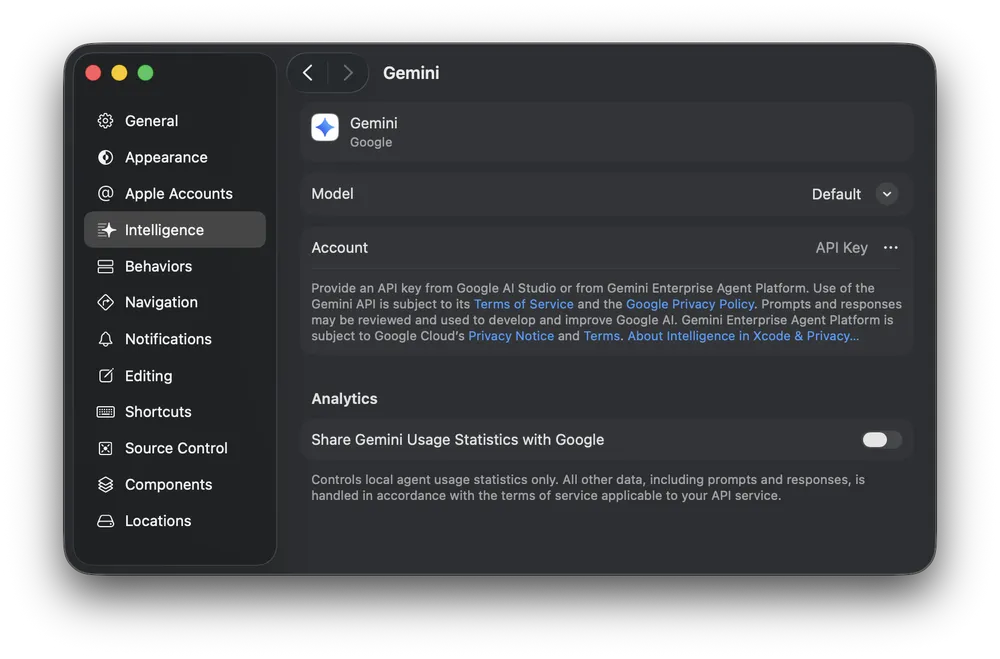
Google also describes Xcode integration separately. Developers can onboard Gemini from Xcode's Intelligence settings panel, then use it for multi-step tasks such as code review, bug fixing, and feature building. Individual developers can use a self-serve Gemini API key from Google AI Studio. Enterprise developers can use a Gemini Enterprise Agent Platform API key with organization quota and data privacy parameters. The same Xcode surface can therefore hide very different audit boundaries depending on whether a personal key or enterprise key is attached.
MCP and ACP Turn IDE Convenience Into a Permission Problem
Xcode plug-ins that accept MCP tools and Agent Client Protocol compatible agents are convenient for developers and interesting for security teams. MCP lets an agent call tools such as file systems, issue trackers, databases, design systems, or internal APIs through a structured interface. Once those tools sit inside Xcode, the boundary between "IDE extension" and "AI agent tool permission" gets blurry. Teams need to know which MCP servers are installed, which tokens they use, where code changes are logged, and where tool-call transcripts are retained.
Agent Client Protocol raises a second set of questions. Apple says any agent compatible with ACP can connect, but agents differ in sandboxing, approval flows, memory behavior, file access, and network access. Xcode may provide the client surface, yet the attached agent's command execution and data egress still need independent review. Apple-platform apps often handle personal data, App Store review requirements, and device permissions, so agent logs and tool calls should become part of the release process rather than an informal developer preference.
GitHub and Figma are symbolically useful first partners. GitHub holds issues, pull requests, review comments, and CI history. Figma holds product design, flows, and design tokens. If Xcode can install and connect both smoothly, an iOS workflow can link planning, design, code, previews, and simulator validation in one agent loop. If the setup is sloppy, private repositories and design files can also end up in the same agent context. The convenience and the data boundary are attached to the same button.
Community Upside and Missing Pieces
The Hacker News thread around Apple's Core AI framework included praise for a system-wide on-device model as an OS API. One developer liked the idea that apps could rely on a local model that already exists across the platform. Another explicitly welcomed local and private AI. For teams tired of cloud model bills and data-center dependency, Apple's on-device route remains the clearest differentiator.
The same thread also pointed to gaps. Developers asked why Core AI does not expose an OpenAI-compatible endpoint. Others wanted more detail about MCP support, containerization, and seatbelt-style isolation. There was also discussion of whether GPU model execution continues when the phone is locked or the user switches apps; one reply framed the restriction as reasonable battery protection. Apple AI APIs run on devices people carry, so they are unlikely to behave like unconstrained server agents.
That reaction captures both the advantage and the limit of Apple's approach. Apple can combine privacy, local execution, OS integration, and IDE validation in a way that external toolchains cannot fully reproduce. But teams that already built around OpenAI-compatible APIs, Anthropic SDKs, model gateways, LangGraph flows, or MCP servers should not expect Foundation Models and Core AI to behave like a backend abstraction with an Apple logo. They are native Apple-platform abstractions, and their value comes with Apple-platform constraints.
What Apple App Teams Should Decide First
The first decision is model routing. Teams need to map which inputs may stay on device, which can go to Private Cloud Compute, and which are allowed to leave for Gemini or another cloud provider. That policy should include user notice, server logs, retention, and what happens when a network call fails. A single Swift-facing API surface can make provider switching feel easy, but the privacy and reliability consequences are still product decisions.
The second decision is Xcode agent governance. Teams should decide whether Xcode 27 agentic coding is allowed across the organization, limited to pilot projects, or restricted to certain file types. They should also define whether agent-written tests and preview validation are required before a generated change can be merged. The valuable part of Apple's implementation is the local validation loop. Ignoring that loop would reduce the agent to another code generator.
The third decision is MCP inventory. If an Xcode plug-in can reach Jira, GitHub Enterprise, Figma, a design-token repository, an internal API mock server, or production-like sample data, it has more power than a normal editor theme or formatter. The organization needs a list of approved servers, token scopes, logging locations, and revocation steps. MCP inside Xcode is a developer-productivity feature only after it is also an access-control feature.
The fourth decision is hardware and CI timing. Xcode 27's Apple-silicon-only requirement can block older maintenance workflows before any AI feature is tested. A team with Intel Macs, old build agents, or constrained simulator capacity should solve the upgrade path before making an agentic-coding promise to product managers.
The fifth decision is cost accounting. Apple's under-2-million-first-time-downloads Private Cloud Compute condition, Google AI Studio keys, Gemini Enterprise Agent Platform, Claude, OpenAI agents, and any custom provider all have separate billing, quota, and privacy terms. Seeing several models from one Xcode screen does not merge procurement, audit, or incident response.
What Apple Opened Late and What It Can Control Quickly
Apple looked late to the generative IDE race. Cursor and Copilot have already pushed repository context, pull requests, issues, and background agents. Claude Code and Codex have moved through terminals and cloud workspaces. Apple is attacking a different surface. Xcode is where Apple-platform build settings, signing, simulators, previews, Device Hub, App Intents, SwiftUI, and Xcode Cloud meet. External IDEs can integrate with parts of that stack, but they do not own the whole platform loop.
The Foundation Models strategy follows the same pattern. Apple is not leading with a general-purpose LLM endpoint that every developer calls as an external API. It is tying Swift APIs, App Intents schemas, Spotlight semantic indexes, on-screen awareness, Private Cloud Compute, and Core AI to OS capabilities. That route can look slower than a model-platform race, but it is more direct for apps that need user context, permissions, and device behavior.
The shortest version of the announcement is this: Apple developers can now choose models and agents from inside Xcode and Swift APIs. The provider set expands to Apple, Google, Anthropic, OpenAI, and other implementations of the LanguageModel protocol. Tooling expands through MCP and ACP. Validation moves closer to tests, Playgrounds, previews, and simulators. The open question is not whether choice exists. It is which data, permissions, costs, and release gates each choice is allowed to touch.
WWDC26's Xcode 27 and Foundation Models updates make AI both an app runtime layer and a developer workflow layer for Apple's platforms. Developers gain more ways to select models and agents. They also inherit more policy files, audit logs, quota dashboards, and privacy reviews. Xcode 27 adding MCP is a useful integration story, but it also means Apple developer teams now need agent permission management inside the IDE settings they use every day.
Sources
- Apple Newsroom, Apple accelerates app development with new intelligence frameworks and advanced tools.
- Apple Developer, 5 takeaways from the Platforms State of the Union.
- Apple Developer, Apple Intelligence.
- Google, Bringing the latest Gemini models to Apple developers.
- Hacker News, Apple Core AI Framework.