Cloudflare Buys VoidZero as Vite Becomes the AI App Deployment Gate
Cloudflare acquired VoidZero, the company behind Vite, Vitest, Rolldown, and Oxc. The deal turns Vite into a front door for AI-generated apps moving from local code to Workers.

- What happened: Cloudflare acquired VoidZero, the company behind Vite, Vitest, Rolldown, and Oxc.
- Cloudflare announced the deal on June 4, 2026. Financial terms were not disclosed.
- The numbers: Cloudflare cited 130 million-plus weekly Vite downloads and 13.9 million weekly downloads for its Vite plugin.
- Why it matters: The target is a
vite deploy-style path that moves AI-generated apps from local scaffolds to Workers, D1, and R2.- Vite says it will keep its MIT license, vendor-agnostic posture, Vite team stewardship, and independent Open Collective management.
- Watch: Cloudflare's $1 million Vite ecosystem fund helps address neutrality concerns, but the real test will be CLI behavior and deployment integrations.
Cloudflare announced on June 4, 2026 that it had acquired VoidZero, the JavaScript tooling company behind Vite, Vitest, Rolldown, Oxc, and Vite+. Cloudflare frames the acquisition as part of the "AI-native web." The immediate story is not just that a major cloud provider bought a widely used frontend tooling company. It is that AI coding agents are turning local scaffolds into deployable applications faster than existing build, runtime, database, and storage workflows can absorb.
Cloudflare put unusually large adoption numbers in the release. It says Vite now sees more than 130 million weekly downloads. It also says the Cloudflare Vite plugin has reached 13.9 million weekly downloads, more than 10% of Vite's total weekly volume. Vite has moved well beyond its original role as a convenient dev server for React or Vue projects. Nuxt, SvelteKit, Astro, TanStack Start, and other frameworks now lean on it as a shared layer for modern web development.
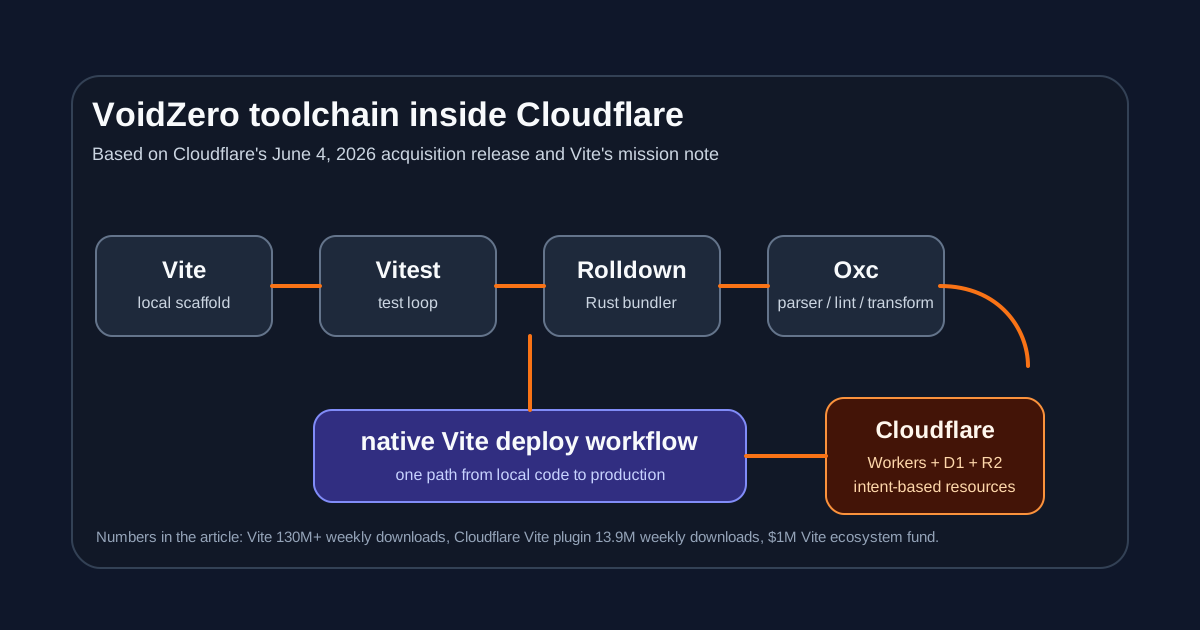
The diagram summarizes the product direction described in Cloudflare's acquisition release and Vite's official post.
Vite published its own statement the same day under the title "Cloudflare supports Vite's mission". The post says Vite will remain MIT-licensed, vendor-agnostic, and stewarded by the Vite team. It also says the Vite Open Collective will continue to be managed by the Vite team, while VoidZero-employed Vite team members will join Cloudflare and keep working on Vite. Those are not boilerplate assurances. They answer the first question many framework authors and deployment providers will ask: did Cloudflare buy Vite, or did Cloudflare buy a company that contributes heavily to the Vite ecosystem?
Cloudflare's answer is the second one. Its release says Vite, Vitest, Rolldown, Oxc, and Vite+ will stay open source under the MIT license and remain vendor-agnostic and community-driven. Cloudflare also announced a $1 million Vite ecosystem open source fund for independent maintainers and contributors, including people who are not part of Cloudflare or VoidZero. That fund is a practical governance signal because Vite's influence now reaches across frontend frameworks, build tooling, test runners, and deployment platforms.
The acquisition still changes the center of gravity. Cloudflare says it will integrate VoidZero's toolchain more deeply with the Workers developer platform. The release describes three concrete directions: aligning Cloudflare's CLI with Vite workflows, shrinking the path from local code to Cloudflare's global network, and using intent-based infrastructure so application logic can trigger automatic provisioning of resources such as D1 databases or R2 object storage.
That third direction is where the AI coding angle becomes concrete. A human developer can open a dashboard, create a D1 database, attach an R2 bucket, wire environment variables, and decide how to route a preview. An agent asked to "build and deploy a small SaaS app" has to connect build tooling, runtime configuration, database bindings, storage, secrets, routes, preview URLs, and logs in one loop. A native Vite-to-Workers path gives the agent a narrower deployment surface and fewer provider-specific assumptions to infer from scattered documentation.
This is why the announcement reads more like AI infrastructure news than a conventional JavaScript tooling deal. Cloudflare's release explicitly points to autonomous AI coding agents and rapid application scaffolding. When AI writes more of the code, the surrounding toolchain has to be faster, more predictable, and more inspectable. If an agent-generated app runs on a local dev server but fails during production build, database binding, object storage wiring, or edge runtime execution, the human developer inherits the debugging cost at the same speed the agent created the files. Cloudflare wants the Vite and Workers integration to reduce that gap.
VoidZero's value to Cloudflare also goes beyond Vite itself. In VoidZero's founding announcement, Evan You described JavaScript tooling as fragmented across bundlers, test runners, linters, formatters, resolvers, transformers, package managers, and runtime configuration. That fragmentation is already annoying for developers. It is worse for agents, because every scattered config file increases the amount of context the agent has to read, reason about, and repair after a failed run.
Rolldown and Oxc are VoidZero's answer to that bottleneck. In May 2026, VoidZero announced Rolldown 1.0 and described it as the Rust-based bundler that will power Vite 8. Oxc supplies parser, resolver, transformer, linter, formatter, and minifier infrastructure. The larger VoidZero plan is not merely "make Vite projects start faster." It is to rebuild the web development toolchain around native-speed components that can serve build, test, lint, and bundle workflows together.
Vite+ sits in the same plan. The Vite+ Alpha announcement in March 2026 described a unified web development toolchain that brings together Vite, Vitest, Oxlint, Oxfmt, Rolldown, and tsdown, with runtime and package-manager integration also in scope. Cloudflare can extend that local toolchain story into runtime, resource, and deployment management. In practical terms, VoidZero works on the local build/test/lint side, while Cloudflare can attach Workers, D1, R2, Durable Objects, routing, previews, and logs.
For product teams using AI coding agents, the upside is straightforward. If a Vite project can naturally discover Cloudflare deployment targets, provision required D1 or R2 resources from code intent or config, and keep preview behavior close to production behavior, then agent-built prototypes can become reviewable deployments faster. Feedback loops matter for agentic development. Build failures, test failures, runtime binding errors, and route mismatches are easier to address when the agent can observe them inside one coherent platform flow.
The tradeoff is neutrality. Vite became a shared web ecosystem tool precisely because it was not a framework owned by one deployment vendor. The Vite post's line that applications built with Vite are meant to run anywhere exists for this reason. Cloudflare has every reason to improve the Workers path from Vite, but framework maintainers and rival deployment platforms will watch whether Vite core starts to prioritize Cloudflare's resource model, CLI assumptions, or deployment affordances over neutral extension points.
The MIT license protects code usage. It does not automatically protect ecosystem influence. A build tool can remain open source while its roadmap, issue triage, defaults, documentation, and integration examples steadily favor one provider. Cloudflare's $1 million fund, the Open Collective language, Vite team stewardship, and the explicit vendor-agnostic statement all address that risk. The stronger evidence will come from releases: how Cloudflare-related issues are prioritized in Vite core, whether Vite+ keeps first-class extension points for other providers, and whether Cloudflare's CLI integration remains opt-in rather than a default assumption.
The competitive context is now clearer. Vercel ties together Next.js, AI SDK, Sandbox, and its deployment platform. Netlify has spent years building frontend deployment and framework integrations. Astro joined Cloudflare earlier in 2026. GitHub Copilot and OpenAI Codex are closer to code generation, workspace, and pull-request surfaces. Cloudflare already has Workers, D1, R2, Durable Objects, Workers AI, and a global edge network. Adding VoidZero gives Cloudflare earlier leverage in the path from generated source code to production candidate.
That competition may be decided less by model quality than by operational details. When an AI coding agent creates 20 files, adds tests, and tries to deploy, the model name is only one part of the outcome. The platform needs local preview and production runtime to behave similarly. Build output must survive the target runtime. Database migrations and storage bindings need audit trails. Preview URL failures should expose logs that an agent can read and act on. Viewed this way, Vite's 130 million weekly downloads are not only a developer adoption metric. They are a measure of how often Vite can become the first automated gate in an agent execution path.
Community reaction already reflects the tension. The Korean source article tracked early Hacker News and Reddit signals: the Hacker News item appeared with hundreds of points and more than a hundred comments within hours, while a Reddit r/webdev thread passed 200 upvotes. Supportive reactions focused on Evan You and the VoidZero team gaining stable resources, plus the possibility of faster tooling and better deployment integration. Critical reactions focused on Cloudflare gaining influence over a tool many teams treat as shared infrastructure.
That concern is not cynical. As open source infrastructure becomes more central, funding and neutrality collide in the same project. Independent maintainer models can be underfunded and slow. Corporate acquisition can provide resources, salaries, and roadmap velocity, but the roadmap now sits next to a platform business. Vite is close enough to being the default web build entry point that this balance matters for framework authors, hosting providers, and AI tooling companies.
AI product teams should treat the deal as a prompt to inspect three things in their own stacks. First, preserve provider abstraction for Vite apps. A better Cloudflare path should not break routes to GitHub Actions, Vercel, Netlify, Kubernetes, or static hosting. Second, audit agent-created infrastructure. If D1 databases, R2 buckets, routes, or bindings can be provisioned from inferred intent, teams need records of which prompt, config, commit, and actor created them. Third, compare preview and production behavior. Agent-generated apps look fast because they appear quickly; hidden differences between local and deployed environments turn that speed into operational risk.
The acquisition is therefore not "Cloudflare bought another frontend company." Vite is a 130 million weekly download entry point for web application creation. As AI coding agents become normal, that entry point becomes less about the first screen a human developer sees and more about the automated path an agent uses to produce, verify, and deploy an app. Cloudflare is pulling that path closer to Workers and its edge network.
The next tests will come through Vite releases, Vite+ direction, and Cloudflare CLI integration. If Vite stays genuinely vendor-agnostic while Cloudflare builds an excellent Workers route on top, the ecosystem gets faster tooling without losing portability. If Vite's defaults, docs, or extension model drift toward Cloudflare-specific assumptions, the $1 million fund will not be enough to settle the neutrality question. The deal gives Cloudflare a stronger claim on the AI-native web, but it also puts the stewardship of a shared JavaScript toolchain under closer public inspection.
Sources include Cloudflare's acquisition release and Vite's official Cloudflare support note. Background comes from VoidZero's founding announcement, the Vite+ Alpha post, and the Rolldown 1.0 announcement.