Oracle cloud commitments become a new buying path for OpenAI Codex
OpenAI and Oracle are opening an OCI Marketplace route for OpenAI models and Codex, moving AI adoption pressure from model access to procurement and governance.
- What happened: OpenAI and Oracle announced a path for OCI customers to use existing cloud commitments to buy OpenAI models and Codex.
- OpenAI published its announcement on June 10, 2026; Oracle followed with an OCI Marketplace explainer on June 11.
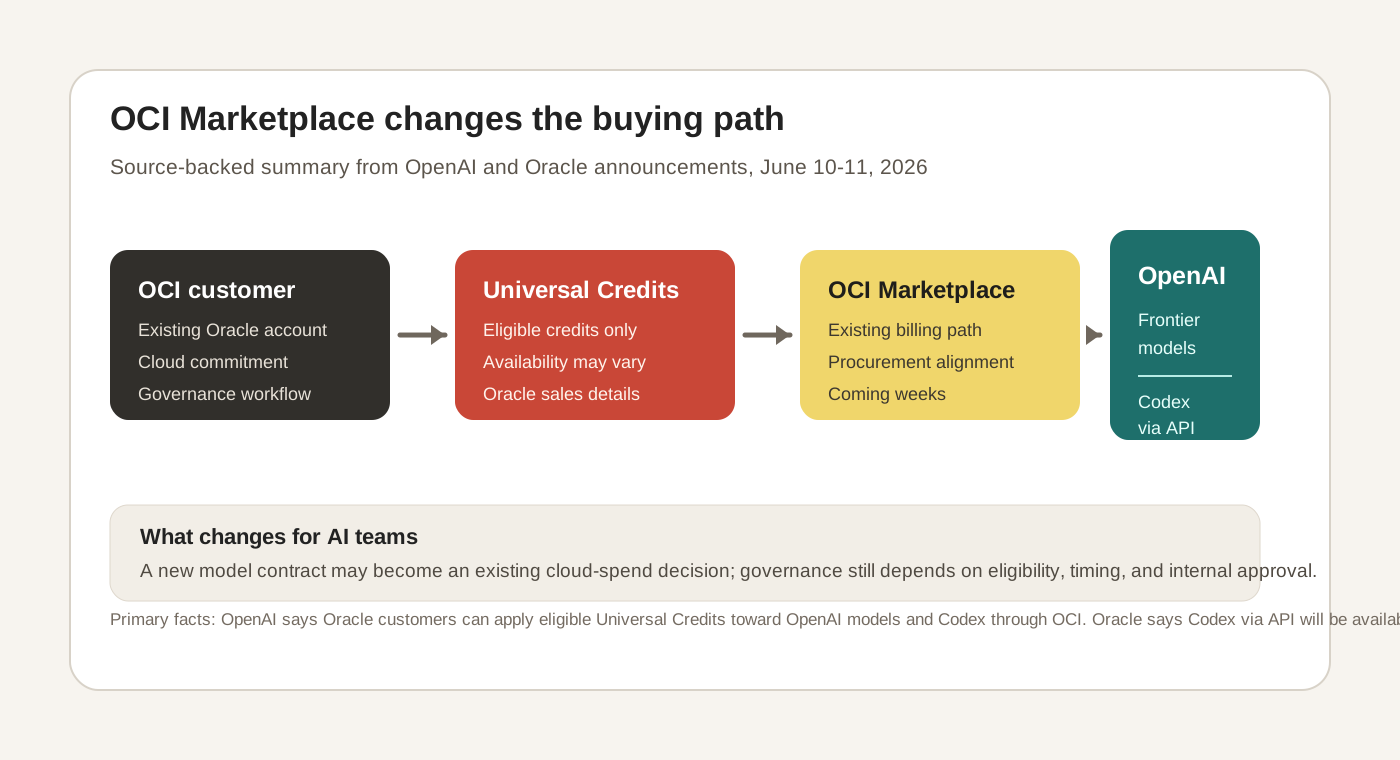
- Buying route: Oracle points to eligible Oracle Universal Credits and the OCI Marketplace.
- Developer impact: Codex can become part of an enterprise Oracle procurement and governance path instead of a separate OpenAI contract or individual account.
- Watch: availability and eligibility remain conditional, and OpenAI describes the rollout window as coming weeks.
OpenAI announced a new purchasing path for Oracle Cloud Infrastructure customers on June 10, 2026. The short version is not a model benchmark or a new Codex feature. OpenAI says enterprises will be able to use existing Oracle cloud commitments to access OpenAI frontier models and Codex, without creating a separate purchasing route. For platform teams, that turns the announcement into procurement infrastructure: the model and coding agent move inside a cloud budget, approval path, and vendor-management process that many Oracle customers already operate.
Oracle confirmed the same direction in a June 11 Oracle Marketplace post. Oracle says customers will soon be able to apply eligible Oracle cloud investments to OpenAI models and Codex. Its FAQ is more specific about the channel: OpenAI frontier models and Codex via API are expected to become available through the OCI Marketplace, using existing billing and procurement processes. The important terms are not hidden in the brand names. They are via API, OCI Marketplace, and Universal Credits.
The announcement does not apply to every OpenAI user. It is aimed at Oracle Cloud Infrastructure customers, and more narrowly at organizations with eligible Oracle Universal Credits and qualifying purchasing terms. OpenAI says availability starts in the coming weeks and directs customers to Oracle sales representatives for timing and availability. Oracle adds that availability and eligibility may vary. In practical terms, this is closer to a procurement-channel notice than a fully open product launch. It does not mean every OCI customer can enable Codex in the console today.
Buying path sounds administrative until a team tries to put an AI coding tool into production. Adding a new AI vendor can trigger security review, legal review, data processing terms, budget approval, procurement onboarding, usage monitoring, and chargeback design. Those steps can take weeks or months even when the API is technically available. Oracle's post says many organizations are blocked less by access to capable models than by procurement complexity, governance requirements, and cloud strategy alignment. OpenAI makes the same point by foregrounding purchasing processes and governance frameworks.
For engineering teams, Codex changes position in the stack. Coding agents often enter through personal subscriptions, separate SaaS contracts, GitHub Copilot agreements, direct OpenAI API accounts, or internal gateways. If this OCI Marketplace route opens as described, Codex via API can become a line item inside the Oracle cloud relationship for organizations that already treat Oracle as a core vendor. A tool that began as an experiment on a developer's card can become a centrally purchased capability funded from a cloud commitment.
That can reduce some shadow-AI pressure. When developers use coding agents from external accounts, source code, issue context, internal logs, stack traces, and customer identifiers can cross boundaries that security teams struggle to audit. An OCI purchasing path gives platform and security teams one more official surface for approvals, account management, cost allocation, and policy enforcement. It does not make Codex safe by default. It does, however, place adoption inside a channel where an enterprise can attach controls before usage spreads informally.
OpenAI describes the use cases broadly: building AI applications, analyzing complex information, automating workflows, and creating customer and employee experiences. Oracle pulls the Codex description toward software delivery. It describes Codex as a coding agent that helps teams build and ship with AI, including code generation, debugging, developer productivity, and software development workflows. That makes the announcement more than a ChatGPT Enterprise sales note. It is also a distribution move for Codex inside enterprise developer platforms.
The competitive signal is in the buying route. Azure AI Foundry already puts model and agent services inside Microsoft contracts and Azure consumption commitments. Amazon Bedrock sells multiple models through AWS accounts, IAM, and billing. Google Vertex AI uses Google Cloud projects, commitments, and governance. If OpenAI models and Codex become purchasable through Oracle Marketplace, enterprise buyers will compare more than model quality. They will ask which approved cloud commitment can fund the work and which governance surface already fits their operating model.
Oracle gets a cleaner AI story for customers that already depend on its database, ERP, finance, HR, and public-sector workloads. Those buyers often have conservative procurement processes and established Oracle account teams. Oracle can tell them that access to frontier models does not require abandoning the existing enterprise process. OpenAI gets a wider enterprise distribution channel that is not framed only through Microsoft. The result is not a replacement for Azure or direct OpenAI sales, but a second commercial doorway for organizations where Oracle is already embedded.
The announcement also fits OpenAI's wider infrastructure posture. In a March 2026 funding and infrastructure strategy post, OpenAI listed Microsoft, Oracle, AWS, CoreWeave, and Google Cloud as cloud partners. It named NVIDIA, AMD, AWS Trainium, Cerebras, and Broadcom as silicon partners, and Oracle, SBE, and SoftBank as data-center partners. The same post said Codex had passed 2 million weekly users and that monthly usage was growing more than 70%. The OCI Marketplace route is the sales and procurement layer of that broader distribution and infrastructure strategy.
Oracle's role also appears in OpenAI's June 1 Michigan Stargate announcement. OpenAI said it had started construction on The Barn, a 1GW data-center campus in Saline, Michigan, with Oracle, Related Digital, and Walbridge. The announcement included more than 2,500 union construction jobs, 450 permanent onsite jobs, 1,500 county-wide jobs, and 1,000 indirect jobs. It also listed a $10 million contribution for Saline Recreation Center improvements and up to $45 million in Codex credits for more than 400,000 Michigan students in the 2026-2027 school year. Oracle is being presented as a compute, data-center, workforce, education-credit, and procurement partner, not only as a reseller.
That infrastructure context carries risk as well as reach. After reports of a 2025 Oracle-OpenAI $300 billion computing deal, a Hacker News discussion focused on cost sustainability, power capacity, and whether Oracle and OpenAI could secure enough money and GPUs. One recurring concern was where multi-gigawatt power capacity would come from. Another was whether the economics worked if demand or financing conditions changed. Those comments are not evidence about the OCI Marketplace listing itself, but they show the skepticism developers bring to Oracle-OpenAI infrastructure commitments.
A separate 2026 Hacker News discussion about Stargate and Oracle data centers framed the same issue more technically. Participants debated whether Oracle could build Blackwell-era data centers quickly enough while GPU generations continue to turn over. One comment described the problem as building today's data centers tomorrow, not yesterday's data centers. Others contrasted debt-funded AI capex with hyperscalers that can fund infrastructure from existing cash flow. The procurement route does not remove delivery and capital-structure questions underneath the compute supply.
Teams should avoid reading this as "Codex gets cheaper on Oracle." OpenAI and Oracle have not published a price list, rate limits, data-retention terms, regional availability, model list, SLA, audit-log surface, private-networking path, or support escalation model for this route. The ability to apply eligible Universal Credits is a billing-path statement, not a discount guarantee. Before production use, buyers need to inspect the OCI Marketplace listing, contract terms, OpenAI product terms, data-processing terms, region support, logging behavior, and any private-connectivity options.
Platform teams have a concrete checklist. First, which Universal Credits are eligible, and under what scope? Second, what exactly does Codex via API include: product access, API-only agent usage, execution environment, or a narrower endpoint? Third, which regions and subprocessors handle source code and development artifacts? Fourth, can billing and usage attribution be separated by project, department, repository, or user? Fifth, do the organization's source-code policies align with the relevant OpenAI data controls? The announcement starts those questions rather than answering them.
Security teams face the same boundary. Buying through OCI Marketplace does not automatically make Codex an internal-network-safe tool. A coding agent can touch repository clones, build logs, package-registry tokens, database schemas, incident traces, and customer identifiers. Its risk follows the developer workflow, not merely the model account. A formal rollout still needs source-code data classification, an allowed-repository policy, secret redaction, tool-execution sandboxing, approval workflows, and an audit trail. Paying through Oracle does not replace that design.
The product and finance implications are different but just as concrete. During experimentation, a team credit card or small API budget can be enough. Once AI becomes part of production workflows, spend commitments, vendor consolidation, forecasts, chargeback, and legal terms become blockers. OpenAI and Oracle are speaking directly to that stage. The promise of reducing friction for enterprises bringing advanced AI into their businesses is not primarily about model capability. It is about making the organizational path less irregular.
This does not mean Microsoft and OpenAI are being displaced. OpenAI's March infrastructure post still lists Microsoft as a cloud partner. What has changed is that OpenAI's cloud and compute portfolio now visibly includes Oracle, AWS, CoreWeave, and Google Cloud as well. For enterprise buyers, OpenAI access is less of an Azure-only story than it used to be. A company with a large Oracle footprint may evaluate OpenAI models and Codex without first expanding Azure commitments. A Microsoft-centered organization may still find the Azure route simpler.
The same questions apply outside the United States. Enterprises and public-sector-adjacent organizations that already use Oracle Database, Fusion Applications, or OCI may prefer expanding an Oracle contract over onboarding a new AI vendor. But data residency, privacy law, source-code export, subcontractor rules, and network-separation requirements are not solved by an OCI Marketplace purchase. Easier procurement can even create a new failure mode if risk review is skipped because the vendor path feels familiar. Procurement convenience only helps when governance design moves earlier, not later.
For individual developers, the next step is modest. If your team already has an Oracle commitment, ask whether the next AI-coding pilot should compare "OpenAI direct" and "OpenAI through OCI Marketplace" as separate options. The evaluation should include account management, SSO, auditability, data retention, region support, usage attribution, procurement lead time, and support path, not just price or model performance. Codex benchmarks can stay the same. The rollout decision may hinge on approval speed and operating controls more than score differences.
OpenAI and Oracle still have to prove the Marketplace path is more than a payment link. Coding agents read repositories, call tools, write patches, run tests, and create pull requests. Those workflows need identity, permission boundaries, artifact storage, logging, and policy enforcement around the model endpoint. If Oracle is making OCI Marketplace the entry point, the next product question is how far Codex via API connects to the Oracle governance surface.
The news value is therefore not that Oracle helps OpenAI sell more models. It is that a coding agent can become a consumer of enterprise cloud commitments. Once AI development tools move from personal productivity apps into formal procurement, the product criteria expand. Model quality, IDE integration, and CLI speed still matter. So do approved budget paths, security-team visibility, and platform-team cost allocation. In enterprise AI, those administrative surfaces are becoming product features.
The next signals are easy to track. First, watch the actual OCI Marketplace listing for the model list and the precise scope of Codex via API. Second, watch the Universal Credits eligibility terms and regional availability. Third, watch whether Oracle customer references show shorter procurement lead times from pilot to production. If OpenAI and Oracle can turn an existing cloud commitment into a faster approved path for AI coding pilots, this will be a quiet but meaningful enterprise AI distribution story.