NAVER 55MW AI factory exposes the power bill behind agent platforms
NVIDIA and NAVER are expanding a DSX-based AI factory from 55MW toward gigawatt scale, tying HyperCLOVA X, NemoClaw agents, and Seoul World Model to infrastructure capacity.
- What happened: NVIDIA and NAVER said on June 7, 2026 that GAK Sejong will expand into an NVIDIA DSX-based AI factory.
- The starting unit is 55MW, the target is gigawatt scale, and the plan puts training, post-training, and inference under one AI cloud strategy.
- Product signal: the announcement links HyperCLOVA X fine-tuning, a
NemoClaw-based AI Agent Platform, and aCosmos-based Seoul World Model. - Developer impact: agent-platform competition is moving below model API names into power, token throughput, data sovereignty, and multi-tenant operations.
- Watch: this is still an infrastructure expansion plan. Public agent-platform APIs, pricing, SLAs, and model cards have not yet been released.
NVIDIA Newsroom published a new AI infrastructure announcement with NAVER on June 7, 2026. The core claim is that NAVER's GAK Sejong data center will expand into an NVIDIA DSX-based AI factory. The initial unit is 55MW. The same announcement then reaches beyond that number: gigawatt-scale expansion, HyperCLOVA X, Nemotron, NemoClaw, an AI Agent Platform, Seoul World Model, and sovereign AI customers in Europe and the Middle East all appear in one infrastructure story. This does not look like a model-release post. For AI product teams, that is exactly why it matters. When agents and physical AI move into production, the bottleneck shifts toward power, token throughput, operational automation, and data location.
Reading this as "NAVER is buying more NVIDIA GPUs" misses the operating layer. NVIDIA describes DSX as an AI factory stack that co-designs chips, systems, software, facilities, and partner technologies. That is broader than adding cloud GPU instances or building a larger cluster. An AI factory puts training, post-training, and inference under one operating target. NVIDIA's release says AI factories are becoming critical infrastructure as useful AI moves into production. That phrase could sound like marketing language, but the number behind it is specific: NAVER starts from 55MW and says the trajectory is gigawatt scale.
55MW is not a unit most developers use every day. Latency, context window, token price, and VRAM are familiar numbers. AI factory announcements start with megawatts. That unit is likely to appear more often as long-running coding agents, browser agents, and enterprise workflow agents consume more inference than a single chat answer. An agent plans, calls tools, reads failure logs, edits code, verifies the result, and retries. Each loop spends tokens and compute. As models improve, product teams stop asking only whether an agent can complete a task. They also ask how much it costs, where it runs, and whether it can repeat the same workflow reliably.
NVIDIA's DSX MaxLPS and DSX OS names should be read in that context. DSX MaxLPS is described as software for increasing token throughput per megawatt and lowering token cost. DSX OS is presented as the layer for lifecycle management, consistent runtime operations, health automation, resiliency, and multi-tenant AI factory management. Those names look like infrastructure details, but the product consequence is simpler: can the same agent workflow run again and again with predictable latency and cost? When an internal document agent, a code review agent, and a manufacturing robotics agent share the same GPU pool, scheduling and health automation become part of user-facing product quality.
NAVER is not positioning the first customer set as Korea-only. NVIDIA says NAVER intends to serve European and Middle Eastern demand for sovereign AI infrastructure as well. Sovereign AI is not a single feature. It bundles local language support, data residency, regulatory compliance, and customer control over infrastructure and access. A global hyperscaler can help a team start quickly, but government, finance, manufacturing, and telecom customers often ask where inference logs live, how tuning data is isolated, which region executes a workload, and who controls access. NAVER's strategy combines data-center operations, HyperCLOVA X, and NVIDIA DSX for exactly that kind of buyer.
| Announcement element | What the official release says | What builders should watch |
|---|---|---|
| AI factory scale | GAK Sejong starts at 55MW with a plan to expand toward gigawatt scale | Agent inference cost and queue stability become power and facility design problems. |
| DSX MaxLPS | Software to increase token throughput per megawatt and reduce token cost | The real bottleneck behind API pricing is GPU utilization and power efficiency. |
| DSX OS | Lifecycle, health automation, resiliency, and multi-tenant management | The control plane becomes as important as model serving. |
| AI Agent Platform | Planned Korea launch in the second half of 2026, based on NVIDIA NemoClaw blueprints | Public APIs and pricing are missing, but the direction points to agent runtime packaging. |
There is also a model-side signal. NAVER says it will enhance HyperCLOVA X by fine-tuning NVIDIA's Nemotron 3 Ultra open model with proprietary data and training expertise. NVIDIA also describes NAVER as the first Korean company to join the Nemotron Coalition. This is more specific than a generic statement that Korea will keep building Korean-language models. NAVER appears to be combining NVIDIA's open model work, coalition participation, proprietary data, and regional enterprise requirements rather than betting only on a closed in-house model. The next checks for developers are concrete: which HyperCLOVA X APIs appear, what latency and pricing they carry, and what data-retention terms apply.
The AI Agent Platform mention is shorter, but it is important for devlery readers. NVIDIA says NAVER plans to launch an AI Agent Platform in Korea in the second half of 2026 based on NVIDIA NemoClaw blueprints. Public API documentation, SDKs, pricing, tool registries, sandbox rules, and observability surfaces are not yet visible. Even so, the placement of "agent platform" inside an infrastructure announcement is meaningful. An agent product consumes more operational machinery than a plain LLM endpoint: tool calls, permissions, long sessions, logs, evaluation, retries, policy enforcement, and tenant isolation. A NAVER-operated cloud built on NVIDIA's NemoClaw direction signals a move to sell the agent runtime as cloud infrastructure.
Seoul World Model is in the same announcement. NAVER says it is using proprietary urban street-view data and spatial modeling technology with NVIDIA Cosmos world foundation models to build a Seoul World Model. This differs from a general office-work agent. It connects city-scale spatial data, physical AI, robotics, simulation, mobility, and manufacturing. A Seoul-specific world model can sound like an extension of maps, but NVIDIA's Cosmos push gives it a robotics and simulation angle. The scope should not be exaggerated before real use cases and data-access rules are public. Still, NAVER has search, maps, cloud, and AI model assets, so the ingredients are unusually aligned.
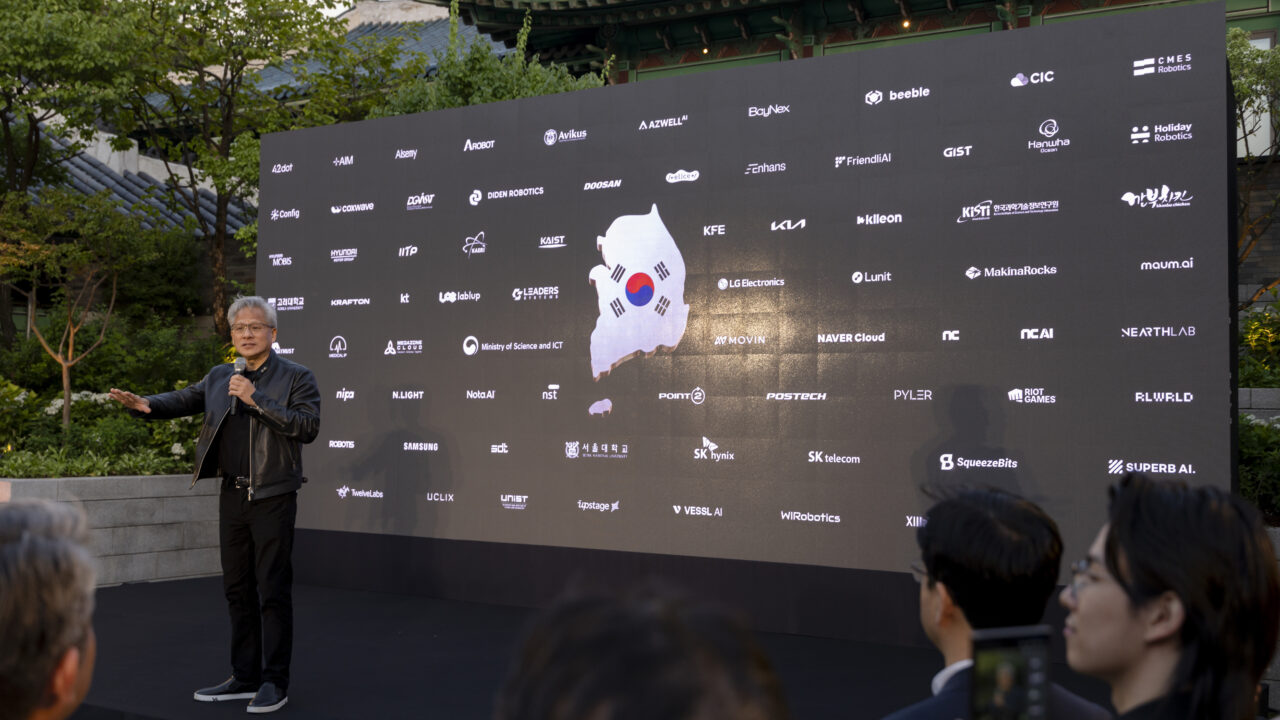
NVIDIA's Korea ecosystem blog places the NAVER announcement in a wider visit. Jensen Huang met NAVER founder Lee Hae-jin, and the same blog discusses SK, LG, Hyundai, and Doosan collaborations. SK Telecom is described with a DSX-based gigawatt-scale AI Cloud plan. LG is discussed around AI factory collaboration for robotics, autonomous driving, data center technologies, and GPU cloud services. NAVER stands out because AI Agent Platform, HyperCLOVA X, and Seoul World Model all sit inside one company's cloud strategy. That creates a clearer path toward developer-facing platform products than a narrower manufacturing automation or memory partnership story.
The competitive frame sits between hyperscalers and regional clouds. AWS, Azure, Google Cloud, and Oracle OCI already sell GPU cloud, managed models, agent builders, and enterprise governance. A recent devlery post on OpenAI and Oracle OCI Marketplace looked at the same adoption problem through procurement. The NAVER-NVIDIA announcement addresses a different layer: production facilities and operating stack. Enterprise agent contracts may run through a marketplace, but local language support, data sovereignty, latency, physical robotics data, and government requirements can pull buyers back toward local AI factories and sovereign clouds.
Korean development teams now have two practical questions. First, when does this infrastructure become an actual API and platform product? The release says the AI Agent Platform is planned for the second half of 2026, but developers cannot yet call an endpoint, inspect a tool-use runtime, run an evaluation harness, configure a sandbox, or open an observability console. Second, what quality and cost will the HyperCLOVA X plus Nemotron strategy deliver? Strong Korean business context and regional compliance help, but coding, retrieval, agent planning, and multimodal reasoning still need to be compared against global frontier models. Sovereign AI is not selected by nationality alone. Price, latency, security, model quality, and operational support have to line up.
Cost is the hardest part to evaluate from the announcement. NVIDIA mentions DSX MaxLPS as a way to reduce token cost by raising token throughput per megawatt, but it does not publish a customer price sheet. Gigawatt-scale ambition signals investment and expected demand, not actual capacity allocation or reservation terms. Enterprise AI pricing is not just input and output tokens. Long-running agents add failed retries, tool calls, file embedding, log analysis, model fallback, and human review. Even if an AI factory operator lowers token cost per megawatt, product teams feel that only when billing units, quotas, and capacity guarantees are understandable.
Security and governance are still open questions. A sovereign AI cloud is meaningful only if customers can see where data is stored, how fine-tuning data is isolated, and how tenant separation is proven. For an agent platform, teams will also need tool permissions, audit logs, secret handling, prompt-injection defenses, and support status for protocols such as MCP or A2A. The current announcement describes infrastructure blueprints and expansion plans. It does not describe application-security details. If NAVER is targeting government, manufacturing, and enterprise buyers, those items need to show up early in platform documentation.
The useful interpretation for Korea's AI ecosystem is not "we can build a giant model too." It is narrower and more operational. Once AI enters production, inference operations can create a larger cost surface and outage surface than training. A coding agent may run dozens of shell commands to fix one pull request. An enterprise agent may move across internal documents and SaaS tools in one task. A robotics agent may cycle through simulation and sensor data. At that point, the GPU cluster is not a research device. It is a production factory. NAVER and NVIDIA are using the AI factory label because factories must produce repeatedly, and repeated production needs power and automation.
Community reaction remains limited. During this research pass, there was no large Hacker News or GeekNews discussion centered specifically on the NAVER-NVIDIA DSX announcement. Developer communities in the same period were more visibly reacting to tools such as Google Gemini CLI, Antigravity, GitHub Copilot, and Claude-related updates. That is understandable. Developers respond first to a CLI they can install today or a pricing change they can feel immediately. Infrastructure announcements often become visible later, when teams compare agent runtime options and regional inference prices.
The immediate checklist is concrete. When NAVER publishes AI Agent Platform documentation, inspect API shape, supported tools, model list, sandbox policy, audit logs, and regional data terms first. When HyperCLOVA X updates arrive, separate Nemotron-based fine-tuning benchmarks, Korean business-language results, coding scores, and agent evaluations. For Seoul World Model, look past demo video quality and ask about data sources, licenses, privacy boundaries, and robotics integration. For a DSX-based cloud product, token price is only one line item; reserved capacity, latency SLOs, failure isolation, and multi-tenant guarantees matter just as much.
The conclusion is not that NAVER has already won a global AI platform race. The announcement alone does not reveal API quality, pricing, or the agent-platform user experience. It does make one part of the agent race visible. Behind model leaderboards and IDE feature tables are token throughput per megawatt, data-center automation, regional data sovereignty, and physical-AI world models. NAVER's 55MW AI factory plan brings that bill to the front. The question for Korean AI builders is not patriotic branding. It is whether their own agent workloads can run repeatedly within the right power, cost, and data boundaries.