QVAC 0.12.0 brings TurboQuant to local KV cache pressure
Tether announced QVAC SDK 0.12.0 with TurboQuant support. The useful question is how KV cache compression changes local long-context AI.

- What happened: Tether announced
QVAC SDK 0.12.0and a TurboQuant implementation on June 1, 2026.- Tether says a 4B model can use roughly 8GB of KV cache at about 262,000 tokens, or about 32GB across four similar sessions.
- Builder impact: The local-AI bottleneck for long documents, long chats, and codebase analysis is moving from model weights to
KV cache. - Evidence to check: QVAC code contains handling for
tbq3_0,tbq4_0,pq3_0, andpq4_0cache types.- OpenCL and Metal limitations, vLLM community counterpoints, and BF16 baseline comparisons still need workload-specific testing before adoption.
Tether AI Research Group announced QVAC SDK 0.12.0 and a TurboQuant implementation on June 1, 2026. Tether's release says it is bringing a Google Research memory-compression algorithm into QVAC Fabric for local AI running on laptops, phones, consumer GPUs, edge devices, and peer-to-peer inference networks. The matching GitHub release for QVAC SDK v0.12.0 was published the same day at 12:05 UTC.
This is not just another "local models get faster" announcement. Tether gives a specific memory example: at roughly 262,000 tokens, a 4B model can consume about 8GB for KV cache alone. Four concurrent sessions at that size can put about 32GB into cache. That number explains why local AI can look comfortable in a short demo and then collapse into cloud fallback when a user opens long documents, large repositories, or multi-hour agent sessions.
This image is the vector-quantization figure Google Research used in its TurboQuant post.
The press release and the release note do not tell the same story
Tether's press release says TurboQuant is included in QVAC SDK 0.12.0 and available through QVAC Fabric. It describes TurboQuant as a way to compress KV cache by up to 5x while preserving output quality close to an uncompressed model. Read by itself, that sounds like the headline feature of the SDK release.
The GitHub release note is framed differently. Its opening section highlights SmolVLA-based vision-language-action inference, image classification, text-to-video generation, @qvac/bare-sdk, @qvac/sdk/commands, Gemma 4 and Qwen 3.5/3.6 multimodal registry constants, mobile fixes, and delegation fixes. The breaking changes focus on TTS moving from ONNX to tts-ggml, Parakeet 0.6.0 moving to a GGUF backend, Bare SDK plugin registration, and CLI bundle or verify command delegation. TurboQuant is not the release-note headline.
That gap matters because otherwise the article becomes a relay of the press release. The QVAC repository gives a more concrete signal. In packages/llm-llamacpp/addon/src/model-interface/LlamaModel.cpp, QVAC handles TurboQuant and PolarQuant KV-cache types. The code comments mention tbq3_0, tbq4_0, pq3_0, and pq4_0, and explain that these cache types currently have Vulkan and CPU implementations. The same comments describe missing OpenCL kernels and a Metal standalone MUL_MAT pipeline limitation, with a guard intended to avoid placing KV-cache tensors on a backend that llama.cpp cannot execute.
That evidence has a clear boundary. The press release connects TurboQuant to QVAC, and the code shows cache-type handling and backend guards. But SDK v0.12.0 is not presented as a finished usage guide that says which model, backend, context length, and cache flag reproduce the headline memory savings. Builders need to read the announcement, release note, addon code, and backend limits together.
| Source checked | What it confirms | Question before adoption |
|---|---|---|
| Tether press release | TurboQuant implementation in QVAC SDK 0.12.0 and an up-to-5x KV-cache compression claim | Which model, backend, and context length reproduce the result? |
| QVAC GitHub release | SmolVLA, classification, text-to-video, Bare SDK, and context-overflow error work | Where is TurboQuant usage documented outside the release note? |
| QVAC addon code | tbq3_0, tbq4_0, pq3_0, and pq4_0 backend guards are visible | How does support differ across Metal, OpenCL, Vulkan, and CPU paths? |
| Community counterpoints | HN and vLLM discussion question BF16 baselines, speed regression, and implementation-specific compression ratios | Is the real workload baseline BF16, 8-bit KV, or already 4-bit KV? |
Why KV cache becomes the local-AI bottleneck
When teams run LLMs locally, the first visible number is usually model weight. People compare 4B, 8B, and 14B parameter counts, then compare Q4, Q5, and Q8 weight quantization. For short demos, that is a reasonable starting point. The model has to fit in RAM or VRAM before anything else can happen.
Long sessions change the math. Transformers keep a key-value cache so the model does not recompute previous token state at every step. That cache grows with context length. A short chat prompt and a few dozen output tokens make the weight file look dominant. A multi-hundred-page document, a long debugging transcript, a codebase snapshot, or an agent session full of tool results can make KV cache the part that grows fastest.
Tether's 262,000-token example is useful because it turns that mechanism into a product constraint. A laptop may load a small model and answer short questions comfortably, then run out of room when a user expects the same assistant to keep a long document, several code files, terminal output, and a review conversation alive. Model weights can often be shared across sessions. KV cache is tied to the session state.
The developer cost appears in two places. First, longer context windows require more local memory. Second, running several local sessions at once becomes difficult. A coding agent can be fixing an issue while a document agent reads a PDF and another process summarizes OCR output. The model may be the same, but each active session grows its own cache.
Google Research's March 24 TurboQuant post frames the problem as memory overhead. Traditional vector quantization can reduce values, but each block needs quantization constants. Google says that overhead can add one or two bits per number and erode the compression gain. TurboQuant combines PolarQuant and QJL to reduce that overhead. In Google's explanation, PolarQuant rotates data vectors and represents them in polar-coordinate terms, while QJL handles residual error through 1-bit signs to reduce bias in attention-score computation.
That is research language, not a copy-paste API contract. Tether's product claim is that the research direction can be moved into a local inference runtime, cache-type handling, and SDK distribution. For builders, the question is not whether vector quantization is academically interesting. It is whether the runtime they ship can keep a long session alive on the device they target.
QVAC is looking at local execution and peer delegation together
QVAC's README describes the project as a local-first, peer-to-peer AI application ecosystem. It lists LLMs, speech, RAG, translation, transcription, OCR, image generation, fine-tuning, and multimodal workflows across Linux, macOS, Windows, Android, and iOS. It also talks about delegating inference to peers rather than only running everything on one local process.
That scope is broader than a typical local LLM runner. Ollama and LM Studio are strong at local model execution and developer ergonomics. llama.cpp is the foundation for much of the local runtime ecosystem. QVAC is trying to combine SDKs, CLI tooling, Bare runtime pieces, addon packages, model registries, and peer-to-peer delegation inside one stack. In that context, KV-cache compression is not a small performance flag. It affects which devices can participate and how long sessions can remain active.
On a phone, reducing cache pressure can let an on-device assistant retain more history. On a laptop, it can let a local coding assistant hold more repository context before falling back. In a peer-to-peer inference network, memory-constrained peers may be able to accept longer work if each session consumes less cache. In all three cases, "can load the model once" and "can sustain the session" are different requirements.
QVAC's own performance notes show the same split. The Metal VLM analysis document treats Q4_0 KV-cache quantization as an immediately available optimization for Apple Silicon Metal. It also notes that a Qwen3.5 hybrid model has KV cache on only six of 24 layers. In the appendix, TurboQuant appears as a more advanced KV-cache strategy connected to llama.cpp discussion. The press release's large memory numbers need to be interpreted alongside backend-specific optimization notes like these.
The 5x compression claim is not a capacity plan
Tether says TurboQuant can compress KV cache by up to 5x. Google Research says TurboQuant can cut KV memory and speed up attention-logit computation. Those claims are attractive for teams trying to put local AI into products. A long-document assistant that looks impossible on a 32GB laptop may become plausible. A smaller GPU may be able to support a larger context window.
The baseline still has to be checked. In Hacker News discussion around TurboQuant, several commenters asked whether 5x or 6x-style language is measured against BF16 KV cache or against production baselines that already use 8-bit or 4-bit KV-cache quantization. Both situations exist. A team still using BF16 cache may see a much larger gain than a team already using Q4_0 cache or model-specific cache optimizations.
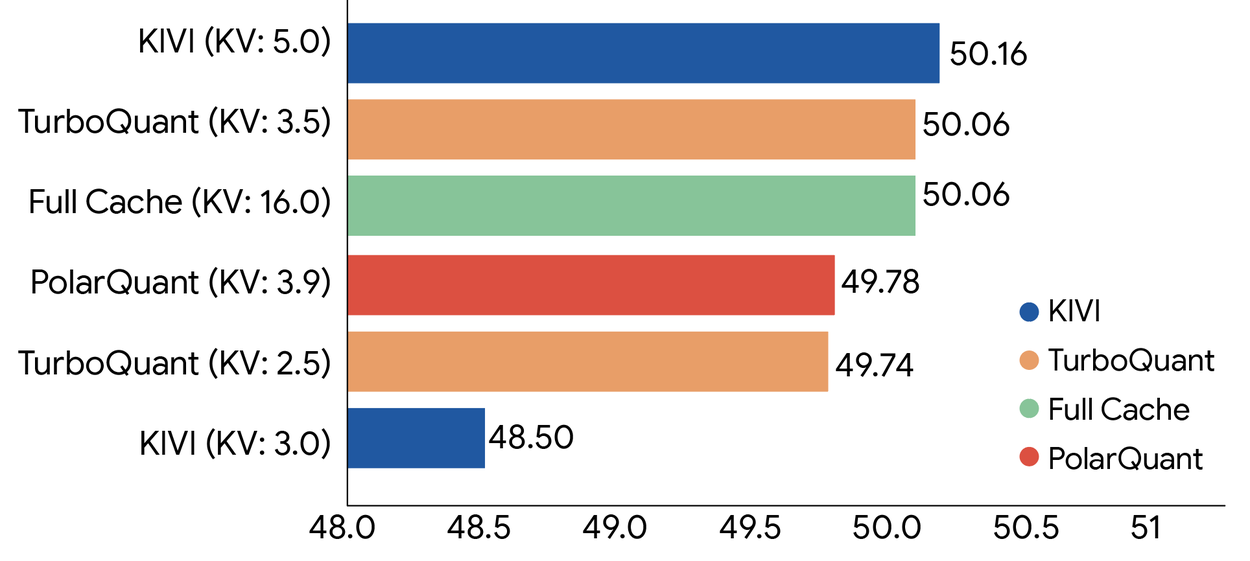
vLLM-related discussion raises the same caution. HN comments point to implementation work and describe compression around roughly 3.8x to 4.9x, with speed somewhere near 80% to 100% of baseline depending on details. That is community interpretation rather than an official benchmark. It is still enough to show why a product team should not put a press-release number directly into capacity planning.
Total memory also matters. KV cache can shrink while model weights still have to stay resident. On a 16GB laptop, a 14B model in Q4, allocator overhead, embeddings or RAG memory, browser memory, and the operating system all compete for space. On a cloud inference server, the picture can be different because per-user KV cache often limits batching and concurrency. The same compression mechanism can matter much more in one workload than another.
The safer reading is not "TurboQuant reduces all memory demand by 5x." It is "TurboQuant may reduce the KV-cache part of memory demand for specific workloads." Long-context coding agents, document analysis, and persistent assistants should test it directly. Short prompts and short answers may barely feel the difference.
Backend limits decide the developer experience
The backend guard in QVAC's code is part of the news. The comments say TurboQuant and PolarQuant KV-cache types currently have Vulkan and CPU implementations, while OpenCL and Metal have limitations. Backend support is not a minor implementation detail in local AI. macOS and iOS users expect Metal. Android and Linux users may see Vulkan or CPU paths. Windows behavior depends heavily on GPU vendor and driver state.
Failure mode matters. If a user selects a cache type such as tbq4_0 and the backend has no kernel for it, silent fallback can make the product misleading: the UI says compression is enabled, but memory use does not change. A hard error is disruptive, but it lets the app show a backend-support table, shorten context, switch backend, or offer cloud fallback. QVAC's guard suggests the project is trying to avoid a silent invalid configuration.
That fits the state of QVAC as an early SDK. The v0.12.0 release note expands the feature surface with text-to-video, SmolVLA, classification, and registry updates. It also exposes context overflow as a typed error. That combination suggests QVAC is moving from "a bundle that can run local AI" toward "an SDK where apps can handle failure modes explicitly."
For local AI products, failure handling is as important as raw quality. When context overflows, an app has to decide whether to trim prompts, reduce RAG chunks, switch models, ask the user, or route to a cloud provider. KV-cache compression sits in the same layer. If a cache type does not work on a backend, the app needs a predictable next step.
Coding agents may fail on tool calls before cache
This article focuses on memory and backend behavior rather than provider integration, but coding agents are still the obvious workload. Long repository analysis and multi-turn fix loops are exactly the kind of sessions that grow KV cache quickly. A single issue can accumulate system prompts, tool definitions, file snippets, test output, diffs, review comments, and user constraints.
KV-cache compression can reduce memory pressure in those sessions. It does not automatically make a small model a reliable coding agent. A 4B or 8B instruct model may still fail to follow tool schemas, emit invalid JSON, call editing tools incorrectly, or misunderstand a test log. QVAC's AI SDK Provider v0.1.0 README also documents tool-use limits for small local models.
That means a useful test plan has two tracks. First, measure memory and speed with the same model, prompt, context length, backend, and cache-type-k or cache-type-v settings. Second, run an agent harness and measure tool-call success, invalid JSON rate, retry loops, test interpretation, and diff quality. Compression can let the agent see more evidence. Whether it uses that evidence correctly is a model and harness question.
Teams trying this now should start with lower-tool-use workflows such as internal document summarization, long-log analysis, or local RAG. Using it as a coding-agent backend requires checking the model size, RAM or VRAM headroom, context length, backend support, cache type, and fallback path together. A local automation that fails silently can cost more engineering time than the cloud bill it was meant to avoid.
The next local-AI comparison is cache and routing
Tether's QVAC announcement also raises the obvious question of why a stablecoin company is building an AI SDK. QVAC fits Tether's broader message around local, edge, and decentralized infrastructure rather than centralized cloud APIs. For that strategy to work, runtime efficiency and integration reliability matter more than a model catalog or a demo.
The competitive field is already crowded. Ollama has strong developer adoption for local model running. LM Studio has a polished desktop experience. llama.cpp remains the base layer for many local runtimes. vLLM is strong in server-side inference. OpenAI-compatible endpoints have become a common integration surface. QVAC is trying to compete by combining peer-to-peer operation, a cross-platform SDK, multimodal addons, Bare runtime support, and a local-first message.
Developers should update the comparison checklist. Tokens per second on one GPU is no longer enough. A runtime also needs to show how it routes between local and cloud providers, how KV cache grows over a long session, whether cache quantization changes output quality, how backend fallback behaves, and whether context overflow is exposed as an error an app can handle.
Tether's June 1 announcement gives enough material to redraw that checklist. The QVAC SDK 0.12.0 release note reads like a feature-expansion release. The press release reads like a TurboQuant productionization release. The repository code shows TurboQuant and PolarQuant cache-type handling with backend guards. Community discussion warns that benchmarks and baselines need scrutiny. Put together, the practical conclusion is narrower and more useful: local long-context AI is becoming a session-memory engineering problem, not only a model-download problem.
QVAC is starting to answer that problem through TurboQuant and SDK-level surfaces. Builders still need to benchmark their own models, devices, backend paths, and agent loops. But KV cache is now a first-class product variable for local AI, and this release makes that variable harder to ignore.