NVIDIA opens a 32B robotaxi model and closed-loop training stack
NVIDIA Alpamayo 2 Super ties a 32B VLA teacher model to AlpaGym, OmniDreams, CoC auto-labeling, and agent skills for L4 robotaxi development.
- What happened: NVIDIA announced
Alpamayo 2 Superat GTC Taipei as a 32B-parameter open reasoning VLA model for Level 4 robotaxi development.- Inference code is planned for GitHub and model weights for Hugging Face in summer 2026.
- Development stack: The release bundles
AlpaGym,OmniDreams, CoC auto-labeling, and physical AI agent skills into an AV training pipeline. - Watch carefully: An open model does not equal a finished robotaxi system. Road validation, safety redundancy, licensing, and commercial-use terms still need separate review.
- The existing Alpamayo 1 repository requires an NVIDIA GPU with at least 24GB of memory and documents non-commercial model-weight terms.
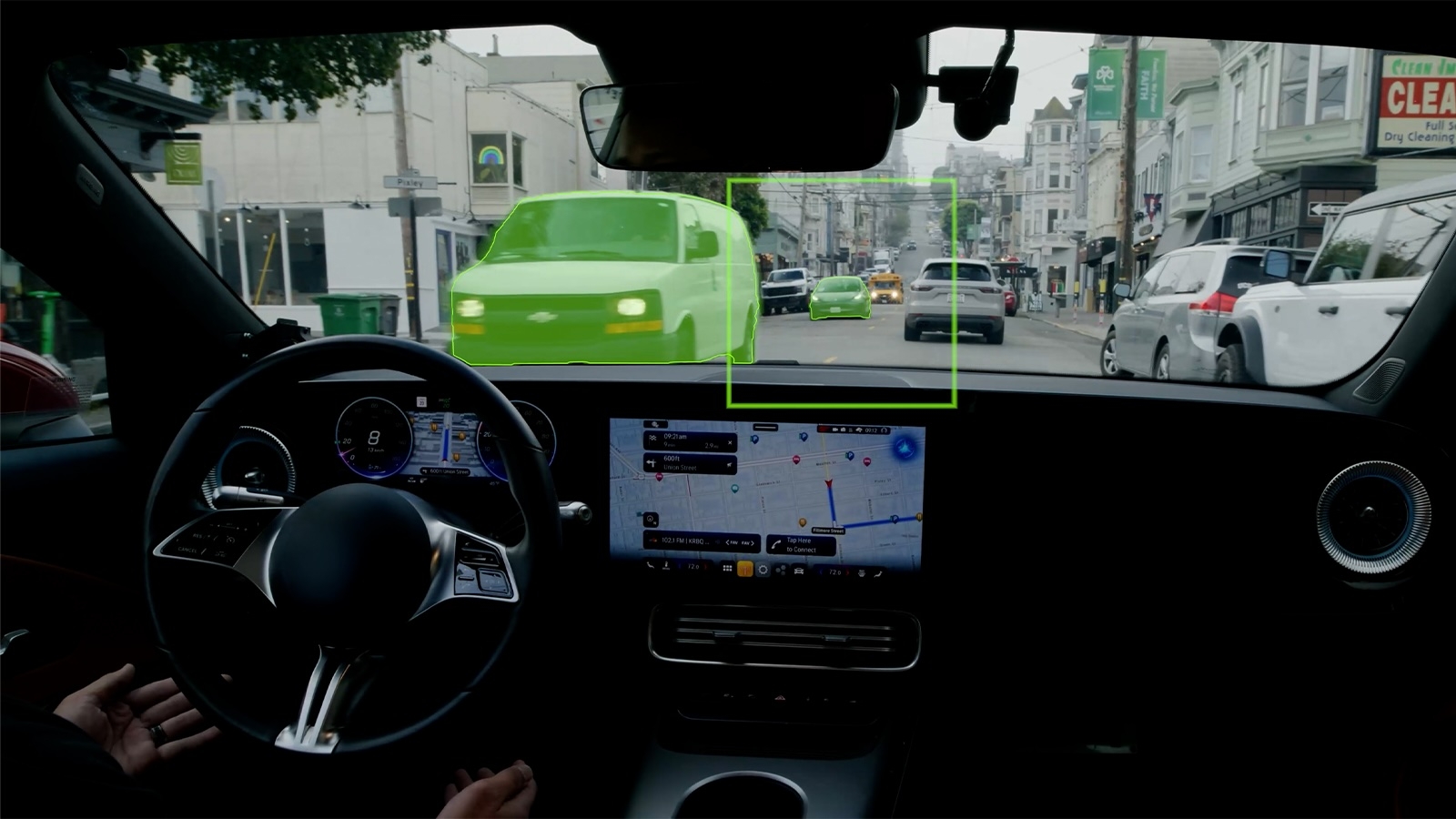
NVIDIA announced Alpamayo 2 Super at GTC Taipei on June 1, 2026. NVIDIA describes the model as a 32B-parameter reasoning-based vision-language-action model. The target is not a general chatbot or coding assistant. It is Level 4 robotaxi development. The same announcement also introduces AlpaGym, OmniDreams, Omniverse NuRec-based physical AI agent skills, and a Chain-of-Causation auto-labeling pipeline. The news is therefore less about a larger autonomous-driving model in isolation and more about NVIDIA packaging robotaxi development as a loop across open models, simulation, automatic labeling, and agent-directed tools.
Alpamayo first appeared at CES in January 2026. NVIDIA's initial Alpamayo announcement covered Alpamayo 1, AlpaSim, and Physical AI Open Datasets, and framed reasoning VLA models as a way to handle long-tail driving situations. The current NVlabs/alpamayo GitHub repository defines Alpamayo 1 as a model for trajectory prediction and Chain-of-Causation reasoning traces. The README says inference requires an NVIDIA GPU with at least 24GB of memory, and the model weights are under a non-commercial license. Alpamayo 2 Super extends that first research release toward a 32B teacher model, 360-degree perception, meta-actions, and closed-loop reinforcement learning.
The first number NVIDIA wants developers to notice is the jump from 10B to 32B parameters. The announcement says Alpamayo 2 Super is three times larger than the previous 10B generation and is built on NVIDIA Cosmos world foundation models. NVIDIA also says the scope expands from trajectory generation to reasoning, planning, and action across the full driving stack.
That sentence deserves a precise reading. In autonomous vehicles, the stack usually separates perception, prediction, planning, control, safety monitoring, fallback policy, mapping, fleet learning, and validation. A single foundation model does not automatically replace every layer. NVIDIA's more actionable position is that the 32B model can act as a teacher model, with smaller models distilled for deployment on vehicle compute such as DRIVE AGX Thor.
The second change is camera coverage and output format. NVIDIA says Alpamayo 2 Super expands from front-facing cameras to 360-degree situational awareness across front, side, and rear views. Its outputs also include meta-actions such as yield, lane change, and stop. A trajectory prediction model answers where the vehicle may go, usually through coordinates or a path. A meta-action sits one level above that: it tells a downstream planner whether the system is choosing to yield, change lanes, or stop.
That distinction matters for safety review. Accident analysis and validation often need more than a coordinate. Investigators and safety engineers ask why a system did not yield, why it selected a lane change, or why it continued instead of stopping. A meta-action does not solve validation by itself, but it gives the system a decision layer that is easier to inspect than a path alone.
NVIDIA's Chain-of-Causation, or CoC, labels fit the same pattern. The announcement says reasoning auto-labeling and 2D grounding can turn raw driving clips into decision-grounded, causally linked CoC labels. NVIDIA claims this can shrink annotation cycles from months to days. Instead of having human labelers separately mark objects, paths, and decision rationales in a scene, a foundation model can fill part of that structure.
The risk is that a model-generated explanation can look useful without being a valid safety argument. For a CoC label to support validation, it has to line up with sensor inputs, scene reconstruction, failure replay, independent evaluation data, and the safety case expected by the organization or regulator. A fluent explanation is not enough.
| Area | Alpamayo 1 public repository | Alpamayo 2 Super announcement |
|---|---|---|
| Model size | Alpamayo-R1/1.5 family in the 10B class | 32B reasoning VLA teacher model |
| Primary output | Trajectory prediction and CoC reasoning traces | 360-degree awareness, meta-actions, and reasoning auto-labeling |
| Training loop | SFT and RL post-training recipe referenced through a separate repository | AlpaGym closed-loop RL and OmniDreams scenario generation |
| Release status | GitHub code and Hugging Face model card are available | Inference code and model weights planned for summer 2026 |
For developers, AlpaGym may be the more important part of the announcement. NVIDIA describes open-loop training as evaluating a single action against recorded data. AlpaGym runs a continuous decision-and-observation cycle inside AlpaSim, where braking, steering, and navigation choices affect the environment. A robotaxi model can predict a good path for one frame and still create a bad situation one second later if that choice changes how nearby cars and pedestrians respond.
Closed-loop environments are designed to expose that compounding error. The software analogy is an agent benchmark that evaluates tool calls over a sequence of state changes, rather than scoring a single generated answer. The AV version needs to measure what happens after the system acts, observes the changed world, and acts again.
OmniDreams is NVIDIA's world model for generating rare and long-tail driving scenarios as photorealistic closed-loop AV scenes. Autonomous driving data is not bottlenecked by ordinary lane keeping. The hard cases are combinations such as construction zones, abnormal parking, incomplete signs, night glare, unexpected pedestrian movement, and local driving conventions. Fleet data can collect these cases, but not always at the pace needed for model iteration.
NVIDIA also mentions a Neural Reconstruction skill built on Omniverse NuRec. The stated purpose is to reconstruct real fleet-driving scenarios as photorealistic 3D scenes, adapt them across sensor configurations, and produce synthetic training data. This is where the announcement crosses from model release into infrastructure strategy: model training, scene generation, reconstruction, and simulation become one development loop.
Real fleet clips and Physical AI AV Dataset
CoC auto-labeling and 2D grounding
AlpaGym closed-loop RL and OmniDreams long-tail scenarios
Distill into smaller vehicle models and connect to DRIVE Hyperion-class systems
The phrase "physical AI agent skills" is also worth tracking. NVIDIA says Neural Reconstruction, OmniDreams, and AlpaGym skills will be available under the NVIDIA Agent Toolkit so developers and coding agents can follow simulation, data generation, and closed-loop training workflows. In software development, an agent skill usually means an instruction artifact that tells an AI coding agent the repository rules, test commands, and deployment steps. NVIDIA is applying the same pattern to AV tooling.
In practical terms, a developer could ask an agent to reconstruct a fleet clip with NuRec, generate rare scenarios with OmniDreams, and run closed-loop RL in AlpaGym. The value is not that the agent invents the safety process. The value is that the tool sequence becomes explicit enough for an agent to help run repeatable workflows.
Alpamayo sits on the boundary between model openness and platform lock-in. Publishing code on GitHub and weights on Hugging Face lowers the starting cost for researchers and smaller AV teams. The surrounding development pipeline, however, points naturally toward Omniverse, NuRec, DRIVE AGX Thor, DRIVE Hyperion, and NVIDIA GPUs. Open source does not automatically mean a platform-neutral stack.
The strategy looks closer to NVIDIA's historical CUDA playbook. By opening enough of the model and recipe, NVIDIA makes its stack the easiest place to experiment. As physical AI matures, the company is trying to connect datasets, simulation, vehicle compute, world models, and agent skills inside one vendor ecosystem.
Commercial-use terms are still unresolved for Alpamayo 2 Super at the time of writing. The Alpamayo 1 GitHub README says inference code is Apache 2.0, while model weights are non-commercial. NVIDIA's Alpamayo 2 Super announcement uses open language and gives a summer release window, but final Hugging Face model cards will decide the details that product teams need: commercial deployment, derivative models, fleet-data fine-tuning, OEM use, and redistribution.
AI teams should not treat the announcement as a green light for product planning. The useful next step is to create a release checklist for summer 2026: license, model card, safety limitations, required hardware, data-use terms, benchmark harness, and integration path into existing AV validation systems.
Community discussion is still thin. I did not find a substantial Hacker News thread around the June 1 announcement. A June 1 Reddit post in r/artificial framed the release as a move from recorded-driving trajectory prediction toward simulation-loop reasoning systems, noting the 32B teacher model, 360-degree awareness, meta-actions, AlpaGym, and OmniDreams. The same post drew the obvious boundary: this is NVIDIA positioning, not proof that robotaxis are solved, and real-world validation remains the hard part.
That reaction matches the debate around the January Alpamayo 1 release. Self-driving and Tesla-adjacent communities treated an open model as notable, but they separated it from driverless miles, operational safety evidence, and deployment experience. Waymo, Tesla, Mobileye, and other AV operators are judged not only by model architecture but by fleet data, safety processes, operations, and public-road results.
NVIDIA is therefore competing less as a robotaxi service operator and more as an AV development-stack supplier. Waymo has spent years building vehicles, maps, simulation systems, operating domains, and safety reports. Tesla emphasizes large consumer fleet data, in-vehicle compute, and end-to-end driving models. NVIDIA's pitch is that OEMs and research teams should not have to rebuild AV foundation infrastructure from scratch.
If Alpamayo 2 Super is strong, it does not remove the need for an autonomy team. It changes what that team has to define. Data policy, validation harnesses, scenario coverage, vehicle integration, fallback systems, and auditability become more important because the model and simulation stack can move faster.
Three practical questions remain for builders. First, how should a team validate CoC labels generated by a 32B teacher model? Second, how well does a policy that succeeds in AlpaGym and OmniDreams survive sensor noise, HD map drift, weather, road culture, and unusual local rules on real roads? Third, how should a company price the tradeoff between an open starting point and dependency on NVIDIA's hardware and simulation stack?
Those questions resemble the ones software teams already face with LLM agents. A stronger reasoning model is a starting point. A production system still needs evaluation data, permission boundaries, observability, rollback, incident review, and a clear owner for failures.
Alpamayo 2 Super is not an immediate robotaxi launch. It is a public proposal for how NVIDIA wants physical AI development to be standardized. The model grows to 32B parameters. Training moves from open-loop replay toward closed-loop interaction. Data generation expands from human labeling into model-assisted CoC and synthetic scenario generation. Whether that stack leads to safe Level 4 deployment depends on the summer release artifacts, the final license, independent benchmarks, and real integrations into AV systems.
The comparison point for autonomous-driving AI is shifting. A driving demo is no longer enough. The stack now has to be judged as a connected loop: model, simulator, world model, agent skill, synthetic data, vehicle compute, and validation pipeline.