Copilot code review now consumes Actions minutes on private PRs
Starting June 1, GitHub Copilot code review uses both AI Credits and Actions minutes, making private PR reviews part of CI budget planning.
- What happened: Starting June 1, 2026,
Copilot code reviewconsumes both GitHub AI Credits and GitHub Actions minutes.- The change applies to Copilot Pro, Pro+, Business, and Enterprise. Private repository reviews are the operational cost surface to inspect first.
- Why it matters: AI review is no longer just a chat-like Copilot feature. It now behaves like a CI workload running on GitHub-hosted runners.
- Watch: Automatic reviews, non-licensed user triggers, Actions budgets, and self-hosted runner policies now belong in the same cost review.
- Public repositories still keep free Actions minutes, but private repositories can exhaust included minutes and then fall back to standard Actions overage rates.
GitHub changed the billing model for Copilot code review on June 1, 2026. GitHub's April 27 changelog said each Copilot code review would begin consuming two cost units on that date: GitHub AI Credits for Copilot usage, and GitHub Actions minutes when a review run executes in a private repository. Public repositories keep the existing free Actions-minute treatment.
This is a bigger operational change than a simple Copilot plan update. GitHub says Copilot code review uses an agentic tool-calling architecture, reads broader repository context, and runs on GitHub-hosted runners. The user experience still looks like selecting Copilot as a pull-request reviewer, but the cost path now combines model inference with runner execution time.
GitHub also published the broader usage-based billing transition on April 27. The company said it would replace premium request units, or PRUs, with GitHub AI Credits on June 1, 2026. Credits are calculated from input, output, and cached token usage, mapped to model-specific public API rates. In GitHub's own examples, Copilot Pro keeps a $10 monthly subscription with $10 in monthly AI Credits, while Pro+ keeps a $39 monthly subscription with $39 in monthly AI Credits.
Enterprise seat prices are not the part that changed. Copilot Business remains $19 per user per month and Enterprise remains $39 per user per month. For the June, July, and August 2026 transition period, GitHub said Business customers receive $30 of promotional included usage per month and Enterprise customers receive $70. The same billing launch also introduced pooled included usage for organizations plus budget controls at the enterprise, cost-center, and user levels. Those controls matter more to finance and platform teams than to an individual developer asking for one review.
Copilot code review adds Actions minutes to that credit model. GitHub's changelog says all Copilot usage is billed through AI Credits, while each review in a private repository also consumes Actions minutes from the plan entitlement. If the organization runs past its included minutes, GitHub applies the same overage rates used for ordinary GitHub Actions usage.
| Item | Before June 1, 2026 | After June 1, 2026 |
|---|---|---|
| Copilot usage | Centered on PRU allowances | GitHub AI Credits based on model token usage |
| Private repository reviews | Did not consume Actions minutes | Consume AI Credits and Actions minutes |
| Public repository reviews | Actions minutes were free | Free Actions minutes remain |
| Budget controls | Copilot requests and Actions usage were watched separately | AI Credit budgets and Actions budgets need to be reviewed together |
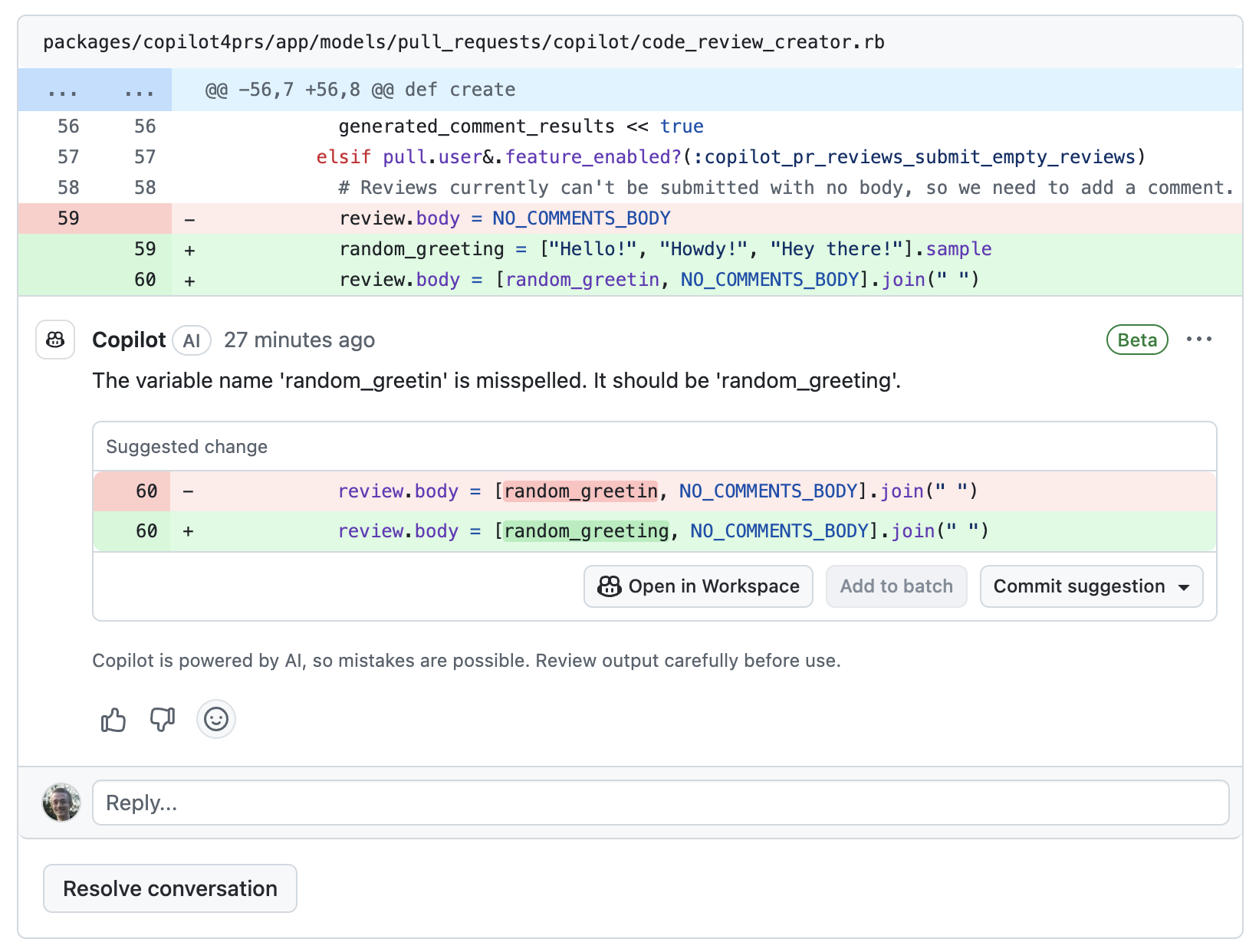
GitHub Docs still describe a simple product flow. A developer creates or opens a pull request on GitHub.com, opens the Reviewers menu, and selects Copilot. The docs say Copilot usually generates a review in less than 30 seconds. Copilot can leave inline comments like a human reviewer, but its review state is Comment, not Approve or Request changes. It does not satisfy required approvals and it does not directly block a merge.
The operational details are further down the documentation. Copilot code review can read custom instructions. Repository-wide instructions live in .github/copilot-instructions.md, while path-specific instructions live under .github/instructions/**/*.instructions.md. GitHub Docs say Copilot code review reads only the first 4,000 characters of an instruction file. That limit is called out separately from Copilot Chat and the Copilot cloud agent.
The 4,000-character instruction limit looks like a product detail, but it connects review quality with cost discipline. A team may put security checklists, language-specific rules, and internal conventions into custom instructions so Copilot can leave more relevant comments. After June 1, running the review itself consumes AI Credits and, in private repositories, Actions minutes. "Run reviews more often" and "give the reviewer more policy context" are now budget decisions as well as quality decisions.
Automatic reviews are the first setting platform teams should audit. GitHub Docs allow Copilot code review to be requested manually per pull request or configured to review every pull request automatically. Automatic review can raise the baseline in small teams, but in a private repository with frequent PRs, every review trigger becomes an Actions-minute event after June 1.
Non-licensed users are another cost variable. GitHub Docs say an enterprise administrator or organization owner can allow members without a Copilot license to use Copilot code review. GitHub's changelog also says reviews triggered by non-licensed users can be charged through direct organization billing. A cost estimate based only on paid Copilot seats can miss review requests from PR authors, reviewers, automation accounts, and users whose Copilot access is governed by organization policy rather than personal subscription state.
GitHub's reason for the billing change is straightforward. Copilot is no longer only an editor-completion product. In its usage-based billing post, GitHub described Copilot as an agentic platform that can run long, multi-step coding sessions, use current models, and work across full repositories. The older PRU model was a poor fit when a short chat response and a multi-hour autonomous coding session could sit inside the same unit.
That explanation maps especially well to code review. A review is not just token generation over a diff. The product surface includes the pull-request diff, repository context, custom instructions, comments, suggested changes, and feedback controls. If the agentic architecture runs on GitHub-hosted runners, attaching Actions minutes is internally consistent from a billing standpoint. For development teams, the practical point is simpler: the AI reviewer now draws from a pool that may already be funding CI.
Teams using self-hosted runners or larger GitHub-hosted runners need a separate calculation. GitHub's changelog says Copilot code review supports self-hosted runners and GitHub-hosted larger runners, and that those runner types may be billed at rates different from standard GitHub-hosted runners. Organizations that already use self-hosted runners for security isolation or compliance should check which runner labels Copilot review uses, whether those runners can reach the required Copilot endpoints, and how the cost is reported.
GitHub also announced Copilot coding-agent network configuration changes in February 2026. Copilot Business, Enterprise, Pro, and Pro+ use different hosts such as api.business.githubcopilot.com, api.enterprise.githubcopilot.com, and api.individual.githubcopilot.com. That notice focused on the Copilot coding agent rather than code review, but it points to the same governance surface: agentic coding features now vary by plan, network policy, runner policy, and billing configuration.
Community reaction centered on predictability. In GitHub Community discussion #192948, the FAQ answered a question about whether Actions minutes consume AI Credits by saying the monthly bill includes both token usage and Actions-minute consumption. Reddit posts in r/GithubCopilot on June 1 described users hitting credit limits, losing confidence in the predictability of a monthly subscription, and reading the code-review change as "double billing" because Credits and Actions minutes are both involved.
Reddit anecdotes should not be treated as official cost evidence. A single user hitting a limit can depend on model choice, plan type, annual subscription state, editor behavior, chat-session length, and organization policy. The verified fact is narrower: GitHub now calculates Copilot usage through AI Credits and attaches Actions minutes to Copilot code-review runs in private repositories. The actual bill depends on PR volume, automatic-review rate, runner type, remaining included minutes, and budget caps.
Competing products will face similar accounting questions, but through different packaging. CodeRabbit, Qodo, Graphite Reviewer, and other PR-review SaaS products usually mix seats, repositories, PR volume, or usage tiers. Cursor Bugbot and IDE-centered review features tie review behavior to editor subscriptions and model usage in different ways. GitHub's choice is distinctive because Copilot code review sits inside the same platform that hosts the repository, CI runner, organization policy, and billing dashboard. That convenience also makes the cost overlap harder to ignore.
Development leaders have four checks to run now. First, confirm whether Copilot automatic review is enabled on private repositories. Second, inspect whether organization members without Copilot licenses can request reviews. Third, compare GitHub Actions budgets and spending limits against AI-review traffic, not only ordinary CI jobs. Fourth, review custom instructions for scope and length so the reviewer receives useful policy context without turning every pull request into a broad repository-reading exercise.
Engineers also need to understand what authority Copilot review has. The review is a Comment review, so it does not replace required human approval. GitHub Docs explain that humans can react to, reply to, resolve, or hide Copilot comments, but Copilot does not automatically respond to those replies. Suggested changes can be applied through the pull-request interface, and with additional configuration, a suggestion can be handed to the Copilot cloud agent for implementation. At that point, code review begins to connect with a broader agent task.
That connection makes cost management and security management hard to separate. A single review comment may be cheap. But if a suggestion is handed to Copilot cloud agent, the agent creates a branch, runs tests, and opens a draft PR, then GitHub Actions usage and Copilot usage can cascade. Organizations should treat the path from "request review" to "agent implements a fix" as one cost center, not as unrelated UI clicks.
GitHub Agentic Workflows' June 1, 2026 weekly update used a similar operational framing. The project advised teams to inspect API consumption per workflow and look for runaway API usage early. On the same day GitHub's Copilot billing transition began, that advice captured the new management unit for agentic work: not only whether the workflow succeeded, but which workflow consumed tokens, API calls, and runner minutes.
The billing change does not argue against AI code review. It shows that GitHub is treating code review as an agent workload that needs repository context, tool calls, and runner execution. The most important shift is not that a cost exists. It is where the cost appears. AI review now lives not only inside a Copilot subscription, but also in Actions entitlements and organization billing dashboards.
Private repositories make the issue more visible for enterprise teams. Internal services, customer projects, compliance-sensitive repositories, and monorepos are usually private. Turning on Copilot code review as an organization default can have a very different result from enabling it on an open-source project. Teams with many small PRs, dependency-update bots, large generated diffs, or frequent branch automation need review-trigger rules that match their workflow.
A pragmatic rollout is measurement before default automation. For two weeks, allow only manual Copilot review requests and separate Copilot code-review minutes in GitHub billing reports and Actions metrics. Then apply stricter rules to security-sensitive repositories, large monorepos, and repositories with heavy generated diffs. If automatic review is later enabled, attach a budget cap at the same time so CI minutes are not unexpectedly consumed by AI-review traffic.
Calling this only a Copilot price increase misses the mechanics. GitHub says base plan prices remain in place, and it is providing included AI Credits plus promotional included usage during the transition. But private PR review now consumes Actions minutes as a separate resource. The event is better understood as AI coding assistance moving into CI/CD budgets, runner policy, organization billing, and repository governance.
After June 1, a team enabling Copilot code review has to decide two things in the same meeting: whether the review quality is good enough, and how often the review should run. One PR review may finish in less than 30 seconds, but hundreds of private PRs per day plus automatic review settings can accumulate quickly. The team needs a dashboard that shows the rate at which AI Credits and Actions minutes are being spent.
GitHub's message is clear. Copilot has become an agentic platform, and agentic usage requires more inference and compute. Development teams need to respond at the same operational level. Copilot code review should not be treated only as an IDE convenience. It is production automation that uses a model and a runner. The June 1 billing transition is one of the first places where that boundary shows up directly on the bill.