AgentCore A/B testing turns prompt edits into release experiments
AWS AgentCore Optimization preview productizes agent quality loops with trace-based recommendations, batch evals, and A/B testing.
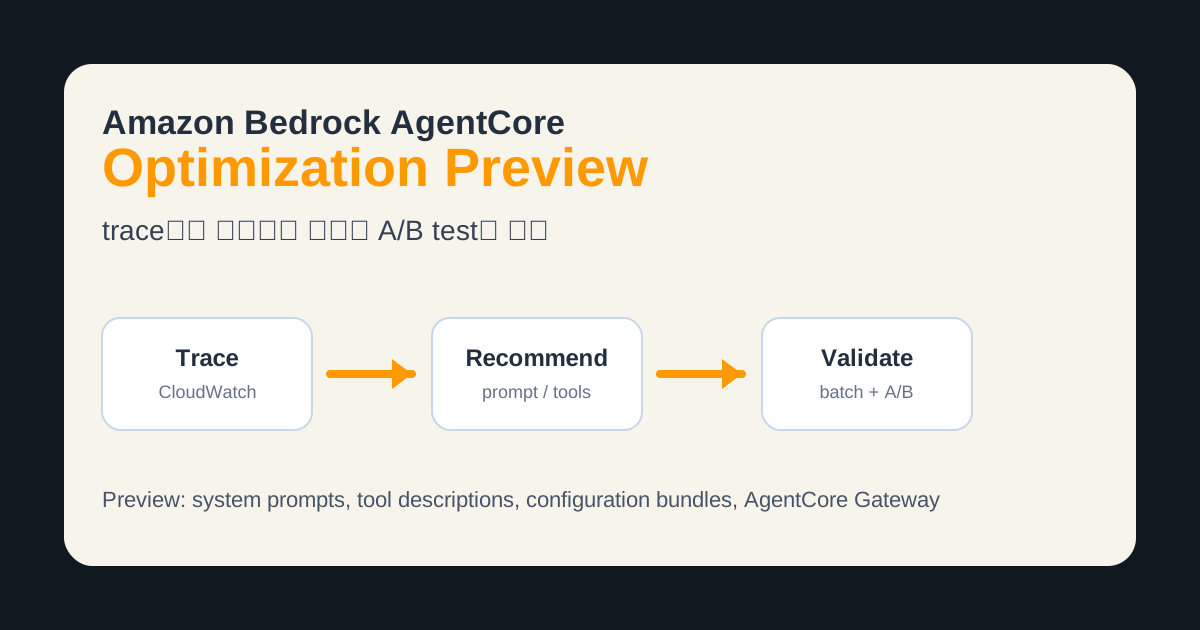
- What happened: AWS introduced the
Amazon Bedrock AgentCore Optimizationpreview.- It uses production traces and evaluation outputs to suggest system prompt or tool-description changes, then validates candidates with batch evals and AgentCore Gateway A/B tests.
- Why it matters: Prompt edits are becoming versioned configuration and release experiments, not just text changes in a repo or console.
- Watch: The preview documentation says Optimization API calls do not yet appear in
CloudTrail.- Production teams with audit requirements need a separate approval and change-log path before treating this as a governed deployment surface.
AWS introduced Amazon Bedrock AgentCore Optimization in preview on the AWS AI Blog on May 4, 2026. The announcement was not about a new frontier model. It was about how production teams repair agent behavior after deployment. AWS described a loop that reads production traces and evaluation output, generates candidate improvements for system prompts or tool descriptions, checks them with batch evaluation, and then uses AgentCore Gateway to run A/B tests on live traffic. AWS had already summarized the feature in an April 30, 2026 What's New post as a preview launch.
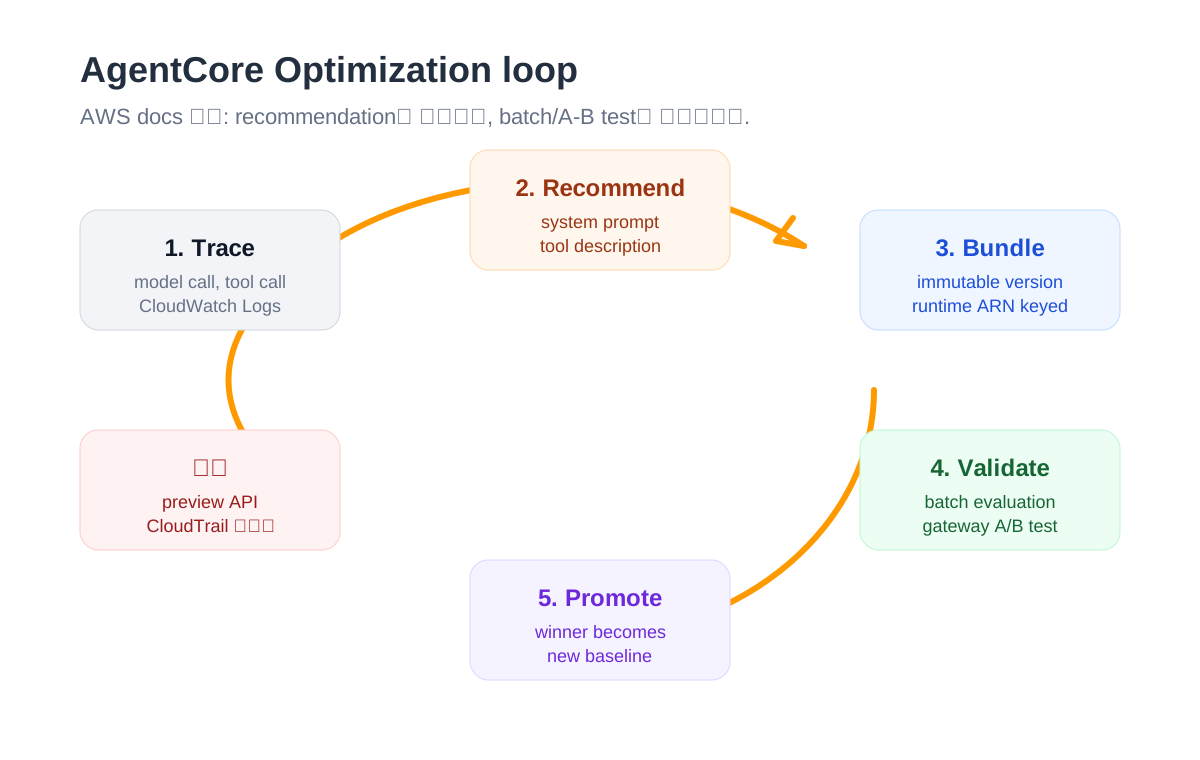
The direct developer impact is that prompt tuning moves closer to release management. In many teams, an agent failure still leads to a manual loop: open the trace, edit the system prompt, run a few sample conversations, and ship the new text. The AWS blog describes that mode as turning the developer into the performance engine. AgentCore Optimization separates the same work into recommendations, configuration bundles, evaluation datasets, and Gateway experiments. The prompt becomes one part of a versioned configuration candidate.
The first component is Recommendations. Developers point AgentCore at agent traces stored in CloudWatch Logs and select a target evaluator. AgentCore analyzes failure patterns and proposes improvements to the system prompt or tool descriptions based on the selected reward signal. The documentation is careful about the boundary: recommendations are generated by an LLM and should be reviewed and tested before use. AWS is not selling a fully automatic repair loop. It is creating candidates that a team can inspect, evaluate, and promote.
Tool-description recommendations target a common production-agent failure mode. Agents often pick the wrong tool when several tools look similar, or when a user request spans multiple domains. AWS's Market Trends Agent example is an investment broker agent that handles risk profile, sector interest, and conversation style. If that agent fails personalization or chooses the wrong tool for a sector query, Optimization can use traces and evaluator output to propose clearer tool descriptions.
The second component is the configuration bundle. AWS describes a bundle as a versioned, immutable snapshot of the model ID, system prompt, and tool descriptions tied to a runtime ARN. If an experiment changes only prompt text or tool descriptions, teams can compare bundle versions without deploying new code. If an experiment changes the framework, the tool implementation, or the agent code itself, AWS says teams should compare separate runtime endpoints. That distinction matters because prompt-only changes and code changes have different rollback and root-cause paths.
The third component is batch evaluation. AWS recommends comparing a candidate configuration with the baseline on a curated dataset before sending production traffic to it. That dataset can include known failure cases, compliance requirements, frequently used workflows, and user requests pulled from earlier incidents. For a coding-agent team, the comparable fixture might be "same issue, same repository, same tests, same expected behavior." Batch evaluation is the regression gate before an online experiment.
The fourth component is A/B testing. AgentCore Gateway splits live traffic between a control and a treatment, and online evaluation scores each session. The documentation says A/B test results include confidence intervals and p-values. There are two variant patterns. For configuration-only changes, teams can run different bundle versions against the same runtime. For code changes, framework upgrades, or completely different agent implementations, teams compare separate Gateway targets. The shape looks familiar to web-product teams, but the measured score is not a click or conversion event. It is evaluator output applied to agent sessions.
| Change type | AgentCore path | Validation focus |
|---|---|---|
| System prompt edit | Compare configuration bundle versions | Instruction following, goal success, safety evaluator |
| Tool-description edit | Recommendations refine descriptions and package them into a bundle | Tool-selection accuracy and ambiguous-request handling |
| Framework or code change | Compare separate runtime endpoints as Gateway targets | Latency, cost, failure mode, and regression against existing fixtures |
| Model ID change | Experiment through bundle or target variants | Quality score versus inference cost and latency |
AWS repeatedly frames the feature as an improvement loop. Traces feed evaluation, evaluation reveals quality drops, recommendations create change candidates, and batch eval plus A/B testing determines which candidates are promoted. If the loop works, the team discussion changes from "this prompt feels better" to "which evaluator improved, which fixture regressed, and what confidence interval did the live test report?"
The preview needs to be read narrowly. AWS documentation says Optimization is in public preview and that APIs can change before general availability. There is no separate charge for Optimization itself, but the underlying AgentCore capabilities still incur costs. The more operationally important limitation is CloudTrail. The documentation warns that Optimization preview API calls do not yet appear in CloudTrail event history or configured trails, and says support is planned. It explicitly tells customers not to use the feature for workloads where a CloudTrail audit trail is required.
That CloudTrail note is not a minor footnote for enterprise agents. Prompts and tool descriptions can look lighter than code, but they control behavior. A refund agent's prompt can decide when to call the refund tool. A data assistant's tool description can influence when a database-query tool is selected. A regulated customer-support agent may include disclaimers, escalation rules, or data-use constraints in prompt text. If those changes are generated through a preview API and promoted through bundles, the approval record and audit log still need to exist somewhere.
Recommendations also need skepticism. AWS asks for review and testing because LLM-generated configuration can create new failures while fixing old ones. A system prompt line that improves helpfulness may weaken a safety evaluator. A more detailed tool description may improve routing but increase token cost and latency. AWS notes future work around multiple-evaluator trade-offs, which is a sign that the product design already sees this tension. Agent quality is rarely a single scalar score.
AgentCore Optimization overlaps with existing LLMOps and observability tools. LangSmith, Braintrust, Langfuse, Honeycomb, and Datadog already cover traces, evaluation, and production monitoring in different ways. Promptfoo and OpenAI Evals give teams ways to put prompt and agent-behavior tests into CI. AWS's differentiator is packaging the loop inside AgentCore Runtime, Gateway, CloudWatch, evaluations, and configuration bundles. For teams already operating agents in AWS accounts, that integration is the product advantage. For teams spanning several clouds, frameworks, and observability vendors, the vendor boundary becomes part of the architecture review.
The public community reaction has been quiet so far. Reddit's AWS community has posts around AgentCore eval integration and Bedrock prompt caching, including a DeepEval maintainer sharing an AgentCore integration. The launch has not behaved like a model release or a new IDE announcement that dominates Hacker News for a day. That quiet reaction fits the feature. AgentCore Optimization is not a demo where an agent builds an app on camera. It is an operations tool for teams asking who reads traces, who approves a candidate fix, and how a live change is measured.
For builders, the release points to the next operational question in agent products. The 2025 and early-2026 agent race focused on whether agents could read code, browse sites, call tools, and complete delegated tasks. Production teams now need to know what detects drift, what proposes a fix, how the fix is validated, and how it is rolled back. AgentCore Optimization is AWS's control-plane answer to that question.
There are concrete checks teams can run before adopting the preview. First, verify that agent traces are captured in CloudWatch and shaped consistently enough for evaluation. Second, check whether evaluators represent the business risks that actually matter, not just generic answer quality. Third, put prompt and tool-description changes through the same approval path as code that changes agent behavior. Fourth, because CloudTrail support is missing in the preview, create an external change log if audit requirements apply.
The success of the feature will depend less on clever recommendations than on good failure data. AgentCore can read traces, but weak traces produce weak candidates. Batch evaluation can provide confidence, but only if the dataset still represents real user distribution. An online evaluator can score live sessions, but p-values do not replace incident handling or user-safety review when the evaluator misses harm. AWS provides the loop; teams still own the data, rubrics, promotion policy, and rollback criteria inside it.
The direction is still notable. Once an agent handles production work, a prompt is no longer only a document. A tool description is not only explanatory copy; it becomes routing policy. A model ID is not only a quality choice; it is a cost, latency, and compliance variable. AgentCore Optimization gives those pieces a product language: versioned configuration, trace-based recommendations, evaluator-scored experiments, and Gateway traffic splits. Agent operations are moving from "did the latest answer look good?" to "how was the behavior change tested, promoted, and made reversible?"