OpenAI and Codex hit Bedrock GA, bringing GPT-5.5 behind AWS IAM
OpenAI GPT-5.5, GPT-5.4, and Codex are now GA on Amazon Bedrock. The real change is governance, Regions, billing, and missing Codex cloud features.
- What happened: OpenAI and AWS announced GPT-5.5, GPT-5.4, and Codex on Amazon Bedrock general availability on June 1, 2026.
- AWS exposed an OpenAI-compatible
ResponsesAPI endpoint, Bedrock API keys, AWS SDK credential chain support, and in-Region processing.
- AWS exposed an OpenAI-compatible
- Developer impact: Codex CLI, desktop app, and IDE integrations can route model inference through the
amazon-bedrockprovider.- The buying unit shifts from per-seat licensing toward token billing, IAM, quotas, CloudTrail, PrivateLink, and AWS account-level governance.
- Watch: Codex on Bedrock is currently centered on local workflows, not the full OpenAI-hosted cloud feature set.
- OpenAI says image generation, voice transcription, the cloud plugin store, cloud agents, MCP namespace tools, and tool discovery are currently excluded.
OpenAI and AWS announced general availability for OpenAI GPT-5.5, GPT-5.4, and Codex on Amazon Bedrock on June 1, 2026. OpenAI framed the launch as a way for companies to use OpenAI inside the security, governance, procurement, and deployment workflows they already run on AWS. The AWS News Blog led with an OpenAI-compatible Responses API endpoint, Bedrock API keys, AWS credential support, Region behavior, and token-based billing. This is less a model benchmark story than a procurement and operations story.
The sentence developers should start with is OpenAI's "OpenAI frontier models and Codex are generally available on AWS." OpenAI wrote that "millions of AWS customers" can now access OpenAI models and Codex through Bedrock, and described Codex as a software engineering agent used by more than 5 million people each week. AWS, in its same-day post, said more than 4 million developers use Codex weekly. The two figures do not line up exactly, so the safer reading is not the precise weekly user count. The launch message is that OpenAI and AWS now want Codex treated as an enterprise workload, not only as an individual developer tool.
AWS's implementation details are more operational than promotional. It positions GPT-5.5 for the hardest customer workloads and GPT-5.4 as the price-performance option. Both models run through Amazon Bedrock's next-generation inference engine and are called through a Responses API shape. AWS's example endpoint is https://bedrock-mantle.us-east-2.api.aws/openai/v1, and the Python example keeps the OpenAI SDK while changing base_url and the model id to Bedrock values.
from openai import OpenAI

client = OpenAI(
    base_url="https://bedrock-mantle.us-east-2.api.aws/openai/v1",
    api_key="<BEDROCK_API_KEY>",
)

response = client.responses.create(
    model="openai.gpt-5.5",
    input="Design a distributed architecture on AWS in Python.",
    reasoning={"effort": "medium"},
    text={"verbosity": "low"},
)
That code is not asking developers to learn a new SDK first. It shows AWS pulling an OpenAI API surface into Bedrock so existing Python, curl, and OpenAI SDK-based code can be kept close to its current shape. Bedrock takes over the model catalog, IAM, quota, billing, and logging layers, while application code still looks close to OpenAI's Responses API. Similar API shape does not mean identical operations. Incidents, quota questions, Region policy, and billing move toward the AWS account and Bedrock support path instead of only the OpenAI organization.
| Area | Direct OpenAI API | Via Amazon Bedrock |
|---|---|---|
| Authentication | OpenAI API key or ChatGPT account-based setup | Bedrock API key, AWS SDK credential chain, IAM controls |
| API path | OpenAI-hosted Responses API | Bedrock OpenAI-compatible Responses API |
| Operating unit | OpenAI organization, projects, rate limits, billing | AWS account, Region, quota, CloudTrail, Bedrock controls |
| Codex scope | Closer to OpenAI-hosted features and cloud agent workflows | Local CLI, app, and IDE inference first; some cloud features excluded |
The Codex change is clearest in configuration. AWS says Codex CLI, the Codex app, VS Code, JetBrains, and Xcode integrations can send all model inference to Bedrock's Responses API. With a Bedrock API key, developers set AWS_BEARER_TOKEN_BEDROCK in the environment and add the provider and Region to ~/.codex/config.toml.
model = "openai.gpt-5.5"
model_provider = "amazon-bedrock"

[model_providers.amazon-bedrock.aws]
region = "us-east-2"
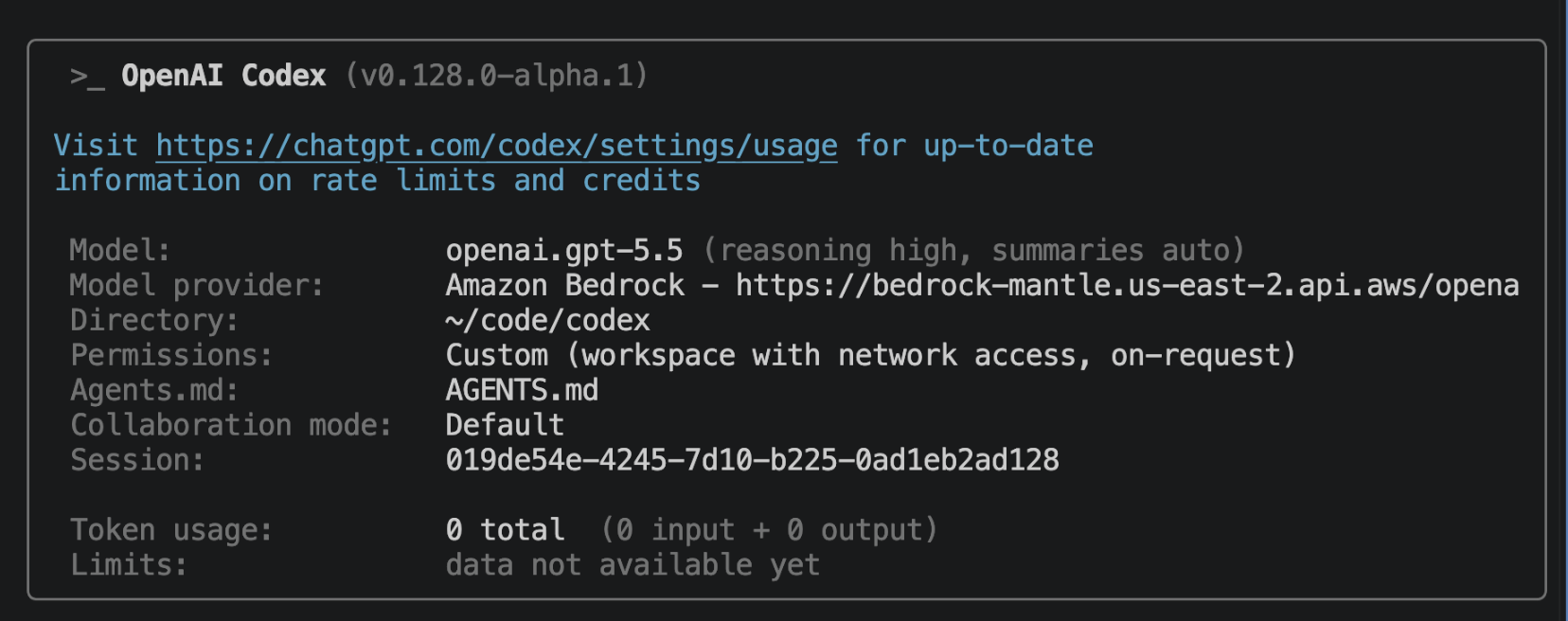
This setting does not turn Codex into an agent hosted inside AWS. OpenAI's Help Center says Codex still runs as a local CLI, desktop app, or IDE extension in the Bedrock configuration, with inference requests forwarded to Amazon Bedrock. It also says the OpenAI-hosted Responses API is not in the request path. File edits, test execution, terminal commands, and repository work still happen through the local Codex harness and the user's environment. The model call and account control layer move toward AWS.
For enterprise development teams, that boundary is the product. Security teams usually ask less about which developer installed which agent and more about which account, Region, log trail, quota, and policy controls carry model requests. Codex through Bedrock gives AWS-shaped answers to those questions. Model access controls, IAM, billing, quota, Region policy, and Bedrock controls can wrap inference. Workflows that depend on OpenAI's cloud plugin store, cloud-managed tool discovery, or Codex cloud agents do not automatically follow.
The exclusion list in OpenAI's Help Center is the most practical part of the announcement. In the Bedrock configuration, image generation, voice transcription, the cloud plugin store, and cloud configuration and policy management are currently unavailable. Codex cloud agents are also missing; OpenAI lists review, security, and web agents as examples. MCP namespace tools and tool search are not currently available either, so teams using MCP and tool discovery need to test feature parity before treating the Bedrock path as a drop-in replacement. "Codex works on Bedrock" and "every OpenAI-hosted Codex cloud feature works on Bedrock" are different claims.
If a team is considering migration, its first test should be a feature inventory by workflow, not a model quality bake-off. Local repository editing, test execution, and refactoring through Codex CLI map cleanly to Bedrock inference. Cloud review agents, security agents, web agents, the cloud plugin store, and managed tool discovery need a separate path. The same Codex brand now covers different authentication models, tool discovery behavior, execution locations, and log ownership.
Region availability matters as much as cost and model quality. AWS said that, as of June 1, GPT-5.5 is available in US East (Ohio), while GPT-5.4 is available in US East (Ohio) and US West (Oregon). For customers with data residency requirements, AWS says processing remains in the selected Bedrock Region. That helps organizations that need to keep processing inside supported US Regions, but it may not be enough for teams with other national or sector-specific requirements. AWS's pointer to the full Region list is not a footnote; it is a deployment constraint.
The latency and capacity language also deserves a careful read. AWS describes GPT-5.5 as fast and GPT-5.4 as medium speed, but real latency depends on reasoning effort, output length, tool calls, background mode, Region, quota, throttling, prompt size, and cache hits. AWS says Bedrock's inference engine queues requests during high demand instead of rejecting them. That can be preferable to a hard 429 for service reliability, but in an interactive coding agent queue time is directly felt as developer wait time.
Billing changes the operating model rather than making cost control disappear. AWS says customers pay by token without seat licenses or per-developer commitments. That is attractive for organizations that dislike seat procurement, but coding agents can produce bursty token usage. Large monorepo exploration, test failure logs, repeated patches, background reasoning, and long tool traces can turn a small task into a large account-level bill. Moving to Bedrock turns cost control into an AWS budget, quota, and observability problem instead of a team seat management problem.
OpenAI also attached Daybreak to the announcement. It described Daybreak as a future path that includes cyber models and Codex Security, with secure code review, threat modeling, patch validation, dependency risk analysis, detection, and remediation guidance moving into the development loop. That part is explicitly future availability. It would be an overread to say Daybreak is included in the June 1 GA scope. The confirmed GA surface is OpenAI models and Codex through Bedrock; security-specific cloud agents remain a forward-looking route.
Comparing the June GA post with AWS's April 28 preview is useful because one term becomes less prominent. In April, AWS grouped OpenAI models, Codex, and OpenAI-powered Managed Agents into a limited preview. It said each agent would have its own identity, log actions, and run inside the Bedrock AgentCore default compute environment. The June 1 AWS News Blog foregrounds GPT-5.5, GPT-5.4, and Codex configuration instead of treating Managed Agents as an equal GA item. For now, articles and internal migration plans should avoid describing Managed Agents as part of this GA unless AWS separately confirms that surface.
Community reaction around the preview was cautious. Hacker News comments focused on whether the announcement was more press release than immediately usable product. Reddit discussions asked whether models appeared in the Bedrock UI, which Regions were live, how quotas behaved, and how latency and cost compared with the direct OpenAI API. That skepticism is predictable. A cloud control layer can reduce contract and governance friction, but it does not automatically guarantee the daily developer experience of speed, feature parity, and predictable cost.
For global AI builders, the notable part is not just "OpenAI is on AWS." Model APIs already travel through cloud marketplaces and gateways. Coding agents are different because they read files, run tests, produce patches, and sometimes maintain longer-running work. Enterprises therefore evaluate not only the model provider but also execution location, permissions, logs, review boundaries, and tool discovery. Bedrock GA means AWS now shares that conversation with OpenAI's product team.
A practical evaluation sequence is straightforward. First, run existing prompts and harnesses against the Bedrock Responses API and compare output behavior with the direct OpenAI path. Second, enable model_provider = "amazon-bedrock" in Codex CLI and run small tasks against the same repository. Third, measure Region-specific latency, queue behavior, quota behavior, and tool-call length. Fourth, list workflows that require the cloud plugin store, MCP tool discovery, or Codex cloud agents. Until those four checks are done, "standardize on Bedrock" is a procurement phrase, not an engineering conclusion.
The launch is too narrow and concrete to reduce to another Microsoft-versus-AWS cloud rivalry story. It does put OpenAI models into the Bedrock catalog, but the more direct change is that enterprise AI coding agent procurement can move under an AWS account. Codex can now operate under IAM, Regions, token billing, and Bedrock quotas instead of only per-team OpenAI setup. The tradeoff is that some OpenAI-hosted cloud functionality is currently absent, and support boundaries split across OpenAI and AWS. Teams planning production use should read that boundary before they read the model names.