GPT-Rosalind hits 63.2% as Codex adds life-science plugins
OpenAI updated GPT-Rosalind with LifeSciBench, MedChemBench, GeneBench, LabWorkBench scores and Codex life-science plugins.
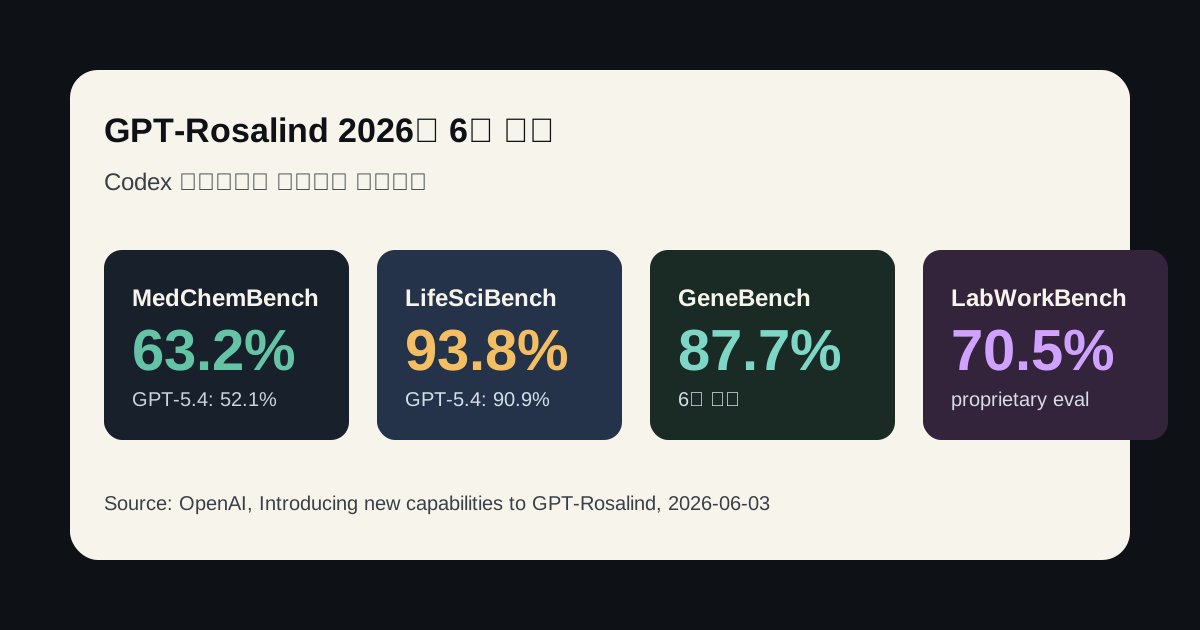
- What happened: OpenAI published a June 3, 2026 update to
GPT-Rosalindwith new benchmark scores and Codex-facing life-science features.- The reported June
MedChemBenchscore is 63.2%, compared with 52.1% for GPT-5.4 in OpenAI's table.
- The reported June
- Developer surface: The practical news is not only the model name; it is
Codexplugins, CSV analysis, and native bio visualizers. - Watch: Several numbers are OpenAI reported scores, and
LabWorkBenchis described as a proprietary dataset.
OpenAI published new GPT-Rosalind capabilities on June 3, 2026. Its May 29 Rosalind Biodefense announcement was about access, trusted developers, and public-health partners. This update moves closer to the workbench: what a researcher can run, inspect, visualize, and package inside Codex.
The company disclosed LifeSciBench, MedChemBench, GeneBench, and LabWorkBench scores, then paired those numbers with two life-science plugins and native bio visualizers in Codex. That pairing is the part developers should read carefully. GPT-Rosalind is not being presented only as a stronger chat model for biology questions. OpenAI is also trying to turn Codex into a domain research workspace where model reasoning, files, plugins, and visual inspection sit in one loop.
GPT-Rosalind first appeared on April 16, 2026 as a life-sciences research preview. OpenAI described it as a specialized reasoning model for qualified customers through ChatGPT, Codex, and the API. The June 3 post adds a more concrete product shape. Benchmark tables and tool tables now live in the same announcement. Literature search, variant exploration, sequence viewers, protein structure viewers, CSV upload, and report writing are all part of the described surface.
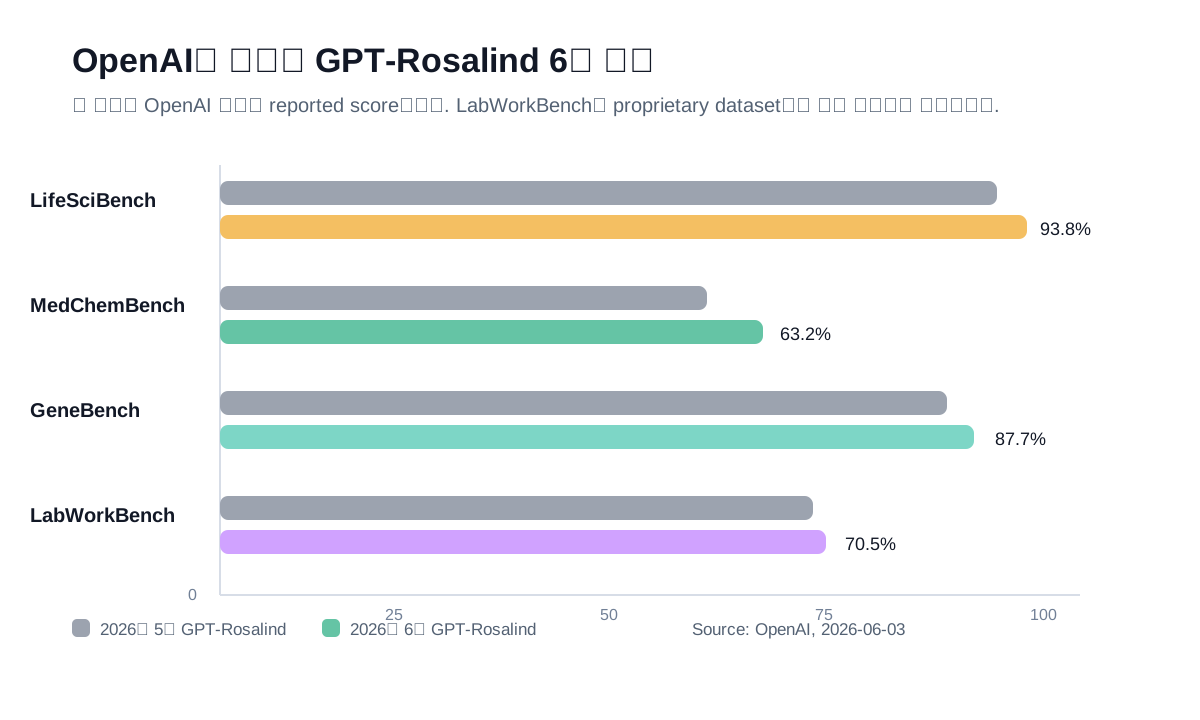
The headline number is MedChemBench. OpenAI's table reports GPT-Rosalind at 56.6% in May 2026 and 63.2% in June 2026. In the same table, GPT-5.4 is listed at 52.1%, and expert medicinal chemists are listed at 53.5%. MedChemBench is described around lead optimization and medicinal chemistry judgment, so the score is closer to drug-discovery decisions than a generic biology quiz.
That makes the number worth noticing, but not worth over-reading. OpenAI is reporting the score in a product announcement. The post does not give outside researchers a full benchmark paper with every item, scoring rule, sampling condition, and repeated-run protocol. The useful interpretation is narrower: OpenAI is signaling that GPT-Rosalind's June build moved in a direction the company thinks matters for medicinal chemistry. Procurement teams and research groups still need internal assay-adjacent evaluations before trusting the model in compound work.
LifeSciBench is less dramatic but starts from a high baseline. OpenAI lists GPT-Rosalind at 90.4% in May and 93.8% in June, while GPT-5.4 is listed at 90.9%. GeneBench moves from 84.5% to 87.7%. LabWorkBench moves from 69.0% to 70.5%. The announcement labels LabWorkBench as a proprietary dataset, and that label should stay attached to every discussion of the result. A proprietary evaluation can guide product development, but it limits independent replication and clean competitor comparison.
For builders, the more durable signal is that the scores are tied to Codex execution. Life-science AI rarely becomes useful by answering one natural-language question well. Researchers move between PubMed papers, gene identifiers, variant databases, protein structures, CSV files, figures, tables, lab notes, and internal reports. A model that lives inside Codex can participate in file handling, tool calls, visualization, and report generation instead of stopping at a paragraph of advice.
The first new plugin is literature search and summarization. OpenAI says it supports literature search, paper summarization, figure and table extraction, and report writing. Those verbs map to real research chores. A scientist is rarely asking only for "a summary of this paper." They need evidence for a pathway or variant, comparisons across experimental conditions, table values copied with provenance, figure captions checked against methods, and report text that can be reviewed by colleagues. Putting those steps into a plugin makes the workflow more explicit than a prompt template.
The second plugin is a genetics and variant explorer. OpenAI describes gene and variant information retrieval, disease association, and database lookup. For life-science developers, databases such as ClinVar, OMIM, HPO, dbSNP, and gnomAD are not interchangeable knowledge sources. They carry accession identifiers, versioning, evidence categories, population frequencies, phenotype mappings, and confidence signals. If GPT-Rosalind is used for variant triage, source attribution and tool routing matter as much as the final natural-language answer.
OpenAI's role-specific plugins repository gives more context for the packaging direction. The public README describes templates for role-specific Codex plugins, including sales, data analytics, product design, and financial markets. Each plugin can bundle .codex-plugin/plugin.json, app bindings, MCP configuration, skills, and assets. The life-science plugins in the GPT-Rosalind announcement are not merely a collection of sample prompts. They fit a broader Codex pattern: installed workflow packages with configuration, tools, and instructions.
That packaging layer may matter more than the model API call. A research organization does not only decide which model name to call. It decides which data sources are allowed, which connector IDs map to approved services, which skills represent approved procedures, which results require human review, and which outputs can leave the workspace. Codex plugins turn those choices into files and settings that can be inspected, versioned, and limited.
Native bio visualizers are another practical clue. OpenAI says Codex can directly display DNA and protein sequences, genes, variants, and protein structures. Biology is hard to audit from prose alone. Sequence alignment, amino-acid position, variant annotation, and structure views give reviewers a faster way to catch an incorrect claim. A model saying "this variant looks important" is weaker than a workflow where the user sees the claimed position, the evidence source, and the relevant structure in the same workspace.
The CSV workflow is even closer to everyday lab work. OpenAI says users can upload a CSV and have GPT-Rosalind perform analysis and visualization. Many research datasets are not clean APIs. They are spreadsheets, lab exports, intermediate result tables, assay readouts, and notebooks converted into CSV. If Codex can ingest those files and produce analysis artifacts, GPT-Rosalind moves from literature assistant toward exploratory analysis assistant.
The risk follows the same path. A CSV column name, missing-value convention, batch effect, assay condition, or unit can be misread. The resulting plot may look plausible while carrying the wrong biological conclusion. This is where the visualizer and plugin architecture need review gates. The right product question is not whether a model can draw a chart, but whether the workflow records the assumptions, source columns, transformations, and human approval points behind that chart.
The four benchmark names should not be collapsed into a single "biology score." LifeSciBench and GeneBench appear closer to knowledge and reasoning over life-science questions. MedChemBench targets medicinal chemistry judgment, which is nearer to drug-discovery decisions. LabWorkBench suggests wet-lab planning and execution reasoning, but OpenAI's proprietary-dataset note limits what outsiders can verify. A team should first map its own work to the relevant evaluation type before treating any number as adoption evidence.
For a variant-triage team, GeneBench and the genetics explorer are the closer signals. For a group automating literature review, the literature search plugin and figure/table extraction quality matter more than MedChemBench. For a medicinal chemistry team, 63.2% is eye-catching, but the real gate is an internal evaluation against assay history, compound series, IP boundaries, and chemist review process. LabWorkBench improvement is not enough public information to hand over experimental planning.
The June 3 update also sits next to Rosalind Biodefense without being the same story. The biodefense announcement focused on trusted developers, the U.S. government, allied public-health partners, and launch support. This update focuses on what a qualified user can do inside Codex. Access still appears restricted. OpenAI is not describing GPT-Rosalind as a broad self-serve public model. It is extending a high-risk-domain model inside qualified access with workflow and tool packaging.
That pattern is different from several other AI-for-science efforts. Google DeepMind Co-Scientist has been framed around hypothesis generation, critique, and ranking. FutureHouse Robin packages biology discovery work into agents. GPT-Rosalind's June update emphasizes Codex plugins, file analysis, bio visualizers, CSV workflows, and benchmark iteration. The race is not only about which model has the strongest reasoning. It is also about which product makes research actions inspectable, reproducible, and reviewable.
Teams evaluating the announcement can start with four checks. First, can they prototype the workflow with public plugin structures and general models even without GPT-Rosalind access? Second, how will literature, gene, variant, and protein-structure sources be attributed in outputs? Third, how will CSV analysis artifacts connect to existing notebooks, ELNs, LIMS, or data warehouses? Fourth, do OpenAI's reported benchmark gains show up on the team's internal evaluation set?
Security and governance need the same specificity. Life-science data can include patient-related information, unpublished research results, pre-patent compound data, and partner-controlled records. Once a model in Codex can read files and call tools, authority boundaries must be concrete. Which CSVs can it read? Which database credentials can it use? Which results can it export? Which logs are retained for compliance review? GPT-Rosalind's reported scores do not remove those operating questions.
The early community response to this specific update has not yet become a large developer debate on Hacker News or GeekNews. Previous GPT-Rosalind and Rosalind Biodefense discussions centered on restricted access, biological misuse, hallucination risk, and the lack of independent evaluation. The June 3 announcement will likely draw the same questions, especially around proprietary LabWorkBench and reported internal scores. Those are not side issues; they are the questions buyers and safety reviewers ask before adoption.
OpenAI's June experiment is more specific than "make a bigger biology model." It puts a specialized model into Codex plugin packages, file analysis, visualizers, and benchmark loops. That combination tries to bring the interface researchers use and the tools AI executes into one workspace. Whether it works depends less on one 63.2% score than on whether teams can reproduce results, inspect sources, and preserve human review where the risk is high.
GPT-Rosalind's update points to the next comparison standard for life-science AI. Model name, benchmark, plugin, visualizer, and access policy are no longer separate surfaces. Research teams will need to ask not only which model is strongest, but which tools it can call, under what permissions, with what evidence trail, and at which points a human signs off. OpenAI's numbers are a starting signal. The real validation starts inside each team's data and governed execution environment.