Codex reaches 5 million weekly users as knowledge work moves into agents
OpenAI says Codex now has more than 5 million weekly users, with knowledge workers using it for reports, contracts, spreadsheets, data analysis, and internal tools.
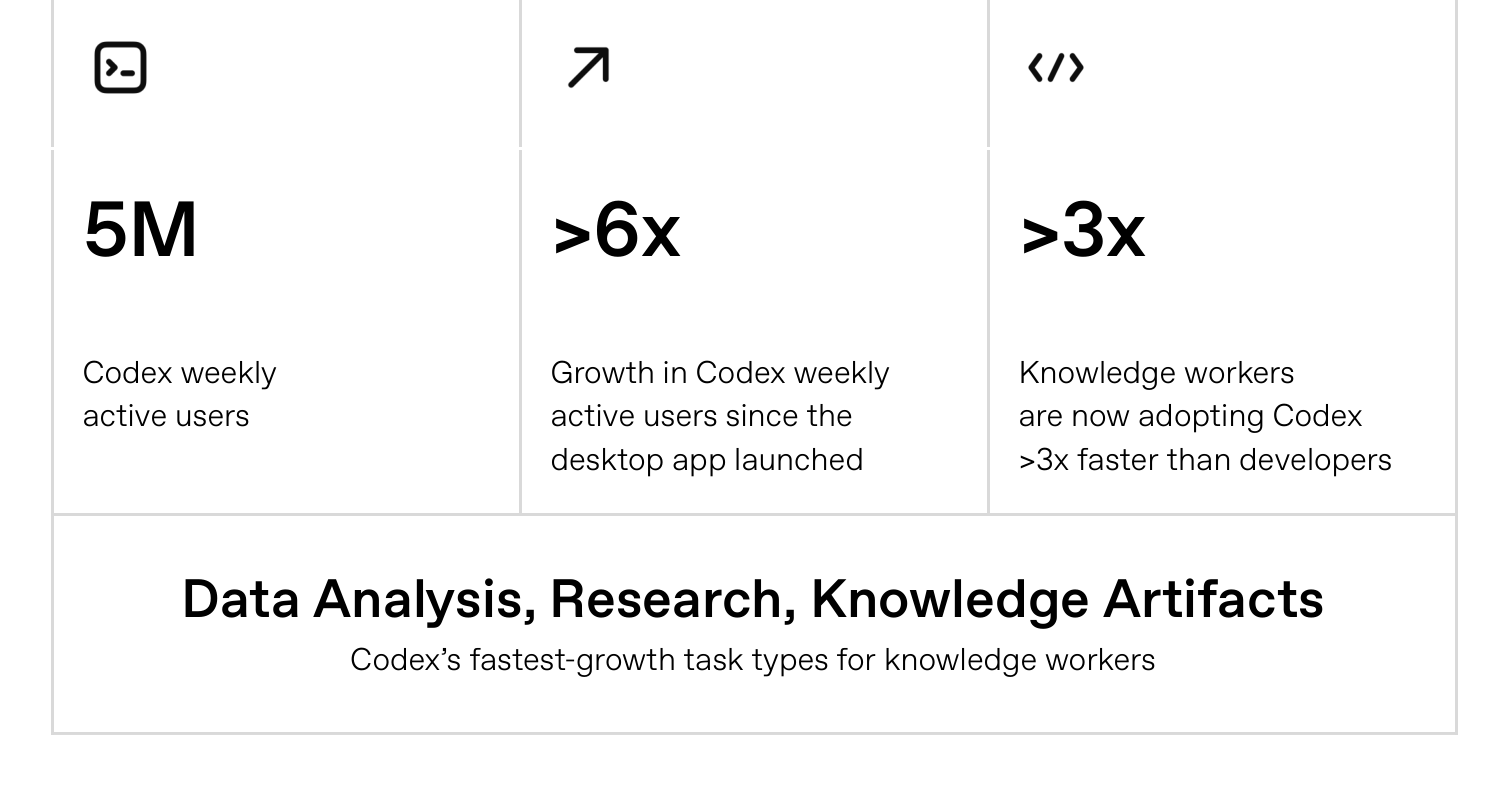
- What happened: OpenAI published a Codex knowledge-work report on June 2, 2026 and said the product now has more than 5 million weekly active users.
- OpenAI says weekly usage has grown more than 6x since the February desktop app launch, while knowledge workers now make up about 20% of Codex users.
- Usage shift: reports, memos, contracts, PDFs, spreadsheets, and other work artifacts are now central examples in OpenAI's Codex story.
- Builder impact: non-developers are using Codex to create dashboards, cleanup scripts, research workflows, and small internal tools.
- The figures are OpenAI's own product data, so they should be read as adoption signals, not externally verified productivity measurements.
OpenAI's June 2, 2026 report, Codex for knowledge work, reads less like a feature launch and more like a usage disclosure. The company says Codex has passed 5 million weekly active users and has grown more than 6x since the desktop app launched in February 2026. It also says knowledge workers now account for roughly 20% of Codex users and are adopting the product more than three times faster than developers.
That framing changes how Codex should be evaluated. OpenAI is no longer presenting it only as a coding assistant that lives beside an IDE. The report highlights reports, spreadsheets, contracts, market research, data analysis, PDF work, and internal business tools. Codex is being positioned as an execution interface for workers who want to automate the task in front of them, even when the task is not primarily software engineering.
The clearest numbers in the report are about task type. OpenAI says 72% of knowledge workers using Codex create text documents, reports, memos, contracts, multimedia artifacts, PDFs, or spreadsheets every week. The same group also uses Codex for engineering operations at 47%, code implementation at 46%, and research at 41%. The boundary is not "developers write code, everyone else writes documents." The more accurate distinction is that workers move between code and documents when the business task requires it.
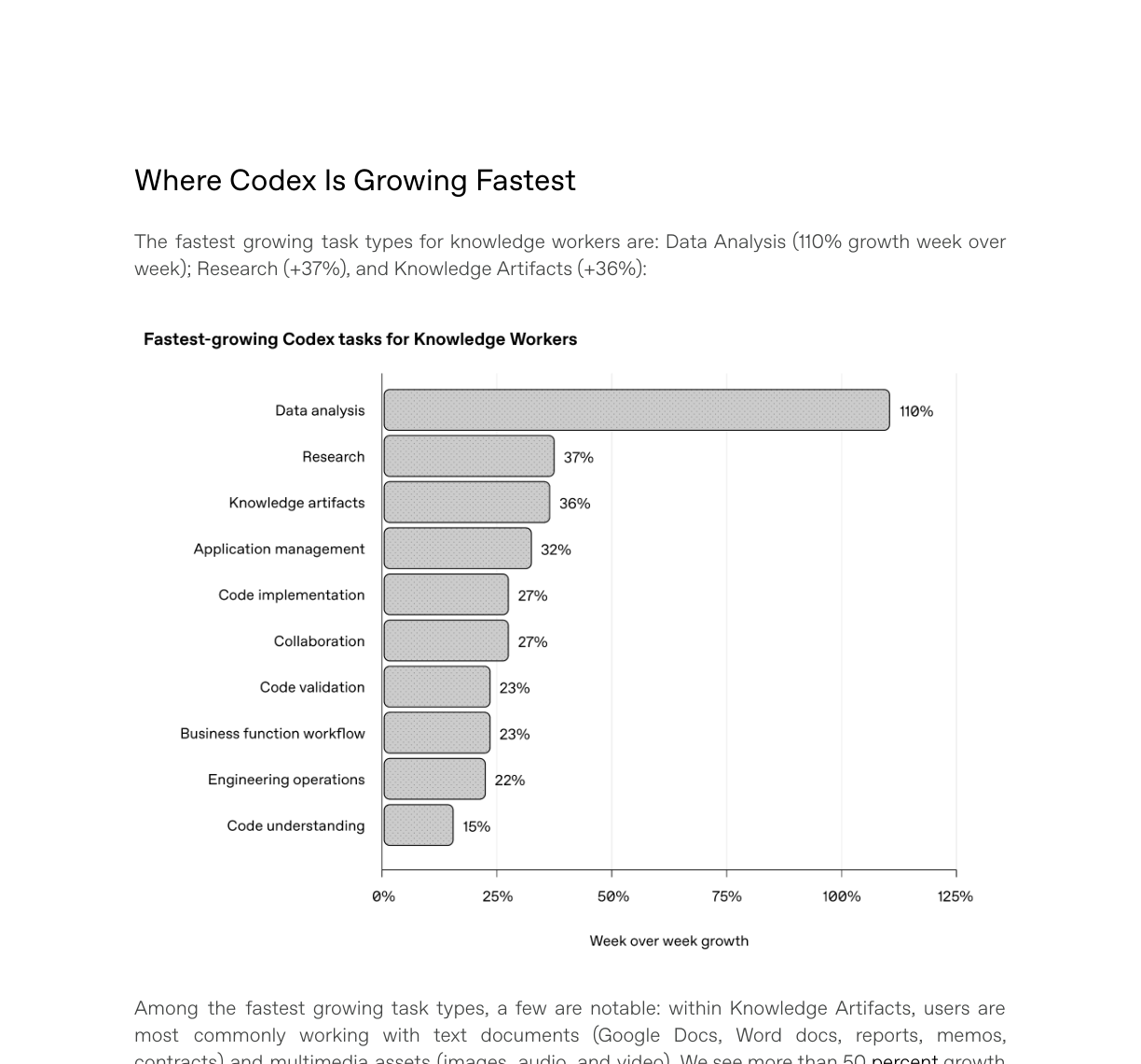
OpenAI's fastest-growing task chart points in the same direction. Among knowledge workers, data analysis grew 110% week over week, research grew 37%, and knowledge artifacts grew 36%. The report says data labeling is a large component inside data analysis, while research includes web search, internal knowledge search, and company, industry, competitor, and market-size investigation. Those are not fringe coding tasks. They are ordinary operational tasks that often sit between an analyst, a product manager, a researcher, and a software team.
For engineering teams, those numbers raise an uncomfortable practical question. If a product manager can build a dashboard, a researcher can write a data-cleaning script, and an executive can compare files to prepare a weekly report, the developer team's role shifts. Some request implementation moves closer to the person with the original problem. The remaining work becomes permission design, data boundaries, review systems, reusable templates, and a platform that makes delegated automation safe.
OpenAI describes that idea in terms of people closest to a task building what they need without waiting for a formal software roadmap. The phrase is useful, but it should be read with operational discipline. A one-off script that cleans a customer file is not the same system as an internal app that runs every week on financial data. Both may start as Codex sessions. Only one may deserve monitoring, an owner, a rollback path, and audit logs.
The customer examples in the report also move away from the language of developer-only tooling. GroundVue uses Codex to make public meeting information from roughly 90,000 government bodies searchable and comparable, according to OpenAI. The work involves scattered videos, websites, local platforms, collection, classification, and ongoing maintenance. In that case, Codex is not just helping someone write an app. It is assisting with a public-information pipeline that has to keep finding and organizing fragmented sources.
Proaction shows the boundary between sales and product work. The five-person startup works with customers that manage vehicle and equipment data. OpenAI says the team uses Codex to create custom proposals, workflow prototypes, and working demos during customer discovery. A proposal stops being only a static document and becomes a small system that reflects the customer's actual operating pattern. Codex reduces the waiting time between a customer conversation, a prototype, and product validation.
The California State University example is smaller and more administrative. OpenAI says Taiyo Inoue, a mathematics professor, used Codex to write scripts that update assignments, schedules, course materials, and announcements in Canvas. He estimated a weekly saving of 4 to 5 hours, which OpenAI says he redirected toward collaborative problem solving in class. The important claim is not that a model replaced math teaching. It is that repetitive learning-management-system work became a target for individual automation.
Luke Xing's example is more personal. OpenAI says he used Codex to build a desktop app that helps run frequency-specific hearing tests and adjust output across devices after significant hearing loss in his left ear. The report is careful to say the app is not a medical device. That caveat belongs in the center of the story. Codex may lower the barrier to software for individual problems, but medical, legal, financial, and regulated workflows still require a separate line between experimentation, validation, and responsible use.
The other important metric is parallel execution. OpenAI says about 50% of users run two or more Codex tasks at least once during a day, up from less than one-third in mid-April. The report describes users asking Codex to inspect a dataset, draft a script, organize a report, and review an app as separate tasks that can run at the same time. This is where Codex begins to look less like autocomplete and more like a lightweight work queue.
Parallel execution changes the bottleneck. In a single-document workflow, one person's time constrains the task. In a multi-agent workflow, the constraint moves to prompt quality, intermediate review, data access, and final approval. Development and security teams then need to record not only who wrote a piece of code, but which data an agent accessed, which artifact it produced, who reviewed it, and whether it passed the organization's approval process.
OpenAI also uses the report to make policy recommendations. It says public-sector organizations should apply agents to administrative backlogs, software-system improvement, records search and reconciliation, scientific research, and service delivery. It suggests measuring success through outcomes citizens understand, such as shorter wait times, fewer forms, faster permitting, better benefit delivery, and lower administrative cost. That section is not just product marketing. It aims at procurement, workforce training, and public-sector modernization budgets.
The same logic appears in OpenAI's comments on AI fluency. The company argues that practical AI training should become a core labor skill, supported through schools, community colleges, public agencies, libraries, employers, subsidies, tax incentives, procurement, and partnerships. If Codex were only a developer tool, that policy section would feel oversized. If Codex is an automation interface for office work, research, education, and public administration, the policy section becomes part of the product expansion strategy.
For developers, the immediate work is concrete. First, teams need rules for authentication, logs, secrets, data export, and permission boundaries when non-developer-built tools connect to organizational systems. Second, teams need to distinguish disposable automation from operational software. Third, engineering groups may become less like a queue that implements every request and more like a provider of approved templates, internal APIs, review loops, and safe execution environments.
The report's numbers should not be overstated. The 5 million weekly active users, 20% knowledge-worker share, 72% artifact creation rate, and 50% parallel-task figure all come from OpenAI's own product data. The report does not publish a comparable table for task quality, failure rate, security incidents, total cost, or how often humans had to rewrite the output. The safer reading is not "Codex has proven office productivity." It is that OpenAI is formally expanding Codex beyond developers and has disclosed early usage patterns for that broader market.
Community reaction was still limited on June 2, 2026. The research note for the Korean article did not find a major Hacker News or GeekNews discussion focused on this report. Early coverage from Axios and Techmeme-linked summaries mostly relayed OpenAI's 5 million weekly-user figure, 6x growth, and 20% knowledge-worker share. Axios search results also showed an editor's note correcting the growth rate to 6x. At this stage, outside validation will have to come from enterprise case studies, cost data, and incident reports, not from the first wave of summaries.
The competitive set is broader than GitHub Copilot alone. Microsoft 365 Copilot targets Word, Excel, PowerPoint, Outlook, and governance surfaces such as Agent 365. GitHub Copilot still owns a large developer workflow position. Anthropic continues to emphasize Claude Code, long-running tasks, and enterprise Claude deployments. OpenAI's move is unusual because it keeps the Codex brand while stretching the user base beyond developers. The name says code. The value being sold is work artifacts plus parallel execution.
OpenAI also places Codex inside a labor-market story. The report says more than 40% of U.S. labor, about 72 million people, works primarily with information analysis, code, documents, design, systems, decision-making, and communication. It compares that shift with agricultural employment around 60% in 1850, manufacturing employment peaking around 26% in 1960, and agricultural employment falling to about 4% by 1970. The point is to frame the next productivity bottleneck as search, coordination, approval, and verification rather than physical equipment.
If this direction succeeds, some software requests will never enter the ticket queue. A department may create a small data transformation tool, an internal dashboard, a contract-review assistant, or a course-management automation directly. If it fails, unverified small automations will spread across the organization without ownership. OpenAI's phrase about giving agency to the person closest to the work can mean fewer tickets for developers. It can also mean more audit, support, and standardization work.
The developer takeaway is therefore not that Codex writes documents. It is that task boundaries are moving. Non-developers are writing small amounts of code, developers are delegating reports and data analysis, and both groups are running multiple agent tasks in parallel. The next bottleneck is less likely to be the model name and more likely to be access control, review granularity, failure logging, cost limits, and ownership of the final artifact. OpenAI's 5 million-user report is a signal that Codex is becoming harder to compare only inside the coding-tool market.