Braintrust moved half its team to Codex as customer requests become preview branches
OpenAI’s Braintrust Codex case study shows a coding-agent operating loop that connects customer requests, tests, sandboxes, preview branches, and evals.
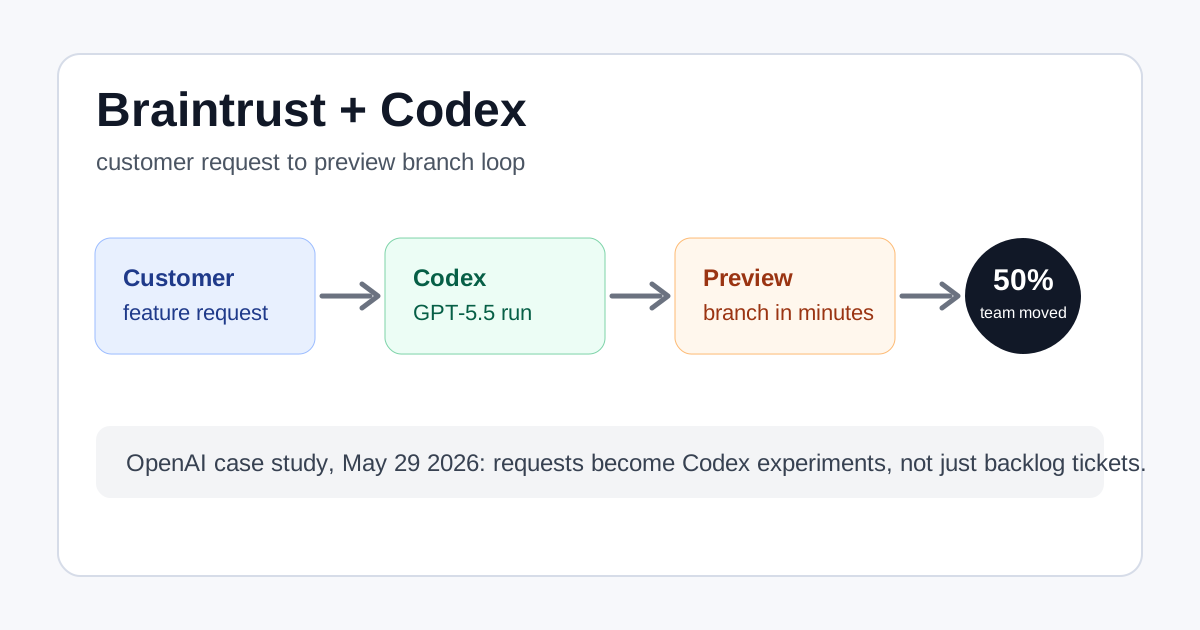
- What happened: OpenAI published a Braintrust case study on May 29, 2026, describing how the team uses
Codex.- The disclosed numbers are specific but narrow: 50% of the Braintrust team moved to Codex within a month, and customer requests can become preview branches in minutes.
- Developer impact: The value of coding agents is shifting from raw code generation toward a loop across customer feedback, tests, sandboxes, previews, and evals.
- Watch: OpenAI did not publish public benchmarks, latency data, token costs, or defect rates, so this is workflow evidence rather than a model leaderboard.
OpenAI published a Braintrust Codex case study on May 29, 2026. At the surface, it is a customer story. For engineering teams, the more useful detail is not a generic claim that Codex is faster. It is the way a customer request moves from backlog material into a preview branch and an experiment. OpenAI says Braintrust engineers use Codex with GPT-5.5 to turn customer feature requests into preview branches within minutes, and that 50% of the Braintrust team moved to Codex within a month.
Braintrust is not a random SaaS example. The company builds tooling for AI evals, observability, prompts, and experiments. That makes this case study different from a simple "AI wrote code for us" story. The team receiving customer requests is also building the measurement layer used to judge AI systems. In OpenAI's article, Braintrust founder Ankur Goyal describes replacing the old pattern of sending requests into a backlog for later prioritization with a workflow where a request goes into Codex, a preview branch is created, and the customer can react while the context is still fresh.
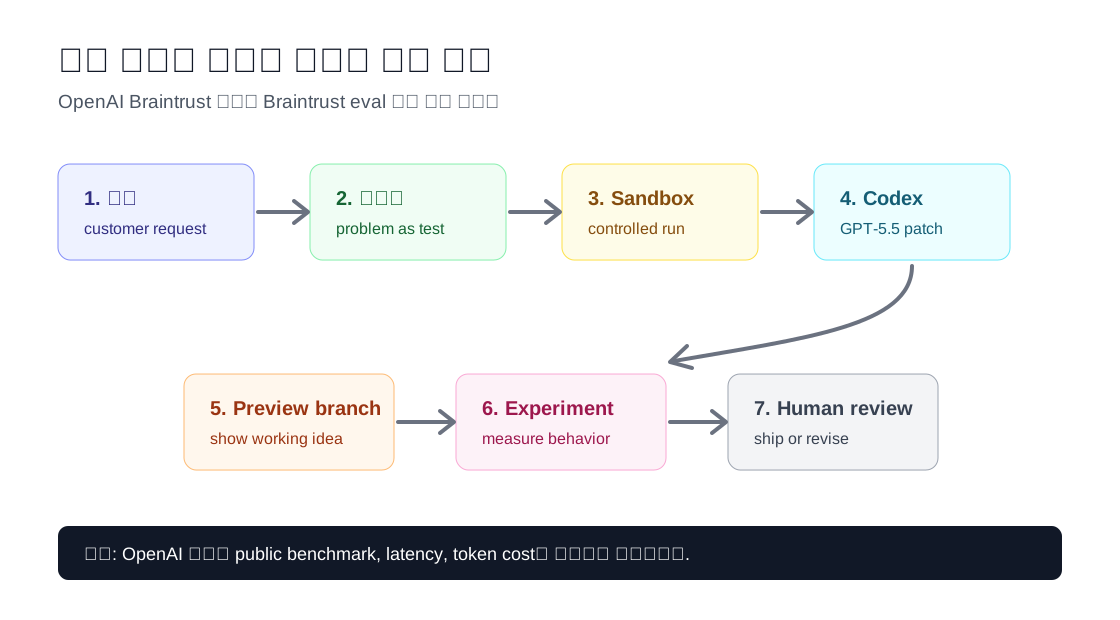
This workflow diagram is reconstructed from OpenAI's Braintrust case study and Braintrust's eval documentation.
Customer requests move from backlog to branch
The most concrete scene in OpenAI's case study is the customer feature request. In the previous flow, a request would enter the backlog and later be prioritized by product and engineering. With Codex in the loop, Braintrust turns that request into working material immediately. OpenAI says the team copies the request into Codex, creates a preview branch, and can show a completed request to the customer within minutes.
That changes where coding agents sit in the organization. This is not the familiar IDE pattern where a developer asks for help with a blocked function. Customer conversation, product judgment, code branch, and preview feedback move closer together. Instead of saying "we will review this later," the team can show a working draft, capture the customer's reaction, and decide whether to refine, discard, or queue it.
The number to keep in view is 50%. OpenAI says half of the Braintrust team moved to Codex within one month. That does not prove a productivity multiple. The article does not disclose commit volume, merged pull requests, defect rate, cycle time, or reverted changes. It does show that Codex moved past a one-person experiment and became part of the team's workflow quickly enough for OpenAI to feature the adoption curve.
Goyal's comments in the OpenAI article repeatedly point to speed. He says Codex can emit more text in the terminal without slowing down, and that this changed how he interacts with models. That is a user-experience claim, not a benchmark. For developers, the more durable point is that latency and streaming stability are not just "feel" variables. They can decide whether a team is willing to put an agent inside a live customer-feedback loop.
Tests give the agent a failure condition
The second axis in the Braintrust story is how the team prompts the agent. Goyal says that with other models, he had to keep adjusting prompts to solve a specific problem. With Codex, he describes writing a test that demonstrates the problem, creating a sandbox environment, and letting Codex run inside that environment. The difference is less about a better prompt and more about a better failure condition.
When a test exists, the agent is judged by execution rather than by plausible prose. If the customer request is "this filter behaves incorrectly," the team can first create a failing test or reproduction case. Codex can then patch the code and rerun the test. This resembles human test-driven development, but the unit of work changes because the agent can spend a longer session reading files, editing code, and running commands.
The sandbox matters for the same reason. Once a coding agent touches a real repository and shell, bad commands and excessive changes become operational costs. OpenAI's Braintrust case says the team builds a sandbox environment for Codex to run in. That environment is not only a safety measure. It is also an experimentation surface where multiple approaches can be tried and compared against tests and product expectations.
Braintrust's own product documents reinforce that context. Its AI agent evaluation material centers on tasks, test cases, UI review, and experiments. Its changelog includes operational surfaces such as self-hosted data planes, secret previews and rotation tracking, and prompt environment assignment. The Codex story fits that product language: the coding agent is useful when its work can be evaluated, observed, and compared.
A preview branch becomes the decision unit
The phrase "preview branch" sounds small, but in a product organization it is a decision unit. A requirements document or Figma mockup can only approximate how users will react. A preview branch can contain actual code, actual UI, and actual test output. The customer can answer a narrower question: does this behavior match the request?
OpenAI says Braintrust iterates and ideates with customers in real time. Read without hype, that means the round trip between customer success and engineering gets shorter. A request no longer has to be interpreted by product, queued for a sprint, deployed to staging, and then sent back to the customer for confirmation. The team can produce a rough implementation in the same conversation or support thread, get feedback, and decide whether the work deserves a cleaner path to merge.
This does not fit every category of work. Payments, permissions, security behavior, and data migrations have side effects that a preview branch cannot fully validate. But UI copy, filter behavior, report layout, prompt templates, eval dashboards, and internal tools are often good candidates. Braintrust's position as an AI eval platform makes the pattern especially natural: many customer requests likely involve observability, experiment views, or workflow details that are easy to inspect in a preview.
The question for other developers is not "can we send every backlog item to Codex?" A better filter is whether a request has a clear failure condition, a small change surface, low rollback cost, and a preview that a customer or internal user can judge. Coding agents are strongest when the task is bounded. They become riskier when they are asked to replace ambiguous product judgment.
The missing metrics matter
OpenAI's Braintrust article is useful as a workflow case study, but it leaves out the numbers that would make it a performance claim. There is no public benchmark, latency measurement, token cost, acceptance rate, defect rate, or reverted-PR count. Even the phrase "within minutes" depends heavily on repository size, task complexity, test setup, and the definition of a completed request.
That is why the case should not be read as proof that Codex is objectively faster than every other coding agent. It is better evidence for a specific operating pattern: when customer feedback, tests, sandboxed agent execution, preview branches, experiments, and review are connected, Codex can occupy a meaningful place in product engineering.
Secondary coverage made the same limitation visible. Silicon Report noted that OpenAI's article does not provide parameter count, training compute, or held-out coding benchmarks. That matters because coding-agent marketing often blends customer anecdotes with model performance claims. "A customer used this well" shows adoption potential. It does not guarantee general model quality.
Reddit discussion around GPT-5.5 in r/codex has also been mixed. Some users reported strong results on complex Python work and problem solving. Others pointed to missed instructions, weaker UI implementation, and usage limits. The Braintrust case does not settle that debate. It adds one production-workflow example with conditions attached: testable problems, sandbox execution, preview branches, and human review.
Braintrust makes the example more persuasive
Braintrust is the reason this story is more interesting than an ordinary customer quote. The company's product surface is built around evals and observability. Teams shipping AI products need to understand how prompt changes, model upgrades, retrieval behavior, and tool calls affect actual quality. Braintrust sells into that problem. When such a team describes Codex less as a faster typing tool and more as a way to run more experiments, the framing is worth paying attention to.
Goyal says Codex lets the team run experiments. That sentence goes beyond feature delivery. It implies that product ideas can be turned into code, tested, shown to customers, measured, and either discarded or improved more often. In AI product engineering, productivity may show up less as lines of code and more as the number of useful experiments a team can run without losing control of review and quality.
That view matches how AI products are built. AI features are less deterministic than traditional UI features. A prompt change or model change can alter behavior even when the interface is unchanged. A branch therefore needs to travel with evals, logs, and review artifacts. In the Braintrust case, Codex becomes meaningful because the distance between code generation and evaluation shrinks.
The competitive map also looks different through that lens. GitHub Copilot's coding agent is strongest when attached to GitHub issues, Actions, pull requests, and code review. Cursor and Claude Code push editor- and terminal-centered agent loops. Braintrust plus Codex emphasizes evals and customer feedback. The category label is the same, but the product strength depends on where the agent is attached.
Teams need three operating controls
The first control is a rule for turning requests into testable problems. Customer feedback usually arrives as "this screen is confusing" or "this result looks wrong." Before handing it to an agent, the team needs expected behavior, a failing case, fixtures, or an acceptance check. That is why OpenAI's case study highlights a test that demonstrates the problem.
The second control is a sandbox and permission boundary. If Codex creates branches and runs commands, the team has to define which repositories, secrets, databases, and external APIs it can access. Braintrust's changelog references secret rotation tracking, which is directly relevant to AI workflows. More agent experiments mean more opportunities for credential exposure and harder audit trails.
The third control is review after the preview branch. A fast preview should not become an automatic ship path. Engineers still need to check whether the customer asked for this behavior, whether the tests cover the risk, whether observability remains intact, and whether regressions are likely. In an AI coding workflow, the bottleneck often moves from branch creation to second-pass verification. Ignoring that shift turns fast branches into fast technical debt.
These controls come before tool choice. Codex, Copilot, Cursor, and Claude Code all need a similar operating frame if they are going to sit inside a customer-request-to-branch loop. The difference is how naturally each product integrates test execution, sandboxing, previews, review, and observability.
A small experiment developers can run now
Teams do not need to copy Braintrust's workflow wholesale. A small team can start with one customer request from the last two weeks. The request should be reproducible, scoped to a small change, and judgeable through a preview by a customer or internal user. The first step is to convert it from an issue into a failing test and an acceptance note.
Then give the agent the task as "make this test pass and produce a preview branch," not as "build this feature." When the run completes, review more than the diff. Look at the test output, screenshots, preview URL, unanswered questions, and assumptions the agent made. Record which files changed, which edge cases were not covered, and what the human reviewer had to fix.
The final step is to feed customer reaction back into the evaluation record. Did the customer say the behavior is now correct? Did they say the implementation missed the request? Did it fail under a condition the team had not captured? A full eval platform is not required to begin. A spreadsheet, issue template, or CI artifact can preserve the run history. The important part is that the knowledge does not disappear when the agent session ends.
Three metrics are enough for the first experiment: time from request to preview, time spent in human review, and whether a follow-up fix or rollback was needed after merge. If Codex is fast but review expands, the bottleneck remains review. If previews are fast but customer requests keep changing, the bottleneck is requirements shaping. Splitting those numbers is the only way to see what the agent actually reduced.
Conclusion
The Braintrust story is not a Codex benchmark. The numbers OpenAI disclosed are 50% team adoption and a workflow where customer requests become preview branches. That is why the article is more valuable as an operating pattern than as a performance table. The loop is specific: convert the customer request into a test, run Codex in a sandbox, show a preview branch, collect customer feedback, and let experiments plus human review decide what happens next.
Coding-agent competition will not be explained by model names alone. Teams will increasingly ask where the agent attaches to the workflow. Does it reduce backlog delay? Does it create preview branches quickly? Does it leave behind tests and evals? Does it preserve review quality? Can the team trace cost, permissions, and failures? Braintrust's Codex workflow is a concrete 2026 example of those questions moving from theory into product engineering practice.