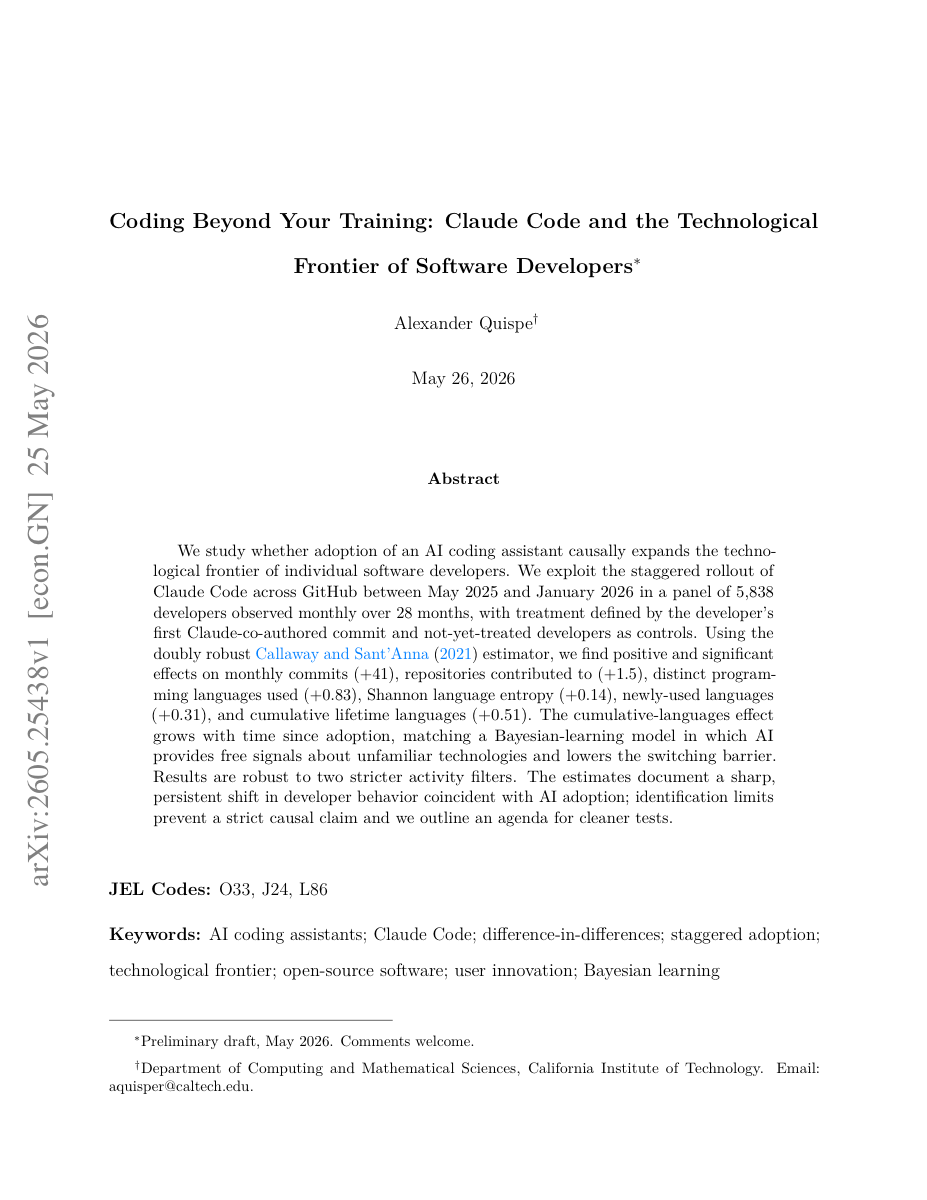
Claude Code study tracks 5,838 developers, +41 monthly commits, and +0.83 languages
An arXiv paper analyzes GitHub activity before and after Claude Code adoption across 5,838 developers, with commit, repository, language, and causality caveats.
- What happened: An arXiv paper analyzes GitHub activity around
Claude Codeadoption for 5,838 developers.- The dataset combines a 28-month developer panel with 7.8 million Claude co-authored commits.
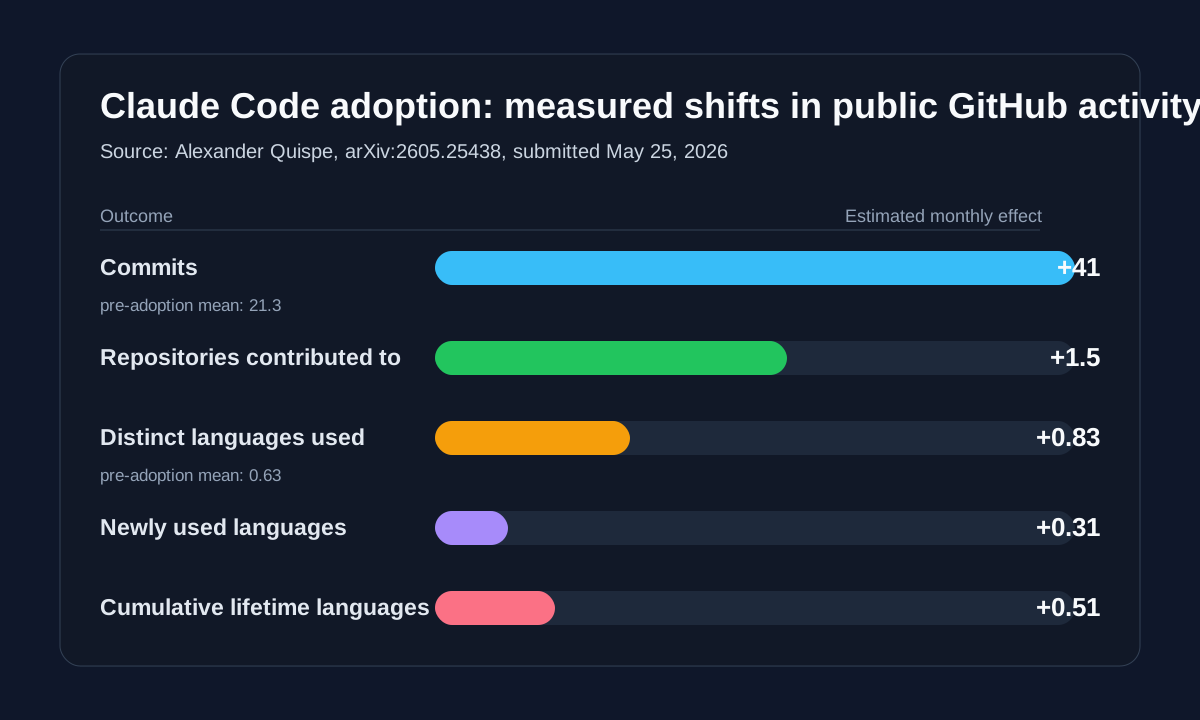
- Key numbers: The paper reports +40.7 monthly commits, +1.5 repositories, and +0.83 programming languages in the adoption month.
- Newly used languages rose by +0.31, while cumulative lifetime languages rose by +0.51.
- Watch: This is not a randomized experiment. Adoption is observed through public GitHub commits and can overlap with a developer starting a new project.
- The author explicitly warns that a developer may install Claude because they are already entering an unfamiliar language.
An arXiv paper submitted on May 25, 2026 moves the Claude Code debate from feature lists to public GitHub behavior. The paper, "Coding Beyond Your Training: Claude Code and the Technological Frontier of Software Developers," is by Alexander Quispe. It follows 5,838 developers over 28 months and treats the first commit marked with Claude as a co-author as the adoption event. The reported adoption-month effects are large: monthly commits increased by 40.7, and the number of programming languages used in that month increased by 0.83.
The paper asks a narrower question than "did Claude Code make developers more productive?" It asks whether developers moved into more repositories and more programming languages after adoption. In practical terms, the study is looking for moments where a Python developer starts touching Rust, or where a data scientist who mostly writes R and SQL contributes to a Swift project. The abstract calls this an individual developer's "technological frontier." A more concrete reading is the range of languages and repositories a developer actually operates in.
The sample is not small. The paper says it combines 7.8 million Claude co-authored commits with public GitHub contribution histories for 5,838 developers. The unit of observation is developer-month activity. The comparison group is not the entire GitHub population. It is developers who had not yet adopted Claude Code but would adopt later. The author uses a doubly robust estimator in the Callaway and Sant'Anna family, a common choice for staggered adoption settings.
The product context matters because Claude Code is not a single-line autocomplete surface. Claude Code's official documentation describes an agentic coding tool that can read a codebase, edit files, run commands, and operate across the terminal, IDEs, desktop apps, browsers, GitHub Actions, Slack, MCP, and scheduled routines. A behavioral shift around this tool is therefore harder to interpret as a simple suggestion-acceptance metric.
The first headline number is commits. The paper estimates that monthly commits rose by 40.7 in the adoption month. The pre-adoption mean was 21.3, so the paper describes the adoption-month effect as a 191% increase. That can easily become a productivity headline, but the author spends more attention on where the activity expanded: repositories, languages, language diversity, newly used languages, and cumulative lifetime languages.
The second group of metrics is about scope. The number of repositories touched rose by 1.5. Distinct programming languages used in the month rose by 0.83. Shannon language entropy increased by 0.14. Entropy matters because it is not just counting languages; it also reflects whether activity is concentrated in one language or spread across several. A month with only JavaScript commits looks different from a month with JavaScript, Python, and Rust distributed more evenly.
New-language metrics make the paper's angle clearer. Newly used languages, meaning languages not previously seen in that developer's observed history, increased by 0.31 after adoption. Cumulative lifetime languages increased by 0.51. The paper also notes that a simple aggregated ATT of 0.59 is larger than the instantaneous ATT of 0.51, and that the event-study profile grows over time. The author connects this to a Bayesian learning model where AI provides a low-cost signal about unfamiliar languages and reduces switching barriers.
| Metric | Paper estimate | What engineering teams should read from it |
|---|---|---|
| Monthly commits | +40.7, with a pre-adoption mean of 21.3 | An output signal, but not a direct measure of quality or review cost |
| Contributed repositories | +1.5 | A sign that one developer touched more codebases |
| Languages used | +0.83 | A proxy for lower entry cost into unfamiliar stacks |
| Newly used languages | +0.31 | Separates new stack entry from more work in an existing stack |
| Cumulative lifetime languages | +0.51, aggregated ATT 0.59 | Shows whether an adoption-month effect accumulates over time |
This differs from early Copilot-style productivity studies because it uses a longer time axis. Many studies ask how quickly a developer finishes a task. This paper stitches together public repository contributions month by month and asks whether the developer's language portfolio changes after adoption. The outcome variables are repository count, language count, language entropy, newly used languages, and cumulative languages, not just task completion time.
The author also applies two stricter sample restrictions. One keeps only developers active in at least 50% of pre-treatment months, leaving 1,620 developers. Another keeps developers with at least six pre-treatment months, leaving 2,672 developers. The paper says the effect sizes remain qualitatively similar under both restrictions, and that five of the six indicators have nearly flat pre-trends.
Still, the paper is not a final causal verdict that Claude Code expanded developer capability. On page 3 of the PDF, the author names the central identification threat: Claude adoption is voluntary, and a developer might install Claude Code precisely because they are about to start an unfamiliar-language project. If a developer decides to build a Rust app and installs Claude because Rust is unfamiliar, the first Claude commit and the first Rust commit can appear in the same month.
That caveat is not a decorative limitation. It determines how teams should use the result. The staggered DiD design handles cohort heterogeneity and avoids some negative-weighting problems from two-way fixed effects designs, but it cannot remove a reverse-causal selection problem by itself. The paper treats the result as a sharp and persistent shift coinciding with Claude adoption. Stronger causal tests would require exogenous shocks, richer covariates, or placebo dates for fake adoption.
For engineering organizations, the first application is not hiring or performance evaluation. Public GitHub commits do not represent private repositories, review quality, security defects, deployment success, or maintenance cost. A developer touching more languages and repositories may indicate broader scope, but it does not prove better software. The paper does not directly measure quality.
A more direct use is onboarding and stack transitions. The +0.31 newly used languages and +0.83 distinct languages results should not become an internal KPI by themselves. They are more useful as a prompt for measuring stack transitions in a team. If a group introduces Rust, Go, Swift, CUDA, or Terraform to engineers who have not used those systems before, an AI coding agent may be less of a speed tool and more of a low-cost signal about the next step. The better metrics would be failed builds, review rejection reasons, new-stack incidents, and documentation fixes, not raw pull request volume.
The second application is review capacity. If Claude Code helps one developer enter more repositories, the review burden can expand with the contribution surface. Developers entering unfamiliar stacks often fail less on syntax than on idioms, ownership boundaries, build systems, dependency policy, and deployment conventions. AI can create the first patch, but the team still needs sharper review checklists and test isolation for unfamiliar-stack pull requests.
The third application is training. The paper's model treats AI as a "free signal channel" for unfamiliar languages. A developer can ask for syntax explanations, error interpretation, example code, and small tests without completing a full course first. For company training, that points toward small migration tasks, agent-assisted spikes, and human review rather than a lecture-only language rollout.
Public community reaction was still limited when the Korean article was written. On June 2, 2026, the Hacker News front page did not show a large discussion of the paper itself, though adjacent AI developer-tool topics were present. GeekNews also showed nearby topics such as Claude Code skills, AI-era technical interviews, and Google SRE AI operations, but not a Korean curation of this paper.
The secondary summary site Commonplace rated the paper's evidence strength as medium. Its limitations are familiar for AI coding research: the sample is biased toward public GitHub developers, the adoption signal is limited to Claude co-authored commits, and enterprise or unmarked AI-assisted work can be missing. Those limits make the result less universal, but they do not make the measurement surface uninteresting.
From a market perspective, this should not be read as an Anthropic-only story. OpenAI Codex, GitHub Copilot, Cursor, Google Antigravity, and related tools are all moving beyond autocomplete. Claude Code's common workflows documentation lists codebase overview, bug fixes, tests, pull requests, and documentation, along with parallel sessions, subagents, and CI batch processing. AI coding tools are becoming project participation systems rather than one-line suggestion engines.
The practical question is therefore not simply whether to adopt Claude Code. Many teams already mix Codex, Copilot, Cursor, and Claude Code in daily work. The harder question is what controls are needed when developer activity expands across more languages and repositories. Wider contribution surfaces also widen permissions, test scope, code ownership, dependency policy, and review demand. Those operating costs often show up later than the model subscription line item.
The paper also does not directly answer whether AI replaces developers. The reported effect is within-worker expansion: one person touching more languages and repositories than before. Whether that becomes healthier cross-stack contribution, diluted specialization, or more maintainer load is outside this dataset. The distinction matters because displacement and frontier expansion imply different organizational risks.
Future studies need more quality-linked indicators. Test pass rates and review rejection rates for Claude co-authored commits would be a start. Post-merge bug rates for first-time-language pull requests would be stronger. Team-level data could show whether specialists and generalists divide work differently after agent adoption. Private repository data would test whether the public GitHub pattern holds under enterprise policies and code review norms.
For now, two numbers are enough to frame the story: in a 5,838-developer panel, Claude adoption coincided with roughly 41 more monthly commits and 0.83 more programming languages used. The same paper explicitly avoids a strict causal claim because adoption was voluntary. The value of AI coding agents is no longer captured by "writes code faster." Teams also need to measure the cost of crossing into new languages, new repositories, and new review boundaries.