Adafruit received a Flux.ai demand letter, and AI PCB tools need verifiable provenance
Adafruit published a Flux.ai demand letter dispute. The real builder question is how AI PCB tools prove provenance, data boundaries, and human review.

- What happened: Adafruit said on June 1, 2026 that it had received a demand letter from Fenwick & West on behalf of Flux.ai.
- Adafruit described the letter as suggesting that AI could be used as cover for IP theft, and the company publicly pushed back.
- Product context: Flux markets a browser-based eCAD platform and an
AI hardware engineerthat can work across schematics, BOMs, layout, and manufacturing outputs. - Why builders should care: AI design tools now need to prove provenance, data boundaries, and verification logs, not just generate plausible boards quickly.
- When an output resembles an open hardware project, missing attribution and missing evidence turn speed into a trust cost.
- Watch: This article does not decide the legal dispute. It reads the public Adafruit post and Flux product materials as a technical case study.
Adafruit said on June 1, 2026 that it had received a demand letter from Fenwick & West, counsel for Flux.ai. In Adafruit's description, Flux.ai argued that Adafruit could be using AI as cover for IP theft. The detailed legal facts still depend on the parties' claims and any later response. For developers, the immediate question is narrower and more practical: when an AI PCB design tool collides with open hardware, what evidence should the tool produce?

The issue does not sit inside an ordinary company dispute because Flux is not just selling a chat interface. The Flux product page describes a browser-based eCAD platform where a user gives Flux a job, and the system plans, explains, and executes work inside an editable design environment. Flux presents the product as help from idea to PCB, covering planning, schematics, BOM generation, layout, and manufacturing outputs. That scope puts the AI system close to real purchase orders, board fabrication, and product liability.
Flux's own product materials make the scope concrete. The page lists browser-based collaboration, projects and templates, manufacturer-oriented workflows, and an AI workflow that checks in with the engineer at key moments. The Korean source article also notes Flux FAQ claims around professional multi-layer PCB support, import formats such as Altium ASCII, Cadence EDIF, KiCad part libraries, Eagle, Upverter, and EasyEDA, plus exports such as Gerber files, drill files, BOMs, pick-and-place files, and netlists. This is not a toy generator. It touches the artifacts that manufacturers and hardware teams actually use.
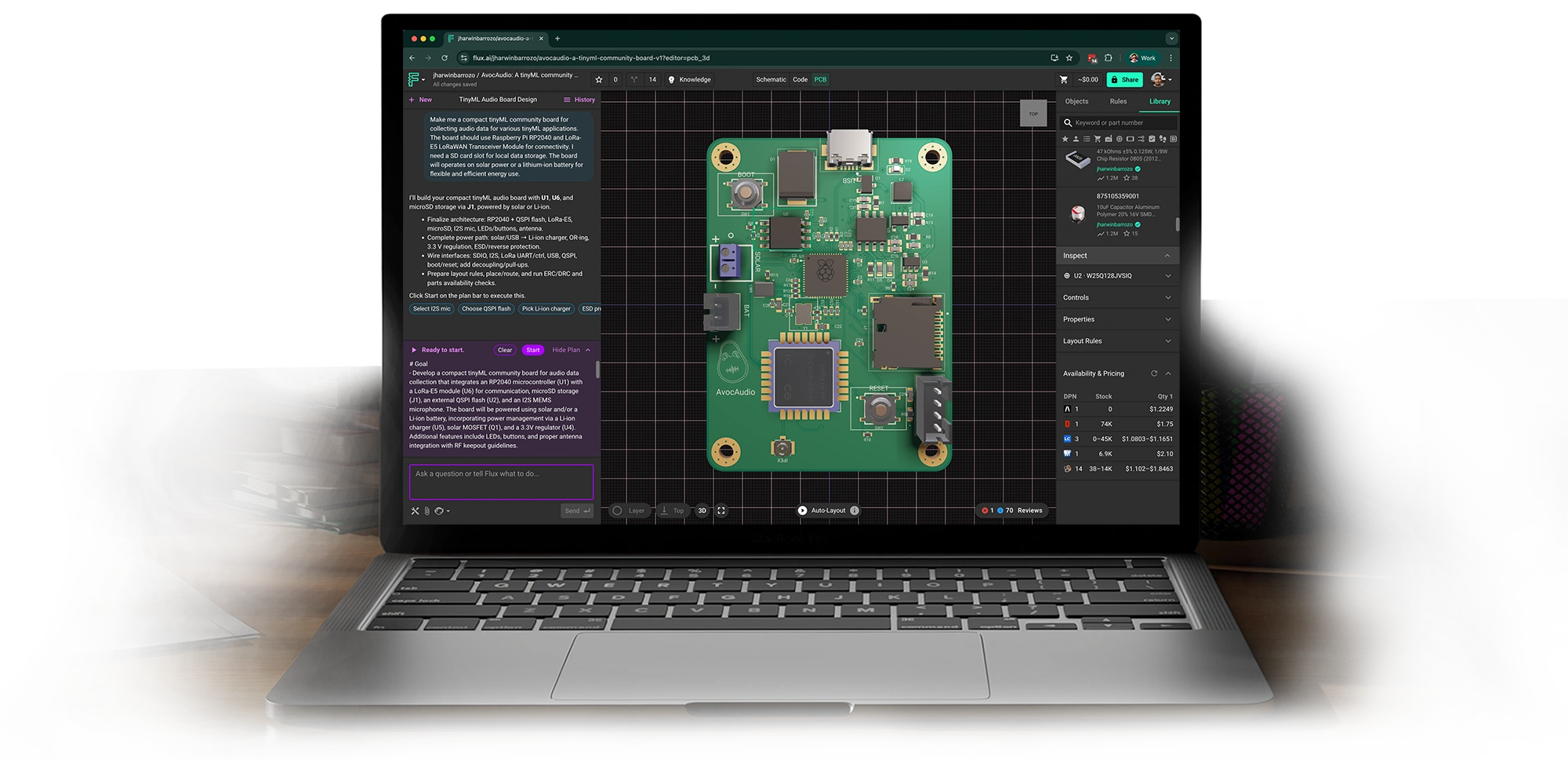
Flux also does not tell users to trust every AI result blindly. Its public materials frame the assistant as an engineering intern or a fast junior engineer, with the human still leading the work and reviewing the output. That safety framing is realistic. It also exposes the central gap behind the Adafruit dispute. If a fast junior engineer produces a board that resembles a public project, the reviewer can ask for notes, references, diffs, source files, and design rationale. If an AI tool produces the same resemblance without a readable trace, the user has much less evidence for separating original design, reference design, AI generation, and coincidence.
Adafruit reacted sharply because open hardware works through public reuse. The company has published boards, tutorials, libraries, schematics, and community material for years. In the maker ecosystem, a public circuit is both an educational artifact and a reference design. A builder can inspect an Adafruit board, design a compatible board, use the same chip vendor's reference circuit, or converge on a similar layout because the constraints are standard. Similarity alone is not enough to prove theft when USB-C protection circuits, ESP32 modules, I2C connectors, battery chargers, and sensor boards often reuse known patterns.
AI eCAD platforms make that familiar reuse harder to audit. A human engineer who references a public design can leave traces in a notebook, commit history, fork, forum post, bill of materials, or attribution line. An AI system can combine part data, public projects, prompt context, built-in libraries, search results, and prior design examples inside the product. The output may be useful, but the source boundary is hidden unless the tool exposes it. A user saying "the AI suggested it" does not answer which project, datasheet, or reference design shaped the suggestion.
| Issue | Scope visible in Flux materials | Verification question after the Adafruit dispute |
|---|---|---|
| AI design | Schematic generation, layout, design review, and BOM research | How does the tool identify and explain public designs that resemble the output? |
| Data boundary | Cloud-native infrastructure, SSO, and project-level permissions | Are private projects separated from public libraries inside AI recommendations? |
| Manufacturing output | Gerber, drill file, BOM, pick-and-place, and netlist export | Do manufacturable files carry attribution, DRC/ERC status, and human sign-off? |
| User responsibility | The assistant is framed like a junior engineer whose work needs review | Does the reviewer receive enough evidence and change history to review responsibly? |
Remove the legal conclusion from that table and a product design problem remains. AI PCB tools should not merely produce faster schematics. They should produce reasons, references, deltas, risk flags, and review artifacts that a human can inspect. If the assistant is presented as a junior engineer, the product needs the equivalent of a reviewable work log: which parts were selected, which datasheets or reference circuits were considered, which design-rule checks passed, and which public projects appear unusually similar.
The pricing model makes this more than a governance debate. Flux's FAQ, as captured in the Korean research note, describes a two-week free trial, paid tiers starting at $20 per month for Starter, $142 per month for Pro, and $158 per month for Teams, and usage based on monthly ACU allowances. When AI design work is sold by plan tier and usage unit, a single generation can create both productivity and liability. In software, a bad suggestion may be caught in code review and reverted. In hardware, a bad board can create fabrication cost, assembly delay, lab debugging, field failure, or recall exposure.
The Hacker News discussion around the Adafruit post was broadly sympathetic to Adafruit, according to the original reporting. Several commenters compared Adafruit's reputation in the maker community with the reputational cost of a legal threat from Flux.ai. Others warned that without the full letter and Flux.ai's later position, readers should not decide the legal merits from one side's description. That caution belongs in the article. Public materials are enough to discuss product trust, but not enough to issue a legal verdict.
The community response still gives AI developer tool companies a useful signal. In open source and open hardware, trust capital often matters before a legal theory is tested. When a company uses public material for learning, search, recommendation, or design automation, the community that produced that material wants to know how it is used. If attribution disappears while outputs become faster, builders may treat the product as extraction even when the tool is technically impressive.
Software code generation has already gone through a version of this argument. Copilot-style tools have repeatedly faced questions about generated code that resembles public repositories, license terms, attribution, and duplication detection. PCB design adds physical constraints. A USB-C protection circuit, an ESP32 reference board, a STEMMA or Qwiic connector pattern, and a Li-ion charging circuit can look similar for standard engineering reasons. That means AI hardware tools need more than similarity detection. They need a way to distinguish standard topology from near-copying of a specific public board.
For builders evaluating AI eCAD, the first practical requirement is provenance. A generated design should preserve the parts libraries, manufacturer reference designs, public projects, datasheets, prompts, constraints, and DRC/ERC results that shaped the output. The record does not need to expose proprietary model internals to be useful. It does need to give a reviewer enough traceability to say why a part was chosen, why a footprint was used, and whether a public design deserves attribution.
The second requirement is data-boundary evidence. Team accounts, SSO, and project-level permissions are necessary, but they do not fully answer the question raised by AI recommendations. A private project can be encrypted at rest and still become a trust problem if its design patterns are allowed to influence suggestions for another customer. Buyers should ask whether private projects are excluded from training, retrieval, similarity search, and recommendation flows, and whether the vendor can prove that separation in logs or policy controls.
The third requirement is an explicit manufacturing sign-off step. If a tool exports Gerbers, drill files, BOMs, and pick-and-place files, the AI output can move directly into fabrication. That path needs a checkpoint for electrical rules, footprints, supply availability, thermal and current margins, regulatory requirements, and attribution or license review. The checkpoint should live inside the workflow instead of a separate spreadsheet that teams forget under deadline pressure.
Flux's public page also mentions security-oriented basics such as cloud-native infrastructure, collaboration, and permissions. Those features matter for enterprise adoption. The Adafruit dispute points at a different control plane: not only whether data is encrypted or access-controlled, but how the AI arrived at a design recommendation. Security controls and generation-provenance controls overlap, but they are not the same question. One protects access to data. The other helps a reviewer understand the origin and risk of an output.
Adafruit also has questions to answer if more of the dispute becomes public. Publishing the demand letter dispute calls on community trust, but readers still cannot see every comparison design, claim, and legal context. If Adafruit can later show the board at issue, its publication history, the relevant vendor reference designs, and any dated commits or tutorials, the discussion can move from sentiment to evidence. The same standard applies to Flux.ai: a credible technical response would need artifacts, not only legal language.
The useful reading is not "AI can design PCBs" versus "AI cannot design PCBs." The useful reading is that AI hardware design tools now need three product capabilities at once. They need to make good boards, explain where the design came from, and leave enough evidence for a human to accept manufacturing responsibility. Adafruit and Flux.ai have pushed the third capability into the foreground.
Hardware teams do not need to ban AI eCAD, and they should not accept it uncritically either. The buying questions should change. Instead of asking only how fast a tool can draw a schematic, ask whether it stores provenance logs, detects similar public designs, proves private-project separation, and forces human sign-off before manufacturing export. An AI PCB tool that cannot answer those questions may look fast in a demo and become slow once product responsibility arrives.