Claude -p automation gets a $20 credit line on June 15
Anthropic is moving Claude Agent SDK and claude -p usage out of subscription limits. Here is what changes for CI, scripts, and third-party agent apps.
- What happened: Anthropic says
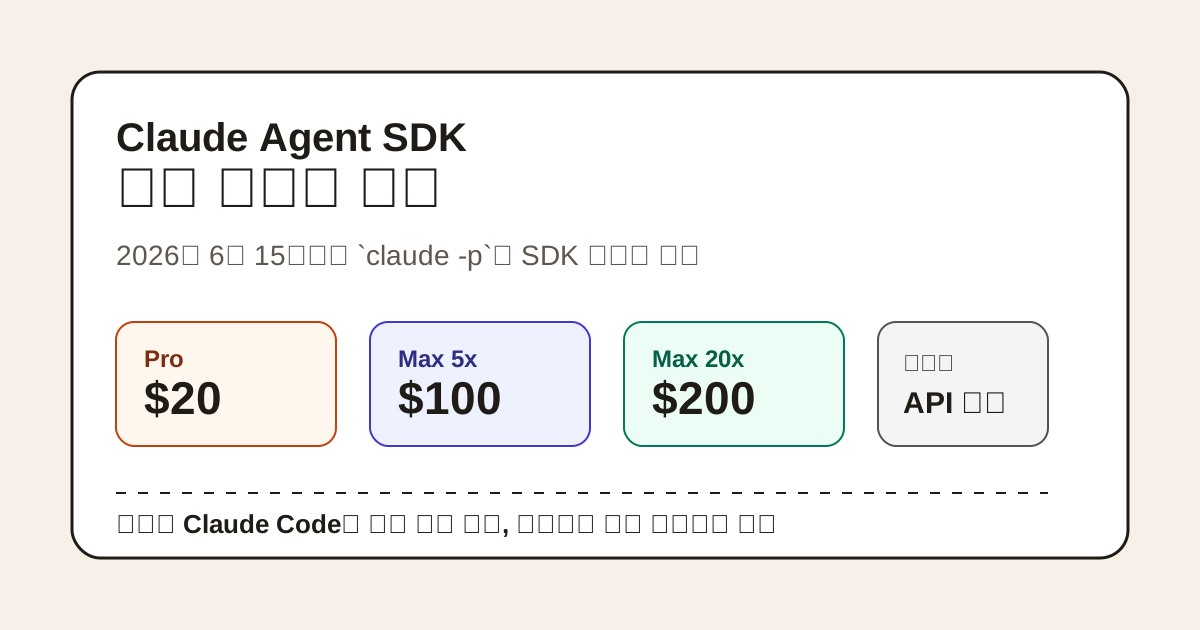
Claude Agent SDKandclaude -pusage will move to separate monthly credits starting June 15, 2026.- Pro gets $20, Max 5x gets $100, and Max 20x gets $200 in monthly Agent SDK credits.
- Interactive Claude Code and Claude app conversations stay under the existing subscription limits.
- Builder impact: CI jobs, GitHub Actions, headless scripts, and third-party Agent SDK apps now need cost tracking.
- Watch: When credits run out, only accounts with usage credits enabled continue at standard API rates.
- Technical boundary: Claude Code docs position
--bareas the recommended scripted/SDK mode and say it will become the default for-p.
Anthropic has redrawn the cost boundary around Claude Code automation. Its Help Center article, Use the Claude Agent SDK with your Claude plan, says that starting June 15, 2026, Claude Agent SDK and claude -p usage will no longer draw from the normal Claude subscription allowance. It will first consume a separate monthly Agent SDK credit pool. Pro users get $20, Max 5x users get $100, and Max 20x users get $200.
That change is less flashy than a model launch or a new IDE feature, but it lands closer to the teams already using coding agents in production workflows. claude -p has been easy to attach to build-log summaries, pull-request diff reviews, nightly code checks, GitHub Actions repair jobs, and internal admin scripts. After June 15, the same call is no longer just "a script running inside my Claude Code subscription." It becomes an automation call with a monthly credit balance and an API-style overage path.
The official scope is fairly precise. Python and TypeScript projects built on the Agent SDK, non-interactive claude -p calls from Claude Code, the Claude Code GitHub Actions integration, and third-party apps that authenticate through a Claude subscription via the Agent SDK are covered by the monthly credits. Interactive Claude Code in a terminal or IDE, conversations in the Claude web, desktop, and mobile apps, and Claude Cowork remain under the existing subscription limits.
| Plan | Monthly Agent SDK credits | Documented condition |
|---|---|---|
| Pro | $20 | Granted per individual user, with no rollover |
| Max 5x | $100 | Continues after credits only when usage credits are enabled |
| Max 20x | $200 | Additional usage moves to standard API rates |
| Team Standard / Premium | $20 / $100 per seat | No team pooling, transfer, or rollover |
| Enterprise | $20 or $200 | Usage-based and seat-based Premium terms differ |
The operational sentence is what happens after the credits are gone. Anthropic says the monthly credits are consumed first, and then additional Agent SDK usage continues only for accounts with usage credits enabled, at standard API rates. If usage credits are disabled, Agent SDK requests stop until the next credit renewal. A developer who runs claude -p a few times a day and a CI system that reviews every pull request, retries test failures, and attempts fixes are both now competing against the same kind of monthly credit balance.
This change extends the debate that surfaced around OpenClaw in April. Hacker News threads discussed Anthropic messages requiring extra usage for third-party harnesses, and some users who had been running subscription-authenticated claude -p or OpenClaw-style tools saw the boundary as moving under them. Other commenters argued that subscriptions were designed for human use in Claude Code and the Claude apps, while machine-driven automation should be priced and managed more like API usage. The Help Center article turns that dispute into a product boundary: interactive use stays in the subscription bucket, programmatic use moves to an Agent SDK credit bucket.
GeekNews summarized the update as a monthly credit structure for programming usage. The quoted developer reactions split in the same direction. One camp sees the credits as a way to describe a tighter limit on automation that previously felt included in the subscription. The other camp sees the boundary between subscription limits, extra usage, API keys, and third-party apps becoming clearer at the documentation level.
Claude Code's programmatic usage documentation adds the more technical half of the story. It describes the Agent SDK as a way to run Claude Code non-interactively from the CLI, Python, or TypeScript, using the -p or --print flag to execute prompts. The examples look familiar to anyone wiring an agent into a script: claude -p "Find and fix the bug in auth.py" --allowedTools "Read,Edit,Bash" gives the call file-reading, editing, and shell-execution permissions.
The same documentation says --bare is the recommended mode for scripted and SDK calls and will become the default for -p. In --bare mode, Claude Code skips hooks, skills, plugins, MCP servers, automatic memory, and automatic CLAUDE.md discovery. The purpose is reproducibility in scripts and CI: the command should not silently inherit a developer's local environment and produce different behavior on another machine.
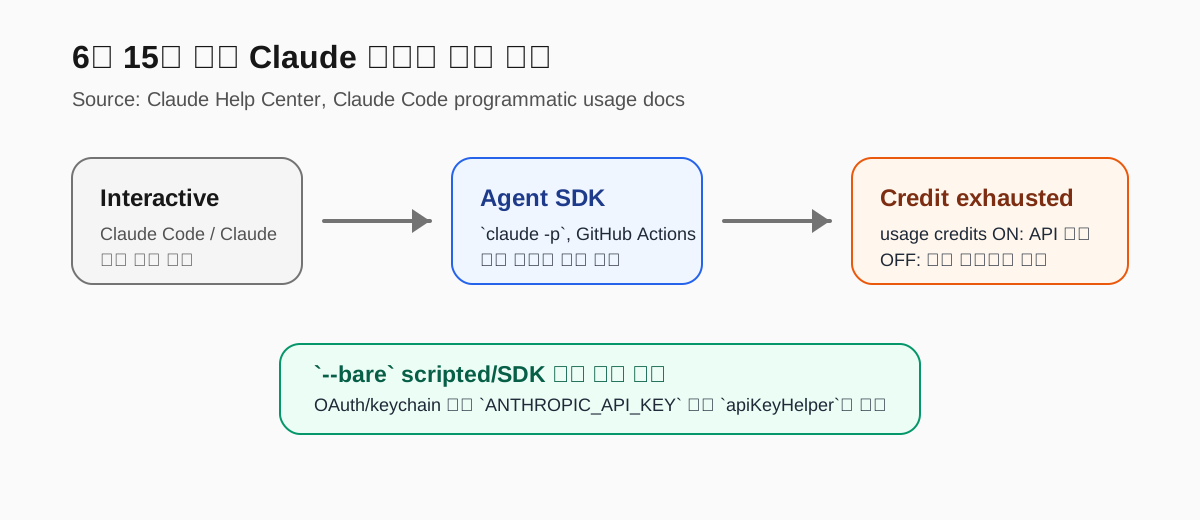
Interactive Claude Code: remains under subscription limits
claude -p / Agent SDK / GitHub Actions: consumes monthly Agent SDK credits
Credits exhausted: only accounts with usage credits enabled continue at API rates
--bare: explicit API key or apiKeyHelper, not OAuth/keychain
That authentication boundary matters. --bare does not read OAuth or keychain credentials. Anthropic authentication must come from the ANTHROPIC_API_KEY environment variable or an apiKeyHelper in settings JSON. Bedrock, Vertex, and Foundry use each provider's own credentials. A CI runner or remote VM borrowing a local Claude Code login is not the direction Anthropic is documenting for durable automation.
Cost observability is now part of the documentation as well. With --output-format json, the response includes total_cost_usd and a per-model cost breakdown so a scripted caller can track cost per invocation without opening the usage dashboard. That is a small field with a large implication: Agent SDK automation is being treated less like a casual local helper and more like an execution unit with a budget, logs, and failure modes.
The first practical audit for a development team is to find every claude -p call. It may be hidden in local aliases, GitHub Actions workflows, pre-commit hooks, nightly jobs, Slack bots, admin scripts, or release tooling. Without that inventory, a team will not know which workflow starts consuming the $20, $100, or $200 credit after June 15. The per-user nature of the credits also matters. If several repositories run headless jobs through one person's account, that user can become the budget bottleneck.
The second audit is the overage setting. If usage credits are off, Agent SDK requests stop after the credit pool is depleted. That is useful for preventing runaway spend, but it can create a different operational risk for pull-request review automation, release-prep checks, or incident-response scripts. If usage credits are on, the work continues at standard API rates, but a failed job with retries can generate a larger bill than expected unless there are external limits on retries, timeouts, and maximum input size.
The third audit is the shape of the automation itself. Before this boundary, a simple git diff main | claude -p ... pipeline often felt sufficient. With a credit budget attached, the input size, retry count, allowed tools, output format, and cost logs all need design. Claude Code documentation notes a 10 MB cap for piped stdin and recommends file paths for larger inputs. Large monorepos that send every diff and log line in one prompt face both cost pressure and input-limit pressure.
Permissions and cost also become linked. The docs show --allowedTools "Bash,Read,Edit" as a way to allow testing and code changes without manual approval. That can raise the success rate of an automated repair job, but a failed loop now burns tool calls, tokens, and retries while also widening the possible change surface. For CI, separating read-only review jobs from write-capable repair jobs makes both spend and blast radius easier to inspect.
Anthropic's decision is understandable from a capacity and pricing perspective. Subscription limits are priced around relatively predictable human use. Agent SDK and claude -p calls can be made by machines repeatedly and at scale. The human-scale versus API-scale distinction showed up repeatedly in community discussion, and the June 15 change gives it a billing mechanism. For users who already built internal workflows around subscription-backed automation, though, this is an operating-cost change, not just a help-center update.
The competitive context makes the boundary more sensitive. OpenAI Codex, GitHub Copilot coding agent, Google Antigravity, and other coding-agent products are all drawing their own lines across subscriptions, seats, usage, action minutes, and API keys. Developers cannot compare only which model fixes a pull request best. They also have to compare what happens when the same review runs 500 times in a month, with retries, action minutes, policy changes, and overage paths included.
Third-party harnesses and Agent SDK apps are part of the same reset. An app may truthfully say that it works with a user's Claude subscription, but the user still needs to know whether it consumes the interactive Claude Code allowance, monthly Agent SDK credits, or usage credits at API rates. App developers should explain that boundary in onboarding and settings, or June 15 will turn cost surprises into support tickets.
The practical model has three layers. Human terminal or IDE use sits in the interactive layer. claude -p, Agent SDK calls, GitHub Actions, and subscription-authenticated third-party apps sit in the monthly credit layer. Overage then moves into the API usage layer when usage credits are enabled. Teams that mix all three in one account need user-level cost attribution, not just a single "Claude Code is installed" inventory item.
The conservative migration path is to instrument every headless call before June 15. Use --output-format json, capture total_cost_usd in job summaries or logs, and add workflow-level limits for retries and timeouts. For CI and remote runners, move toward --bare with explicit credentials so local hooks, plugins, MCP settings, and memory do not change the result. For production automation at scale, Anthropic's own documentation points teams toward Claude Platform API keys.
This news does not mean Claude Code automation stops being useful. It means the accounting unit changes before the feature surface does. The one-line claude -p utility can still run, but after June 15 it belongs to a system with monthly credits, usage credits, API keys, --bare, and JSON cost logs. In the coding-agent market, the next comparison is not only model quality. It is the billing unit and failure mode of the automation call itself.