Finding issues without keywords, Copilot gets a triage index
GitHub Copilot Chat semantic issue search moves issue search from keyword matching toward a backlog-understanding layer for coding agents.
- What happened: GitHub made semantic issue search generally available in Copilot Chat on web.
- Users can ask in natural language to find, group, and analyze issues without knowing the exact title, keyword, or filter.
- Why it matters: Coding-agent context is expanding from code files into backlogs and triage.
- What to watch: Teams should evaluate the
semantic issues index, permissions, content exclusions, and result verification together.- If issues are grouped incorrectly, agent task assignment and prioritization can drift with them.
GitHub added semantic issue search to Copilot Chat on web on May 20, 2026. On the surface, it looks like a small search upgrade. In the context of coding agents, it points at a larger product direction: Copilot is moving from a tool that reads code files into a tool that also reads a repository's unresolved work and team context.
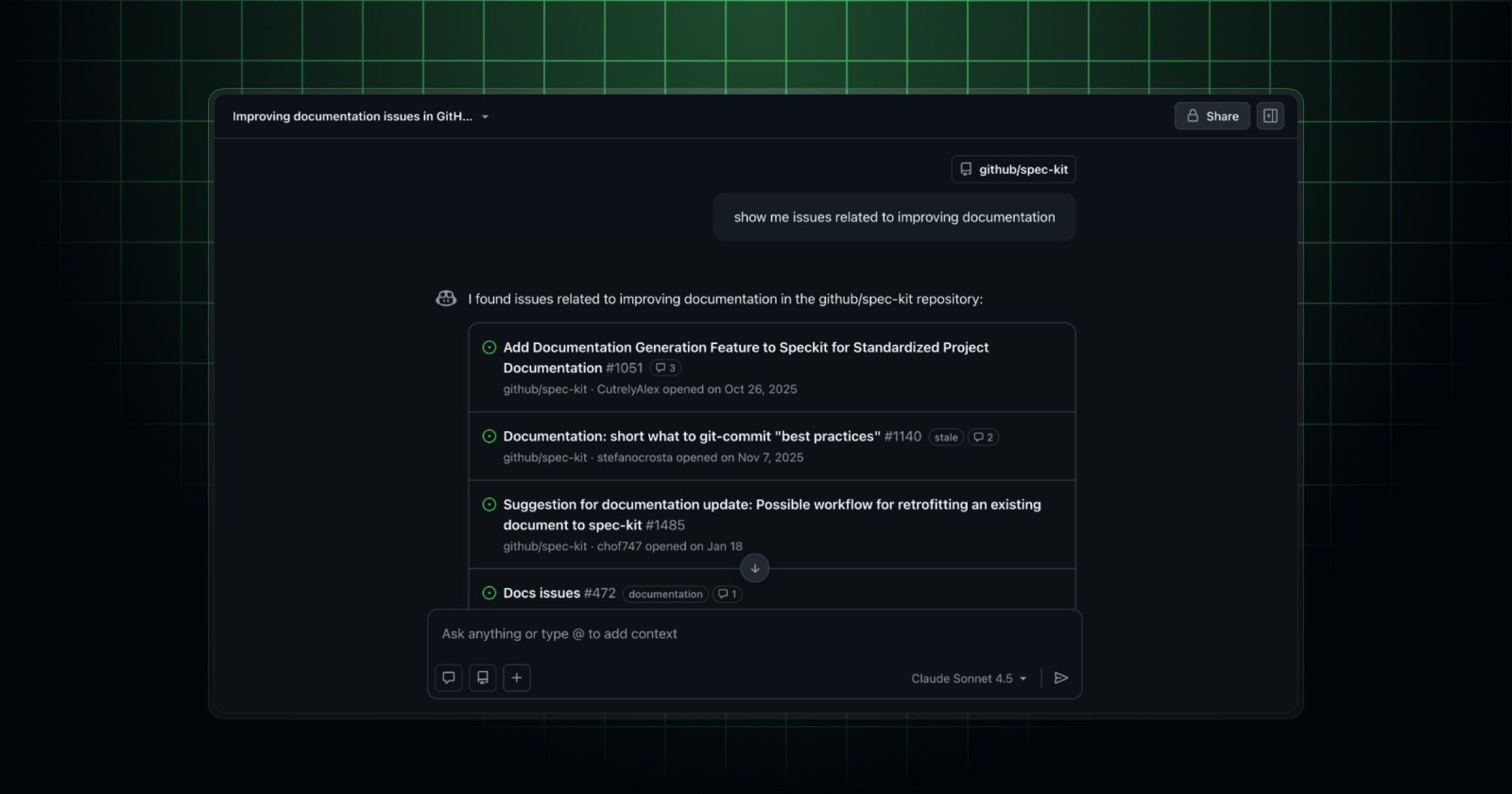
GitHub's official changelog describes the feature in compact terms. Users can ask Copilot Chat on web to find, group, and analyze issues in natural language. The results are context-aware and powered by a new semantic issues index. GitHub says the feature is generally available to users on all Copilot plans.
The important part is not "issue search" by itself. It is intent-based issue search. Existing GitHub search is powerful, but it assumes the user knows enough about labels, titles, body keywords, authors, state, or dates to form a useful query. Semantic issue search targets the cases where a person remembers the shape of the problem, not the exact text: "login failures that only happen on Android," "open tasks about documentation cleanup," or "flaky tests that reproduce in a specific environment."
This matters because issues are less structured than code. Source code is constrained by compilers, tests, types, and file paths. Issues are human records. Titles are short, bodies are long or empty, labels vary by team, and the same bug might be written as "login crash," "auth redirect loop," or "mobile sign-in failure." Exact keyword search is brittle across those variations.
Semantic issue search tries to reduce that brittleness. GitHub says Copilot Chat can understand query intent and surface semantically related issues even when the wording differs. That is a search UX improvement, but it is also a preprocessing layer for agents. Before an agent changes code, it needs to know which problems belong together, what should be handled first, and which user complaints connect to a planned change.
After code indexes come issue indexes
GitHub Docs on repository indexing explain that Copilot uses a semantic code search index to understand repository context. When a conversation starts with repository context, Copilot Chat can index the repository automatically and use that index to answer questions about code structure and logic. Copilot cloud agent can also use semantic code search when exact text matching with tools such as grep is not enough to find relevant code.
The May 20 changelog adds a separate phrase: semantic issues index. If a code index helps answer "where is the function that does this?", an issue index helps answer "what does the team currently consider broken or worth doing?" A coding agent that opens commits and pull requests still needs an earlier step: discovering work in the backlog, grouping similar reports, and turning a user's vague description into a task candidate. Expanding search from code to issues is a natural extension of that workflow.
User asks in natural language: "Find mobile documentation cleanup issues"
Copilot Chat on web: combines intent with repository context
Semantic issues index: retrieves related issues despite wording differences
Planning, triage, and discovery: suggests clusters and candidate work
The feature also fits Copilot's recent expansion. On May 6, 2026, GitHub's Copilot update for VS Code said semantic indexing works across all workspaces and that agents can run grep-style searches across GitHub repositories and organizations. The same update included terminal read/write access for agents, browser tab sharing, inline diffs, and remote monitoring for Copilot CLI sessions. Copilot is being stretched from completion into a surface for finding, executing, and reviewing work.
Issue search sits close to the "finding work" part of that surface. In many teams, a backlog is less a clean database than an accumulated conversation. Duplicate issues appear, old reports connect to newer regressions, and a single incident can split into documentation, test, UI, and infrastructure tickets. If an agent can first collect related issues and recover context before editing code, triage cost can fall.
Grep and filters still matter
Semantic search should not be treated as a replacement for exact search. GitHub's changelog frames it as a way to avoid relying only on exact matches and manual filters. That wording matters. Structured search is still better when the user knows the issue number, security label, assignee, milestone, release blocker, or creation date. Semantic search is strongest when the title or keyword is unknown, wording is fragmented, or the boundary of a cluster is unclear.
| Situation | Existing search and filters | Semantic issue search |
|---|---|---|
| You know the exact number or label | Fast and reproducible | May return unnecessarily broad candidates |
| Keywords are scattered across different phrases | Likely to miss relevant issues | Better at finding issues by intent |
| Triage and planning | A person has to assemble the candidate set | Creates a starting point for clusters, summaries, and priority discussion |
| Auditability and repeatability | The query conditions are easy to record | Requires verification of why each result appeared |
Teams should use both modes. A support engineer looking for "checkout button disabled in Safari since last week" can start with semantic search to collect candidates. Then they should narrow the set with label, milestone, creation date, assignee, and linked pull requests. For agents, "collect related issues and summarize likely common causes" is a safer first instruction than "fix this issue."
The trust problem starts at that point. Semantic search can find issues that look related, but product decisions require more than apparent similarity. Issues with similar wording can have different causes. The same symptom can differ by platform. A closed issue may be relevant only because the bug regressed. Copilot Chat's grouping can be useful input for a triage meeting, but automated prioritization needs a separate verification step.
When the backlog becomes an agent queue
Semantic issue search connects naturally to Copilot cloud agent. GitHub Docs say the cloud agent can use semantic code search to find relevant code when it does not know exact names or patterns. Add semantic issue search, and the workflow gets longer: find issues by meaning, group related reports, use the code index to locate likely change points, let the agent perform the task, and connect the result back to a pull request.
That changes how development teams should think about issues. Until now, an issue has mostly been data for a person to read, classify, and assign. Agents can turn that data into candidate work: identifying duplicates, summarizing release blockers, suggesting related code areas, or proposing a task plan from a cluster of reports. GitHub explicitly mentions planning, triaging, and discovery because issue retrieval is upstream of task assignment.
Quality control changes with that shift. A backlog with vague titles, stale labels, empty templates, or missing reproduction steps is already hard for humans. It becomes riskier when agents consume it as task input. Semantic search can bridge wording differences, but it cannot make low-quality source data precise. Better AI search increases the value of issue hygiene rather than removing it.
Consider three old "login failure" issues. One was caused by an OAuth provider outage, one by Android WebView cookie behavior, and one by an incorrect redirect URI in documentation. Semantic search may correctly bring all three into one candidate set. That helps discovery. It becomes dangerous only if an agent treats the set as a single root cause and starts editing code. Search should widen the candidate set; diagnosis still has to split causes apart.
Governance starts with the index
GitHub Docs include a few important governance details for repository indexing. GitHub says indexed repositories are not used for model training. Copilot Enterprise and Copilot Business administrators can define content exclusions that control Copilot behavior for seats, and content covered by those policies is filtered when a semantic code search index is created.
The semantic issue search changelog does not provide a long description of issue-index retention, refresh behavior, or exclusion handling. That leaves adoption questions for organizations. Which issue fields are indexed? How are private and internal repository permission boundaries reflected? What happens when sensitive customer logs are copied into an issue body? How are closed issues, deleted comments, and locked conversations handled? Can search results cross team boundaries?
Those questions are not objections to semantic search. They matter because agents are beginning to use issue data as work input. Excluding sensitive source files from code search may not be enough. Customer names, incident timelines, security reproduction steps, internal URLs, and logs often live in issue bodies and comments. The more Copilot can read the backlog, the more carefully teams need to manage what the backlog contains.
Copilot Chat retention is also part of the operating model. GitHub Docs say Copilot Chat stores up to 100 recent conversations and permanently deletes messages inside a conversation after 28 days. If a team discusses semantic issue search results in Chat, both the results and the follow-up conversation become part of the data-handling surface. Incident response and customer support workflows should account for that.
Search is becoming task assignment
This is not an isolated GitHub search improvement. Atlassian is adding AI search and summarization across Jira and Confluence. Linear is also moving issue and project context into AI-assisted workflows. Sourcegraph, Cursor, Claude Code, and Google Antigravity compete on codebase understanding and work execution. GitHub's advantage is that code, issues, pull requests, Actions, and Copilot agents sit inside the same platform.
Inside that platform, semantic issue search occupies a small but strategic position. Developers do not start every task in the IDE. Many tasks start in issues: bug reports, customer requests, flaky tests, release blockers, documentation fixes, and security hardening. Searching and grouping those issues in natural language is tied to the question of what work an agent should receive.
Search is no longer only an exploration UI. If search results become task candidates and task candidates trigger agent runs, search quality becomes automation quality. Miss the right issue, and the agent may edit the wrong code. Fail to group duplicates, and the same bug can fragment into several pull requests. Group related reports well, and one fix can resolve several user complaints. Issue search is part of the agent productivity pipeline before code generation begins.
What teams should change
First, revisit issue templates. Semantic search helps with wording differences, but structured fields for reproduction environment, platform, version, impact, expected behavior, and actual behavior make much better input. "It does not work" is weak for both people and Copilot. "Blank page after GitHub OAuth redirect in iOS 18 Safari" gives the search and the agent concrete anchors.
Second, keep labels and milestones healthy. Semantic search is good at widening the candidate set. Labels and milestones are good at narrowing it. If a team lets structured metadata decay because AI search feels convenient, verification cost rises. A practical workflow starts with semantic search, confirms candidates through structured filters, and leaves root-cause and priority decisions to a reviewed triage step.
Third, reduce sensitive data in issues. Customer logs, tokens, internal URLs, and personal data in issue bodies were risky before Copilot. They are riskier when search and agent context may consume issue text. Organizations should review content exclusions, repository access, and Copilot policy, then decide whether incident issues need to be separated from ordinary backlog items.
Fourth, change what you ask agents to do. "Fix this issue" is often too direct. "Group related issues, summarize likely causes, and suggest relevant code areas" uses semantic issue search where it is strongest. It turns loose user reports into a reviewed task candidate before an agent starts changing files.
A small feature with a larger signal
GitHub's semantic issue search announcement is a short changelog entry, but it is a useful signal about coding-agent products. An agent that writes code well still needs to know which work matters, how often the same symptom appears, which environment fails, and which pull requests are connected. Much of that information lives in issues and PR conversations.
The core update is therefore not simply that Copilot searches better. It is that Copilot is starting to read unresolved team work at a semantic level. If that ability improves, planning, triage, and discovery will get more AI assistance. At the same time, bad issue grouping, sensitive issue bodies, stale labels, and unclear reproduction steps become automation risks.
The next bottleneck for coding agents is not only whether a model can write correct code. It is whether the system can choose the right work. GitHub attaching a semantic index to issues is a small move toward that bottleneck. "Finding issues without keywords" sounds like a convenient search feature. Operationally, it means the backlog is entering the agent's work map. Good issue management is becoming infrastructure for agents, not just organization for humans.