Model Choice Becomes Org Policy Before Copilot AI Credits
GitHub Copilot targeted model rules arrive just before the June 1 AI Credits switch, turning model choice into an org-level cost and security control.

- What happened: GitHub opened Copilot targeted model rules in public preview on May 26, 2026.
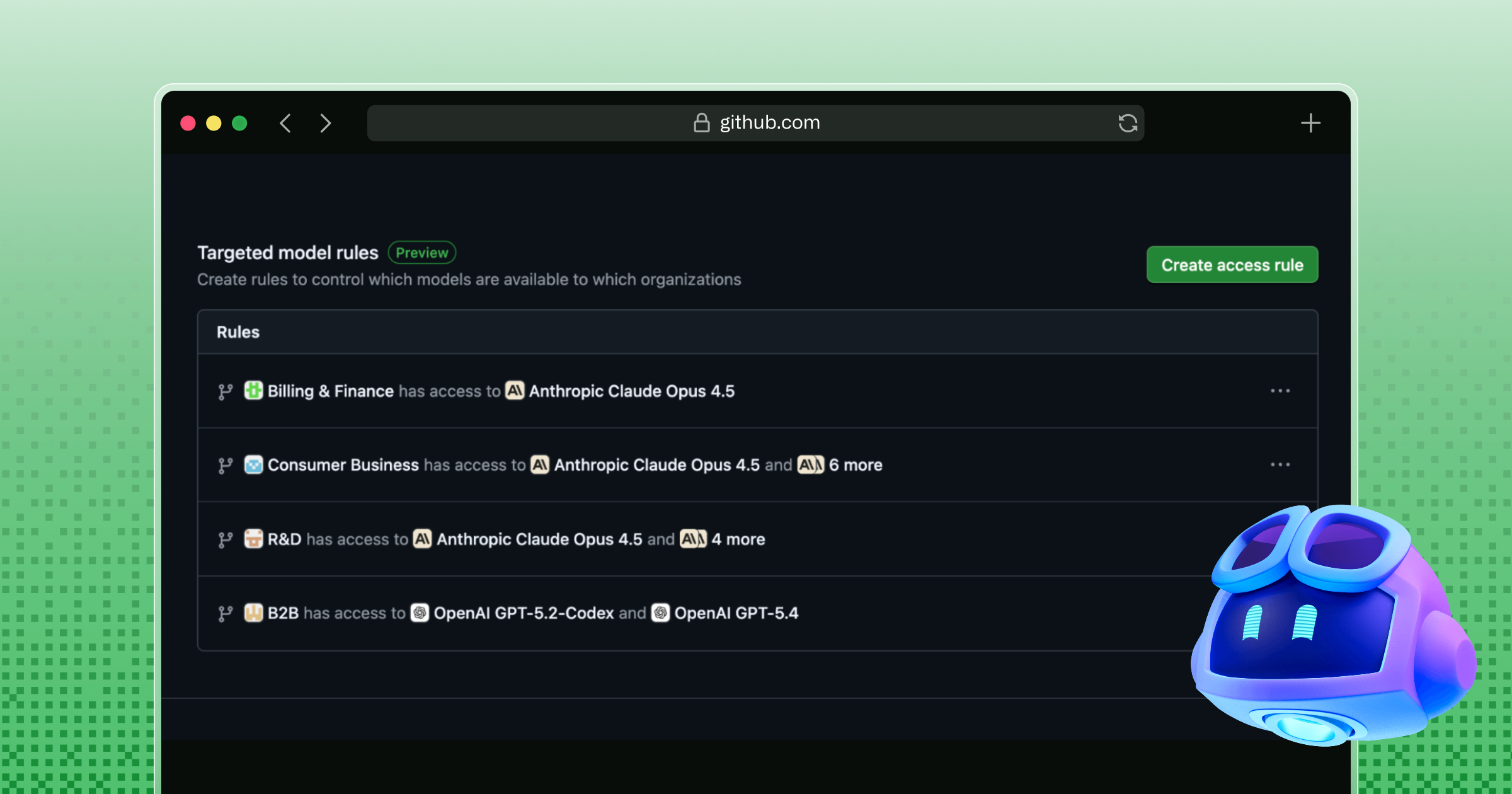
- Enterprise owners can allow specific Copilot models only for selected organizations instead of relying on one enterprise-wide default.
- Billing context: Copilot moves from Premium Request Units to GitHub AI Credits on June 1, 2026.
- Builder impact: The model picker now sits next to
Enabled,Optional, budget, and security-review decisions.- Platform teams need to review model allowlists and usage reports together, because cost now follows organization, model, and token consumption.
GitHub opened targeted model rules for Copilot Business and Copilot Enterprise in public preview on May 26, 2026. In the changelog, the feature looks like a narrow administration update: enterprise owners can allow particular Copilot models for particular organizations, rather than managing model availability only as an enterprise-wide default. The timing changes the reading. On June 1, 2026, Copilot moves from Premium Request Units to GitHub AI Credits, so model availability is no longer only a developer-experience setting.
GitHub's official changelog describes three related controls. Enterprise owners can target model access by organization. They can create rules that allow selected models for selected organizations. The default model availability page also now separates models that are automatically on for every organization, marked Enabled, from models that organizations may opt into, marked Optional.
The feature is available to Copilot Business and Copilot Enterprise customers. That audience matters. A personal Copilot user mostly experiences model selection as a quality and preference question. A company running several GitHub organizations has a different problem: one org may have completed a legal and privacy review for a model, another may be running experiments, another may be constrained by budget, and another may work with repositories containing customer data. Copilot model rules let GitHub start handling those differences at the organization level instead of the seat level.
 .
.
Why Model Rules Now
GitHub announced on April 27, 2026 that Copilot plans would move to usage-based billing on June 1. Instead of the old premium request structure, Copilot plans get monthly GitHub AI Credits, and paid plans can buy additional usage. Usage is calculated from input tokens, output tokens, cached tokens, and model-specific API rates. Code completion remains a separate core experience, but chat, agent work, review, and multi-model calls become easier to discuss as direct cost drivers.
GitHub gave a related explanation when it described changes to individual plans on April 20, 2026. Agentic workflows had changed Copilot's compute demand. Longer sessions, parallelized work, and requests that run for extended periods consume more resources than older plan assumptions expected. GitHub said some requests can cost more than the plan price and noted that session limits and weekly limits are affected by token consumption and model multipliers.
Model rules are a management layer for that billing shift. The old question was mostly "which model is better for this coding task?" After AI Credits, organizations also need to ask which team may use which model for which type of work. A company may block an unreviewed model from repositories with customer data, open a higher-cost model only to a platform migration team, or leave an experimental model as Optional while monitoring usage. The model picker becomes part of policy design.
| Date | GitHub Copilot change | What organizations should review |
|---|---|---|
| April 20, 2026 | Individual plan sign-ups paused, usage limits tightened, Opus model access adjusted | Agentic workflows that pressure session limits, weekly limits, and token budgets |
| April 27, 2026 | June 1 AI Credits transition announced | Cost forecasting based on input, output, cached tokens, and model-specific rates |
| May 17, 2026 | GPT-5.3-Codex becomes the Business and Enterprise base model | LTS availability, multipliers, and internal security approval cycles |
| May 26, 2026 | Targeted model rules enter public preview | Organization-level model access, budgets, and experiment boundaries |
GPT-5.3-Codex Adds A Second Question
On May 17, 2026, GitHub said GPT-5.3-Codex had become the base model for Copilot Business and Enterprise, replacing GPT-4.1 as the default. The base model is what an organization uses when it has not approved another model through its own review path. GitHub described GPT-5.3-Codex as the first LTS model it provides with OpenAI, with 12 months of availability from its February 5, 2026 release date through February 4, 2027.
For enterprises, "LTS" can be as important as benchmark gains. Large organizations usually run security, privacy, legal, procurement, and regulated-workload reviews before they allow a model into production development workflows. If a model changes every few weeks, review cycles cannot keep pace with product cycles. GitHub's LTS language fits that enterprise review process. Targeted model rules are the next layer: after a model is stable enough to review, a company still has to decide which organizations can use it.
The same changelog said GPT-5.3-Codex carries a 1x premium request unit multiplier, and that GPT-4.1 will be deprecated when usage-based billing launches on June 1. That sentence sits at the boundary between the old premium request language and the new AI Credits system. Model choice now bundles quality, availability window, cost coefficient, and deprecation schedule into a single operational decision.
The practical effect is visible in a simple enterprise setup. A platform organization may run large migrations and agentic refactors. A product organization may mostly use Copilot for pull request review, issue triage, and day-to-day chat. A security organization may work in sensitive repositories and threat-model documents. All three can have the same Copilot seat type while needing different model access, data boundaries, and spending limits. Targeted model rules prevent those organizations from being treated as one default policy.
The Permission Structure
GitHub Docs for enterprise default model availability describe the permission structure in more detail. Enterprise owners manage allowed Copilot models from AI controls. In the default models tab, they choose whether each model is Enabled or Optional, and in the targeted model rules section they create access rules that combine target organizations with allowed models.
Enabled means the model is on for every organization in the enterprise. Optional means an organization can enable the model itself. A targeted rule is narrower: it opens selected models to selected organizations. This looks less like a product toggle and more like delegated policy. The enterprise owner sets the upper boundary; organization owners operate inside that boundary.
GitHub's organization-level default model docs make the limit explicit. If an organization belongs to an enterprise, the enterprise owner controls which models are available and how those models can be configured at the organization level. When a model appears in organization settings with a lock icon and an Enabled or Disabled state, the enterprise has enforced that state. Organization owners can adjust only the models that appear with Enabled, Disabled, or Unconfigured in a dropdown.
That structure matches how many companies run internal developer platforms. A central platform or security team can say that one model has passed privacy review and should be enabled everywhere, that another model is still experimental and should be available only to a platform organization, or that a higher-cost model is limited to a migration task force. Companies that prefer more local autonomy can leave models as Optional and let each organization owner decide based on its policy and budget.
AI Credits Turn Model Choice Into Accounting
GitHub's preparation docs for usage-based billing tell administrators to check billing previews and usage reports before the June 1 transition. The report includes rows by user, model, and day, with new fields such as aic_quantity and aic_gross_amount. The first is the number of AI Credits consumed. The second is the estimated gross amount in U.S. dollars under the usage-based billing system.
Those two columns explain why model rules matter in day-to-day operations. Administrators will not only ask whether Copilot usage is high. They will be able to ask which person used which model on which day and what that implied for gross usage. If rates vary by model, identical request counts can produce different bills. Long-running agent sessions can increase output tokens and tool use. Once cached tokens enter the equation, repeated work is not captured well by a simple request counter.
Developer work: chat, code review, cloud agents, model selection
Usage measurement: input tokens, output tokens, cached tokens
Model-specific rates and organization-specific access policy
AI Credits usage, gross amount, budget, and approval policy
Under usage-based billing, the model picker is both product UX and a cost selection interface. A stronger model may solve a task in fewer attempts, but a long task can also consume more tokens. A smaller model may lower per-call cost while raising failure and retry rates. GitHub's April plan-change post mentioned plan mode, reduced parallel workflow use, and lower-multiplier models as ways to manage limits. Model rules alone cannot solve cost control. Teams also need operating norms for session length, parallelism, review size, and escalation to expensive models.
Public Reaction Is Focused On Billing Opacity
Public discussion of targeted model rules themselves is still limited; GitHub's changelog points readers to the GitHub Community announcements category. Most visible reaction is aimed at the broader June 1 AI Credits transition. In Reddit's r/GithubCopilot, commenters focused on the difficulty of predicting token-based costs before the bill arrives. One compared usage-based billing to shopping in a grocery store without visible prices, a shorthand for concern about model rates, credit conversion, and task-level token consumption.
The r/devops reaction was more operational. One commenter observed that organizations that previously did not know which engineers used Copilot heavily would find out after June 1. That is closer to the enterprise problem than a generic pricing complaint. Once a developer productivity tool is attached to team budgets, the conversation shifts from whether a seat is valuable to whether a particular agent session, model selection, and workflow pattern justify their cost.
In that context, GitHub's model rules are a guardrail. If every developer can access every model, teams have a harder time explaining costs by organization and task type. If access is restricted too aggressively, developers may be forced onto weaker models for work where failure and retries erase the savings. Good policy is less a blunt cost-cutting mechanism than a routing rule: security, migration, and product teams may all need different model access for valid reasons.
Competitors Face The Same Question
GitHub is not alone. OpenAI Codex, Claude Code, Cursor, Google Antigravity, and Sourcegraph-related tools are all pushing longer tasks, larger context windows, and more tool calls to the center of the product. As model competition intensifies, a buyer cannot evaluate coding assistants only by a benchmark or demo. Budget management, audit logs, data boundaries, model allowlists, repository access, and agent permissions all become part of procurement.
GitHub's advantage is that Copilot sits inside GitHub Enterprise surfaces: repositories, organizations, Actions, pull requests, issues, and code review. In that environment, model rules are not merely a list of available models. They map AI model access onto GitHub's existing organization boundary. For companies that already separate teams and repositories by organization, model policy can follow an existing administrative unit.
That design also has limits. An organization is not always the same thing as a cost center, data classification boundary, or regulated workload. One GitHub organization may contain both experimental repositories and production systems with stricter controls. Some enterprises will eventually want repository-level or workload-level model policy. The current public preview opens organization-level targeting; adoption will show whether GitHub needs finer-grained rules.
What Development Teams Should Check Now
First, administrators should download usage data before June 1 and review it by model, user, and day. GitHub Docs point to billing previews and CSV reports with aic_quantity and aic_gross_amount. Without that report, model policy is built on guesses about which teams and workflows create high-cost usage.
Second, model allowlists should connect to the company's security review process. An LTS model such as GPT-5.3-Codex is easier to fit into an internal evaluation cycle. New or external-provider models may still be useful, but teams should decide which organizations can use previews and what data those organizations may expose. Turning every model on enterprise-wide is fast, but it can make audits and cost explanations harder.
Third, organization owners need to understand what Optional means. A model marked Optional by the enterprise can be enabled by the organization. If the company has not decided whether that power belongs to a product engineering manager, a platform team, or a security-approved workflow, the UI creates access without a clear responsibility boundary.
Fourth, agentic workflow rules should be written next to model rules. GitHub's own discussion of plan mode, parallel workflow limits, and lower-multiplier models shows that operating habits can affect spend faster than admin policy. A powerful model may be appropriate for one organization, but unbounded parallel agent sessions can still make AI Credits hard to forecast.
Fifth, developers need the reason behind the model policy. If the message is only cost reduction, engineers may hear "use a worse model." A clearer policy separates models by security review, long-task suitability, review and completion adequacy, and repository sensitivity. That framing makes model access a work-routing system instead of an arbitrary restriction.
A Small Admin Button With A Larger Operational Meaning
GitHub Copilot targeted model rules are more significant because of the date than the UI surface. The feature arrived days before the June 1 AI Credits transition. When Copilot was mainly tab completion, model choice looked like an individual productivity preference. With cloud agents, code review, semantic search, CLI sessions, and subagent workflows attached, model choice becomes part of enterprise spending and security approval.
The preview does not answer every governance question. Some organizations will need policies below the organization level. Teams still need better ways to estimate model-specific costs before work starts, understand the relationship between agent success rate and spend, and limit usage without damaging developer experience. Even so, GitHub's organization-level model rules point in a clear direction: the next unit of coding-agent management is not only the seat. It is the model, the organization, the task type, and the token cost on the same dashboard.
After June 1, the Copilot operations meeting will ask a different question. Not "did we enable Copilot?" but "which model is open to which organization, and why?" Teams that can answer that question can treat AI Credits as an operations redesign. Teams that cannot may discover at month-end that the model picker was also a billing switch.