CopilotKit Puts $27M Behind the Agent UI Layer
CopilotKit’s $27M Series A turns AG-UI into a signal that agent competition is moving from models and tools into user-facing interface protocols.
- What happened: CopilotKit announced a $27 million Series A for its agentic frontend stack.
- The May 5, 2026 round was led by Glilot Capital, NFX, and SignalFire, with the company positioning
AG-UIas the event layer between agents and app interfaces.
- The May 5, 2026 round was led by Glilot Capital, NFX, and SignalFire, with the company positioning
- Why it matters: agent standards are expanding beyond
MCPtool access into UI events, shared state, approvals, and frontend tool calls. - Watch: AG-UI carries both a protocol story and a commercial platform story.
- Teams should separate open protocol value from CopilotKit product lock-in, and treat generated UI as a permission and audit problem rather than only a rendering problem.
CopilotKit announced a $27 million Series A on May 5, 2026. Glilot Capital, NFX, and SignalFire led the round. On the surface, that sounds like another agent startup financing event. The more useful signal is where CopilotKit says the money will go: an Enterprise Agentic Frontend Stack, the layer where agents and users collaborate inside a real application screen.
That placement matters because the agent stack is starting to split into visible layers. MCP is commonly discussed as the protocol for tool and data access. A2A is framed around agent-to-agent coordination. CopilotKit wants AG-UI to own the stream between an agent backend and the user-facing app: what the agent asks the interface to show, what state the user changes, when a human must approve an action, and which frontend functions the agent may call.
Why The Frontend Became An Agent Bottleneck
The fastest way to prototype an AI agent product is still a chat box. A user types a request, the model responds, and the server calls tools when needed. That pattern is fine for a demo. It becomes thin inside a SaaS application where the user is not only asking for text but changing records, filtering tables, approving workflows, comparing options, or correcting an agent mid-run.
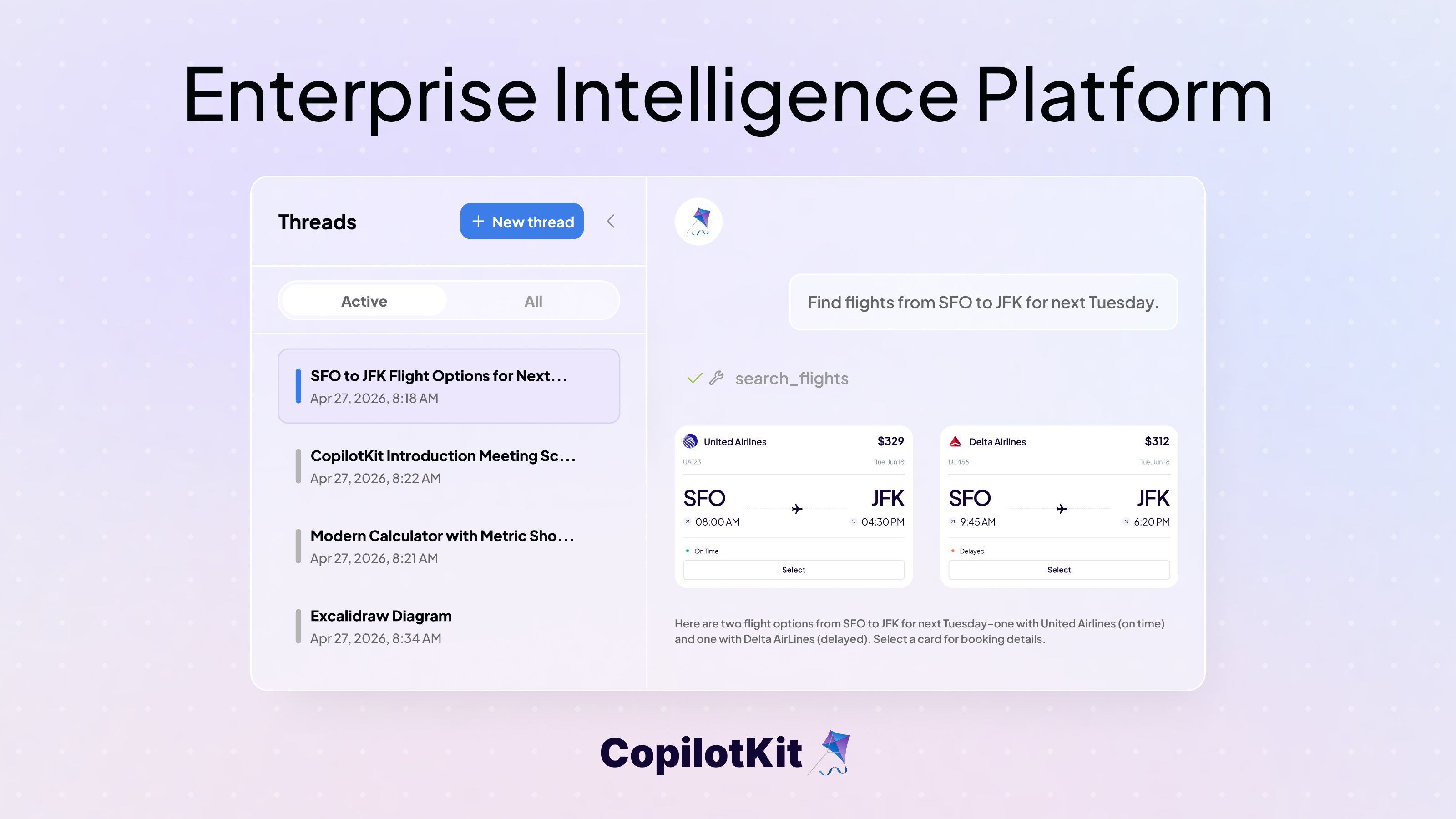
If a CRM agent identifies renewal risks, the user likely wants a table, account filters, editable deal fields, confidence notes, and approval controls. If a travel agent builds an itinerary, the user wants flights, hotels, budget constraints, and changes reflected in one shared workspace. Text is not enough. The agent has to understand the application state and the application has to expose safe, inspectable ways for the agent to affect the UI.
TechCrunch described the founders' view as a reaction against text-only interfaces that do not always produce a smooth experience. CopilotKit's answer is app-native agents: agents that live inside the product, read what the user is doing, and render company-defined interactive UI instead of only returning a paragraph. That is why AG-UI emphasizes streaming chat, frontend tool calls, shared state, and human-in-the-loop behavior as protocol concerns.
The AG-UI docs frame the same problem as a break from old request-response frontend architecture. Traditional apps could often assume a client request, a server response, and a rendered result. Agentic apps are longer-running. Intermediate state changes. Natural language, structured tool calls, user approvals, and partial results all interleave. A few REST endpoints and a final confirmation button do not describe that workflow well enough.
What AG-UI Wants To Standardize
AG-UI describes itself as an open, lightweight, event-based protocol. Its purpose is to standardize how agent state, UI intents, and user interactions move between an agent runtime and a user-facing application. Put more directly, it tries to define the event vocabulary for what an agent tells the frontend and what the frontend sends back to the agent.
| Layer | Representative protocol | Core question |
|---|---|---|
| Agent to tools | MCP | Which external systems can the agent call safely? |
| Agent to agent | A2A | How do multiple agents divide work and share state? |
| Agent to user UI | AG-UI | How should screens, approvals, user edits, and state changes become events? |
This separation is useful in product design. Adding an MCP server does not automatically create a safe approval interface. Connecting subagents through A2A does not decide where a user can inspect or override a step. AG-UI targets that missing surface: showing execution state, reflecting user input back into agent state, and allowing the agent to call frontend functions that the app exposes.
CopilotKit's announcement says AG-UI has been adopted by Google, Microsoft, Amazon, Oracle, LangChain, Mastra, Pydantic AI, Agno, LlamaIndex, and others. CopilotKit's own homepage also presents the company as the organization behind the AG-UI protocol and foregrounds logos from major cloud and agent-framework ecosystems. Those claims still need careful interpretation because "support" can mean different depths of integration. The signal is not that AG-UI has already won the standard war. The signal is that a frontend event protocol is now being pitched as a first-class piece of the agent stack.
The Adoption Numbers Need A Careful Read
CopilotKit's official announcement provides four concrete number clusters. The funding round is $27 million. The company says AG-UI-related libraries have more than four million weekly downloads. It reports more than 40,000 combined GitHub stars across CopilotKit and AG-UI open-source SDKs, plus 150 contributors. It also says CopilotKit is used by multiple Fortune 500 and Global 50 customers and powers millions of agent-user interactions every week.
On GitHub, the CopilotKit/CopilotKit repository showed about 31.8k stars, 4.1k forks, and 9,931 commits when the Korean article was researched. The repository is not just a set of chat widgets. It spans React and Angular support, generative UI, shared state, human-in-the-loop workflows, AG-UI protocol pieces, and even Claude Code plugin skills. CopilotKit is trying to sell agent frontend work as a runtime concern, not as a decorative message component.
Those numbers should not be read as proof of standard dominance. Fortune 500 "usage" does not disclose production dependence, active seats, or deployment scope. Weekly downloads can include CI, template generation, experiments, and transitive installs. The right conclusion is narrower: investors and enterprise buyers are starting to treat the agent UI layer as a separate market category.
Enterprise Intelligence Shows Where The Budget Is
CopilotKit also used the Series A announcement to push its Enterprise Intelligence Platform. The product promises persistent threads and cross-device sync now, with observability and self-improvement described as next steps. Deployment starts with Kubernetes self-hosting, while managed cloud is listed as coming soon. That combination is a clear enterprise signal: agent state must persist, and many customers want control inside their own infrastructure.
TechCrunch quoted Atai Barkai saying enterprise customers almost always ask for optionality and self-hosting. That explains CopilotKit's positioning. The Vercel AI SDK is already a strong developer-experience standard for AI applications. OpenAI Apps SDK enables richer interfaces inside ChatGPT. assistant-ui focuses on chat interface components. CopilotKit stands near those layers but argues for a horizontal agent frontend stack that can sit across different frameworks, clouds, and agent backends.
The strategy has a real advantage. Enterprises rarely start with a clean agent stack. They may already have LangGraph, CrewAI, Mastra, Microsoft Agent Framework, Google tools, custom APIs, and internal design systems. CopilotKit can argue that the frontend event surface should remain consistent even when the backend mix changes.
The burden is neutrality. If AG-UI is both the growth engine for CopilotKit and a would-be open protocol, the ecosystem will watch governance, compatibility tests, versioning, and support for competing implementations. A protocol becomes trusted through boring operational details: stable changes, clear conformance, good debugging, and working integrations beyond the vendor that benefits most.
Generative UI Is Really A Permission Problem
CopilotKit's announcement divides agent UI into three categories: controlled UI through AG-UI, declarative UI through Google's A2UI, and open-ended UI through Anthropic MCP Apps. The distinction is practical. Fully free-form UI generation is risky in business applications. Fully predefined screens can make agents feel trapped. Useful products need a middle layer where the agent can choose from approved components and actions under explicit constraints.
Consider a finance SaaS agent analyzing revenue categories. A generated paragraph is less useful than a table, chart, editable grouping, and period selector. If the user merges categories or changes the reporting window, that state should return to the agent. But the same agent should not be allowed to invent a wire-transfer button, terminate a contract, or approve a refund without a product-defined permission boundary.
That is why generated UI quality is not only a visual question. The real product question is which components and actions are allowed, under which user role, in which state, with what confirmation, audit log, and undo path. A beautiful generated interface that can mutate production records without traceability is worse than a plain table with strict approvals.
AG-UI's tool concept points in this direction. The docs describe tools as the mechanism for interacting with external systems and inserting human judgment into workflows. The important implementation detail is dynamic availability: tools can be added or removed based on the user's permissions, context, and application state. In enterprise apps, user A and user B may see different approval tools for the same agent plan. That dynamic boundary is not an accessory. It is part of the safety model.
Community Interest Sits Between Plumbing Cost And Protocol Fatigue
A Reddit post in r/AI_Agents highlighted Google, Microsoft, and AWS support for AG-UI, focusing on typed events for runs, tool calls, state channels, and human-in-the-loop flows. Another r/AI_Agents thread listing new 2026 agent products classified CopilotKit as an app-native agent SDK. The developer interest is consistent: teams want agents inside existing apps instead of as external chatbots, and they want less custom plumbing for the shared state between user and agent.
The counterpressure is protocol fatigue. The agent ecosystem already has MCP, A2A, AG-UI, A2UI, Apps SDK, Open JSON UI, and related names competing for attention. Each may describe a different layer, but product teams experience them as implementation cost. AG-UI will have to reduce duplicate integration work in real systems, not only add a new diagram to the stack.
The survival test for a protocol is not the name. It is implementation count, compatibility behavior, debugging quality, and failure-mode clarity. When an event stream is interrupted, a user approval arrives late, a frontend tool call fails, or the agent state diverges from the UI, teams need predictable recovery. That operational experience will matter more than the launch claim.
What Builders Should Check Now
Teams evaluating an agent UI layer should start by separating application state into actions the agent may suggest, actions it may draft, and actions it may execute after approval. Chat mistakes can often be deleted. CRM updates, payment approvals, permission changes, emails, bookings, and contract edits have higher reversal costs. The action taxonomy and approval policy should come before protocol adoption.
The next check is testing and observability. Existing frontend tests mostly verify clicks, renders, and routes. Agent UI tests need to replay event streams, assert which components appear, verify that user edits update agent state, and confirm that side-effect tools are unavailable before approval. Playwright, component tests, event replay, and audit logs all become part of the same quality gate.
The third check is lock-in at each layer. AG-UI's cross-framework story is valuable if the protocol remains usable apart from CopilotKit's commercial platform. A team may still adopt CopilotKit's React components, runtime, Enterprise Intelligence Platform, and Kubernetes deployment model. That can be reasonable, but the replacement cost should be explicit. Which parts are protocol? Which parts are product? Which parts are business-critical state?
The fourth check is design-system integration. Agent-generated UI should not bypass accessibility, brand, security, or product review. A safer pattern is to expose approved charts, tables, forms, confirmation dialogs, empty states, and action components, then let the agent choose data and constrained layouts inside that catalog. Designers and frontend engineers end up curating the component set that agents are allowed to use.
CopilotKit's Series A gives a price tag to a category shift. Many teams have treated agents as a backend problem: connect a model to tools and let it run. AG-UI argues that the user-facing surface is a separate competitive layer. If MCP gives agents hands, AG-UI is trying to define the interface where users decide what those hands may touch, when they must stop, and how every state change gets reflected back into the product.
Sources: