Google Pay MCP Brings Payment Integration Into IDE Agents
Google Pay and Wallet now expose an MCP server for docs, account status, pass validation, error metrics, and merchant integration workflows.
- What happened: Google released the
Google Pay & Wallet Developer MCP serveron May 28, 2026.- AI IDEs can call tools for documentation search, account status, Wallet pass validation, error metrics, and merchant integration management.
- Why it matters: the bottleneck in payment integration moves from sample-code generation to live console state.
- Watch: the Marketplace listing describes a preview product with ADC authentication,
roles/mcp.toolUser, and downstream Google API quotas.- The MCP surface is closer to an integration inspector than a production-release authority; review gates still belong to the engineering team.
Google Developers released the Google Pay & Wallet Developer MCP server on May 28, 2026. The announcement says AI development tools such as Antigravity, Cursor, and Visual Studio Code can use Google Pay and Google Wallet documentation, account status, integration state, Wallet pass definitions, and performance metrics from inside the IDE. This is not just a payment-button code generator. The assistant can read parts of the Google Pay developer environment, validate Google Wallet pass JSON or JWT payloads, and help manage merchant accounts and API integration settings.
The news looks smaller than a frontier-model launch, but it shows how AI coding assistants are entering real operational systems. Payment integration rarely ends with one import or one React component. Merchant identifiers, Google Cloud projects, Android and web callbacks, Wallet pass classes, error codes, review status, payment sheet behavior, and recurring billing token lifecycles have to line up. A general-purpose LLM that answers from remembered docs is easy to mislead in this area. Google connected the MCP server to the parts that change per account and per integration.
Google Pay's May 27 update points in the same direction. In its I/O recap, Google wrote that Google Pay is changing for the agentic commerce era and that existing Google Pay backends and Merchant IDs are compatible with Universal Commerce Protocol based agentic commerce experiences. The same post introduced the MCP server as a public preview and said AI agents can help with integration management, error troubleshooting, trend analysis, and code generation. UCP belongs to the agentic commerce protocol conversation. MCP, in this article, is the Model Context Protocol server. The names are close enough to invite confusion, but the roles are different.
The MCP server's feature set breaks down into five areas. First, search_documentation retrieves RAG-based answers and code samples from the official Google Pay and Google Wallet developer sites. Second, account and integration detail tools can read merchant identifiers, Google Wallet pass class lists, and integration status. Third, Wallet pass JWTs and JSON definitions can be validated and amended from the development environment. Fourth, the assistant can inspect key performance metrics, common error codes, and trends for an integration. Fifth, the tool surface includes creating merchant accounts and registering or configuring Google Pay API integrations.
That scope changes what an AI coding assistant is doing. Until now, the common assistant pattern was to read payment docs and say, "try implementing it this way." With Google's MCP server attached, the assistant can move closer to, "your current merchant account is this," "this integration is blocked at this status," "this Wallet pass schema is being rejected for this reason," or "these errors increased over the last 30 days." The user no longer has to paste console screenshots and error codes for every step. The tradeoff is that the assistant now touches a more sensitive boundary, so identity, audit, and review policy matter more.
| Task | Previous workflow | With MCP attached |
|---|---|---|
| Documentation | A developer searches docs and copies samples into the IDE | The assistant queries official documentation through a RAG tool |
| Account status | The team checks merchant IDs and integration status in the console | Tool calls read account, pass class, and integration details |
| Wallet pass | JSON or JWT payloads are checked against separate docs and validators | The IDE can validate and amend pass definitions in context |
| Incident analysis | Developers compare error codes and metrics across multiple screens | Common error codes and trends enter the assistant conversation |
Google's reason for starting in payments and Wallet is clear. Agentic commerce assumes that AI agents can handle product search, cart operations, checkout, and order-state tasks through APIs. But the developer building the merchant integration still moves among consoles, docs, samples, payment service provider settings, Android apps, and web checkout code. If the buyer changes from a person to an agent, developer tooling also has to shift from static docs toward current state. Google Pay's MCP server places that transition first inside the developer workflow.
The Visual Studio Marketplace listing for the Pay and Wallet Developer MCP Extension is more operational than the launch post. It says the extension lets GitHub Copilot access Google Pay and Google Wallet developer data, search official documentation, and manage integrations. It is a preview product subject to Google Cloud Service Specific Terms for Pre-GA offerings. Before use, a developer or administrator has to select or create a Google Cloud project, enable the Google Pay and Wallet Developer API, and grant the roles/mcp.toolUser IAM role.
Authentication is also part of the product story. The Marketplace page describes Google Application Default Credentials and points users to gcloud auth application-default login. That means teams need to know exactly which identity and project an assistant is using when it calls tools from an IDE. This is not a read-only documentation search extension. Merchant account creation, integration registration, and configuration changes are within scope. The listing also says the MCP server itself has no separate call limit, but downstream Google APIs still apply their own quotas.
This is where MCP security stops being an abstract standards debate and becomes a settings problem. Asking an assistant to show Google Pay error metrics and asking it to register a new integration are different risk classes. The schema may describe both as tool calls, but authorization, approvals, logging, and organizational policy should treat them separately. Google positions its managed MCP server context around enterprise-ready governance, security, and access control, but each project still has to verify which MCP clients are approved, which tools are read or write, and whether sandbox and production merchant accounts are separated.
The most immediate developer-experience gain is less context switching. Google's announcement asks developers to imagine getting documentation answers, account details, pass validation, performance metrics, and merchant account management without leaving the IDE. In real payment projects, the slow work is often not writing the API call. It is finding why a merchant ID does not match, why a Wallet pass is rejected, or why a callback behaves differently from the expected checkout state. Once an assistant can query the current integration, the question changes from "show me a Google Pay React example" to "find the items blocking this integration from production launch."
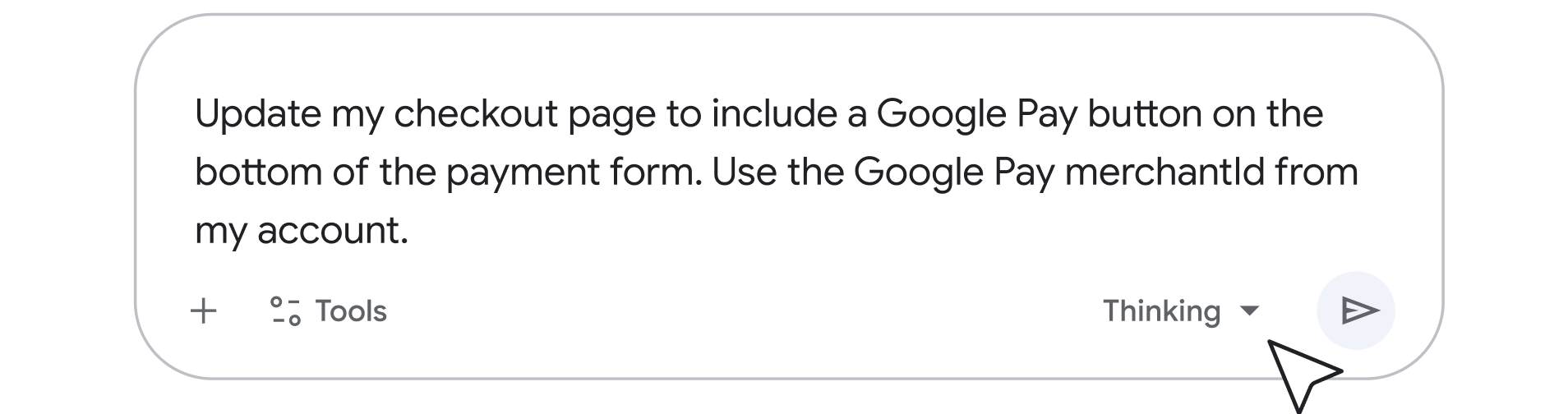
That does not transfer production responsibility to the assistant. Payments combine security, compliance, user experience, disputes, refunds, fraud signals, and multi-factor authentication requirements. Even if an AI agent reads error metrics and rewrites a pass definition, the team still has to run code review, test cards, sandbox transactions, payment service provider reconciliation, accessibility review, and legal copy checks. Google's screencast-style example shows an AI agent proposing logic for adding a Google Pay button to a web application. The distance between suggestion and deployment still needs a human approval line.
The announcement does not lean on big performance numbers. Google did not claim that the MCP server cuts integration time by a particular percentage or reduces errors by a measured amount. It published tool categories instead. That is more useful than a vague productivity number for engineering teams. The AI coding assistant market keeps cycling through benchmark results and editor UI launches, but enterprise developers often need answers grounded in a specific product console and account state. Google Pay's MCP server expands the assistant's context from the repository into the payment platform.
Community reaction is still limited. As of May 30, 2026, there were no large Hacker News or Reddit discussions around the launch. English and Chinese personal blogs and AI-news curators reacted first, mostly framing it as less flashy than a model launch but practical for payment integration. Some secondary posts also misexpanded MCP as "Merchant Commerce Platform" or blended UCP and the MCP server as if they were one backend. That confusion is worth calling out because it changes the reading of the announcement. In Google's materials, MCP is the Model Context Protocol server, while UCP appears in the agentic commerce protocol context.
The competitive frame is not only "which checkout button wins." OpenAI and Stripe are pushing agentic checkout experiences, while Microsoft ecosystem work around Copilot and Dynamics points toward commerce agents in enterprise workflows. Google Pay says existing Google Pay backends and Merchant IDs can connect to agentic commerce, but the developer-facing product here is the MCP server. The front-stage story is "AI can help someone buy." The back-stage story is "AI can inspect and manage the merchant integration that makes buying possible." Google productized the second layer first.
That move puts pressure on payment service providers and commerce platforms. Good documentation is no longer enough if an AI assistant cannot read live account status. Without account, validation, metric, and configuration tools, the assistant's answer remains generic. With those tools, it can inspect whether a specific merchant is ready for launch. If Stripe, Adyen, Shopify, commerce SaaS vendors, or loyalty platforms expose similar surfaces, the developer console becomes both a human-clicked interface and an agent-called tool API.
Engineering teams evaluating this preview have three concrete decisions to make. First, read-only tools and write tools should be separated. Documentation search and error lookup are lower risk; merchant account creation and integration settings need an approval workflow. Second, sandbox and production projects should be split clearly. The more convenient an MCP client becomes, the easier it is for a local ADC login to point at the wrong project. Third, any AI-generated fix still needs to pass the Google Pay test suite, Wallet pass validation, and real sandbox transactions.
The headline uses "payment integration into IDE agents" because that is the substance of the release. Google did not launch one new checkout UI. It grouped the documentation, account status, schema validation, metrics, and setup tasks required for Google Pay and Wallet integration into an agent-callable tool surface. Developers may open fewer browser tabs, but they now have to decide what authority the assistant receives inside the IDE. Convenience and control are moving onto the same screen.
The next metric to watch is tool granularity, not adoption alone. The practical value depends on which Google Pay MCP tools are read-only, which require explicit confirmation, and how much detail error metrics expose. Public preview status also matters for support and stability. Because the Marketplace listing names Pre-GA terms, the realistic use case is not handing the entire production-critical payment workflow to an assistant. The better starting point is integration inspector, documentation navigator, and validation helper.
Google Pay & Wallet Developer MCP server is a sign that the MCP ecosystem is moving beyond demo file readers into higher-risk development work. AI agents writing code is now familiar. The next layer is agents reading product consoles, interpreting account state, analyzing operational metrics, and proposing configuration changes. Google's preview opens that boundary inside payment development. The engineering task is not writing a faster prompt. It is deciding which tools an assistant may use and which approval gates humans must keep.