HTTP 402 is back, and AWS is drawing the guardrails for agent wallets
AWS AgentCore Payments preview turns AI agent payments into an infrastructure problem of x402, session budgets, credentials, and audit logs.
- What happened: AWS introduced
Amazon Bedrock AgentCore Paymentsin preview and published a technical deep dive on May 26.- The flow connects Coinbase CDP and Stripe Privy wallets so agents can pay for
HTTP 402resources during execution.
- The flow connects Coinbase CDP and Stripe Privy wallets so agents can pay for
- Why it matters: Payment is moving from checkout pages into agent runtime APIs such as
ProcessPayment, session budgets, and credential vaults. - Developer impact: Agents can reach paid APIs and MCP servers without pre-created accounts, subscriptions, or API keys, but approval boundaries become much more important.
- AWS is foregrounding discovery across 10,000-plus x402 endpoints, atomic budget checks, and CloudWatch observability.
- Watch: The preview provides payment rails, not automatic buyer-intent validation, refunds, disputes, or regulatory accountability.
AI agents eventually need to spend money if they are going to complete real work. Until recently, that sentence still felt like a future-facing idea. Coding agents run tests, browser agents fill forms, and research agents scan the web, but payment usually remains on a human-owned screen. The equation changes when an agent has to choose paid data APIs, MCP servers, premium model endpoints, sandbox execution, or paywalled content while a task is already running. An agent cannot comfortably type a card number, create a fresh account each time, or ask a platform team to pre-provision dozens of API keys before it knows which resource it needs.
AWS addressed that bottleneck directly with the Amazon Bedrock AgentCore Payments preview, announced on May 7, 2026. Its May 26 technical deep dive makes the stronger point: this is not just a wallet connection. It is a payment runtime tied into AgentCore identity, gateway, budgets, and observability.
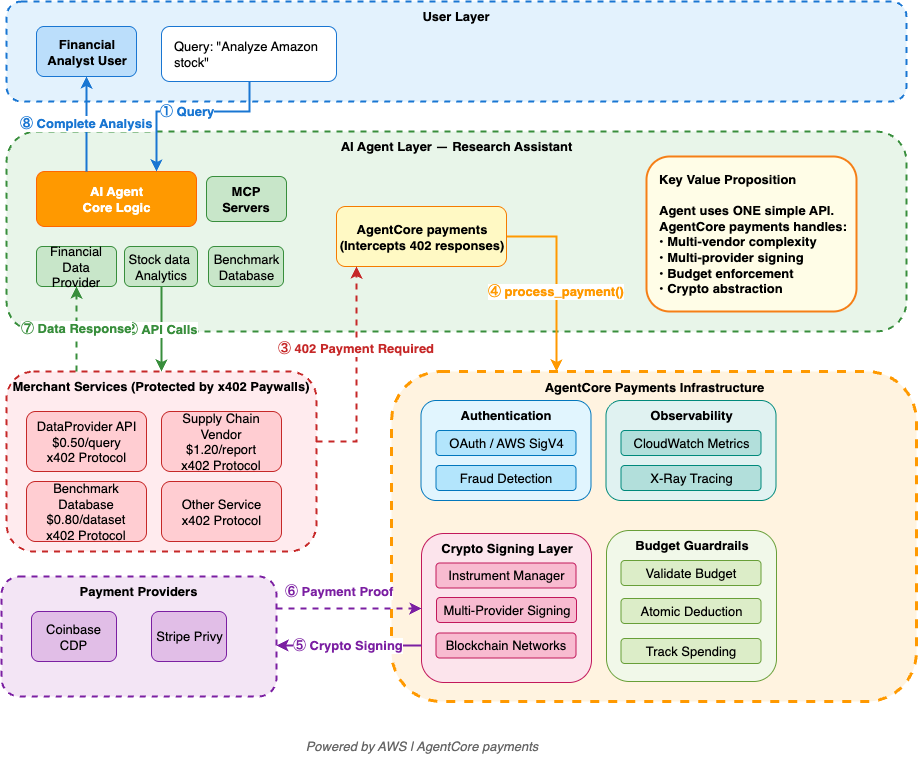
The surface news is easy to summarize. AgentCore Payments starts with Coinbase and Stripe as partners, and it lets AI agents pay for paid APIs, MCP servers, web content, and other agents. In preview, the central protocol is x402. x402 revives the long-neglected HTTP 402 Payment Required status code. A server returns a payment requirement, the client attaches a payment proof, and the client retries the request inside the same machine-readable loop. Instead of sending a person through a checkout page, the agent reads the payment terms, creates proof, and obtains the resource as part of execution.
The more important signal is AWS's framing. The company is not simply saying that agents can pay. It is saying that agents that pay need a different control plane. If a model gives a wrong answer, the problem is output quality. If an agent makes the wrong payment, real money moved. That makes the core of this category less about prompts and more about credential vaulting, spending limits, audit logs, buyer-intent verification, and dispute paths.
Payment becomes a runtime API
Traditional SaaS and API billing were designed around humans. A developer opens a service page, creates an account, chooses a plan, enters a card or tax profile, copies an API key, and then watches monthly usage. That flow works tolerably well when a person chooses one or two providers ahead of time. It works poorly when an agent decides during execution that this task needs a financial data API, then a news API, then a paid benchmark dataset.
AWS's key interface is ProcessPayment. When an agent calls a paid endpoint and receives HTTP 402, AgentCore Payments interprets the x402 payment payload, works through the connected wallet provider, creates a payment proof, and lets the agent retry the request with that proof. The developer does not need to wire a separate payment SDK, wallet signing flow, protocol version handler, and retry loop for every provider. AWS's pitch is that the orchestrator absorbs protocol and provider differences while the application keeps calling one managed interface.
This matters because agent payment is not a single button click. A user might ask for a competitive analysis of a market segment. A research agent may call several paid sources in parallel. One API costs 50 cents, a report costs $1.20, and a benchmark dataset costs 80 cents. Each transaction is small, but together they become a budget. If several sub-agents share the same session budget, concurrency becomes a correctness problem. One worker can read remaining budget while another worker spends it first. A client-side check is not enough to prevent overspending.
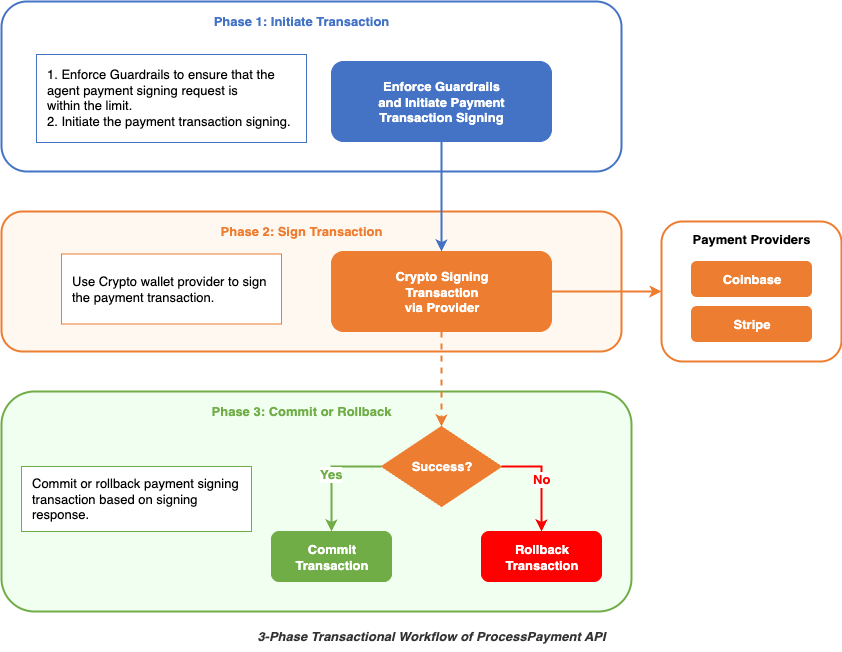
The AWS deep dive describes budget control as a three-step workflow: reserve, process, then commit or roll back. The requested amount is atomically reserved before payment, the provider processes the payment, and the reserved amount is either committed after success or released after failure. The operative word is "atomic." Agent payments are closer to database transactions than to checkout buttons. AI does not remove the consistency problem around money. Parallelism and retries make it sharper.
| Category | Traditional API billing | Direct x402 implementation | AgentCore Payments |
|---|---|---|---|
| Access model | Accounts, subscriptions, API keys | HTTP 402 plus payment proof | Managed generation of x402 proof |
| Agent fit | Weak fit for runtime discovery | Machine-friendly, but wallet logic is required | Tied to Gateway, Identity, and session budgets |
| Control point | Monthly invoices and API-key limits | Policy written by the implementer | Session limits, auth, logs, and traces |
| Open question | Signup and key-management overhead | Balances, chains, approval UX, disputes | Buyer intent and accountability boundaries |
What x402 solves, and what AWS adds
x402 is not an AWS invention. It is an internet-native payment protocol led by Coinbase, and the developer community has already explored it in several directions. The protocol's appeal is not merely that an agent can pay for an API. Its deeper promise is removing the API-key lifecycle from small, on-demand purchases. An agent discovers a capability, pays a tiny amount, and receives a result without negotiating a billing dashboard, rate-limit contract, or subscription plan first.
That primitive still leaves several product questions. What happens when the wallet has insufficient balance? Who manages gas, chain choice, and token support? How does a company express that one agent can spend only $5 per day on financial data, while another can spend more on approved security scanners? x402 defines the payment language. It does not, by itself, define enterprise authorization, procurement, observability, or dispute handling.
AWS's move is to pull those missing layers into AgentCore. A payment connector represents the provider integration, such as Coinbase or Stripe. A payment instrument is the actual payment method used by the agent. A payment session binds a user and a run to time-limited and budget-limited context. AgentCore Identity stores credentials in a secure token vault and avoids exposing raw credentials to the agent runtime. AWS says cryptographic material lives in AWS Secrets Manager and is not returned through the API.
That is different from simply handing a private key to an agent. The more precise model is that workload identity and user context participate in payment authorization, while the resulting capability is constrained by session policy and budget. Even if the agent acts autonomously, the whole wallet is not open to it. It can create payment proof only within the scope of the session. That distinction matters because practical agent failures often become dangerous through excessive authority, not through reasoning failure alone.
Discovery is the harder procurement problem
AWS's What's New post says the Coinbase x402 Bazaar MCP server is available through AgentCore Gateway, enabling agents to discover and pay across more than 10,000 x402 endpoints. The number is useful as a signal of early supply, but the developer question is not only how many endpoints exist. It is how an agent chooses one.
As paid MCP servers and APIs multiply, tool selection becomes a blend of search ranking and procurement. Which API is trustworthy? Is the price proportional to the task value? Could the same result come from a free or already-approved source? Does the provider retain user queries or data? If the paid result is wrong or incomplete, is there a refund, retry, or dispute path? Vendor review, which used to happen before a human bought SaaS, moves into runtime tool selection.
That is why AgentCore Payments is better understood as the beginning of a payment rail, not a complete purchasing system. AWS also acknowledges that broader agentic commerce requires more protocols, stronger buyer-intent verification, and end-to-end transaction lifecycle observability. In other words, the preview does not mean agents can safely book flights, buy goods, or make high-risk purchases without additional controls. The natural early fit is smaller paid resources with clearer task boundaries: APIs, datasets, MCP tools, premium content, and execution environments where failure can be contained.
Observability changes when money moves
Agent observability has mostly meant prompts, tool calls, latency, token cost, and output quality. Payments change the meaning of observability. Teams need to know which user request triggered a paid endpoint, why payment was considered necessary, how much was spent, what budget remained, whether a failed run reserved money or actually spent it, and how payment proof correlates with the returned result.
AWS says AgentCore Payments emits metrics, logs, and traces into the customer's AWS account. processPayment records success, failure, latency, and spend amount by token type. Structured logs include payment resource context and request IDs. Traces use W3C trace context and OpenTelemetry-compatible spans. That design treats payment as operational evidence, not just an SDK helper.
This is especially relevant to finance and security teams. Even if each agent spends only a small amount, aggregate spend can climb quickly. Thousands of agents repeatedly calling a few-cent API can create a month-end bill that does not feel intuitive to a human operator. On the other hand, asking a human to approve every low-risk purchase destroys much of the automation value. The practical answer is likely risk-tiered policy: low-cost and low-risk actions are handled by session policy, while higher-risk purchases escalate to a person.
Identity remains central. "The agent paid" is not enough. A useful audit trail must show which user the agent represented, which team's budget it used, what work objective it served, which policy allowed it, and who can review the decision later. That is why AWS places Identity and observability so close to the payment feature.
Why coding agents may feel this first
This announcement may matter to coding agents and developer tooling before it matters to shopping agents. Coding agents already call search tools, package registries, sandboxes, CI systems, issue trackers, code review services, and security scanners. If some of these become pay-per-use resources, an agent can buy exactly the capability it needs for the current task: a one-off vulnerability scan, a specialized benchmark runner, paid documentation search, or an ephemeral browser or GPU sandbox.
The existing model requires teams to contract with providers in advance and issue keys before the agent can use them. That creates platform and security overhead. If x402-style discovery becomes common, the agent could discover a tool during execution while the team controls it through session budgets and provider allowlists. A policy such as "this agent may spend up to $3 on approved external scanners for npm package audits" becomes conceivable.
That does not automatically create a free-form tool marketplace. Coding agents operate near source code, secrets, customer data, and build artifacts. Automatically discovering a paid MCP server also means deciding what context can leave the environment. Controlling the payment authority is necessary, but insufficient. Data egress policy, tool input redaction, provider trust, audit logs, and result verification have to travel with it. Code and data may be more expensive than the payment itself.
The market signal
The broader AI platform race is moving from model calls toward agent runtimes. Google, Microsoft, OpenAI, and AWS are all widening the boundary around tools, execution, identity, and governance. AgentCore Payments targets the moment when an agent touches an outside economy.
That is a natural cloud-provider problem. Agent payments require identity, secrets, logs, metrics, traces, rate limits, policies, regions, and compliance posture. These are control-plane problems cloud vendors already understand. A protocol or small SDK can define the payment exchange, but enterprise adoption also needs audit and accountability. x402 and managed cloud infrastructure may therefore sit at different layers rather than competing directly. The protocol gives machines a language for HTTP 402 and payment proof. The cloud platform wraps that language in operational policy.
For builders, the questions are concrete. Does the agent need to discover and use paid resources at runtime? Should spending limits be set per user, per session, per team, or per tool category? What data leaves the system when a paid tool is called? Can payment and output be reconstructed after the fact? Is there a path for incorrect purchases or low-quality results?
The first problem is control, not the wallet
AgentCore Payments can be described as giving agents a wallet. A more accurate description is that it puts agent payment inside infrastructure policy. Agents that can spend money can complete more work. They can also create more real-world failures. The important question is not only how to connect a wallet, but how to restrict it, record who authorized it, show what was bought, explain why it was chosen, and recover when the result is wrong.
HTTP 402 returning to the center of a developer conversation is historically interesting. But the core of this news is not the resurrection of an old status code. It is the possibility that agents will consume APIs, MCP servers, content, and other agents through per-execution payments rather than human-centered subscriptions. If that shift becomes real, payment control has to arrive before payment freedom. AWS is drawing that control boundary inside AgentCore. The question for developers and platform teams is now unavoidable: what can your agents buy, how much can they spend, and can they explain the decision later?