Cisco Cloud Control brings Codex into network operations
Cisco Cloud Control puts AI agents, Codex, policy, audit logs, and digital-twin validation into one network operations platform.
- What happened: Cisco unveiled
Cloud Controlat Cisco Live US on June 2, 2026 and opened Controlled Availability for U.S. commercial customers.- The platform joins networking, security, compute, observability, and collaboration data so humans and AI agents can work from the same operational evidence.
- Developer surface: Cloud Control Studio includes an App Builder with OpenAI
Codexembedded.- Cisco is moving Codex from standalone coding workflows into a governed enterprise builder for operations apps and workflows.
- Why it matters: production agent adoption is shifting from model capability toward identity, policy, auditability, approval paths, and pre-change validation.
- Watch: third-party marketplace details are scheduled for the second half of 2026, and Cisco has not disclosed the platform revenue-share rate.
Cisco brought AI agents into the network operations console on June 2, 2026. At Cisco Live US in Las Vegas, the company announced Cisco Cloud Control and started Controlled Availability for U.S. commercial customers. The newsroom release describes it as a unified platform where people and AI agents manage, monitor, and defend critical IT infrastructure. The scope is not one router dashboard or a chatbot attached to an admin screen. Cisco is trying to combine networking, security, compute, observability, and collaboration into one data layer and one execution surface.
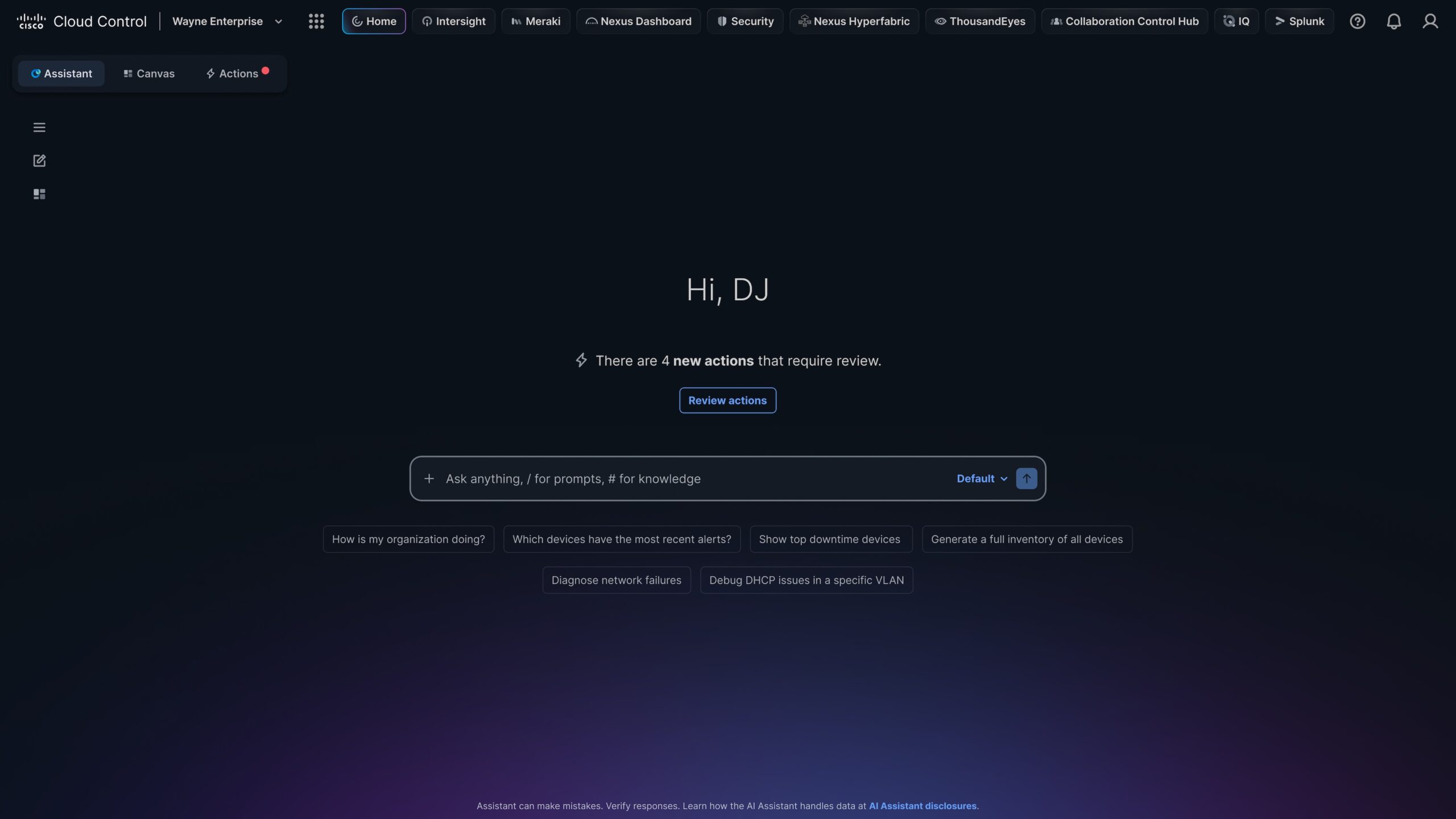
The announcement is worth reading from two angles. First, Cisco is arguing that operations agents need the same evidence, policy boundaries, approval path, and audit trail as human operators before they are allowed to change real systems. Second, Cloud Control Studio's App Builder embeds OpenAI Codex. That turns Codex from a coding assistant inside a developer workflow into part of a vendor-controlled builder for network operations apps and workflows.
Cisco's description is different from the familiar "management console plus AI assistant" pattern. Cloud Control aggregates telemetry from Cisco networking, security, compute, observability, and collaboration products. Cisco also names AWS, Linear, Microsoft, PagerDuty, ServiceNow, Slack, and Google Cloud, including Wiz, among the connected systems. The goal is to keep incidents, permissions, cost, token usage, and user-experience signals inside one operating environment instead of scattering them across ticket queues, cloud consoles, network tools, and chat rooms.
The Cisco AI blog frames Cloud Control as a harness around models. The comparison is deliberate. Codex and Claude Code became useful in software development not only because the models improved, but because they were wrapped in repositories, terminals, tests, permissions, and feedback loops. Cisco is applying the same idea to infrastructure operations. If an agent is going to touch routers, switches, controllers, firewalls, clients, users, workloads, or applications, Cisco says the agent needs identity, policy, zero trust, and audit logs around every action.
Cloud Control is organized around three surfaces: AI Canvas, Cloud Control Studio, and Cloud Control Marketplace. AI Canvas is the workspace where people and agents investigate and resolve issues from the same live evidence. Studio is the design surface where customers and partners build agents, apps, and workflows. Marketplace is the distribution surface for the apps and agents created in Studio, plus tools from Cisco's ecosystem.
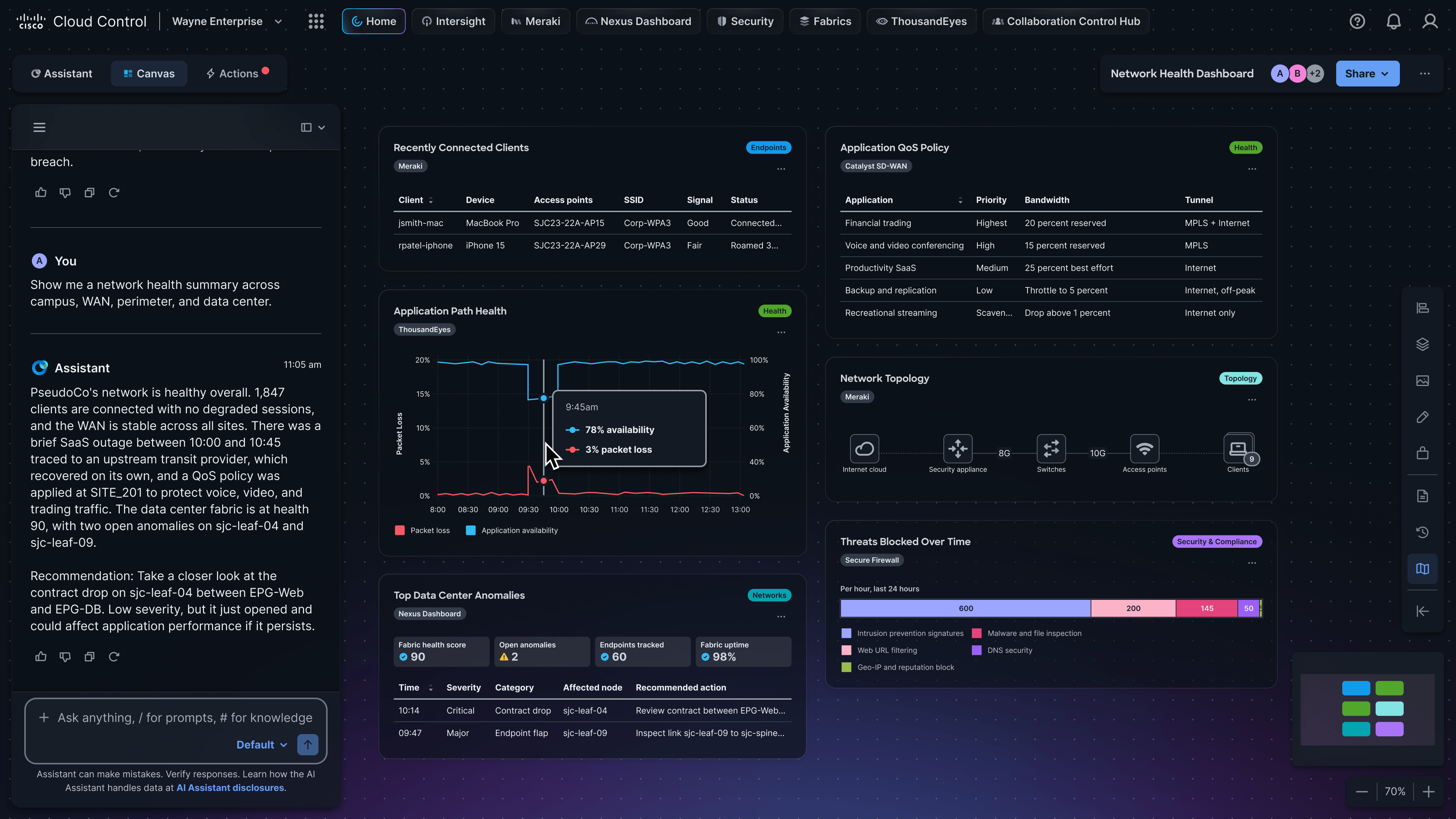
Studio includes Agent Builder and App Builder. According to Cisco's newsroom release, Agent Builder connects to more than 50 third-party platforms and tools through native connectors or MCP. App Builder uses natural-language prompts to create Cloud Control apps and workflows, and OpenAI Codex is embedded inside that builder. That is a small sentence with large product implications. Codex is no longer only writing code in a local terminal, GitHub task queue, or IDE-adjacent surface. In Cisco's model, it sits inside an operations platform with Cisco identity, hosting, policy, and deployment paths attached.
OpenAI and Cisco did not begin this relationship with Cloud Control. OpenAI published a Cisco customer story on January 20, 2026 describing how Cisco used Codex for AI Defense development and large engineering workflows. OpenAI said Cisco used Codex to analyze build logs and dependency graphs across more than 15 connected repositories, reducing build time by roughly 20% and saving more than 1,500 engineering hours per month. The same story says Codex helped with C and C++ defect remediation, cutting work that previously took weeks by hand into hours and increasing defect-resolution throughput by 10x to 15x.
Cloud Control makes that earlier story more strategic. Cisco first tested Codex inside its own large codebases and engineering workflows. It is now placing Codex inside a customer-facing tool for building operations apps. The boundary between the place where developers write code and the place where operators change infrastructure is getting thinner. The output of the App Builder is not just a script a developer runs locally. It can become an app or workflow that lives inside Cloud Control Marketplace and executes under Cisco's platform rules.
| Component | Cisco description | Developer and ops impact |
|---|---|---|
| AI Canvas | Workspace where people and agents investigate and resolve issues from the same live evidence | Incident notes, hypotheses, evidence, and actions can survive shift changes and escalation paths. |
| Agent Builder | Connects to more than 50 third-party platforms through native connectors or MCP | Tool scope and approval requirements for operations agents move into the platform policy layer. |
| App Builder | Creates apps and workflows through natural-language prompts with OpenAI Codex embedded | Codex becomes an operations app generator whose output runs under Cisco hosting and governance. |
| Marketplace | Publishes Studio outputs and ecosystem apps and agents | Agent tool distribution may shift toward app-store-style review, approval, and billing. |
The timeline matters more than the feature names. Cloud Control entered Controlled Availability in the United States on June 2. Cisco says Global Availability will follow, but the newsroom post does not give a precise date. A separate Cisco blog says Agentic Actions for networking, Expanded Experience Metrics, and Deep Reasoning are planned for beta in June 2026. Digital Twin is planned for alpha in July 2026.
Those dates point to a staged deployment, not a sudden arrival of fully autonomous network operations. Agentic Actions for networking presents incidents, recommendations, reasoning, evidence, confidence scores, risk scores, and next actions. Expanded Experience Metrics uses ThousandEyes to detect wired and wireless user-experience degradation. Deep Reasoning structures competing hypotheses, evidence, impact, root cause, and recommended action. Digital Twin emulates devices, connections, topology, and configurations so teams can validate operational changes before production execution.
Security announcements arrived alongside the operations platform. Cisco said Live Protect is available on N9000 series switches, included with Nexus One product entitlements, and planned to expand to campus and branch smart switches and security routers. The company also said quantum-safe secure boot will be built into new campus, branch, and data center router, switch, and firewall series. Cisco IQ Quantum Ready Assessments are planned for global availability in July 2026.
Reuters added the business mechanics around the platform. Its June 2 report says Cloud Control is available in North America and that the third-party tool marketplace is planned for the second half of 2026. DJ Sampath, Cisco's head of AI software and platform, told Reuters that Cisco expects to receive a share of revenue from platform sales, while the exact rate has not been determined. That turns the operations-agent platform into a technical control surface and a distribution channel for agent tools.
The embedded Codex feature changes character in that context. When a developer subscribes to Codex and assigns repository work, cost and permission decisions usually sit at the developer, team, or source-control boundary. In Cloud Control's App Builder, Codex becomes a feature inside Cisco's platform. The bigger questions are which prompt produced which app, which network or security systems that app can touch, where execution authority is granted, and what evidence remains in logs after an app or workflow runs.
Cisco repeatedly uses the language of human control. The newsroom release says people and agents share operational context and a system of action while humans remain in control. The Cisco blog says agent actions need to be transparent, auditable, bounded, reversible, and subject to human approval. That is still product-launch language, but the requirement is real in infrastructure operations. An agent changing firewall policy, router configuration, cloud connectivity, or user-experience routing has a higher failure cost than an agent opening a pull request.
Compared with recent systems such as Google's SRE AI Operator, Cisco is emphasizing the execution point. An SRE operator focuses on incident procedures and operational knowledge. ServiceNow and Microsoft agents have strength in tickets, collaboration, endpoints, and work data. Cisco's differentiator is the installed base of routers, switches, firewalls, ThousandEyes, Splunk, and network policy. It is trying to make "infrastructure an agent can change" the product boundary.
For developers and platform teams, Cloud Control raises four practical review questions. First, what form do the source, reviews, tests, and rollback paths take for operations apps generated by Codex? Second, can access to external systems connected through MCP or native connectors be reduced per session, per user, and per task? Third, how closely does Digital Twin validation match real devices, topology, and configuration drift? Fourth, what metadata and runtime logs does a Marketplace app expose before an internal security team approves it?
Cloud Control does not mean autonomous network operations are finished. Controlled Availability, beta, alpha, and second-half Marketplace are all still in the public timeline. The direction, however, is specific. The pattern that coding agents use in repositories, where they plan, edit, test, and request approval, is moving into the operations console. The deciding layer is less likely to be the most fluent chatbot and more likely to be identity, policy, evidence, validation, billing, and audit logs attached to each execution path.
Teams that do not run Cisco should still pay attention to the design unit. Today, GitHub Actions, Terraform, ServiceNow, Slack, PagerDuty, cloud consoles, and security consoles often maintain separate approval paths and logs. Cisco is proposing a surface where those pieces are joined and agents move beyond suggestions into app generation and execution. Even in a different vendor stack, the policy document for "what can an agent do?" needs more detail once agents can request changes across network, cloud, and security tools.
The real test will come after incidents, not demos. Operators will need to inspect which evidence an agent used, whether confidence and risk scores came with explanations a human can evaluate, how long rollback takes after a bad recommendation, and how a Codex-generated app passes security review. Cisco has the installed base to make this credible, but that base also lowers the tolerance for mistakes. A bad agent action in a production network is not the same class of failure as a broken local code edit.
The announcement also sends a signal to the coding-agent market. Codex, Claude Code, Copilot, and Cursor have mostly competed in IDEs, terminals, repositories, and task queues. Cisco's version adds another channel: large enterprise vendors embedding coding agents inside operations platforms. In this case, Codex becomes part of Cisco's operations app builder. The next buyer for coding-agent capability may be a network operations platform, security operations suite, ITSM system, or cloud-management console rather than an individual developer account.
So Cisco Cloud Control is not just "Cisco launched an AI agent product." A more precise read is that Cisco is opening network-operations execution to agents by bundling Codex, MCP, policy, digital-twin validation, and marketplace distribution into one product family. When the Marketplace and Global Availability details arrive later in 2026, the useful comparison will not be how many agents a vendor can announce. It will be how well each platform handles pre-execution validation, post-execution audit, external-tool billing, and recovery after a bad operational action.