Salt Code brings MCP policy enforcement into AI coding tools
Salt Code uses MCP to push security policy into Cursor, Codex, Claude Code, and other AI coding assistants before vulnerable code reaches review.

- What happened: Salt Security introduced
Salt Code, an MCP-based product for enforcing security policy inside AI coding tools.- The official page lists Cursor, GitHub Copilot, Claude Code, Codex, Gemini CLI, Antigravity, and other MCP-capable clients as targets.
- The numbers: Early access starts with the first 100 organizations, four secure coding packs, and more than 40 policies.
- Why it matters: AI code security enforcement is moving from PR review and SAST toward the prompt, MCP server, and code-generation path.
- Salt is trying to make API auth, MCP scope, LLM input handling, and OpenAPI rules part of the assistant's working context before a diff exists.
- Watch: MCP can give multiple assistants a shared policy baseline, but the policy server itself becomes a sensitive control and telemetry point.
Salt Security introduced Salt Code on June 1, 2026. The announcement is not mainly about finding vulnerabilities after an AI tool has already generated code and handed it to PR review, SAST, or DAST. Salt says it wants to place API security, MCP security, LLM security, and OpenAPI policy inside the assistant workflow used by tools such as Cursor, GitHub Copilot, Claude Code, Codex, and Gemini CLI. The security decision moves closer to the moment an assistant writes an endpoint, registers a tool, or drafts an agent integration.
Salt's official product page describes Salt Code as a solution that enforces security policies inside AI coding assistants. The same page says Salt Posture Governance Engine connects to tools developers already use and carries policy from prompt to production. One product screenshot shows Cursor generating an agent registration API while checks for HTTPS authentication, UUID user IDs, JWT bearer auth, PII encryption, rate limiting, and shadow API prevention are marked as Salt Compliance Verified.
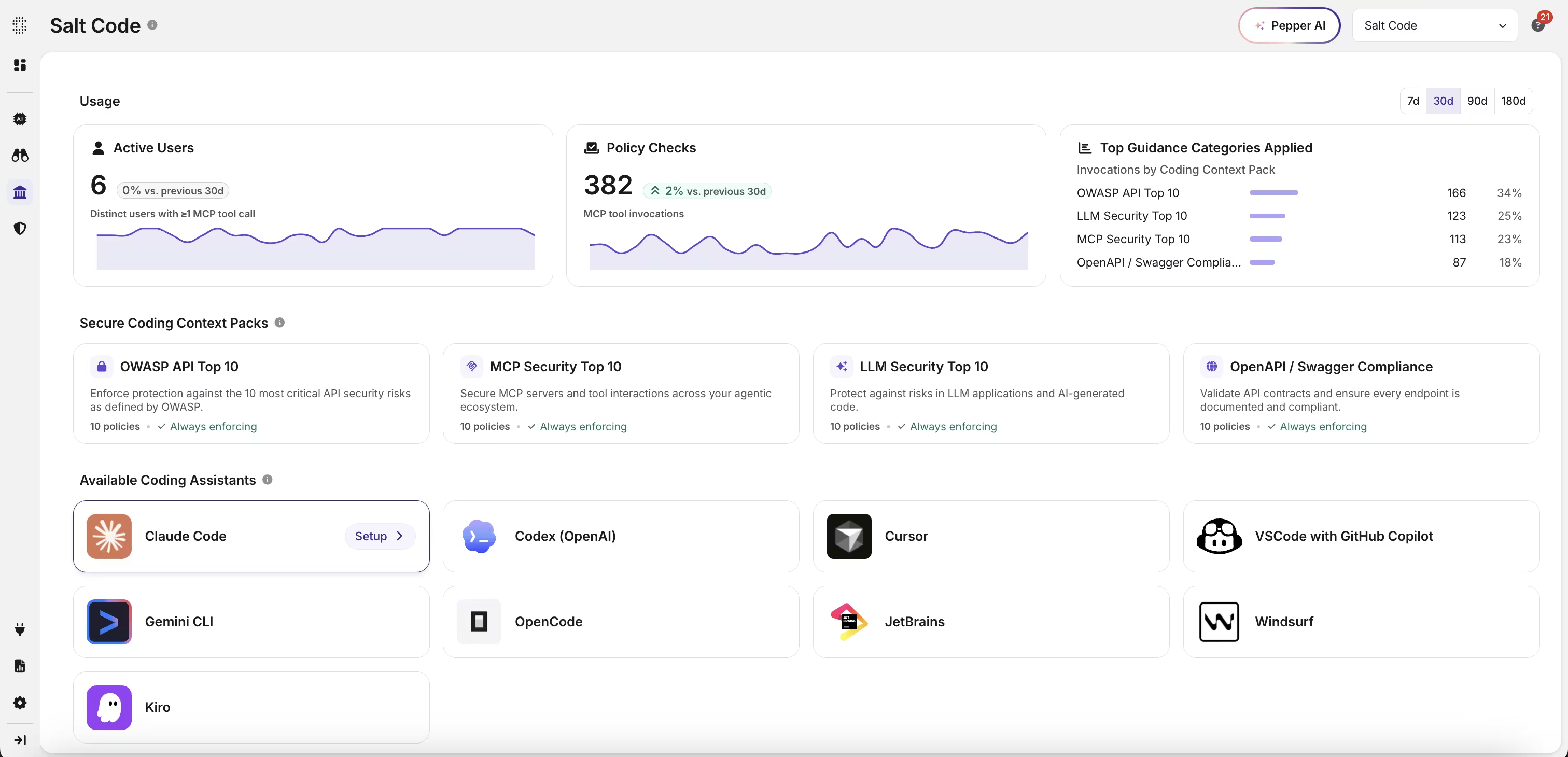
The free early-access page makes the positioning more concrete. Salt says early access is open to the first 100 organizations and includes four secure coding packs with more than 40 policies. The four packs cover OWASP API Top 10, Salt's MCP Security Top 10, LLM Security Top 10 based on OWASP Top 10 for LLM Applications, and OpenAPI/Swagger compliance. The page also mentions support for more than 10 AI coding assistants and a no-credit-card start.
The release matters for AI development teams because the review location changes. Many teams still describe control with a sentence like "humans review AI-generated code." Salt Code is arguing for a different path: before the reviewer sees a diff, the assistant should already receive security context and MCP tool guidance that reflect the organization's rules. Instead of asking a PR reviewer to notice that a new API endpoint lacks authentication, the assistant should receive the authentication schema and rate-limit requirement while the endpoint is being created.
Salt compresses the operating model into three steps. First, connect Salt Code as an MCP server to assistants such as Cursor, GitHub Copilot, or Claude. Second, enable policy packs for OWASP API, MCP Security, LLM Security, or OpenAPI. Third, developers continue prompting the assistant in the same workflow while generated code is shaped by those policies. Salt presents this as "one configuration, every assistant," but deployment will still depend on how an organization distributes MCP settings, grants permissions, and audits policy decisions.
| Review point | Traditional code security | Salt Code's proposed model |
|---|---|---|
| Before code generation | Relies on developer memory, wikis, and security guidelines. | Connects policy packs to assistant context through an MCP server. |
| During code generation | The assistant follows public training patterns and the user's prompt. | Applies API, MCP, LLM, and OpenAPI rules to generated output. |
| PR and CI/CD | SAST, DAST, and reviewers push back on code that already exists. | Extends policy validation into PRs and CI/CD gates. |
| Runtime | Runtime detection is often separated from the developer workflow. | Feeds runtime findings back into fix suggestions and assistant workflows. |
The volume of AI-assisted code is already large enough for security teams to treat this as an operational problem. Sonar's 2026 State of Code Developer Survey, based on more than 1,100 professional developers, says AI-generated or AI-assisted code currently represents 42% of committed code. Respondents expected that share to reach 65% in 2027. The more uncomfortable number is the verification gap: 96% of developers said they do not fully trust the functional accuracy of AI-generated code, but only 48% said they always verify it.
That gap explains the market Salt is targeting. If reviewers cannot inspect every AI-generated diff closely, and if the assistant creating APIs and agent tools does not know the organization's security policies, defects move downstream into PR queues and CI failures. Taking Sonar's numbers at face value, security review is no longer handling only human-authored code. Salt's argument starts from that verification gap: policy needs to move closer to prompt context and code generation.
Veracode's 2025 GenAI Code Security Report adds pressure from another direction. Veracode tested more than 100 large language models across 80 coding tasks and reported that 45% of generated code samples contained OWASP Top 10 vulnerabilities. That number is not proof that every model fails the same way, but it weakens the assumption that a bigger or newer model reliably produces secure code. It also explains why Salt puts OWASP API Top 10 and LLM Security Top 10 packs at the front of the product.
Georgia Tech SSLab's Vibe Security Radar tracks public vulnerability advisories rather than synthetic benchmark prompts. Its about page says the project analyzed 46,831 advisories from May 1, 2025 through March 24, 2026 and tracked 78 AI-linked vulnerabilities. The pipeline finds fixing commits across OSV, GitHub Advisory Database, Gemnasium, and NVD, then uses SZZ-style blame to identify the commit that introduced the vulnerable code and checks for more than 54 AI coding tool signatures.
Vibe Security Radar is not a relative-risk study. The researchers state that it only covers public repositories with disclosed and fixed vulnerabilities, and that the conservative pipeline accepts missed cases to avoid false positives. Even with that caution, the data moves AI code security from a vague concern to a trailing indicator: some public advisories now have visible AI-tool traces in the commit history. Products like Salt Code are trying to turn that trailing indicator into an upstream policy-enforcement market.
Salt chose MCP as the connection layer. The official page says that if a tool supports MCP, Salt Code can govern it. The named targets include Claude Code, Cursor, GitHub Copilot, Windsurf, Kiro, Codex, Gemini CLI, Antigravity, VS Code, OpenCode, JetBrains, and any MCP client. As MCP becomes a common interface between assistants and external tools, security vendors are starting to enter the same interface.
The advantage of MCP-based enforcement is that security teams do not need to build and maintain a separate plugin for every assistant. A team may use Cursor, Claude Code, and Codex at the same time. Without a shared interface, security engineers have to chase each assistant's prompt conventions, extension APIs, and configuration model. If Salt's "one configuration, every assistant" claim works in practice, a policy pack can remain stable while a development team changes IDEs or CLIs. Developers keep tool choice while security teams attach a common baseline.
MCP also creates a new trust boundary. A policy server may observe or influence the assistant context, tool calls, repository metadata, API schema, and runtime findings. Security teams should ask what prompt fragments, source snippets, API descriptions, and telemetry are sent to Salt Code or any similar MCP server. A policy-enforcement tool can become another collection point for sensitive development telemetry, especially in regulated industries or closed-network environments.
Developer prompt and repository context
Salt Code policy packs connected through MCP
AI assistant generates API, MCP server, and agent-tool code
PR validation, CI/CD gate, and runtime feedback
The policy-pack list shows that Salt is aiming beyond generic code quality and toward agentic applications. The OWASP API Top 10 pack targets API risks such as broken object-level authorization, unrestricted resource consumption, and server-side request forgery at generation time. The MCP Security pack lists examples such as MCP server authentication, tool-description validation against prompt injection, and least-privilege scope for registered agent tools. The LLM Security pack covers prompt injection, sensitive information disclosure, and excessive agency.
The OpenAPI/Swagger compliance pack may be especially useful to platform teams. When AI assistants quickly create small endpoints, undocumented paths, missing response codes, and ambiguous authentication schemes can accumulate until API inventory breaks. Salt's page says every AI-generated API should include a documented authentication scheme, response codes, and schema definitions. That is less about blocking one vulnerability and more about preventing AI-created API sprawl from escaping inventory and governance.
Community discussion has not yet concentrated heavily around Salt Code itself. I did not find a large Hacker News or GeekNews discussion focused on the product name. The surrounding conversation about MCP security is already active, though. Hacker News discussed "The S in MCP Stands for Security" in April 2026, and Reddit threads in r/mcp and r/programming have shared tools that attach security checks or package-malware checks to AI coding assistants through MCP servers. The shared concern is that AI agents are no longer just text generators; they touch files, shells, dependencies, and remote APIs.
Salt Code will meet competition from several directions. One group includes small MCP tools such as SafeDep MCP Server, which adds threat intelligence before an AI agent installs a package. Another group includes code-security platforms such as Sonar, Veracode, Snyk, Semgrep, and GitHub Advanced Security, which already own post-generation analysis and developer feedback loops. A third group includes agentic-security and API-posture platforms such as Noma, Zenity, Onyx, Traceable, and Akto. Salt is trying to connect its API-security background to MCP and agent integration inventory.
The first evaluation question for a development team is whether the policy actually changes assistant output. A compliance screenshot is easy to understand, but real repositories contain legacy authentication, internal gateways, exception paths, test mocks, and partially documented APIs. If the policy server cannot read that context accurately, the assistant may generate overly conservative code or attach a compliance badge while missing an important exception. Evaluation should use real internal API changes, not only demo prompts.
The second question is where violations are blocked. Salt's page mentions generation-time enforcement, PR and CI/CD validation, and runtime validation. Those three points have different failure costs. Blocking during generation can improve developer experience, but too many false positives will lengthen prompt loops. Blocking at PR time is easier for reviewers and CI to understand, but developers must roll back code that already exists. Detecting at runtime gives traffic-based evidence, but the incident cost is higher.
The third question is how MCP server permissions are limited. Policy injection requires some view into repository structure, API specs, assistant context, tool calls, and CI results. Sending every prompt and source fragment to an external SaaS can be unacceptable in regulated industries or closed-network development teams. Organizations should verify whether Salt Code can be self-hosted, how data retention works, how custom policies are expressed, and whether audit logs can be exported to a SIEM.
The fourth question is whether the assistant can bypass the policy. MCP tool descriptions themselves can become prompt-injection targets, and repository content such as README files or issue text can instruct an assistant to ignore security rules. Salt's MCP Security pack names tool-description validation against prompt injection, but real defense requires separate trust levels across the assistant, MCP client, policy server, and CI gate. Teams should document what wins when a prompt instruction conflicts with a policy-server decision.
The fifth question is whether the security team's policy language is explainable to developers. When a PR reports a violation such as JWT bearer auth required on external APIs, the developer needs to know which endpoint, schema, and commit should change. If a policy is injected into the assistant without a readable remediation path, developers will spend time rephrasing prompts instead of fixing the cause. Salt's claim that runtime findings can become actionable fixes inside the developer workflow is aimed at that bottleneck.
For this product category to work, it needs a stricter model than "the AI reads the security team's PDF." Policies need to be versioned artifacts. Assistant calls and CI results need to carry the same policy IDs. Teams need to see which policy changed which generated code, how many false positives appeared, and who approved each exception. Without that evidence chain, Salt Code could become an invisible prompt-advice layer rather than an enforcement system.
Salt Code's launch is a sign that AI coding security is moving from prompt education to operational control. Telling developers to review AI-generated code carefully is not enough when AI-assisted code may already represent 42% of committed code in surveyed teams. Post-generation review remains necessary, but repeated policies such as API authentication, MCP scope, LLM input handling, and OpenAPI schema requirements are better applied while the assistant is writing the code.
That shift also creates more work for security teams. When enforcement moves upstream, security teams can no longer manage only quarterly audit documents. They need to operate the MCP servers that Cursor, Codex, Claude Code, and Copilot call, track policy-pack versions, manage assistant-specific exceptions, monitor CI gate outcomes, and feed runtime findings back into the development loop. Development teams capture the productivity gains of AI coding, but the code surface created by that productivity enters security operations in near real time.
Even teams that do not adopt Salt Code immediately can inspect their current workflow. Check whether AI assistants generate API endpoints without authentication schemes, whether MCP server registrations use least-privilege scopes, and whether prompt-injection defenses exist for user-facing inputs. Confirm that OpenAPI documentation matches real routes and that PR and runtime findings can be traced with the same policy identifiers. Salt Code is one productized version of that checklist, and MCP is the path it uses to reach the assistant.
The June 2026 AI coding security race is no longer only asking which model writes better code. The sharper question is who can enforce an organization's security standards at the moment an assistant writes code. Salt Code's early access may look like a small product launch, but for teams running Cursor, Codex, Claude Code, and Copilot side by side, it raises a practical architecture question: where should security policy live when code generation itself becomes part of the development platform?