Postman AI Engineer brings API contract checks into pull requests
Postman introduced AI Engineer, an API-aware agent that uses Context Graph, sandboxed execution, and PR QA to review API contracts.

- What happened: Postman introduced
AI Engineer, an agent for API exploration, design review, RCA, and pull-request QA.- The Postman blog metadata lists the announcement at
2026-06-02T12:00:46Z, with early access expanding by capacity.
- The Postman blog metadata lists the announcement at
- How it works: The product is built around
Context Graph,API Catalog, a sandboxed execution layer, and the Postman toolset. - Why it matters: API contract review can move from separate documentation work into the PR workflow where agent-generated code is merged.
- Teams still need to verify credential scope, write approval, VPC execution controls, audit logs, and catalog freshness before trusting automated checks.
Postman introduced AI Engineer on its official blog on June 2, 2026. The name sounds like another coding agent, but Postman's announcement is aimed at a narrower and more operational problem than generating functions. AI Engineer reads an organization's APIs, services, dependencies, owners, and test assets, then uses that context for API exploration, system design review, root-cause analysis, and API QA on pull requests. Postman says the product sits on its Context Graph and runs work inside a sandboxed cloud environment.
The developer-facing issue is API contracts. Coding agents have become faster at creating files and opening pull requests, yet large service teams often fail on changes that compile while violating the real contract. A payment company may have 17 similarly named endpoints, one canonical version, several deprecated paths, and downstream clients that expect a specific payload shape. If an agent does not know which endpoint owns the contract, which team maintains it, or which mobile client depends on a field, its pull request can look correct in the diff and still be wrong for production.
Postman calls that accumulated problem context debt. The announcement describes organizations with decades of APIs, services, databases, queues, and internal conventions, often held together by the memory of senior engineers. AI raises the cost of that debt because new services, new contracts, and agent-generated changes are created faster than the old review process can absorb. When the API context in a human reviewer's head does not reach the agent at implementation time, the generated change drifts away from how the system actually works.
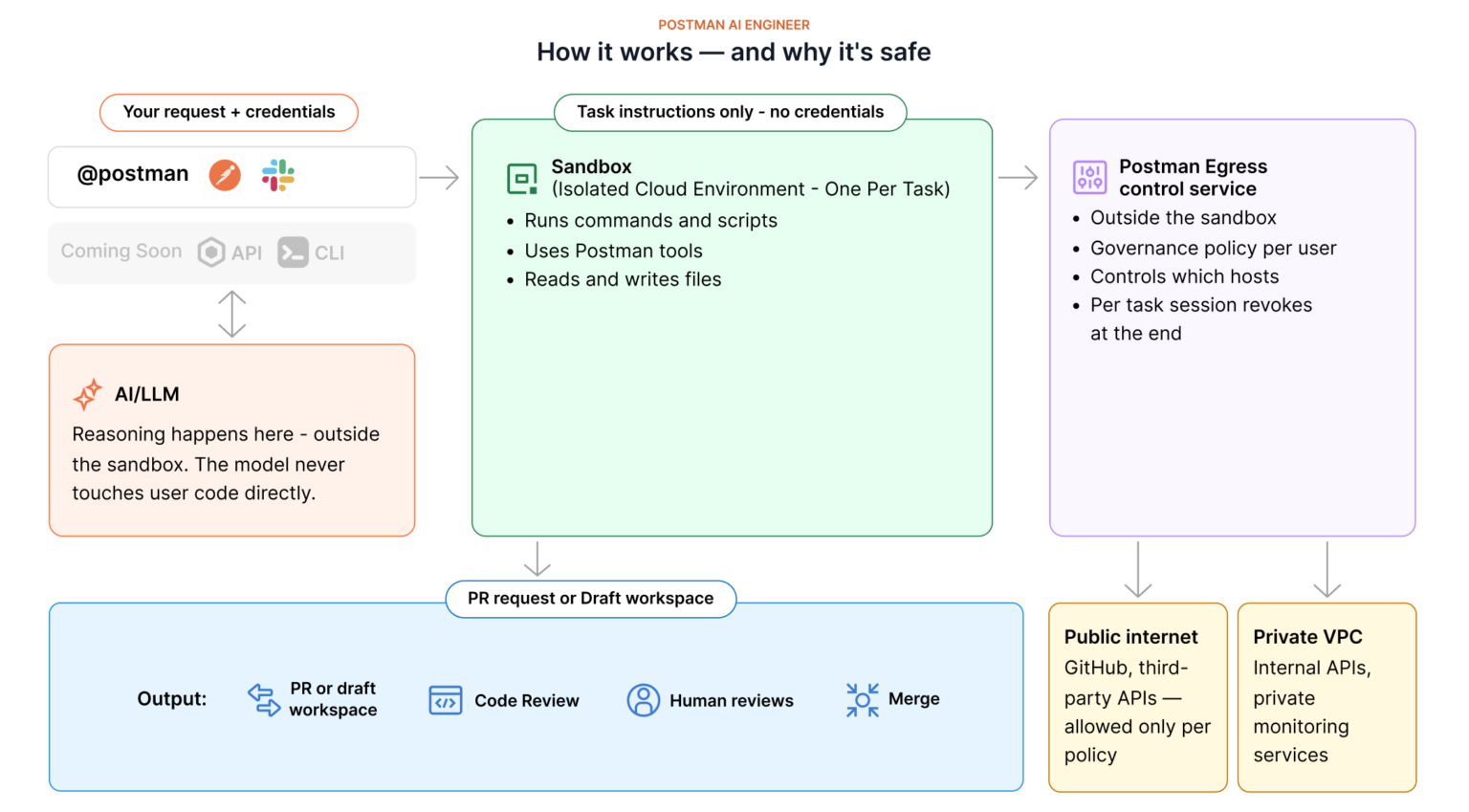
Postman's answer has four named components. Context Graph is the map of APIs, services, and dependencies across the Postman organization. API Catalog is the management plane for which APIs exist, who owns them, and what is approved. Execution Layer is the sandbox that can pull repositories, run bash commands, execute UI tests, and use Postman capabilities. Postman Toolset packages existing Postman features as tools the agent can call during its work.
That architecture starts from Postman's existing data. The company says its platform already contains collections, environments, specs, and workspaces from millions of developers and hundreds of thousands of organizations. That information differs from public API knowledge in a model's training data. A company's internal gateway, staging environment, approved credential, review rule, and owner map usually do not exist in public documentation. Postman is positioning those records as working memory for an agent.
The first workflow is Directed API Exploration. A developer selects an API or application and gives the agent a goal. Postman says AI Engineer can explore endpoints, infer behavior, and produce documentation, a working collection, and a runtime map. This reaches teams where OpenAPI specs and runtime behavior have drifted apart. A spec may show a field as required while staging treats it as optional, or an error response may have changed without the documentation catching up.
The second workflow is System Design Reviews. According to the announcement, AI Engineer reviews architecture across services, identifies dependency risk and inconsistency, and proposes changes. The important detail is that Postman frames the review around the organization's Context Graph, not generic microservice advice. The review is supposed to ask whether this service depends on that contract, owner, versioning rule, or authorization boundary inside the current organization.
The third workflow is API Design. Postman says the agent can create or improve API specifications while matching the naming, convention, and contract patterns already present in the API surface. Coding agents face the same problem when they generate a new endpoint. A route can work locally while still breaking the company's conventions for field names, status codes, pagination, authentication errors, or versioning. Postman treats those conventions as catalog and graph problems rather than only code-style problems.
The fourth workflow is Root Cause Analysis. During an incident, AI Engineer uses the Context Graph to follow dependencies, actively tests APIs with Postman tools, and returns a hypothesis with reproduction steps. Postman describes the target work as the first hour of senior-engineer investigation. In real operations, the decisive question is often not just "which log line changed?" but "which API contract changed, when, and who now receives the different response?" Collections, monitors, environments, and API tests are a more concrete starting point than a generic log summary if they reflect the live system.
The fifth workflow is API Testing and QA on Every PR. When connected to the pull-request review process, AI Engineer checks for contract regressions, breaking changes, security issues, and design inconsistencies before merge. That is the strongest reason to treat the announcement as more than an API documentation feature. API governance has often been split across manual Postman collection runs, platform-team review, gateway policy, and CI contract tests. Postman wants an agent to bring that work into the PR where code changes are reviewed.
| Workflow | Postman description | Question for teams |
|---|---|---|
| API exploration | Infer endpoint behavior and create documentation plus working collections | Can it capture differences between specs and real staging responses? |
| Design review | Use Context Graph to review service dependencies and inconsistency | Are owners, dependencies, and version rules current in the catalog? |
| RCA | Test APIs and trace dependencies to produce reproduction steps | Are logs and credentials narrow enough for agent investigation? |
| PR QA | Check contract regression, breaking change, security, and design consistency | Which findings block merge, and which require human approval? |
The security model will decide whether the product is usable in conservative engineering organizations. Postman says AI Engineer runs in a sandbox, does not touch infrastructure or the Postman instance unless the user asks it to, and stays within workspace boundaries and user-granted credentials. The announcement also says credentials do not pass through the agent reasoning layer. For more controlled deployments, Postman describes a separate execution layer inside a customer's VPC so teams can govern what the agent calls.
Write operations require explicit human approval, and outputs still pass through the existing PR review process. Postman compares the risk model to a junior engineer whose work is reviewed before it is accepted. That analogy is not a complete safety guarantee. It is useful because it confirms that AI Engineer is presented as a reviewed contributor and tester, not as a system with direct production-change authority.
The first adoption question is not which model powers the agent. It is whether the API Catalog represents real ownership and authorization. If the Context Graph is stale, AI Engineer can follow old relationships with confidence. If the canonical payment endpoint moved to a different team but the catalog still points at the old owner, an automated design review may request approval from the wrong group or preserve a deprecated contract.
The second question is credential scope. Postman says credentials do not move through the reasoning layer, but any agent that tests APIs still causes authenticated calls to happen in an execution layer. Teams that do not separate staging tokens, read-only tokens, write-capable tokens, and production access should not treat the sandbox as a complete answer. RCA and PR QA may need to reproduce failures by calling internal endpoints, so VPC execution, audit logs, and token boundaries need to be designed together.
The third question is how PR failures are handled. If AI Engineer flags a possible breaking change, does that finding block merge, create a non-blocking comment, or require API owner approval? Postman says the product integrates with the existing PR review process, but the actual effect depends on the organization's GitHub, GitLab, Bitbucket, CI, and API-governance rules. The difference between "agent warning" and "merge gate" is a policy decision, not a model capability.
The announcement fits beside other 2026 products that expose organizational context to agents. Microsoft Work IQ APIs open Microsoft 365 work context so agents can read organizational state. Google's Pay and Wallet MCP work brings payment and wallet development surfaces into IDE tooling. Postman's version turns collections, specs, environments, and catalog data into a graph an agent can use. In each case, the differentiation is less about the base model and more about how internal state is made available to an agent without losing control.
The comparison with coding tools is broader than it first appears. GitHub Copilot code review and cloud agents are strongest around repositories and pull requests. Cursor and JetBrains tools live close to the IDE and editing loop. Sourcegraph Amp emphasizes codebase understanding and agent execution. Postman enters with the API system of record. If its claim holds, the unit of review is not only the diff. It is the diff plus API contracts, collections, environments, and dependency graph.
Public community reaction was still limited at publication time. A search for "Postman AI Engineer" in HN Algolia returned no story or comment results, and GeekNews search did not show a direct item. That means it is too early to claim strong developer enthusiasm or backlash. The recurring issue in recent coding-agent discussions is still visible: as generation speed rises, context, permission boundaries, contract tests, and review criteria become the bottleneck.
The practical meaning of the announcement is the relocation of API contract checks. Before this, API governance could live in documents, gateway rules, CI tests, and periodic platform-team reviews. If AI Engineer can read Postman's graph and catalog reliably, the question in a pull request becomes more specific: does this change break the response contract expected by an existing client, owner, or downstream service?
The early-access status also matters. Postman's announcement says AI Engineer is available today, but access is starting with selected segments and expanding based on capacity. Postman also says it will publish more detail on Context Graph, the execution sandbox, internal operations experience, and customer use cases. Pricing, usage limits, CLI timing, VPC execution deployment details, audit-log shape, and PR-platform coverage still need follow-up documentation.
Teams can prepare without buying a new agent immediately. First, check whether the API catalog contains owner, lifecycle, version, and authentication requirements. Second, validate whether collections and environments reflect staging or production-like behavior. Third, define which contract-regression signals should fail a PR. Fourth, separate agent execution credentials from personal accounts and split read and write scope. Fifth, make sure agent hypotheses and test results have stable log locations so they can be reused in incident review and design review.
Postman AI Engineer asks a smaller and more operational question than "will AI replace developers?" Where is the organization's API memory stored? Is that memory called automatically during pull-request review? Which credentials and approvals does an agent pass through when it tests an API? If a team cannot answer those questions, coding agents can still produce fast changes, but humans remain responsible for proving that those changes preserve real service contracts.
Postman's advantage is that many API workflows already leave traces inside its platform. Its weakness is the same dependency. If a team does not use Postman as a system of record, if collections are stale, or if ownership is missing from the catalog, the Context Graph will be thin. AI Engineer's quality will depend less on a public model benchmark than on the quality of the API records an organization has maintained.
The next evidence to watch is operational rather than promotional: alert precision per PR, false-positive rate, stale-catalog detection, credential-isolation proof, write-approval logs, VPC execution conditions, and integration depth with review platforms. Until those details are public, AI Engineer is best understood as Postman's entry into the coding-agent race and as a warning that agent quality is bounded by API context quality.