Work IQ APIs reach GA on June 16, setting Microsoft 365 agent pricing
Microsoft Work IQ APIs reach GA on June 16 with M365 context, 10 generic tools, Copilot Credits pricing, and ACS control points.
- What happened: Microsoft says
Work IQ APIswill become generally available on June 16, 2026.- The APIs expose Microsoft 365 email, meetings, files, chats, people signals, and workspace state across Chat, Context, Tools, and Workspaces domains.
- Developer angle: Work IQ Tools use MCP progressive disclosure to reduce the action surface to 10 generic tools.
- Context API is closer to source context for agents than to a prewritten Copilot answer, which changes how teams design retrieval and tool calling.
- Cost and control: Work IQ is billed through Copilot Credits, while ASSERT and ACS move evaluation and runtime controls into the agent loop.
Microsoft used the first day of Build 2026 to announce the general availability date for Work IQ APIs: June 16, 2026. Work IQ had already appeared inside the Microsoft 365 Copilot experience, but this release moves it into developer APIs, Copilot Credits billing, Microsoft 365 admin cost controls, and MCP, A2A, and REST access surfaces. The May 28 Copilot redesign changed the user-facing input box and in-app execution surface. This announcement is about how external developers and enterprise IT teams attach Microsoft 365 work context to agents.
Microsoft describes Work IQ as a semantic model built from email, calendars, meetings, chats, files, people, collaboration patterns, and line-of-business systems. The API surface is less abstract than that description. Chat gives access to Microsoft 365 Copilot responses and agents running inside Copilot. Context returns source material in a form an agent can consume instead of returning a synthesized answer. Tools exposes Microsoft 365 actions such as sending email, scheduling meetings, and uploading documents through simple verbs and resource paths. Workspaces stores long-running agent state, files, memory, and progress inside the Microsoft 365 tenant boundary.
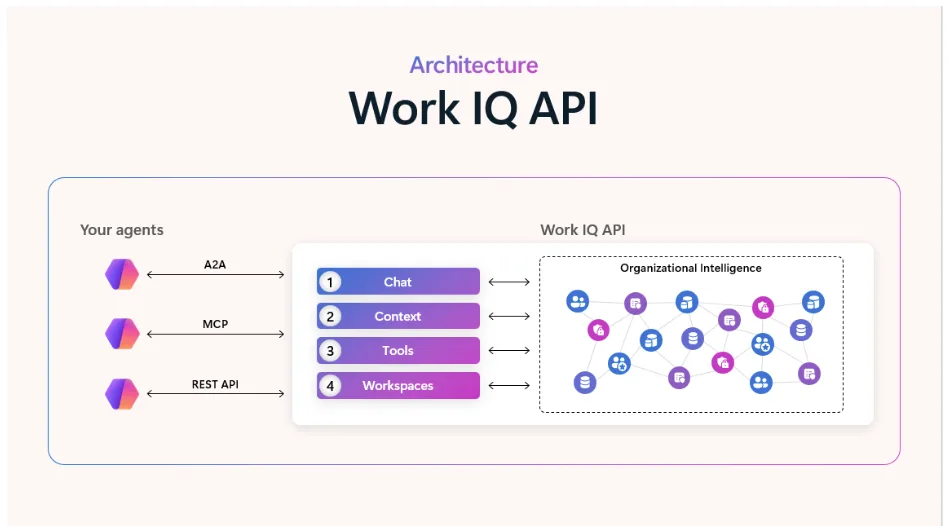
For developers, Context and Tools are the most direct changes. Many enterprise agents today stitch together Microsoft Graph, SharePoint, Teams, Outlook, CRM connectors, and a custom retrieval pipeline to construct context. That design forces teams to handle permission trimming, citations, file schemas, meeting signals, people relationships, and audit logs separately. Work IQ API's pitch is that part of that assembly cost should move into the Microsoft 365 runtime. The Context API claim that it returns agent-ready context instead of raw data is what separates it from a basic search endpoint.
The Tools domain targets the same operational problem from the action side. Microsoft says Work IQ APIs use MCP progressive disclosure so developers do not have to teach a model hundreds of data-specific tools. The surface is described as 10 generic tools. That number will not erase the complexity of every work scenario, and it comes from Microsoft's product framing rather than an independent benchmark. It is still a different model from prompting an agent with narrow wrappers such as sendMail, createEvent, uploadDocument, or searchDriveItem. The model specifies work through verbs and resource paths, while the Work IQ runtime applies Microsoft 365 knowledge and permissions.
Microsoft also published aggressive performance and efficiency claims. Its announcement imagery says the average Work IQ data footprint at Fortune 500 organizations is more than 600 TB. It also says Work IQ APIs are twice as fast at runtime compared with existing APIs and use 80% fewer tokens in a coding harness. Those numbers should be read as Microsoft internal data and internal tests, not independent benchmarks. The direction of the claim matters more than the exact figures for now: Microsoft is treating enterprise agent bottlenecks as context assembly, tool surface area, round trips, and token budget, not only model capability.
Pricing makes the announcement more concrete. Work IQ APIs use consumption-based pricing through Copilot Credits. Tools have a fixed component, while Chat and Context have variable components. Microsoft 365 admin center is getting a new cost management dashboard for AI credit usage, prepaid or pay-as-you-go billing, tenant, group, and user spending limits, and credit request monitoring. Work IQ APIs are the first product entering this management experience, and Microsoft says other Copilot Credits products such as Copilot Studio will follow.
That changes the adoption question for enterprise AI teams. Work IQ is not only selling "better search over Microsoft 365 data." Procurement and platform teams now have to ask how much a Context call costs, how Tools and Chat billing differ, how strongly per-user spending limits are enforced, and whether internal apps can use the consumption model without giving every user a Copilot license. The Microsoft 365 Developer Blog says Work IQ API access is available through a consumption model independent of Microsoft 365 Copilot licensing. That condition matters for teams that want to attach Work IQ to back-office automation or internal agents rather than to the Copilot UI.
| Domain | Role in Microsoft's description | What development teams should verify |
|---|---|---|
| Chat | Copilot answers and agent access inside Copilot | Citations, latency, and Chat variable credit cost |
| Context | Agent-ready source context instead of a final answer | Permission trimming, source freshness, and Context variable credit cost |
| Tools | Microsoft 365 actions through generic verbs and resource paths | Approval policy, audit logs, and fixed credit cost |
| Workspaces | State, files, memory, and progress for long-running agents | Tenant boundary, retention, and sensitive-data deletion policy |
The same Build 2026 announcement placed Work IQ inside a larger Microsoft IQ system. The official Build post describes Microsoft IQ, Work IQ, Fabric IQ, Foundry IQ, and Web IQ together. Work IQ handles Microsoft 365 work signals. Fabric IQ is framed as the semantic foundation for structured business data. Foundry IQ connects enterprise knowledge with live web retrieval planning. Web IQ provides MCP-native web grounding. Microsoft is positioning itself less as another model vendor in this layer and more as the enterprise context provider around which agents operate.
Microsoft Scout attaches to the same architecture. The Build post describes Scout as an always-on personal agent in private preview for Frontier customers. Scout runs on OpenClaw and Work IQ, and uses tools such as Teams and Outlook for meeting prep, scheduling conflicts, and routine tasks. Scout is not immediately available to every development team, but it shows the use case Microsoft has in mind for Work IQ APIs: not only chatbots that wait for prompts, but work agents that carry state over time and call organization data and tools.
Closer access to work data raises the control problem. If an agent can read meeting notes, email, and files, then schedule meetings and upload documents, the first question is not only what it can do. It is where it stops. Microsoft grouped that concern with Agent 365, ASSERT, Agent Control Specification, and MDASH. Agent 365 is described as a control plane that connects even local agents to Entra, Defender, and Purview for observability, governance, and security. ASSERT and ACS are closer to the developer language for that control plane.
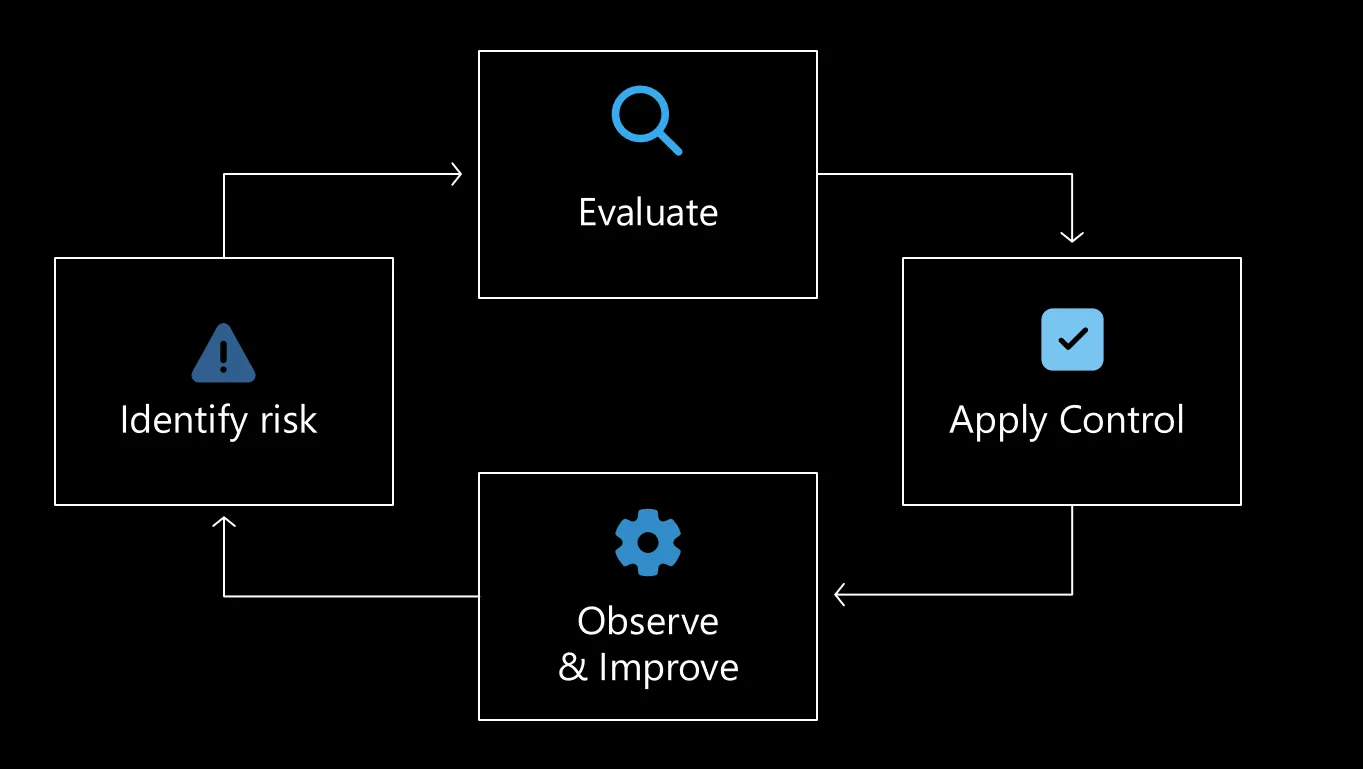
The Microsoft Foundry Blog introduces ASSERT as an open-source framework for policy-driven agent evaluation. It generates adversarial tests from policy and exposes where an agent fails. Agent Control Specification tries to standardize where controls apply across the agent loop: input, model, state, tool execution, and output. TechCrunch described ACS as Microsoft's attempt to make agent behavior controls more consistent and granular as agents are deployed across different environments.
The pieces form a clearer enterprise-agent stack. Work IQ opens context and tools. Copilot Credits meter usage and cost. Agent 365 watches inventory and governance. ASSERT automates evaluation before and after deployment. ACS names the control points at runtime. MDASH is described on the security side as a system where more than 100 agents find and validate vulnerabilities. These products and projects come from different parts of Microsoft, but Build 2026 arranged them as one operating model for enterprise agents.
Three practical questions fall out for development teams. First, teams that already run agents over Microsoft 365 data need to compare their retrieval pipeline boundary with the Work IQ Context API boundary. A custom pipeline keeps vendor independence and fine-grained control, but rebuilding Microsoft 365 permissions, relationship signals, meeting context, and audit evidence is expensive. Work IQ can reduce that cost, but it ties the architecture to Copilot Credits, tenant boundaries, and Microsoft API availability.
Second, tool calling design deserves another pass. Exposing dozens of Microsoft Graph wrappers can be quick at first, but it expands the prompt surface and raises the model's tool-selection cost. Work IQ's 10-generic-tool approach takes the opposite shape: a small action surface with resource paths and progressive disclosure layered on top. Even teams using their own agent framework can borrow the design lesson. Tool count is less useful than clear work scope, permission boundaries, and approval conditions.
Third, cost and evaluation now belong in the same design document. More Context calls may improve answer quality, but they increase variable credit cost. Tools may have a fixed component, but the risk differs by action. Reading email and sending external email should not receive the same review path. Looking up a meeting and creating a meeting should not share the same approval rule. Searching files and uploading files have different data-loss consequences. ASSERT and ACS matter because evaluation has to inspect state access and tool execution, not only the final response text.
Community feedback is still thin. I could not find a large Hacker News discussion centered on Work IQ APIs GA. Reddit had practical questions about Work IQ MCP public preview and the difference between Work IQ User MCP and Copilot MCP, but broad operational experience after the June 2 Build announcement has not accumulated yet. Some Build-related Reddit reactions pointed to the gap between polished agent demos and real incident response at 2 a.m. That criticism applies to Work IQ as well. A context API does not automatically solve authorization design, approval flows, cost prediction, or failure recovery.
Microsoft's advantage is data location. Microsoft 365 already holds email, calendars, documents, meetings, and chats for many enterprises. Google Workspace Gemini, OpenAI workspace agents, Glean, Notion AI, and Salesforce Agentforce also compete for work context. Microsoft can bundle Graph, Entra, Purview, Teams, SharePoint, Outlook, Copilot Studio, and Agent 365 into one procurement and governance story. The same advantage creates the lock-in question. If Work IQ becomes the best API for reading an organization's work knowledge, agent architecture becomes more dependent on Microsoft tenant policy and Copilot Credits accounting.
The June 16 GA is therefore larger than a few new endpoints for Microsoft 365 data. Microsoft is drawing a product boundary where a work agent reads organization context, calls tools, stores state, converts usage into credits, and runs inside evaluation and control standards. Developers gain a convenient context API, but the convenience comes with earlier pressure to document cost, permissions, audit evidence, and evaluation strategy.
The next checkpoint is real tenant rollout. Preview documentation said A2A and local MCP were available first, with REST and remote MCP following. After GA, teams need to verify the behavior of remote MCP, REST endpoints, Copilot Credits dashboards, tenant limits, admin approval flows, and audit evidence in their own environments. Microsoft's 2x runtime and 80% token-reduction claims also need external workloads. The larger test is whether humans can understand the cost, permission boundary, and action history when agents start operating on organization data.