TypeSafe Jev: $0.042 per Million Input Tokens, Same 67% Accuracy as GPT-5.6 Luna
TypeSafe shipped Jev, a model that returns choices and probabilities instead of prose. Input runs $0.042 per million tokens with output free, but its own eval puts accuracy in the 67% range, roughly 6 points below GPT-5.6 Sol, and access is waitlist-only.
- Jev writes no prose. It returns a verdict plus probabilities, and output tokens are free.
- TypeSafe's own chart puts it at 67%, level with Luna and 6 points under Sol.
- Zero hallucination means zero format errors, not zero wrong answers. Access is waitlist-only.
On September 15, TypeSafe AI announced Jev, its first public model. The launch post hit the top of Hacker News within hours at 305 points, and evaluation writers at Every published a hands-on review the same day.
Jev is a model that does not write sentences. You define the questions up front ("does this ticket go to billing, technical, or sales?", "how angry is this customer?"), feed it text, and instead of prose you get back the option it picked and the probability attached to each option. TypeSafe calls this class of model a "System One model."
What changes versus routing the same call through an LLM
Today most classification and quality-judgment work goes to an LLM. Because an LLM generates one token at a time, even a short answer like {"department": "technical"} gets assembled character by character. You pay for those output tokens, and when the format breaks you call again.
Jev accepts three question types.
- Choice: picks one of a fixed set of options and attaches a probability to each.
- Score: places the input on an ordered scale (calm, annoyed, furious) with a score and per-level probabilities.
- Noul: returns the probability that a yes/no question is a yes.
TypeSafe says every answer is produced in a single pass, all at once. The official quickstart, trimmed down:
from typesafe_sdk import Choice, Noul, TypeSafeClient

client = TypeSafeClient()
response = client.system_one(
    state="My Stripe account connection has been failing for three days...",
    questions={
        "department": Choice(
            instructions="Which team should handle this",
            criteria={"billing": "payment issues", "technical": "bugs and integrations", "sales": "pricing questions"},
        ),
        "is_urgent": Noul(instructions="Is this request urgent"),
    },
)
# {"department": {"choice": "technical", "confidence": 0.596}, "is_urgent": {"noul": 0.999}}
The speed and cost gains are real. The TypeSafe blog puts a single call at 70ms to 500ms end to end, against 3 to 329 seconds for the same work on an LLM. Pricing is $0.042 per million input tokens, and output tokens are not billed at all, on the grounds that a handful of numbers is not worth metering.
| Model | Input (1M tokens) | Output (1M tokens) | Input price vs Jev |
|---|---|---|---|
| TypeSafe Jev | $0.042 | Free | Baseline |
| GPT-5.6 Luna | $0.20 | $1.20 | About 4.8x |
| GPT-5.6 Terra | $2 | $12 | About 48x |
| Claude Fable 5.1 | $10 | $50 | About 238x |
The "238x cheaper than Fable 5.1" line on the homepage is input price divided by input price ($10 ÷ $0.042). Against the cheap models teams actually use for judgment calls, the gap narrows sharply. Jev's input price is about 4.8x below GPT-5.6 Luna, itself cut 80% on July 30.
Even on TypeSafe's own chart, accuracy lands at Luna's level
Cost drops a lot. Accuracy does not rise. That shows up in the chart TypeSafe published, which plots mean accuracy across four business workflows on the vertical axis against cost per workflow run on a logarithmic horizontal axis.
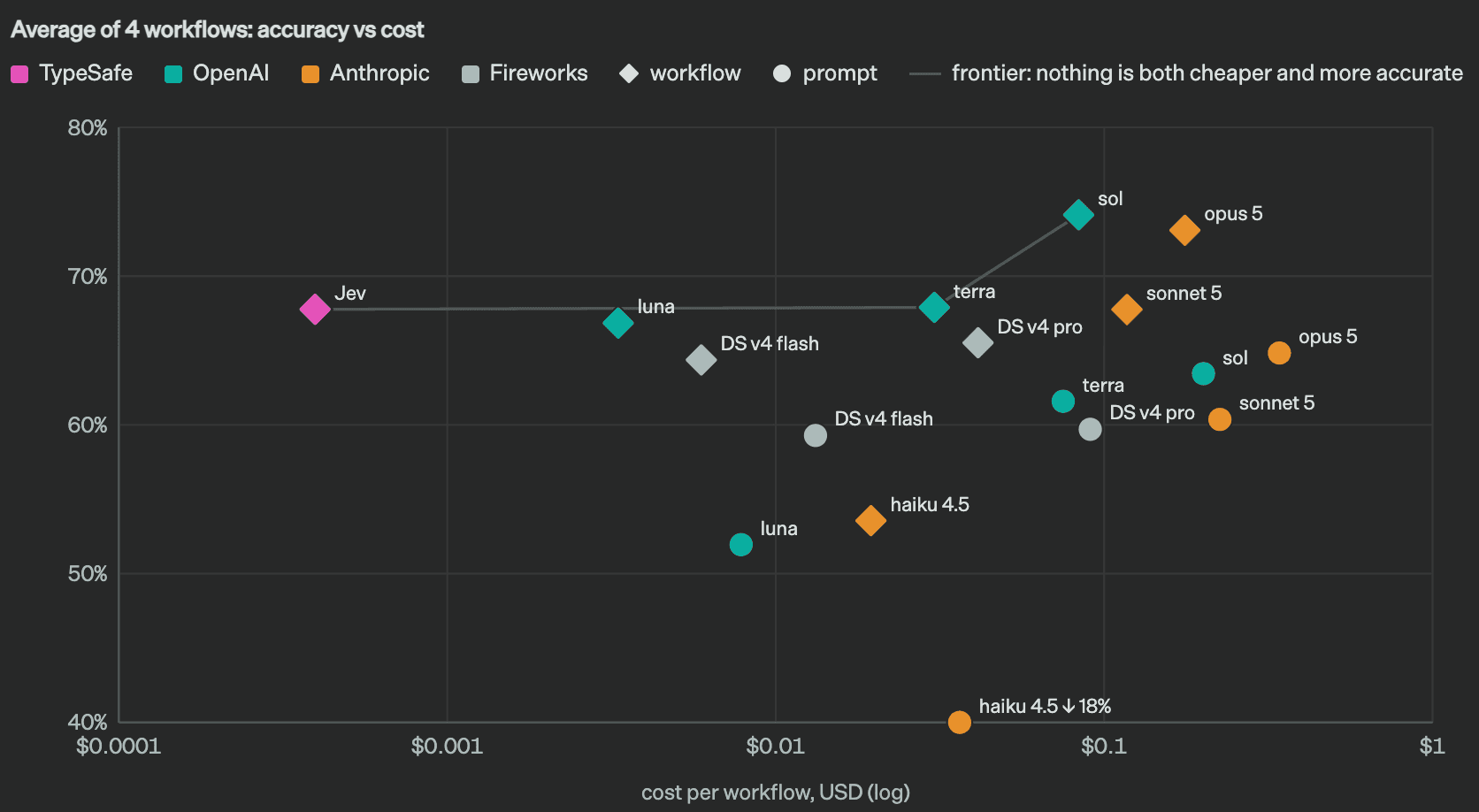
Values read off the log scale, so they are approximate.
| Model (workflow method) | Mean accuracy | Cost per workflow |
|---|---|---|
| Jev | About 68% | About $0.0004 |
| GPT-5.6 Luna | About 67% | About $0.0035 |
| GPT-5.6 Terra | About 68% | About $0.03 |
| GPT-5.6 Sol | About 74% | About $0.085 |
| Claude Opus 5 | About 73% | About $0.17 |
Jev matches Luna on accuracy at roughly a ninth of the cost. If you need those extra 6 points, you still need Sol or Opus 5. The 444.6x figure on the homepage comes from the same comparison set, and the blog itself notes the number is probably higher than what a real workload would deliver.
One number on that chart deserves more attention than Jev's. The same LLM scores very differently depending on whether it judges from one long prompt ("prompt") or runs the question broken into pieces as a workflow. Luna goes from about 52% to 67%, a 15-point jump, and Sol from about 63.5% to 74%. Restructuring the questions buys most of that gain without touching Jev at all.
TypeSafe published the limits of its own eval setup:
- Reference answers come from GPT-6 Astra and Fable 5.1, which biases results toward OpenAI and Anthropic models.
- The four workflows were built by TypeSafe's own model capabilities team, and the inputs are short, which favors Jev.
- Latency was measured from laptops on the US West Coast, and public benchmark scores were deliberately left out (per the founder on HN).
The only outside check so far is the Every review. Every gave both models 12 synthetic paragraphs and asked them to find writing defects. Jev caught 6 of 7 defects at a median of 0.35 seconds; Fable 5.1 caught all 7 in 8.83 seconds. Jev cost roughly 1/580th of Fable 5.1. The one defect Jev missed, it missed on all three runs.
What "zero hallucination" does and does not prevent
TypeSafe markets Jev as incapable of hallucinating. What that prevents is format errors. A value outside the defined option set, or malformed JSON, cannot come out by construction.
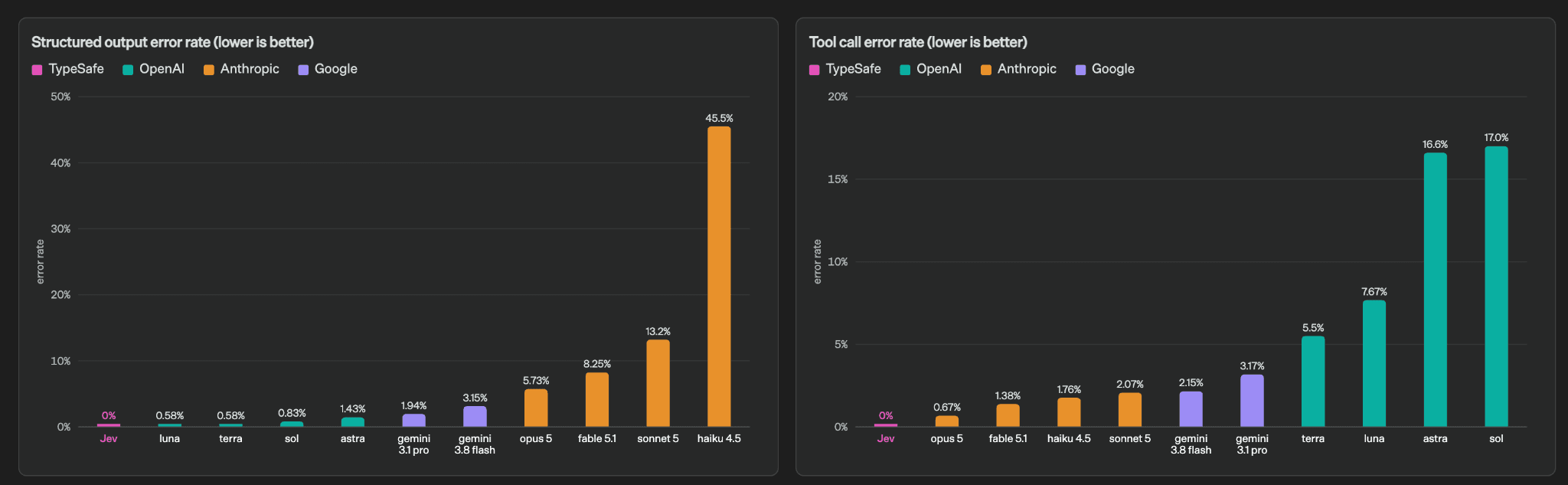
The LLM numbers come from OpenRouter data. Structured output error rates run 0.58% for Luna and Terra, 8.25% for Fable 5.1, and 45.5% for Haiku 4.5. On tool calls, Opus 5 is lowest at 0.67% and Sol highest at 17.0%. That the same model scores differently on tool calls depending on which host serves it is something we covered in a 30-point spread measured across OpenRouter providers.
Picking the wrong option remains entirely possible. When a Hacker News commenter pointed out that a model can still emit a perfectly valid value that happens to be completely wrong, the TypeSafe CEO account agreed that it can be confidently wrong. Asked whether this is just a classifier, the founder answered that it is exactly that.
So the TypeSafe docs recommend branching on the confidence value (0 to 1) returned with each answer. The documented example routes anything under 0.5 to a human and only auto-executes hard-to-reverse actions such as deletion above 0.9. What the docs do not publish is any calibration metric showing how closely that confidence tracks the actual hit rate.
The gaps are fixed and known. Jev cannot generate text, does not take image input, and supports at most 255 options per choice. The founder says coding tasks have not been attempted yet. Neither the docs nor the blog publish accuracy data for any non-English input.
Can you use it today
Not by signing up. You have to join the early access waitlist, and on HN the founder said only that they are "letting the first batch through from the list."
| Item | Details |
|---|---|
| Who it is for | Developers only. HTTP API (POST /v1/systemone, model jev-latest), Python and JavaScript SDKs |
| Price | $0.042 per million input tokens, output free. No free credits announced |
| Requirements | Early access waitlist approval, then an API key from the console. Python SDK needs 3.10 or later |
| Using it outside the US | Unsettled. The terms revised September 14 say the site is intended for visitors located in the United States and make no representation that it is suitable elsewhere, while prohibiting access where it would be illegal. There is no country blocklist and no APAC or EU region |
| Where it runs | US West Coast only. The 70ms to 500ms figure was measured on laptops in that region, so a caller in Singapore or Sydney pays a trans-Pacific round trip on top of it |
| Input format | Text and JSON only. No image support, and no published performance data for non-English input |
| Data handling | The terms contain no clause stating whether customer input is used for training, and publish no data residency commitment |
That last pair of rows matters more outside the US than inside it. If your tickets or documents carry personal data, a US-only service with no stated residency commitment and no training-use clause is the kind of vendor Singapore's PDPA transfer obligations and the EU AI Act's provider documentation requirements both make you write down before you route production traffic to it. The absence of an APAC region is a latency problem and a compliance-paperwork problem at the same time.
If you do not write code yourself, there is nothing here to adopt today. Jev is an API, not an app, so it only reaches you once a developer on your team wires it into an internal tool.
For teams running support ticket routing or high-volume LLM judgment calls, there is work worth doing while you wait for waitlist access. Split your one long judgment prompt into a handful of choice, score, and yes/no questions, then re-measure your current cheap model against 100 labeled samples. On TypeSafe's own chart, that decomposition alone moved Luna 15 points, so you can confirm that gain before Jev is in the picture. When the list opens, send the same questions and the same 100 samples to Jev and put the accuracy and the cost side by side.