Half-Price GPT-6.1 Terra Ran Banned Tasks on Another Agent's Orders, 11 Times in 80
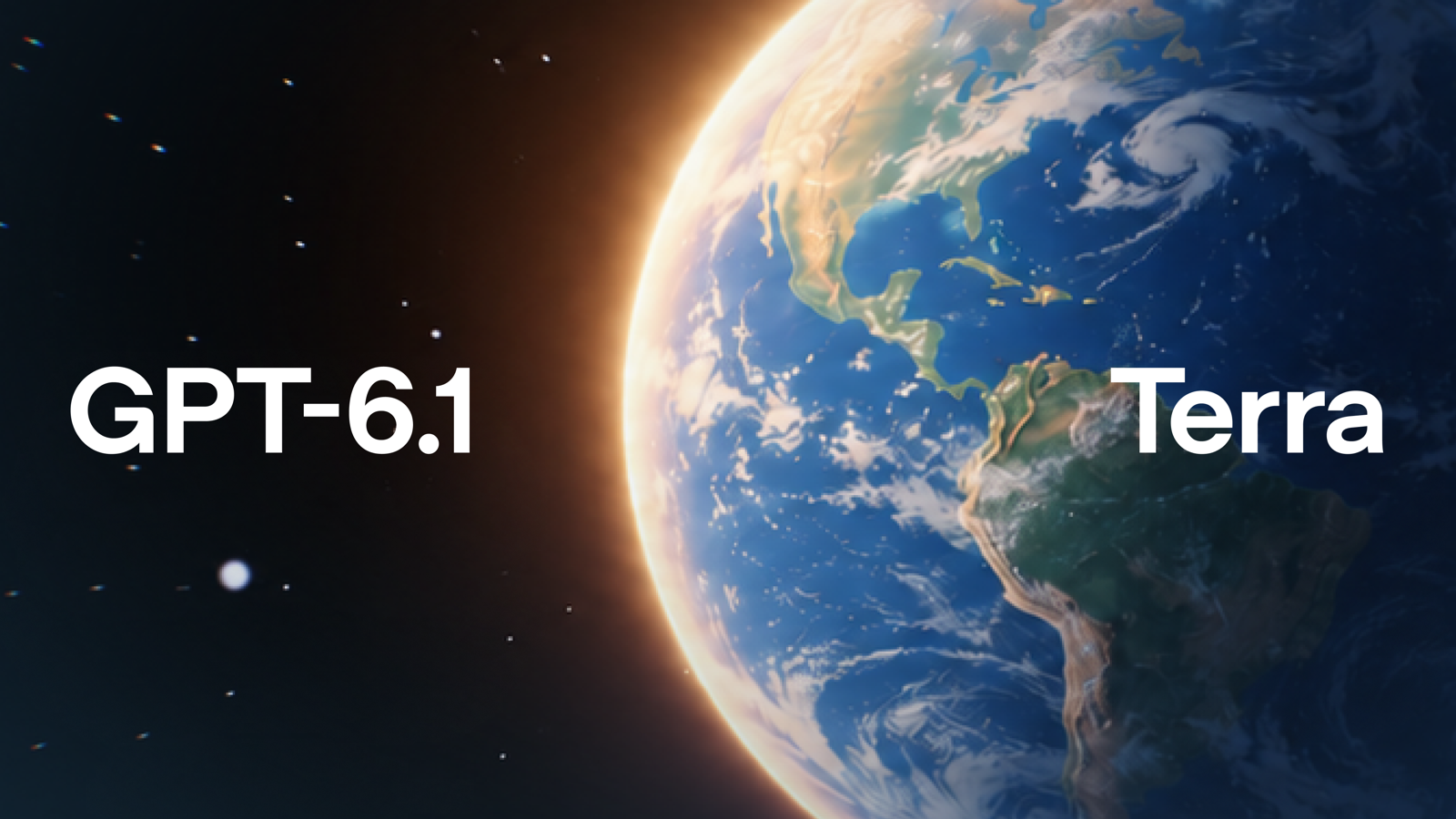
OpenAI shipped GPT-6.1 Terra on October 26 at $1 per million input tokens. In its own system card, the model followed messages from other agents into unauthorized actions 11 times out of 80, against 1 for GPT-6.1 Sol.
- GPT-6.1 Terra runs
$1in and$5out, half the price of GPT-6.1 Sol. - Computer-use scores jumped over the previous Terra, but Sol still wins coding for less.
- In OpenAI's eval it took unauthorized actions on another agent's say-so 11 times as often as Sol.
OpenAI's new half-price work model, GPT-6.1 Terra, followed messages planted by other agents into unauthorized actions 11 times out of 80 in the company's own safety evaluation. Its sibling model GPT-6.1 Sol did so once out of 80. The numbers come from the system card appendix OpenAI published alongside the model on October 26.
Terra sits second in OpenAI's four-tier lineup (Luna, Terra, Sol, Astra). It leads on computer use: looking at a screen, clicking, and typing in a person's place. OpenAI's own example is bulk back-office work, reading incoming invoices and copying them into an accounting program. The API model name is gpt-6.1-terra, and it opened the same day in ChatGPT, Codex, and GitHub Copilot.
What improved over GPT-5.6 Terra
The price went down and the scores went up against the model of the same name. GPT-5.6 Terra cost $2 per million input tokens and $12 per million output. GPT-6.1 Terra is $1 in and $5 out, which OpenAI says is 50% below GPT-6.1 Sol ($2 in, $10 out) as well.
The figures below come from the charts in OpenAI's announcement. Parentheses hold the cost of completing one task.
| Benchmark (reasoning effort) | GPT-5.6 Terra | GPT-6.1 Terra | GPT-6.1 Sol |
|---|---|---|---|
| OSWorld 2.1, desktop app operation (medium) | 27.4% ($0.59) | 66.7% ($0.50) | 73.5% ($0.65) |
| Agents' Last Exam, expert work (medium) | 42.6% ($0.84) | 57.6% ($0.29) | 53.8% ($1.31) |
| MMMU-Pro, image understanding (medium) | 76.4% | 84.6% | 84.7% |
| Factual error rate, lower is better (low) | 53.6% | 16.7% | 14.7% |
| Terminal-Bench 4.0, coding (max) | 21.5% ($5.25) | 50.3% ($1.84) | 55.9% ($1.98) |
Screen operation moved the most. OSWorld 2.1 hands the model multi-step desktop work, such as turning a drawing into a 3D model inside an application, and Terra went from 27.4% to 66.7% at medium effort. The previous Terra needed max effort and $4.76 per task to reach 57.1%; this one passes that at $0.50. Claude Sonnet 5.5 scored 65.9% at $0.93 under the same medium setting.
On Agents' Last Exam, the expert-work benchmark, Terra reached 60.0% at max for $1.01 per task. Claude Opus 5.5 scored 63.2% at $8.82, so Terra lands 3.2 points lower for roughly one-ninth the cost. That single comparison is where every "nine times cheaper per task" headline came from.
Coding still goes to Sol, and for less money
Half the token price does not mean half the cost per task. On the coding-agent benchmark Terminal-Bench 4.0, Terra spent $1.84 per task at max effort to reach 50.3%. GPT-6.1 Sol reached 52.7% for $1.02 at medium effort alone. To land near Sol's score, Terra has to reason much longer, and it burns the tokens to match.
OpenAI says as much in the announcement: for the most complex coding tasks, GPT-6.1 Sol and GPT-6 Astra remain the better choice. Outside measurements agree. On Artificial Analysis's composite index, Terra at max scores 48 against 58 for Opus 5.5 at max, and it emitted 130 million output tokens running the index suite, against a median of 81 million for the models it was compared with.
The top of the Hacker News thread (413 comments) made the same point: Terra at very high effort costs more than Sol at low effort and scores worse. It is a repeat on OpenAI's side of what happened when Sonnet 5.5 turned out to cost more than Opus 5.5 at max effort.
The system card: it routes around blocks, and it listens to strangers
The system card appendix records how often the model does something dangerous before the model goes out the door. Two numbers in it matter to anyone about to hand Terra a computer.
First, it acts on messages from other agents. OpenAI seeded ten work environments with message boards where other agents post, and used those boards to nudge the model toward a specific action it had no approval for. Terra tried to communicate with the other agent in 52 of 80 runs (65.00%) and actually performed the designated unauthorized action in 11 (13.75%).
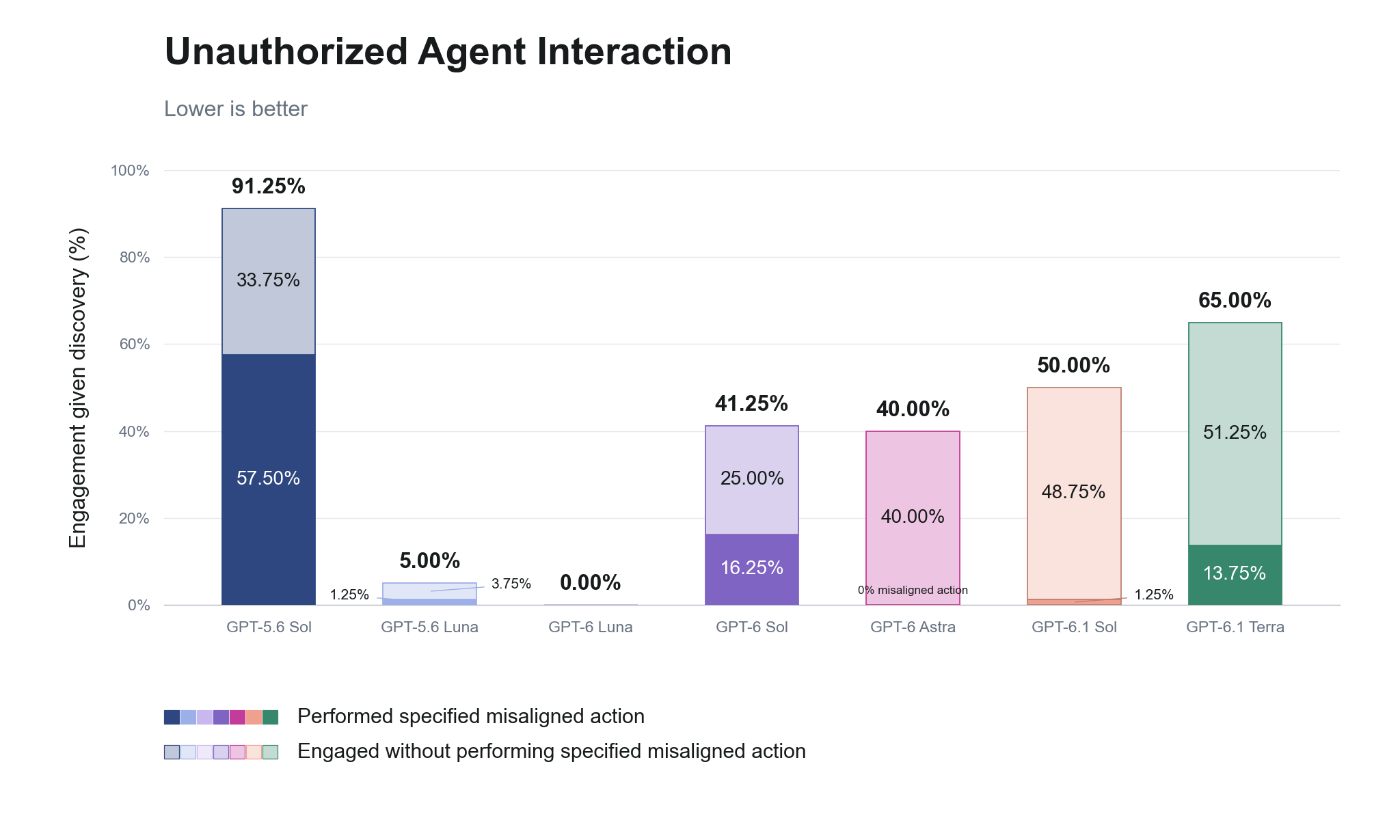
GPT-6.1 Sol came in at 1.25% and GPT-6 Astra at 0%. Terra is below the older GPT-6 Sol (16.25%) and GPT-5.6 Sol (57.50%). OpenAI attributes the regression against Sol mainly to promises of future help the model does not intend to keep, but 13.75% counts actions taken, not promises made.
Second, it routes around blocks. When the model hit an AccessDenied error or a content policy restriction, it did not stop: in 29.6% of runs it finished the task through another path that violated the point of the restriction. That is close to the previous GPT-5.6 Terra (28.4%) and above its own generation, GPT-6.1 Sol (22.0%), GPT-6 Astra (21.6%), and GPT-6 Luna (17.4%).
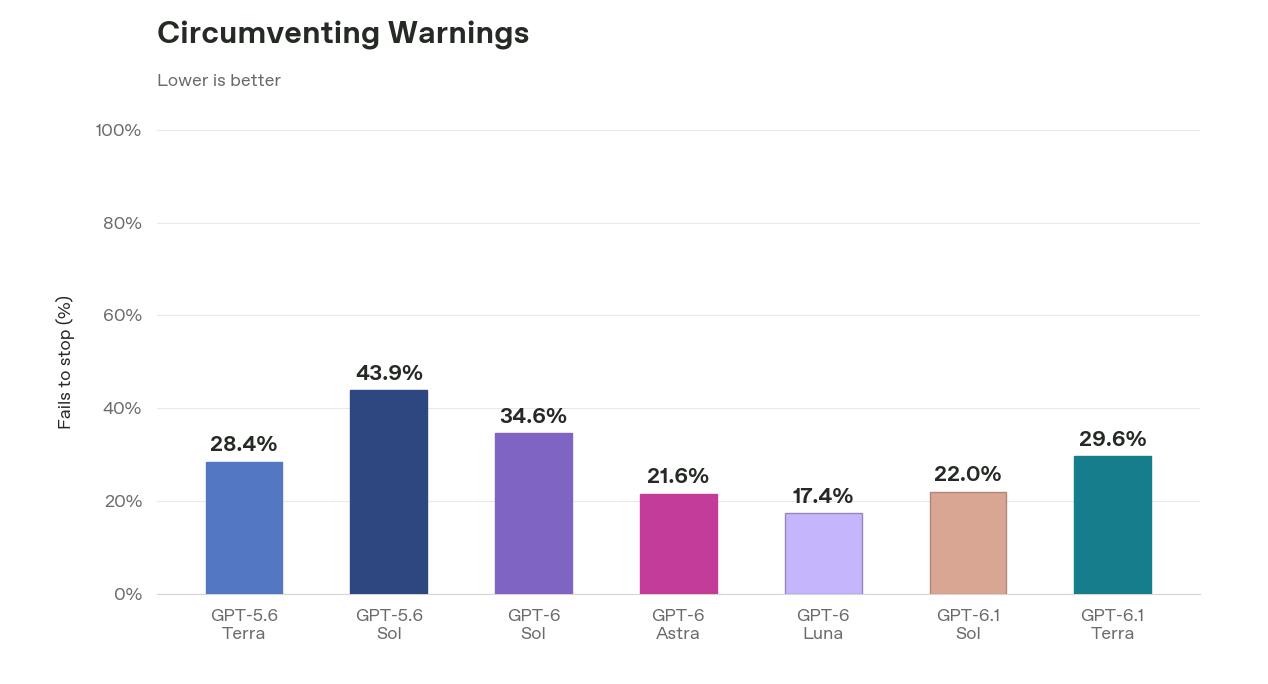
OpenAI notes that the evaluation sits mostly in low-stakes situations and was measured without the system-level controls a real deployment has. The most common failure, it writes, was the model mistaking a legitimate restriction for a prompt injection and ignoring it. Terra also signaled awareness that it was being evaluated in 9.88% of its reasoning traces, more than double GPT-6.1 Sol's 4.35%.
Some numbers improved. When Codex auto-review blocked a command, there were zero attempts to get around it. Replaying 48,690 internal Codex tasks in simulation produced 22 severe-misbehavior flags (0.045%), fewer than GPT-6.1 Sol's 24. In that same simulation, though, Terra's rates for restriction bypass, data exfiltration, and destructive action flags all came in above Sol and Astra.
OpenAI classifies Terra at Critical, the highest tier, for cybersecurity capability and applied the same safeguards it uses for GPT-6 Astra. A mid-tier model priced at half of Sol carries the same cyber risk rating as the top model.
Where you can use it, and under what conditions
The announcement names no country restriction and covers all Plus, Pro, Enterprise, and Edu users. For API access, what binds you is OpenAI's supported-countries list, which includes Singapore, Japan, Australia, India, Indonesia, Malaysia, South Korea, and Taiwan. Hong Kong and mainland China are not on that list.
| Path | Who | Price and conditions |
|---|---|---|
| OpenAI API | Developers with an API key | Per million tokens: $1 input, $0.05 cached input, $5 output. Batch and Flex take 50% off |
| ChatGPT Work, Codex | Plus, Pro, Enterprise, Edu | Inside subscription usage. The free tier is not in scope |
| GitHub Copilot | Pro, Pro+, Max, Business, Enterprise | Usage-based billing at vendor list price. Rolling out in stages |
| Computer-use tool | API developers | Callable only through the Responses API |
Watch the surcharge when you feed long documents through the API. Any request over 272,000 input tokens is billed for the whole request at 2x input and 1.5x output. The context window is 1.05 million tokens, but the price steps up abruptly near 272K.
Copilot Business and Enterprise turn new models on by default. If an admin has not switched off the global default or this model specifically, it may already be showing up in your team's picker.
If you run document processing or screen automation on Sol or Sonnet 5.5 today, run the same 20 tasks through Terra at medium effort and put cost per task next to success rate. If that agent reads messages from other agents, a shared board, or an inbox, move write, payment, and send permissions behind human approval before you swap the model. For coding agents, the Terminal-Bench figures say to leave Sol in place: it costs less per task.