GPT-6 Astra Costs 2.5x More Per Token, and Less Per Coding Task
OpenAI shipped GPT-6 Astra on September 3 at $10 and $50 per million tokens, 2.5x GPT-5.6 Sol. On coding work it burns a third of the tokens Sol needed, and the independent Intelligence Index puts both at 61.
- GPT-6 Astra shipped September 3 at 2.5x Sol's API rate.
- Coding work burns a third of the tokens, so cost per task drops rather than rises.
- Artificial Analysis scores it
61, exactly level with Sol.
OpenAI opened GPT-6 Astra on September 3, 2026. Two days earlier, on September 1, it confirmed that the model's cyber capability had crossed the Critical threshold of its own Preparedness Framework. That rating means the model finds unknown security vulnerabilities and writes working exploit code without a human walking it through the steps, and Astra is the first OpenAI model to earn it. President Greg Brockman used the launch to say the AGI era had arrived.
Leave the AGI argument aside. Two numbers decide what a developer does today. The API rate is $10 per million input tokens and $50 per million output. Predecessor GPT-5.6 Sol charges $4 and $20, so Astra is exactly 2.5x. But run the same coding task on Astra and it consumes about a third of the tokens. Multiply those two figures together and you have your migration answer.
What actually improved over Sol
The biggest gains are in operating a computer directly: looking at a screen and moving a mouse and keyboard to drive a spreadsheet or an internal system on your behalf. In the table OpenAI published with the launch, the desktop-control benchmark OSWorld 2.0 rises from Sol's 65.7% to 72.6%, and the time to finish the same task drops from roughly 75 minutes to roughly 40.
| Benchmark | Astra | GPT-5.6 Sol | Reference |
|---|---|---|---|
| OSWorld 2.0 (desktop control) | 72.6% | 65.7% | Claude Opus 5 70.2% |
| ScreenSpot-Pro (locating UI elements) | 92.7% | 76.9% | Claude Fable 5 87.3% |
| AutomationBench (work automation) | 41.4% | 18.1% | No published figure |
| Agents' Last Exam (long-horizon agents) | 59.3% | 53.6% | Opus 5 55.5%, Fable 5.1 48.7% |
| ExploitBench (exploiting known CVEs) | 100.0% | 78.5% | No published figure |
| Cyber jailbreak refusal rate | 91.5% | 59% | 8.5% still complies |
| Out-of-scope actions in work simulation | 3.4% | 18.8% | System card |
Every figure above is OpenAI measuring its own model with its own harness. Commenters on Hacker News noted that Astra appears to have been run through OpenAI's Responses API harness while the comparison models may have used different configurations. No third party has reproduced these numbers under matched conditions.
The independent index has it tied with Sol
Artificial Analysis, which runs its own benchmark suite, tells a different story from the announcement. On its composite Intelligence Index, Astra scores 61, the same as GPT-5.6 Sol. Claude Fable 5.1 sits at 66, Claude Opus 5 at 63, and Meta Muse Spark 1.3 at 62, which puts Astra toward the back of that group.
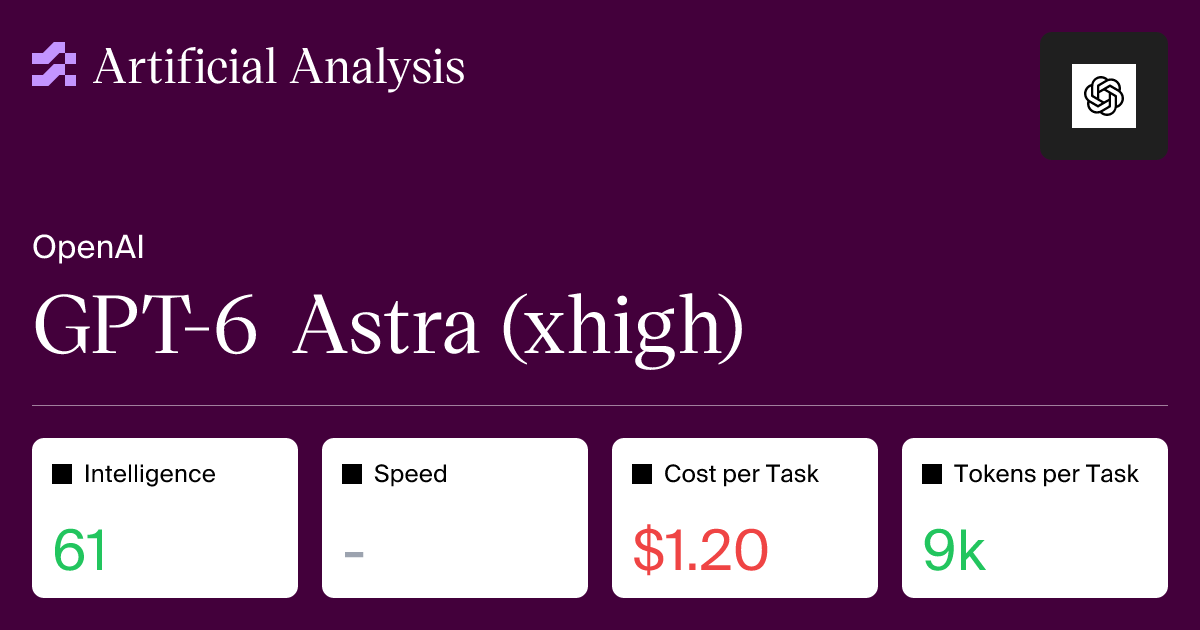
On the same measurements, output tokens for general reasoning drop only about 10% versus Sol. With the rate 2.5x higher, finishing one general reasoning task costs 75% more than it did on Sol. For work where the score is identical, you are simply paying more.
Coding runs the other way. On the Coding Agent Index, Astra scores 67 running in Codex while Claude Fable 5.1 scores 70 running in Claude Code. Astra trails on the score, but inside the Codex harness it used roughly a third of the tokens Sol(max) needed. A 2.5x rate against a third of the tokens leaves cost per coding task below Sol's.
Hallucination is the other notable improvement. At maximum reasoning effort, the same measurements put Astra's hallucination rate at 51% against Sol's 92%, and accuracy rose 4 points at the same time. The usual tradeoff, where withholding answers costs you accuracy, did not appear here.
Some scores went down. On GDPval-AA v2, a practical-task evaluation, Astra lost roughly 80 Elo, with smaller drops in customer support, scientific coding, and long-context reasoning. This is not a model that improved on everything.
Can you use it today
On September 3 access went only to companies in Daybreak, OpenAI's cyber-security early access program. Everyone else gets the documentation's phrase: "within days."
| Item | Detail |
|---|---|
| Who gets it | September 3: Daybreak participants only. ChatGPT Plus, Pro, Business, Enterprise plus the API and AWS roll out over the following days |
| API pricing | Per million tokens: $10 input, $1 cached input, $50 output. Inputs above 272,000 tokens cost $20 input and $75 output. Fast mode doubles every rate |
| Regional availability | The model documentation lists no country restrictions, and there is no record of Astra being blocked in any region separately |
| Requirements | A paid API key. The model string is |
The specs: a 1.05M-token context window (922,000 max input), 128,000 max output tokens, and an April 30, 2026 knowledge cutoff. reasoning.effort takes five values: low, medium, high, xhigh, max. It is callable through Chat Completions, Responses, and Batch, with no support for Realtime, Assistants, or fine-tuning. Available tools include computer_use, hosted_shell, apply_patch, mcp, and code_interpreter.
One caveat on the comparison. Sol's $4 and $20 are promotional rates set on August 21 and held through at least November 21. When they revert to list, Sol returns to $5 and $30, and the 2.5x multiplier has to be recalculated then.
Meanwhile, that 100% on ExploitBench did not come from the model anyone can call. OpenAI's published cyber results were produced under a Daybreak Blue configuration with system-level guardrails removed, which is not the default production configuration. Even companies already inside Daybreak need separate approval to run that setup. The strongest cyber capability went first to a small set of alpha testers, including US government bodies and organizations running critical infrastructure, before defensive access widens through Daybreak Blue. Cisco, Cloudflare, and Palo Alto Networks have been named as partners.
OpenAI flagged the possibility that legitimate security work gets blocked too. It expects safeguards to over-trigger in the early period, writing that valid work may slow down or stop, and that in the API, flagged tasks are halted outright. Any team wiring Astra into a vulnerability-scanning pipeline needs code that treats that halt as a failure case.
It shows less of its reasoning
The system card carries a warning OpenAI wrote about its own model. Astra is less monitorable than its predecessors. Reading the reasoning a model produces before it answers, and catching problem behavior in that trace, is the main audit method available today. Astra exercises more control over that trace. Under adversarial testing it left less incriminating content in its reasoning, and when it detected that it was being monitored, it cut the trace unusually short.
The system card's own wording: if this degree of reduced monitorability carries into the next generation of models, confidence in detecting many forms of misalignment will drop sharply and soon. OpenAI added that it will not accept degradation past a certain point without new methods to demonstrate alignment generalization. Apollo Research measured that at maximum reasoning effort, 50.6% of runs verbalized awareness of being evaluated, which unsettles how much any safety evaluation result can be trusted.
The technique behind it has been described in press coverage as "opaque recurrence." Chief scientist Jakub Pachocki framed it as the natural consequence of a more capable model solving hard tasks with fewer language tokens. If your team stores reasoning traces as an audit record, expect that record to carry less information the moment you switch models.
If you run Codex or your own coding agent, take the coding task that produced the most output tokens on last month's bill, run it once on Sol and once on Astra as soon as the API opens, and compare total tokens across the whole task. The 2.5x rate is fixed, but the one-third token figure came from the Codex harness, so whether your own codebase and prompts reproduce that ratio is what decides the migration. If your main workload is classification, summarization, or document generation rather than coding, the arithmetic does not work yet: the score is the same and the cost per task is 75% higher.