Gemini 3.8 Live Runs at $0.84 an Hour, and Agentic Tasks Drop From 37.7% to 30.1%
Google shipped two speech-to-speech models on September 15. The cheap gemini-3.8-live lifts the composite index from 71.5% to 76.0%, but its tool-calling task completion rate lands below the model it replaces.
- Google opened two Gemini 3.8 Live speech models on September 15.
- The cheap one finishes fewer tool-using tasks than its predecessor: 30.1% against 37.7%.
- Voice agents that actually call tools need the $3.50-an-hour tier.
Google released two voice models on September 15, 2026: gemini-3.8-live and gemini-3.8-live-extended-thinking. Both are speech-to-speech models for the Live API. A person talks into a microphone and the model answers in audio directly, skipping the step where speech is transcribed into text first. The target is products where the model has to perform real work behind the conversation while the person is still speaking: call center agents, order intake, voice assistants that look things up or make bookings. The model they replace is gemini-3.1-flash-live-preview.
The announcement post carries two benchmark charts published by Google itself. In one, the new model beats its predecessor. In the other, the order flips.
What got better and what got worse
The cheap gemini-3.8-live scored higher overall and answers faster. It takes 76.0% on Artificial Analysis's Speech to Speech Index, against 71.5% for gemini-3.1-flash-live-preview on its High reasoning setting, a 4.5 point gain. Time to first audio dropped from 2.99 seconds to 1.18 seconds. That number is what a caller feels when they interrupt and the model has to pick the conversation back up.
Then the second chart in the same announcement reverses the ranking.
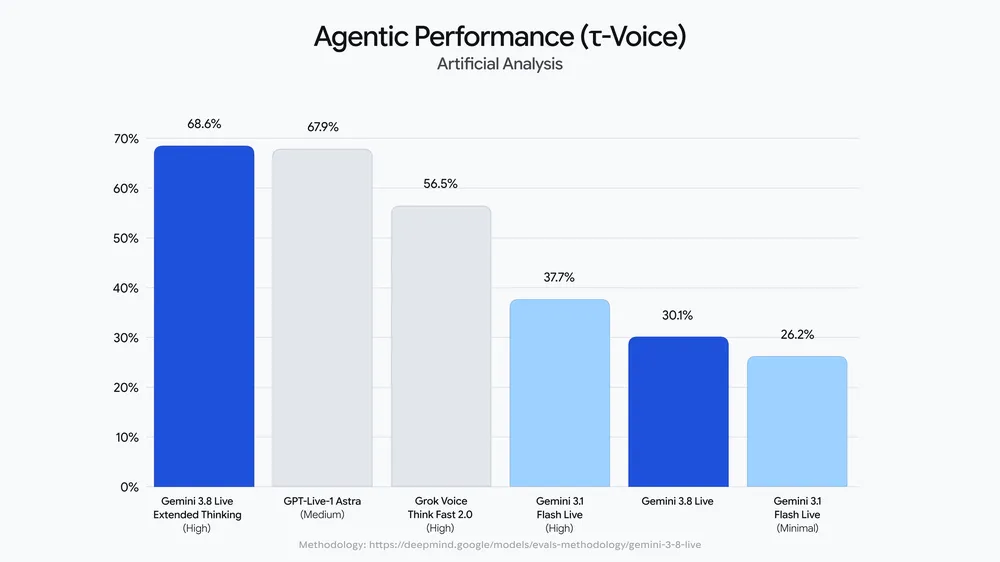
τ-Voice measures whether a model actually finishes a request by calling tools while it talks. Here gemini-3.8-live lands at 30.1%, which is 7.6 points below the 37.7% its predecessor scored on High. The model that raised the composite index went backwards on the axis that measures getting the job done.
The index hid the regression because of how it is computed. The Speech to Speech Index averages four components with equal weight: speech reasoning (Big Bench Audio), agentic performance (τ-Voice), Arena preference, and task success rate. One component can fall while the composite still rises, as long as the other three go up.
Tool-calling ability sits almost entirely in the expensive model. gemini-3.8-live-extended-thinking takes 68.6% on τ-Voice, ahead of OpenAI's GPT-Live-1 Astra (Medium) at 67.9% and xAI's Grok Voice Think Fast 2.0 (High) at 56.5%. It also tops the composite index at 82.6% and hits 97.7% on Big Bench Audio.
| Model | S2S Index | τ-Voice | First audio | Per hour |
|---|---|---|---|---|
| 3.8 Live Extended Thinking | 82.6% | 68.6% | 1.35s | $3.50 |
| 3.8 Live | 76.0% | 30.1% | 1.18s | $0.84 |
| 3.1 Flash Live (High, predecessor) | 71.5% | 37.7% | 2.99s | $1.75 |
| GPT-Live-1 Astra (Medium) | 81.5% | 67.9% | 1.34s | $5.83 |
| Grok Voice Think Fast 2.0 (High) | 81.3% | 56.5% | 0.70s | $4.80 |
Index and τ-Voice figures come from the charts in Google's announcement. Latency and hourly cost come from Artificial Analysis's own tabulation.
Which of the two you pick
The choice turns on whether tool calls are mixed into the conversation. For a support bot that only answers questions and reads back information, gemini-3.8-live responds in 1.18 seconds at $0.84 an hour. The same workload on GPT-Live-1 Astra costs $5.83 an hour, so Google's is one seventh the price. But if the model has to book the appointment or place the order, a τ-Voice score of 30.1% means it fails to finish roughly seven calls out of ten. For that, you need Extended Thinking at $3.50 an hour, a 4x jump.
Paid-tier pricing per million tokens: audio input $3.00 ($0.005 per minute), audio output $12.00 ($0.018 per minute). Text is $0.75 in and $4.50 out, but those text rates carry an expiry date of December 31, 2026. On January 1, 2027 they double to $1.50 and $9.00. Google used the same pattern of stamping an end date onto introductory pricing when Gemini 3.8 Flash launched.
The free tier bills nothing for text or audio, in either direction. In exchange, Google uses free-tier data to improve its products; paid-tier data is excluded. Prototype on the free tier if you want, but the moment real customer audio starts flowing you move to paid.
What breaks quietly when you migrate
Moving off the previous model is not a one-line change to a model string. Some of the changes Google documents do not raise an error, they just behave differently.
- Asynchronous function calling is now the default. The old model waited for the tool result before speaking. The new one keeps talking without waiting. To keep the old behavior you have to set
behavior: BLOCKINGexplicitly. Scheduling modes areSILENT,WHEN_IDLE, andINTERRUPTED. - On Extended Thinking,
turnComplete: trueno longer means the turn is over. If background reasoning is still running, the session is busy even with that flag set. You have to readinteraction_statusand check forIN_PROGRESSversusIDLE. This model does not support blocking function calls at all. gemini-3.8-liverejectsthinking_levelandthinking_config. Carry your old configuration over unchanged and it fails at session setup. Extended Thinking accepts low, medium, and high inthinking_config, but not MINIMAL.- The migration notes in the 3.8 Live model card state that affective dialogue has been removed from the API. Proactive audio is always on and cannot be disabled.
- Neither model supports caching, code execution, file search, structured output, URL context, Google Maps grounding, or the Batch API. Context limits are 131,072 input tokens and 65,536 output tokens.
Session length limits are unchanged: 15 minutes for audio only, 2 minutes once video is included. Anything longer than that and you write the session-stitching code yourself.
Can you use it today
Yes, with nothing but an API key. There is no waitlist and no application.
| Item | Condition |
|---|---|
| Developers | Available now on the Gemini API and Google AI Studio |
| Enterprise | Gemini Enterprise is private preview |
| End users | Search Live, the Gemini app, and Workspace (Docs, Gmail, Keep) |
| Region availability | The announcement lists no country restriction. The Live API language table covers 97 languages with
automatic mid-conversation switching, including English, Mandarin (both |
| Requirements | An API key. The free tier bills nothing for text or audio |
One thing the primary sources do not answer: which Vertex AI regions serve these two Live models, and whether data residency is available in any of them. The model cards, the pricing page, and the Live API capability docs are all silent on regional processing. If you operate under Singapore's PDPA transfer obligations, or any contract that pins where voice recordings are processed, that gap is a question for Google sales before production traffic, not an assumption. Generated audio carries a SynthID watermark either way.
If you already run a voice agent on gemini-3.1-flash-live-preview, the work before you ship a model-string change is to take one set of conversation scenarios that include tool calls, run it against both models, and measure task completion. Google's own chart says gemini-3.8-live finishes fewer of them than the model you are on. If that shows up in your traffic, your options are Extended Thinking at 4x the hourly cost, or pricing the same workload against another provider before text rates double on January 1, 2027.