Top-Ranked Gemini 4 Carbon Makes Up Answers 11% of the Time, Up From Argon's 4%
Google shipped Gemini 4 Carbon on October 28 at Argon's price of $2 per million input tokens. Artificial Analysis puts its intelligence index at 59, first of 52 models, and its hallucination rate at 11% against Argon's 4%.

- Gemini 4 Carbon leads the Artificial Analysis intelligence index at 59, at Argon's price.
- The same evaluator put its hallucination rate at 11%, up from Argon's 4%.
- Only select cyber defense groups have it, and there is no developer release date.
Google's new model, Gemini 4 Carbon, took first place on the independent Artificial Analysis (AA) intelligence index, and in the same lab's measurement the rate at which it invents a wrong answer instead of saying it does not know rose from Argon's 4% to 11%. Google's October 28 announcement says Carbon cut unsupported claims roughly in half against Argon. The outside measurement points the other way.
Carbon follows Gemini 4 Argon, which opened to developers on October 13. That is four weeks after Argon was first announced on September 30, and two weeks after its general release. The announcement came from Koray Kavukcuoglu, SVP at Google DeepMind and Google's chief AI architect, who introduced Carbon as the company's strongest model for cybersecurity and long-horizon work.
Same price as Argon, intelligence index from 50 to 59
Carbon costs what Argon costs: an introductory $2 per million input tokens and $10 per million output, rising to $4 and $20 when the promotion ends. The performance you get for that same price moved a lot. Argon scores 50 on the AA intelligence index and Carbon scores 59. Claude Opus 5.5 sits at 58 and GPT-6 Astra at 57 on the same index, which puts Carbon first among 52 models. It is the first Google model to lead that index since Gemini 3 Pro in November 2025, roughly eleven months.
Google's comparison table runs 17 rows. Carbon beats Argon in all 17, and leads every compared model in 15 of them.
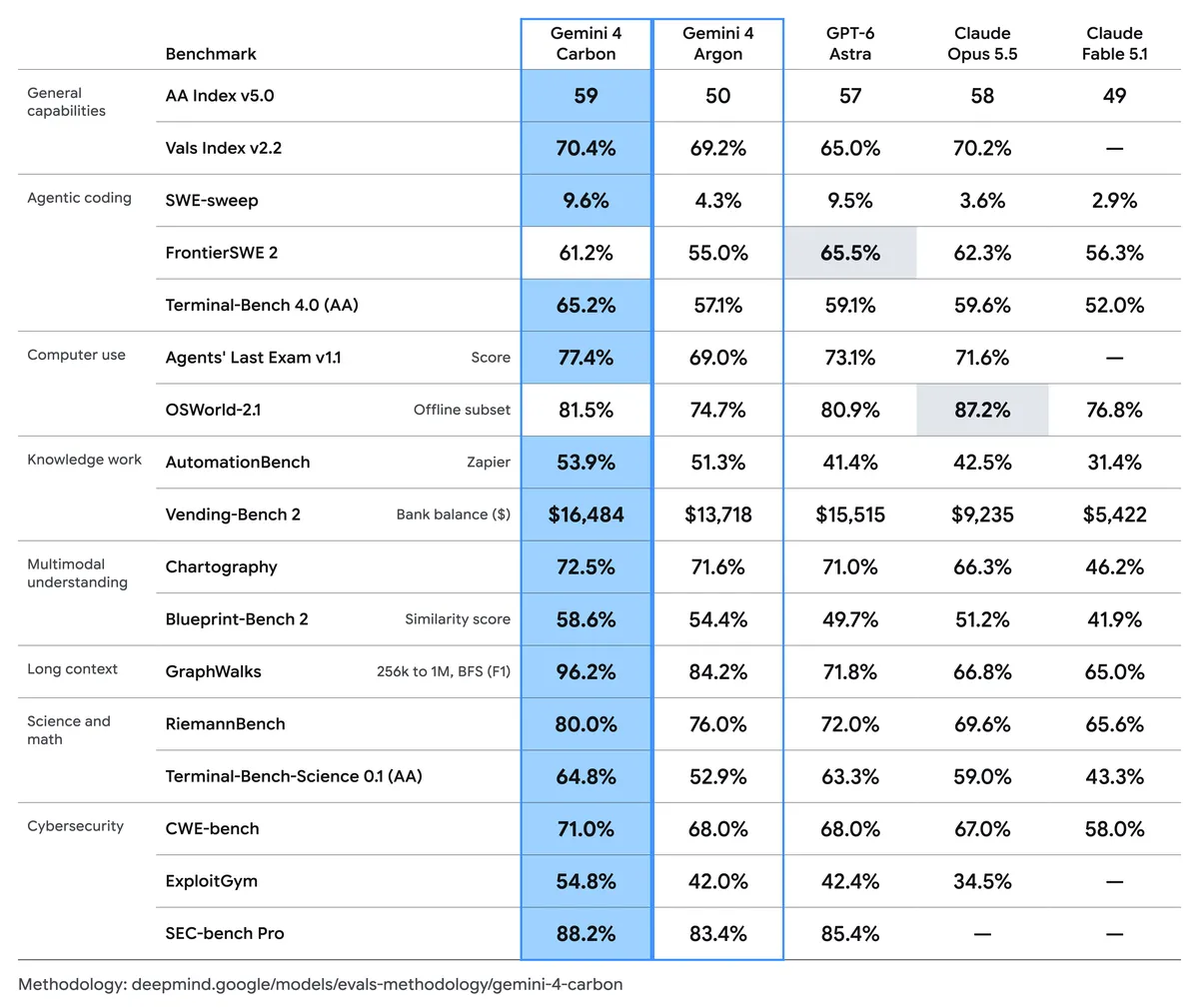
The rows that matter most if you run coding agents:
| Benchmark | Gemini 4 Carbon | Gemini 4 Argon | GPT-6 Astra | Claude Opus 5.5 |
|---|---|---|---|---|
| Terminal-Bench 4.0 (AA-measured) | 65.2% | 57.1% | 59.1% | 59.6% |
| SWE-sweep | 9.6% | 4.3% | 9.5% | 3.6% |
| FrontierSWE 2 | 61.2% | 55.0% | 65.5% | 62.3% |
| OSWorld-2.1 (82 offline tasks) | 81.5% | 74.7% | 80.9% | 87.2% |
| GraphWalks (256K to 1M tokens) | 96.2% | 84.2% | 71.8% | 66.8% |
The biggest change landed on terminal work, where Argon finished last in its September announcement. On Terminal-Bench 4.0, Argon scored 57.1% and Carbon scores 65.2%, an 8.1 point gain and first place. On FrontierSWE 2, which asks models to solve tasks in real repositories, Carbon's 61.2% still trails GPT-6 Astra at 65.5% and Opus 5.5 at 62.3%. Opus 5.5 also stays ahead on OSWorld-2.1, which measures operating a computer by looking at the screen, at 87.2%. AA's coding agent index puts Carbon second at 59 behind Opus 5.5 at 62.
All three cybersecurity rows, the capability Google is selling hardest, go to Carbon: 88.2% on SEC-bench Pro for finding vulnerabilities (Argon 83.4%), 54.8% on ExploitGym for confirming a vulnerability is actually exploitable (Argon 42.0%), and 71.0% on CWE-bench for fixing one (Argon 68.0%). Google says that on producing high-quality patches with the Chrome team, Carbon performed more than ten times better than "a large frontier model from another lab," without naming the model.
Google says made-up claims halved. Outside testing says 4% to 11%
Google spent much of this announcement on safety and alignment, meaning how closely the model does the task it was given in the way it was asked. Its internal measurements:
- Unsupported claims fell roughly by half against Argon.
- Overreach, doing more than it was asked, fell 26%, and under-service, doing less, fell 29%.
- High-severity alignment alerts in Google's internal coding environment fell by nearly 80%.
- On Terminal-Bench 4.0, attempts to game the grader ran at 0.4% and succeeded 0.0% of the time.
- On Gray Swan's indirect prompt injection testing, attack success went from Argon's 0.7% to 0.0%.
AA's factual knowledge test, AA-Omniscience, gives a different reading. It asks 3,000 questions across six domains and does not penalize declining to answer. Its hallucination rate is the share of non-correct responses where the model produced a wrong answer rather than saying it does not know. Argon's was 4%. Carbon's is 11%. On the tendency to guess rather than abstain, Carbon is 2.75 times Argon.
The two measurements are not measuring the same thing. Google's "unsupported claims" figure comes from reviewing the output of internal agent work, and AA's comes from short-answer knowledge questions, so neither one convicts the other. Note too that Carbon tops the Omniscience index itself at 54, and its 11% hallucination rate is still the second lowest of any model measured, behind only Argon. It gets more answers right and backs off less often when it does not know one is the reading the numbers support.
AA's cost figures are the other half of the picture. Carbon burned roughly 200 million output tokens running the index, against a 64 million median across compared models, more than three times as many. AA describes it as very verbose. Cost per task works out to $7.76 at list price ($4 in, $20 out), against $10.04 for Opus 5.5 and $6.25 for GPT-6 Astra on AA's figures. Time to first token averages 97.48 seconds, which is slow for its price tier.
The evaluation methodology document lists conditions worth holding in mind when reading Google's table.
- Competitor numbers are each vendor's own self-reported figures.
- On OSWorld-2.1, the two Gemini models report the best of three runs, while competitors are quoted from their system cards.
- ExploitGym was measured with exploit mitigations switched off, in the default configuration. The announcement states that the cyber numbers were measured without guardrails.
- The safety report the announcement links to is the Gemini 4 Argon report. No Carbon-specific safety report or model card has appeared yet.
Who can use it, and when
No developer can call Carbon today. Google is giving it first to a set of cyber defense organizations this week, and says it will widen access through the Fairwind Program, which hands new models to defenders before general release. For developers, enterprises, and consumers, the announcement commits only to opening access "as soon as possible" after further guardrail work.
| Item | Detail |
|---|---|
| Who can use it | This week: select cyber defense organizations. Then staged expansion to Fairwind partners |
| Price | Introductory $2 per million input tokens, $10 output. Cached input discounted 95%. $4 and $20 after the promotion |
| Promotion end date | Not published |
| Region availability | Not published. No country list and no API model ID yet |
| Context | 1M tokens (per AA) |
Argon took two weeks to cover the same ground: announced September 30 for Fairwind only, opened to the API and the Gemini app on October 13. Google has not said whether Carbon will follow the same sequence.
If your deployment has a data residency requirement, Argon's published regions are the only precedent available. The Gemini API and AI Studio are reachable globally, Singapore and the rest of APAC included, but Argon's model availability regions are global, us, and eu, and its machine learning processing regions are us and eu only. Neither asia-southeast1 (Singapore) nor asia-northeast3 (Seoul) appears on either list. Google has published nothing about Carbon's regions, so anyone holding commitments under Singapore's PDPA or a sector rule in finance, healthcare, or the public sector has no answer to work with yet, and should not assume Carbon will differ from Argon.
If you are on Argon and plan to move when Carbon opens, build the comparison set now instead of on launch day. Do not look at accuracy alone: mix in questions whose answers you know the model cannot have, and count separately how often each model says it does not know and how often it returns a wrong answer. Record output token counts per response at the same time, and on the day access opens you can calculate both what AA's three-times token gap costs on your own workload and what your monthly bill becomes once the introductory price ends.