Mercury 3 Outputs 1,068 Tokens a Second, and $0.35 Is a Launch Discount
Inception shipped Mercury 3, a diffusion LLM, on October 19. Output runs at 1,068 tokens per second, about 8x GPT-6 Luna, and $0.35 per million output tokens is a 50% launch discount off a $0.70 list price.
- Output runs at 1,068 tokens per second, about 8x the roughly 130 of GPT-6 Luna.
- It leads 8 of 12 benchmarks in Inception's own table and loses both long-context tests.
- The
$0.35output price is a 50% discount; list price $0.70 tops Haiku 5.5's $0.50.
The models behind today's chatbots write out one token at a time, in order. The next token cannot be chosen until the previous one is fixed, so a longer answer means a proportionally longer wait. Mercury 3, which Inception shipped on October 19, predicts many tokens at once and then revises that block several times over. That is the architecture described in the June 2025 Mercury paper (arXiv:2506.17298), which says the model was trained to predict multiple tokens in parallel. The industry calls this a diffusion model.
The speed gap comes straight from Inception's own numbers. Mercury 3 produces 1,068 tokens per second on NVIDIA GPUs. In the same comparison table, GPT-6 Luna runs at roughly 130 tokens per second and Claude Haiku 5.5 at roughly 240. That is 8x Luna and a little over 4x Haiku 5.5. The table notes all three were measured at the medium setting.
Pricing is $0.10 per million input tokens and $0.35 per million output tokens. Those are launch-discount numbers. List price is $0.20 input and $0.70 output. Neither the announcement nor the pricing page says when the discount ends.
Quality is up from Mercury 2.5, and the speed number is down
The biggest change from Mercury 2.5 is how much the model can read at once. Context grew from 260K tokens to 1M tokens. Total parameter count is more than 40x that of the first model, Mercury 1, according to co-founder Stefano Ermon in the press release.
Inception published quality as an index averaged over 11 benchmarks. On the chart plotting each generation, Mercury 2.5 sits near 36 and Mercury 3 near 50.5, roughly three times the 16 of Mercury 1 (Mini). The chart footnote lists the 11 as GDPval (Elo), SciCode, IFBench, GPQA Diamond, Terminal-Bench v2.1, BrowseComp+ and others.
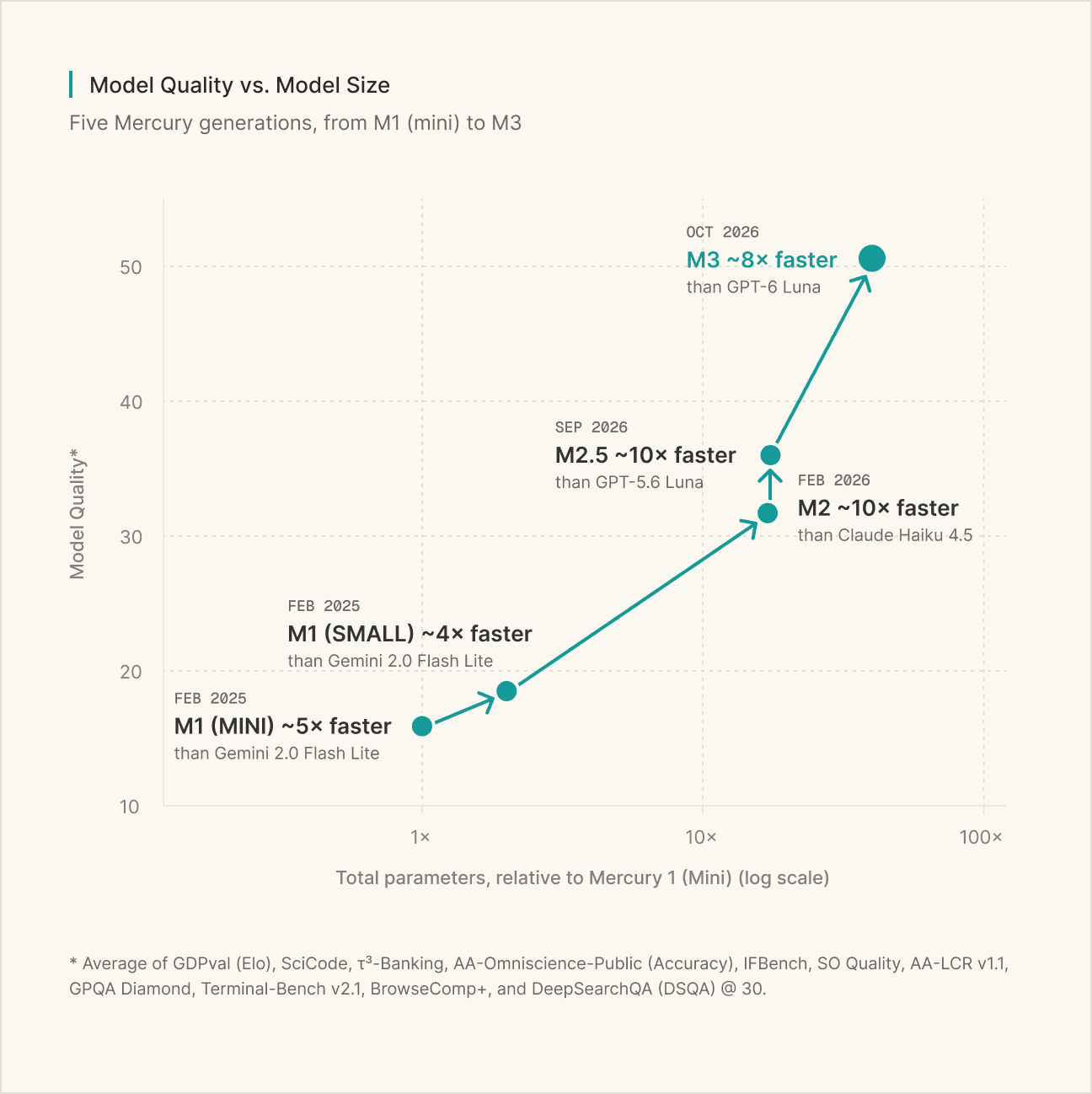
The speed number is actually lower than the previous release. Mercury 2.5 was published at 1,107 tokens per second; Mercury 3 is 1,068. Inception's framing is that it grew the model 40x and held speed nearly flat, and Ermon said it is "more than 40 times larger and far more capable, and still over 1,000 tokens per second." Put the other way, a team already on Mercury 2.5 gets quality and context from the move, not extra speed.
All of these numbers are Inception's own. Artificial Analysis, the independent benchmarking outfit, has no Mercury 3 page in its index yet. The same outfit measured Mercury 2.5 at 705.9 tokens per second, far off the 1,107 the company published. Given how wide that gap between vendor figure and independent measurement runs, 1,068 is a number to re-measure in your own environment.
It leads 8 of the 12 benchmarks
Several outlets reported on launch day that Mercury 3 shipped without benchmark scores. That is wrong. The announcement page carries a 12-benchmark comparison table. It is an image rather than text, so tools that scrape the page as characters come away with nothing.
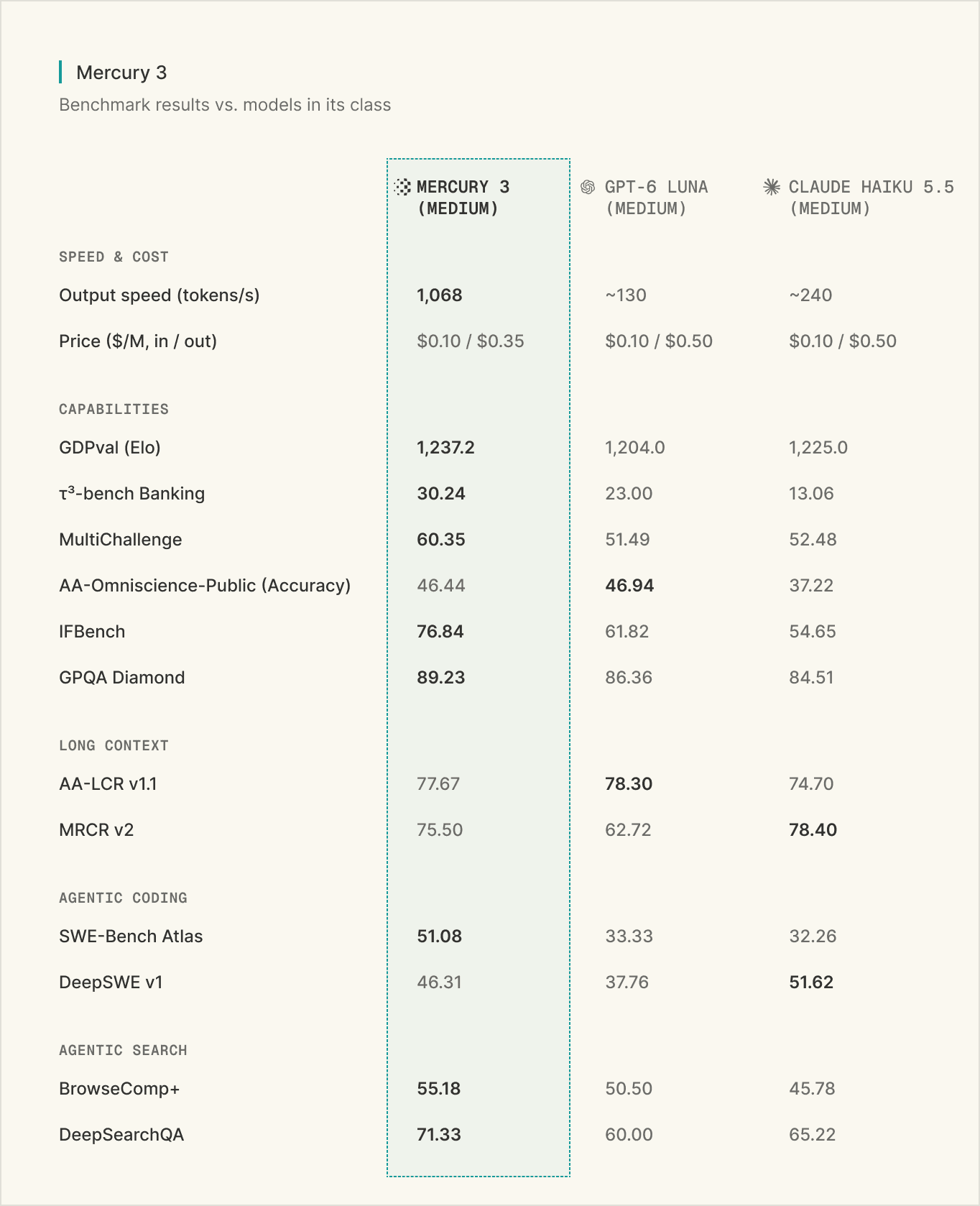
Mercury 3 is first on 8 of the 12. The widest gaps are on agentic work. On the code-fixing benchmark SWE-Bench Atlas it scores 51.08 against 33.33 for GPT-6 Luna and 32.26 for Haiku 5.5, about 18 points clear. IFBench, which tests whether a model follows instructions as written, goes 76.84 against Luna's 61.82 and Haiku's 54.65. On GPQA Diamond, graduate-level science questions, it scores 89.23 to Luna's 86.36.
The more useful information is where it is not first.
| Benchmark | Mercury 3 | Leader |
|---|---|---|
| AA-LCR v1.1 (long context) | 77.67 | GPT-6 Luna 78.30 |
| MRCR v2 (long context) | 75.50 | Claude Haiku 5.5 78.40 |
| DeepSWE v1 (coding) | 46.31 | Claude Haiku 5.5 51.62 |
| AA-Omniscience-Public (knowledge) | 46.44 | GPT-6 Luna 46.94 |
Both long-context benchmarks are in that list. A 1M-token context window is the headline of this release, and on the two benchmarks that actually search a long input for an answer, Mercury 3 is not first. Widening the window and using the window well are different problems, and those four rows are the difference. If your workload feeds the model million-token inputs daily, re-measure on your own data before switching.
One row in that table is a layout problem rather than a number. The pricing row shows Mercury 3 at $0.10 and $0.35, and GPT-6 Luna and Haiku 5.5 each at $0.10 and $0.50. Only the Mercury 3 cell carries the 50% discount; the other two are standing rates. Once the discount ends and list price returns to $0.70, Mercury 3 has the most expensive output of the three. Luna's $0.10 and $0.50 are the standing prices set by its October 7 cut. Haiku 5.5's $0.50 applies when the prompt stays under 100K tokens.
Can you use it today
Any developer with an API key can call it today. General users can try it through Mercury Chat, but every number in this article is measured on the API.
| Item | Detail |
|---|---|
| Who | Developers. No waitlist and no approval step |
| Price | List $0.20 input and $0.70 output per 1M tokens. With the launch discount, $0.10 and $0.35. Cached input is 10% of the input rate |
| Free allowance | 100M tokens on a new account, no payment method required |
| Region availability | Neither the announcement nor the pricing page states a country restriction. Four routes: Inception API, OpenRouter, Baseten, Vercel. Inception publishes no named serving regions, so there is no documented APAC or Singapore endpoint. The only residency note anywhere in the primary sources is OpenRouter's, which says in-EU-region routing is not supported for this model |
| Requirements | OpenAI-compatible API. Change the model name to mercury-3 and existing code runs unchanged |
| Previous generations | Mercury 2 and 2.5 are closed to new signups. Customers with usage before October 19 keep access until November 15; enterprise contracts run on their existing terms |
If you were already on Mercury 2.5, that leaves under a month. The per-token rate also goes up on the way across. Mercury 2.5 Preview launched at an 80% discount, $0.04 input and $0.15 output, against Mercury 3's discounted $0.10 and $0.35. Comparing discount period to discount period, output costs 2.3x more.
If you run a service where output latency drives product quality, the fastest way to check this release is to spend part of the 100M free tokens measuring time-to-first-token and total response time on your own traffic. Only the model name changes, so the comparison takes half a day. For quality, start with the four benchmarks where Mercury 3 was not first in Inception's table, and within those, the long-context work, since that is where the gap surfaces soonest. Price comes after that. The discount has no published end date, so a monthly bill should be calculated at the $0.70 list price rather than $0.35, and set against Haiku 5.5's $0.50.