DeepSeek Now Sells the Search Engine Behind Its Chatbot, $0.75 per 1,000 Calls
DeepSeek opened the search engine that runs its own app to outside developers on October 17. Search and page fetch both cost $0.75 per 1,000 successful calls, and the free path through Claude Code ends October 31.
- DeepSeek opened the search engine behind its own app and chatbot to outside developers.
- Search and page fetch both cost $0.75 per 1,000 successful calls.
- The only free path runs through Claude Code or Codex, and it closes October 31.
Telling an agent to "look it up on the web and then answer" means contracting with a search company and holding a second key. That price has come down twice in two weeks. On October 2, Cloudflare opened a web search API inside AI Gateway starting at $0.25 per 1,000 searches. On October 17, DeepSeek arrived.
What DeepSeek started selling is the search engine that runs its own app and website. The announcement calls it a "self-built search engine serving hundreds of millions of requests per day worldwide." This is not a reseller wrapping someone else's index. It is the same engine that fires when you ask the chatbot to search, exposed at the same host. Search costs $0.75 per 1,000 requests.
What you get back is a result list and a markdown body
There are two endpoints, and they do different jobs.
Send a query, get the pages it found
Title, URL, a short snippet, a longer summary written for the model, a relevance score, an authority grade
Send a URL, get that page's body
Title plus the body converted to markdown. You do not parse HTML yourself
The part that separates this response from other providers is that the summary arrives twice. snippet runs 100 to 200 characters and exists to be shown on screen. summary runs 600 to 800 characters and exists for the model to read. The design gives the model enough to judge a result without pushing the full page into context. When you do want the full page, need_content returns it in content.
Two scores come with each result. rerank_score combines relevance, authority, and freshness into a 0 to 3 value, and the docs treat anything at or above 1.5 as high quality. authority grades the page itself from 0 to 4, with 3 and up counted as high authority. Having both numbers means your code can filter results before the model ever sees them. Queries take the operators you already know: site:, -site:, lang:zh,en, after:2025, before:2026-06-01.
curl https://api.deepseek.com/v1/tools/search \
  -H "Authorization: Bearer <DeepSeek API Key>" \
  -H "Content-Type: application/json" \
  -d '{"query": "DeepSeek site:github.com lang:en after:2025", "count": 5, "need_content": true}'
Where $0.75 sits on the price sheet
Per 1,000 requests, DeepSeek landed below the dedicated search vendors and above the cheapest provider Cloudflare brokers.
| Provider | 1,000 searches | Page fetch |
|---|---|---|
| Ceramic.ai (via Cloudflare) | $0.25 | Billed separately |
| DeepSeek | $0.75 | $0.75 |
| Exa (instant) | $4 | $1 per 1,000 pages |
| Linkup (via Cloudflare) | $5 | Billed separately |
| Exa (auto, fast) | $7 | $1 per 1,000 pages |
| Anthropic built-in web search | $10 | Billed as input tokens |
Against Exa's auto search at $7, DeepSeek is one ninth the price. Against Anthropic's built-in search at $10, one thirteenth. You are not buying the same thing, though. The $10 at Anthropic includes the model deciding when to search, searching several times inside one request, and attaching citations. The $0.75 at DeepSeek buys a result list. Deciding when to search and which results survive is your code's job.
The billing rules are pinned down in three places in the docs. First, you are charged per successful request, not per token. Second, a request counts only when it returns HTTP 200 with actual results, so failures, empty result sets, and timeouts are free. Third, count changes how many results come back and nothing else. Ten results and fifty results are the same one request.
Max results per call, still billed as one request
Per-account rate limit, separately for search and fetch
Charge for failures, empty results, and timeouts
The five-per-second ceiling is per account, so issuing extra API keys does not raise it. Search and fetch quotas are independent of each other and of your model concurrency limit. Fetch carries a per-domain limit on top of the account limit, so hammering one site returns 429.
There is exactly one way to try it for free
You can run this without paying right now, under narrow conditions. The docs make only server-side tool calls that happen when you set the DeepSeek API as your model provider in DeepSeek Harness, Claude Code, or Codex free. Calling /v1/tools/search yourself is billed today.
The cutoff is 00:00 on November 1 Beijing time, which is midnight on November 1 in Singapore and anywhere else on UTC+8. The official announcement post gives the same moment as 16:00 UTC on October 31.
That free path carries a second condition that is easy to miss. Point Claude Code at the DeepSeek API and the model writing your code becomes DeepSeek's too. On the same October 17, the model behind deepseek-flash was swapped to DeepSeek-V4.1-Flash-1017. The call signature and token prices did not change, so only the model changed, quietly.
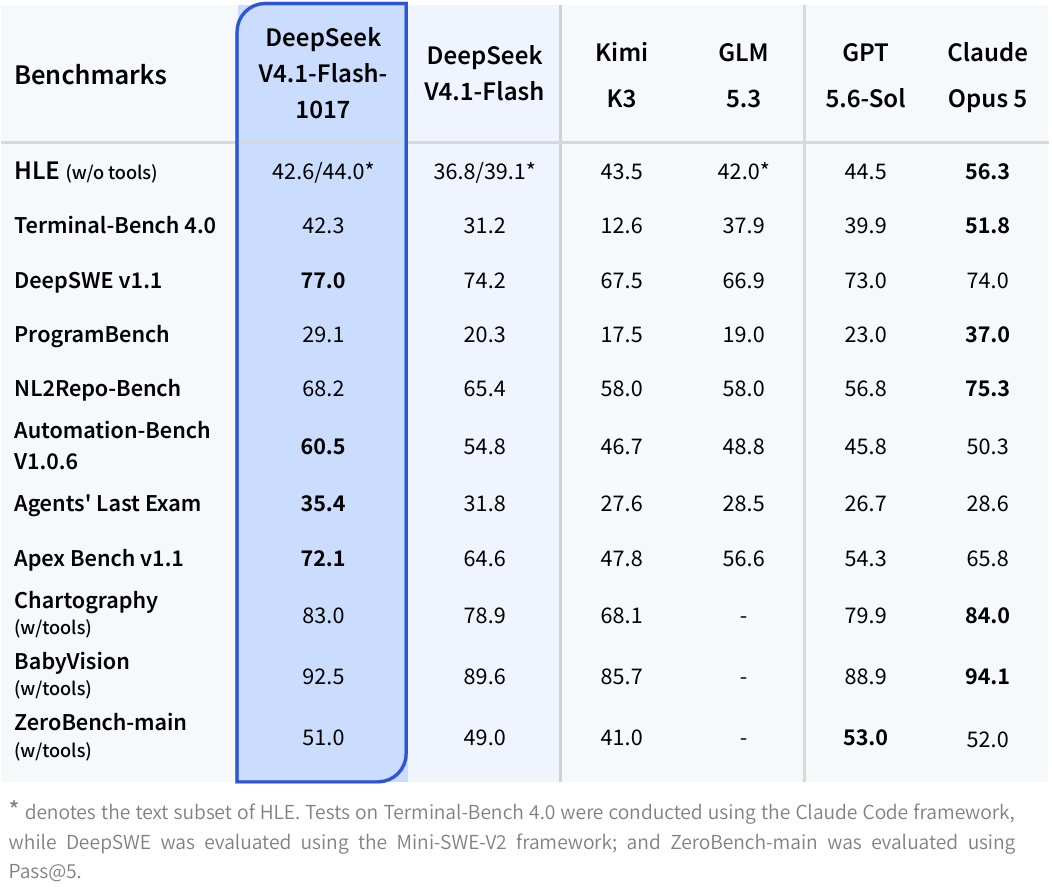
The announcement prints the predecessor's scores alongside, so the comparison is available. On Terminal-Bench 4.0, a terminal-task benchmark, it scores 42.3 against 31.2 for the previous V4.1-Flash. On DeepSWE v1.1, an agentic coding benchmark, 77.0 against 74.2. In the same table Claude Opus 5 scores 51.8 on Terminal-Bench 4.0 and 74.0 on DeepSWE v1.1. So Opus 5 still leads on terminal work while DeepSeek leads on DeepSWE. A footnote says the Terminal-Bench 4.0 runs used the Claude Code framework.
Token prices are $0.15 per million input tokens ($0.003 on a cache hit) and $0.60 per million output tokens. Monday through Friday, 01:00 to 04:00 and 06:00 to 10:00 UTC, those rates double; the rest of the time they are as listed.
Can you use it today
Nothing in the docs gates this by region. There is no restriction clause, no application, and no waitlist. An API key and a funded balance are all it takes.
| Item | Detail |
|---|---|
| Who | Any developer with a DeepSeek API key. No application or approval step |
| Price | $0.75 per 1,000 for search and for fetch, drawn from a prepaid balance |
| Region | No region list and no restriction stated. There is one host, |
| Free until | Calls routed through DeepSeek Harness, Claude Code, or Codex only, until 16:00 UTC on October 31 |
| Limits | 5 QPS search, 5 QPS fetch, plus a per-domain limit on fetch |
One thing the docs do not answer. The full search guide says nothing about retention periods, whether queries are used for training, or where processing happens. There is no ap-southeast-1 to pick and no data residency statement to read. In the HN thread, apwheele wrote that not being able to get past the DeepSeek API's lack of zero data retention rules it out for sensitive work. The same thread carried unsourced claims about data routing that other users asked for evidence on.
That silence is a compliance problem before it is a trust problem. Singapore's PDPA bars sending personal data abroad under section 26 unless the recipient is bound to a comparable standard of protection, and the usual route is a contract that names the countries the data may travel to. A vendor that does not publish where processing happens leaves you unable to name them. The one audited public account of where this data goes comes from Korea's Personal Information Protection Commission, which resolved a preliminary inspection of DeepSeek on April 23, 2025, found that user information and prompt contents had been transferred to three recipients in China and one in the United States without consent, and issued a corrective recommendation. DeepSeek published a Korean-language privacy policy and an opt-out, and app downloads resumed in Korea on April 28, 2025. That action targeted the consumer app, not the developer API, but it is the clearest confirmation that queries land on servers in China. If internal data ends up inside your query strings, that is a legal review before it is a procurement decision.
Quality verdicts are still split. On HN, ggnore7452 ran a fetch benchmark and wrote that despite liking DeepSeek, search and fetch are not very good, while the price is very cheap. dsco, who uses it daily, called search the strong part. Two opposite readings in one thread means results vary by query type, and neither test covered non-English queries. The operator examples in the docs show zh and en, so anyone searching in Bahasa, Thai, Vietnamese, or Japanese is testing unmeasured ground.
If you already have search wired into an agent, point Claude Code at the DeepSeek API before October 31, throw your twenty most typical queries at it for free, and compare what survives a rerank_score filter at 1.5 and above against what your current provider returns. If quality holds, the per-1,000 difference is pure savings; if your language loses, those twenty queries are the evidence. If you have not attached search yet, starting after November 1 under balance-based billing costs you nothing in options. A depleted prepaid balance returns 402, which makes the account itself your spend cap.