This Week in AI: Argon Reaches the Gemini App, OpenCode Console Keys Exposed
Google opened Gemini 4 Argon to paying Gemini app subscribers on October 13, and OpenCode disclosed on the 17th that OpenAI and Anthropic keys belonging to 1.4% of Console users may have been exposed.
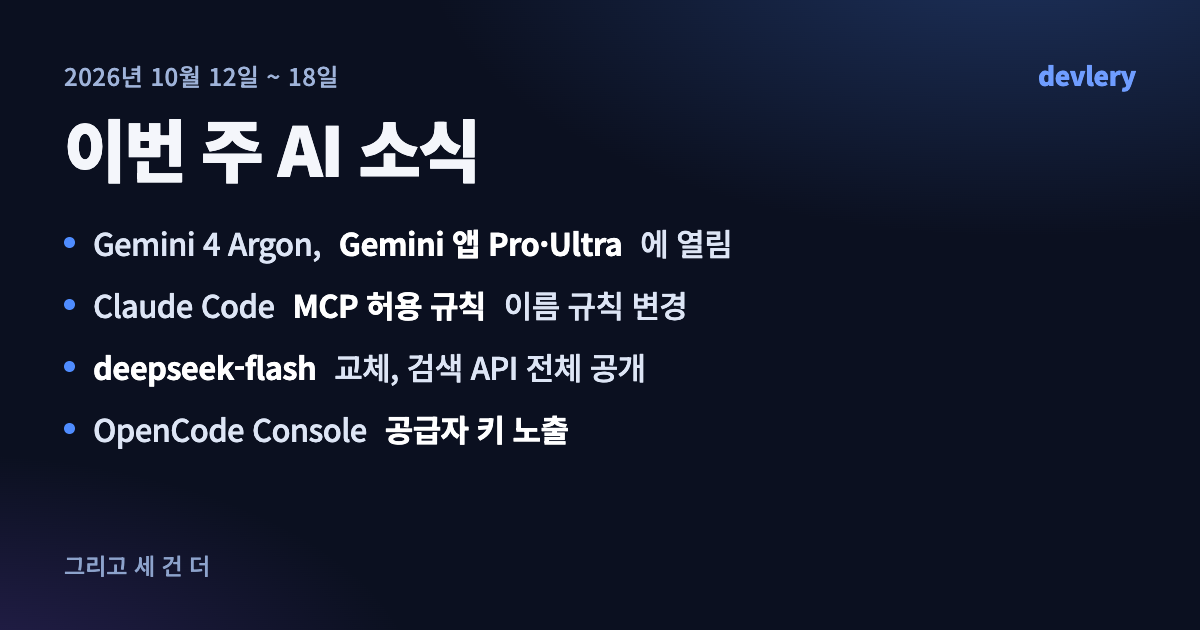
Google put Gemini 4 Argon in the Gemini app for paying subscribers on October 13. Two weeks earlier, at its September 30 debut, the model was restricted to cyber defense organizations; it is now on every Google AI Pro and Ultra plan, worldwide. Four days later OpenCode disclosed that OpenAI, Anthropic, and Google API keys stored in Console workspaces may have been exposed for about 1.4% of its Console users.
Here are seven items from October 12 through October 18.
1. Gemini 4 Argon reached paying Gemini app subscribers
Google added an Argon entry to the Gemini app release notes on October 13. It is the largest model Google currently ships: it pulls scattered material into a finished report, and will build an interactive 3D model in a single pass. The release note names the audience as "Google AI Pro and Ultra subscribers" and the scope as worldwide.
Two weeks ago the model was limited to cyber defense organizations in Google's Fairwind Program plus internal Google teams. The API went generally available the same day, with $2 per million input tokens holding only until November 30.
Both plans that carry Argon are sold across APAC. Google lists AI Pro and AI Ultra in more than 150 countries, Singapore included, and the subscriptions page quotes each in the local currency of the account's country rather than one USD figure. Argon is absent from free accounts and from AI Plus, the cheapest paid tier, whose model column stops at Flash. Rollout is staged per account, so a paid plan does not guarantee the model has appeared yet. If you are on AI Pro or above, check the model list first, then re-run one long task that got cut off on Flash last week. The difference shows up immediately.

2. Claude Code MCP allow rules now require the server's full name
Claude Code 2.1.299, released October 14, narrowed the naming rule for MCP tool allow rules. An allow rule is an entry on the list of tools Claude may run without asking first. The changelog states that MCP allow rules now match only the named server, removing the behavior where mcp__a also covered a server named a__b.
The permissions docs are more specific. For a server named reports__v2, the wildcard has to sit after the complete server name, as mcp__reports__v2__*. Both mcp__reports__v2 and mcp__reports now read as rules about a server called reports, so neither matches.
There is no plan or region condition: this applies to everyone on 2.1.299 or later. The failure mode is quiet, though, because a stale rule does not block the tool, it just brings the approval prompt back. Scan settings.json for allow rules starting with mcp__ and rewrite any entry whose server name contains a period or a double underscore into mcp__<server>__* form.
| Server name | Allow rule that works now | Rule that no longer matches |
|---|---|---|
| puppeteer | mcp__puppeteer__* | None |
| reports__v2 | mcp__reports__v2__* | mcp__reports__v2, mcp__reports |
| my.server | mcp__my_server__* | mcp__my.server__* |
Source: Claude Code changelog and permissions documentation
3. deepseek-flash switched checkpoints and the search API opened to everyone
DeepSeek shipped V4.1-Flash-1017 on October 17 and changed what the deepseek-flash model ID resolves to. Call sites stay the same, and requests still addressed to the retired deepseek-v4-flash land on the same model and bill at Flash rates. The model card lists 763B parameters under an MIT license and puts Terminal-Bench 4.0 at 42.3, up from 31.2 on the previous V4.1-Flash.
The Search and Fetch APIs opened to all users the same day. They let the model look things up on the web and pull pages back itself. Each endpoint costs $0.75 per 1,000 calls, but calls made through the server-side tools in DeepSeek Harness, Claude Code, and Codex are free until October 31, 2026 at 16:00 UTC.
An API key is the only requirement, with no regional restriction, and the swap is already live. The pricing page puts deepseek-flash at $0.15 per million input tokens on a cache miss and $0.60 for output, doubled on weekdays between 01:00 and 04:00 UTC and between 06:00 and 10:00 UTC. If you already run Claude Code or Codex, wire up the DeepSeek search tool before October 31 and decide whether $0.75 per 1,000 calls is worth it once the free window closes.
| Benchmark | V4.1-Flash | V4.1-Flash-1017 |
|---|---|---|
| Terminal-Bench 4.0 | 31.2 | 42.3 |
| ProgramBench | 20.3 | 29.1 |
| Apex Bench v1.1 | 64.6 | 72.1 |
| DeepSWE v1.1 | 74.2 | 77.0 |
Source: Hugging Face DeepSeek-V4.1-Flash-1017 model card
4. Provider keys stored in OpenCode Console were exposed
Anomaly Innovations, which builds the open source coding agent OpenCode, disclosed a breach at 18:08 UTC on October 17. An outside party reached a legacy system that was being decommissioned, and OpenAI, Anthropic, and Google API keys saved in user workspaces on Console, the hosted service, may have been exposed. The company puts the blast radius at roughly 1.4% of Console users who had connected an external provider account.
Anyone running only the open source OpenCode in a terminal is unaffected, because those keys never leave the user's machine. The Hacker News thread ran under the title "OpenCode Hacked," which blurred that distinction for a while; why the local CLI and Console split here is covered in detail separately.
Console is a web signup and the docs state no regional restriction, so readers in Singapore and the rest of APAC are in scope on the same terms as anyone else. OpenCode has not published where the affected users are. The company emailed everyone it believes was affected and said no email means not affected. As of October 18, though, there is no status page and no postmortem, and the company said it cannot itself confirm whether any key was used. If you have ever connected a provider account to Console, revoke and reissue in each provider's console now, regardless of whether an email arrived.
Affected
Anyone who saved their own OpenAI, Anthropic, or Google key in a Console workspace. The company's figure is about 1.4%, and the investigation is still open.
Not affected
Keys stay on the user's own machine and never reach OpenCode's servers. Console is an optional service you can take or leave.
Source: Anomaly Innovations disclosure post and OpenCode documentation
5. GitHub secret scanning blocks Anthropic keys by default
GitHub added three detectors to secret scanning on October 13: Anthropic service keys, Anthropic user keys, and Cloudsmith API keys. Secret scanning looks through code pushed to a repository for strings that look like API keys, and push protection stops a commit containing one from landing at all.
Both new Anthropic key types went onto the default push protection block list. The changelog states that commits containing these secrets are automatically blocked. Salesforce joined as a partner the same day, so a Marketing Cloud OAuth2 token found in a public repository is forwarded to Salesforce for revocation or rotation.
There is no application step, no admin approval, and no regional condition: any repository with secret scanning turned on is covered, free public repositories included. Landing in the same week as the OpenCode incident, where keys actually did leak, it is worth opening settings on any repository that uses Anthropic keys and confirming secret scanning and push protection are both on.
| New detector | Alert scope | Blocked on push by default |
|---|---|---|
| Anthropic service API key | Repositories with secret scanning on | Blocked |
| Anthropic user API key | Public and private repositories | Blocked |
| Cloudsmith API key | Public and private repositories | Not mentioned in the changelog |
Source: GitHub changelog, 2026-10-13
6. Meta published 816B weights with two conditions attached
The meta-models/Muse-Spark-Open-816B-A42B repository went up on Hugging Face on October 15, which means Meta's large model can now be downloaded and served on your own hardware. It activates 42B of its 816B total parameters per forward pass, and the model card puts Terminal-Bench 2.1 at 76.4.
Two conditions come with it. The first is attribution: "Built with Muse Spark Open" has to appear prominently somewhere in the product UI, documentation, website, or settings. The second is a revenue threshold. An organization with more than $20M in total revenue over any 12 months that offers this model to third parties as an API has to notify Meta and sign a separate agreement. Internal use, research, and shipping it inside your own product do not trigger it. That clause is also why Meta's own API pricing did not move when the weights opened.
Neither the license nor the model card contains a country restriction, which is not a given in this category: the Tencent Hunyuan community license carves the EU, the UK, and South Korea out of its grant. Hardware is the real constraint. The model card asks for roughly 700GB of VRAM for the NVFP4 build and about 2TB for BF16. Without that in house, compare response quality first on a hosted endpoint such as Baseten, and go shopping for hardware only if the quality justifies the move.
7. Three models leave Copilot on November 16
GitHub announced a deprecation schedule for three Copilot models on October 15: Claude Opus 4.8, Claude Opus 5, and GPT-5.6 Terra, all on November 16, 2026. They go at once across every Copilot surface, including chat, inline edit, ask mode, agent mode, and code completion.
Until then nothing changes. The announcement carves out one exception: individual subscribers on an annual plan keep access to Claude Opus 4.8. Enterprise and Business tenants with default model enablement on get the replacement models automatically, but an organization that has turned the global default off needs an admin to enable them in the model policy section of Copilot settings.
There is no regional condition. The teams that break on November 16 are the ones that pinned a model name in an internal guide or a script, and since the announcement names a replacement for each model, swapping the string is the whole fix.
| Retired November 16 | Replacement named in the announcement | Exception |
|---|---|---|
| Claude Opus 4.8 | Claude Opus 5.5 | Individual annual subscribers keep access |
| Claude Opus 5 | Claude Opus 5.5 | None |
| GPT-5.6 Terra | GPT-6.1 Sol or GPT-6 Luna | None |
Source: GitHub changelog, 2026-10-15
The short version
The biggest change this week is Gemini 4 Argon moving from cyber defense organizations only to every Google AI Pro and Ultra subscriber, in the 150-plus countries where those plans are sold. Three things are doable today: rewrite Claude Code's mcp__ allow rules to use full server names, wire up the DeepSeek search tool before the free window closes on October 31, and confirm push protection is on in any repository that uses Anthropic keys. If you have ever connected a provider account to OpenCode Console, do that one first. Meta's 816B weights are downloadable with no country restriction, but 700GB of VRAM comes before that. And if your team is on Opus 4.8, Opus 5, or GPT-5.6 Terra in Copilot, November 16 is the date to revisit.