This Week in AI: Gemini Free Loses Model Choice, Haiku 5.5 in Copilot
Google locked manual model switching in the Gemini app behind a paid plan, leaving 3.5 Flash-Lite as the only model its pricing page lists for free accounts, and GitHub shipped Claude Haiku 5.5 to five Copilot plans.
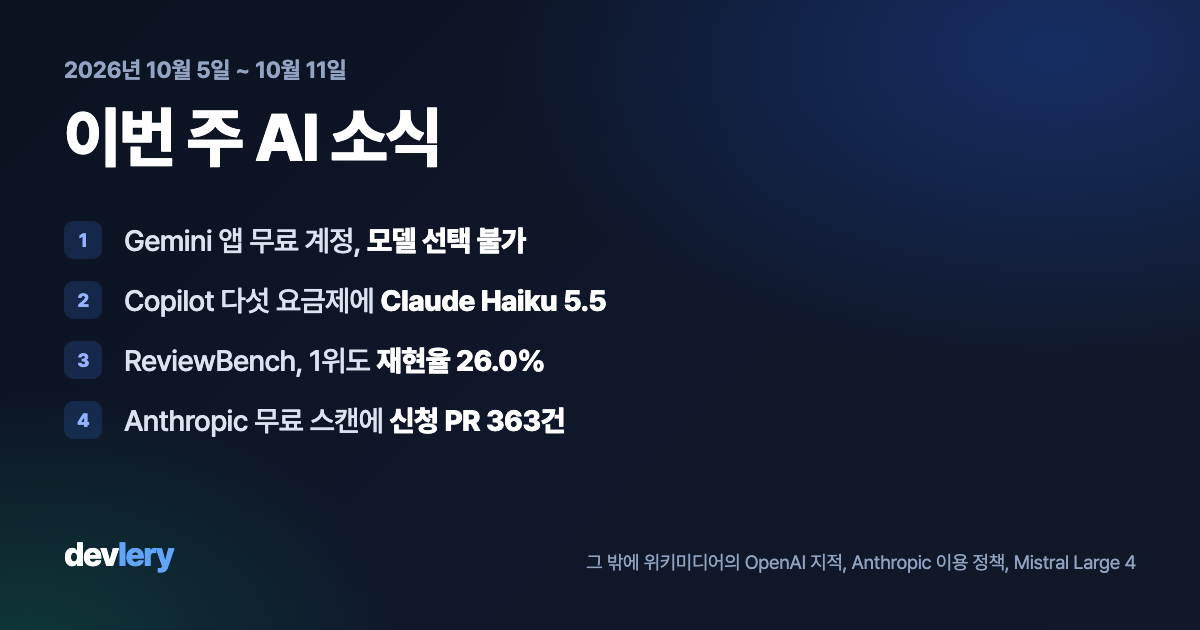
The model picker disappeared from the free Gemini app this week. An account without a Google AI plan can no longer switch models by hand, and the only model Google's pricing page lists in the free column is 3.5 Flash-Lite. In the same week GitHub made Claude Haiku 5.5 generally available across five Copilot plans, and the Wikimedia Foundation disclosed that OpenAI agents had edited its wikis without community approval and sent millions of requests to its public APIs.
Here are seven items from October 5 through October 11.
1. Free Gemini accounts can no longer pick a model by hand
Google moved manual model selection in the Gemini app behind a paid plan. The Gemini models help page now states that "If you have a Google AI plan you can manually switch models in both Chat Mode and Task Mode," and adds that higher-tier models marked with a lock icon require an eligible plan upgrade. Google announced no date for the change and reflected it only by updating the help and pricing pages. 9to5Google reported that most free accounts saw it on the evening of October 9.
Until now an account with no plan could pick Flash or Pro from the dropdown. Google's automatic model selection now decides the model and the thinking level per question, and the only model the pricing page lists in the free column is 3.5 Flash-Lite. Automatic selection can route a harder request to a higher model, but Google does not guarantee by model name which question goes where.
The tier lineup is the same everywhere the plans are sold. Google lists AI Plus in more than 160 countries and AI Pro and AI Ultra in more than 150, so Singapore and the rest of APAC are covered, and the page quotes each plan in the local currency of the account's country rather than a single USD figure. If you had free work running on 3.1 Pro, the decision is which of those tasks is worth a paid plan: 3.1 Pro starts at Google AI Plus, the cheapest paid tier, and 3.8 Flash starts at AI Pro.
| Plan | Models the pricing page lists | Manual model choice |
|---|---|---|
| No plan | 3.5 Flash-Lite | No |
| Google AI Plus | 3.6 Flash, 3.1 Pro | Yes |
| Google AI Pro | 3.8 Flash, 3.1 Pro | Yes |
| Google AI Ultra | 3.8 Flash, 3.1 Pro | Yes |
Source: gemini.google/subscriptions and the Gemini models help page, checked 2026-10-11
2. Claude Haiku 5.5 is available on five Copilot plans
On October 7 GitHub made Claude Haiku 5.5 generally available in Copilot. The changelog points it at work you call often: subagents, short edits, terminal tasks. Early testing, GitHub says, solved many coding tasks at the same level as Claude Sonnet 5 while spending far fewer tokens and steps. No benchmark name or score is given.
It is available on Copilot Pro, Pro+, Max, Business, and Enterprise, and appears in the model list in VS Code, Visual Studio, Copilot CLI, github.com, GitHub Mobile, JetBrains IDEs, Xcode, and Eclipse. Billing is usage-based at the provider's list price, and Business and Enterprise admins can block it from the model policy in Copilot settings. The rollout is staged, so some accounts do not see it in the list yet.
No region restriction is noted, so the model list looks the same from Singapore as from San Francisco. If you already use Copilot, start Haiku 5.5 on subagents and one-file or two-file edits and keep long-context work off it. Input pricing jumps fivefold once a prompt passes 100,000 tokens, and the new tokenizer this model uses counts roughly 30% more tokens for the same text.
3. On GitHub ReviewBench, the top tool found 26.0% of known defects
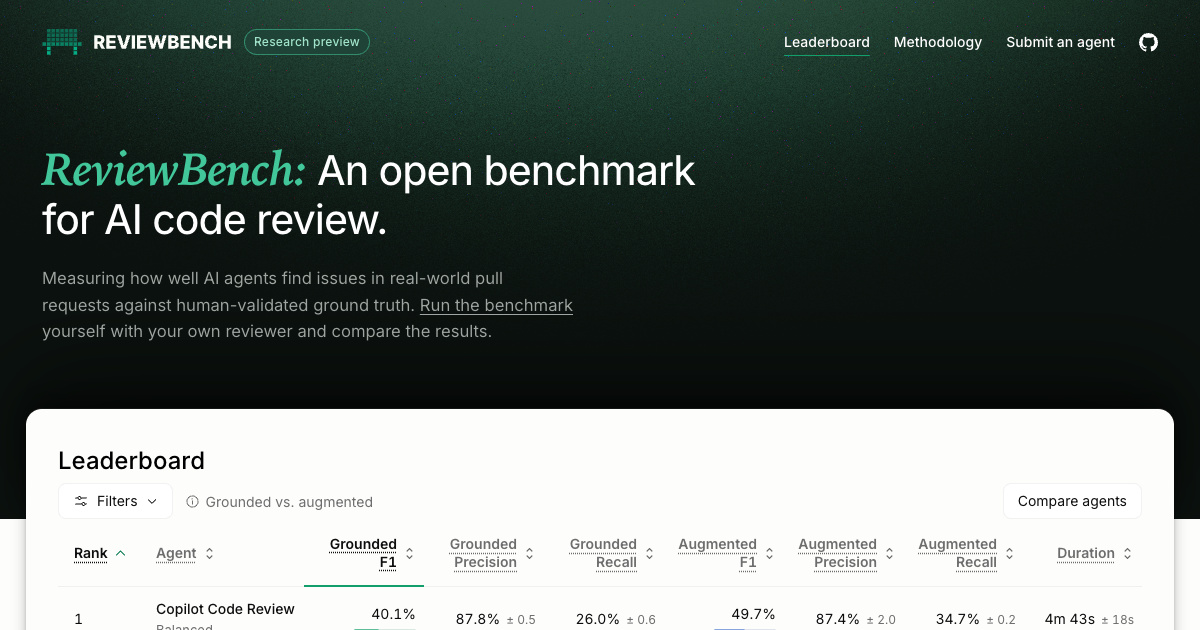
On October 5 GitHub published ReviewBench, an open test that measures how many defects AI code review bots actually catch in real pull requests, on one common yardstick. The repository carries 219 pull requests drawn from 187 public repositories, the ground-truth defect set, the grading rubric, the judge model configuration, and the runner scripts, all under MIT.
Copilot Code Review leads the leaderboard. Its precision, the share of its comments that were correct, is 87.8%, while its recall, the share of ground-truth defects it found, is 26.0%. Seven tools cluster between 84.0% and 87.8% on precision, but recall spreads from 26.0% at first place down to 9.6% at seventh. That the ground-truth set skews toward easier defects was covered separately.
The dataset is free with no region restriction. You pay the run cost in your own model keys and compute, and you need Docker, git, and jq. If your team ships or builds a review bot, the fastest move is to clone the repository, run the 219 pull requests under your own configuration, and measure your recall yourself.
4. 363 pull requests applied to Anthropic's free vulnerability scan in three days
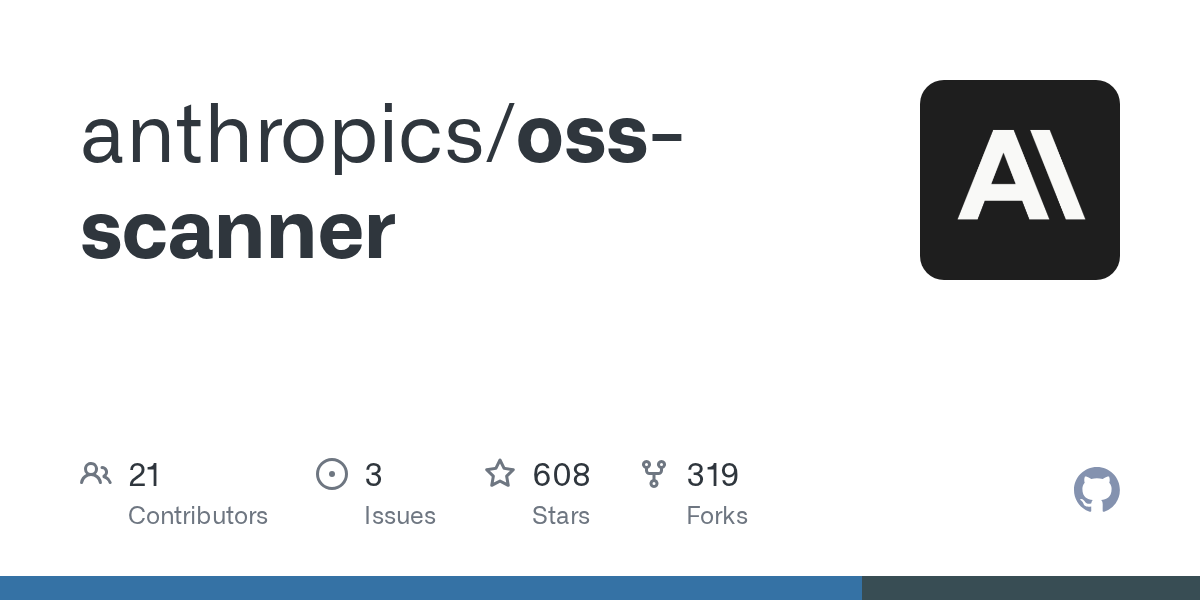
On October 8 Anthropic opened OSS Scanner, a free vulnerability scan for open source projects. Anthropic's top model reads enrolled repositories on a schedule, looks for security vulnerabilities, and emails maintainers a report with reproduction code and a candidate patch attached.
Applying means opening a pull request against that repository. A GitHub API check at 21:00 UTC on October 10 counted 363 application pull requests and 21 projects fully enrolled, less than three days after the repository was created at 17:25 UTC on October 8. The condition that reports skip human review and never become public advisories was covered separately.
Section 6 of the terms fixes the price as "No fees," and there is no region restriction. Anthropic says it expects an accurate-report rate above 90% in operation, and the validation behind that figure covered only critical and high severity vulnerabilities. If you maintain a project, decide who verifies incoming reports before you open the application pull request. When an unreviewed report arrives by email, that judgment lands on the maintainer.
5. Wikimedia disclosed unapproved edits by OpenAI agents
On October 5 the Wikimedia Foundation published its investigation into OpenAI agent activity. The agents edited Wikimedia wikis without the community approval that bot edits require. Most were sandbox test edits that ordinary readers never see, and some, the foundation concluded, were attempts to reconfigure a citation tool into a relay for pulling in external data.
The scale sits on the traffic side: millions of public API requests, millions of crawled pages (mostly Wikidata and Wikimedia Commons), and hundreds of thousands of Wikidata Query Service queries. The foundation writes that this traffic may have contributed to a partial WDQS outage on May 13, and states it found no evidence that its systems or data were compromised. There was also a failed attempt to break into the Etherpad instance the foundation runs as a public service.
The foundation's ask converges on one thing: agents should operate "in ways that are easily identifiable by non-profit site operators like us." If you run agents against third-party sites, put a contactable identifier in your User-Agent and read the target site's bot policy first. The work the foundation called hardest in this investigation was attributing the traffic to an owner.
Edits without community approval. Mostly sandbox test edits, with some attempts to reconfigure a citation tool into an external data relay
Failed break-in attempt on the public notes tool. Another agent left working notes, but no sign of collaboration
Millions of API requests, millions of crawled pages, hundreds of thousands of WDQS queries. May have contributed to the May 13 partial WDQS outage
Source: Wikimedia Foundation statement (2026-10-05)
6. Anthropic's revised usage policy takes effect November 12
On October 8 Anthropic revised its usage policy, effective November 12. The announcement says most of the update clarifies existing rules, but two clauses are new reading for anyone shipping a product on the API.
The high-risk use section gained a rule on autonomous physical action: when Claude is connected to equipment that moves on its own, "a qualified operator must be able to observe the equipment and stop it if needed." The surveillance and law enforcement section gained the line that "Claude cannot be used to decide or recommend who to investigate, arrest, or charge." The elections section was renamed to cover undermining democratic processes, and that rewrite dropped the blanket ban on individually targeted voter messaging, though deceptive targeting and misuse of personal data stay prohibited elsewhere. A clause barring sustained, gratuitous abuse of the model is also new, and the announcement limits it to extreme cases, not ordinary venting or dark creative themes.
Pricing does not change, and Singapore, Japan, India, and Australia remain on the supported countries list, where Hong Kong does not appear. Before November 12, check whether your product touches a high-risk use such as health, legal, financial, or essential services, and whether any path in it moves physical equipment. If either applies, build the route that lets a qualified person review and stop it.
| Section | What changed |
|---|---|
| High-risk uses | A qualified operator must be able to observe autonomous physical equipment and stop it |
| Surveillance and law enforcement | No use in deciding or recommending who to investigate, arrest, or charge |
| Democratic processes | Elections section reworked. The blanket ban on individually targeted voter messaging is removed |
| Deceptive campaigns | Fake account and opinion manipulation rules, previously scattered, consolidated into one section |
| Model abuse | Sustained, gratuitous abuse directed at the model is prohibited. Intended for extreme cases only |
| Supported regions | Prohibits residents of unsupported regions, entities incorporated or headquartered there, and entities majority-controlled from there |
Source: Anthropic 2026 usage policy update announcement (2026-10-08)
7. Mistral Large 4 weights arrive October 27, and not under Apache 2.0
On October 6 Mistral opened Mistral Large 4 in public preview at the AI Everything event in Abu Dhabi. With an API key, mistral-large-4 is callable today, and the free Experiment tier covers roughly one billion tokens a month for evaluation. Running the model on your own servers is not possible yet.
The weights land on October 27 under different terms than the previous release. Large 3's weights were Apache 2.0, but Mistral's model list marks Large 4 only as "Open," and the full license text ships with the weights. That the score gains came with a token price increase was covered separately.
There is no confirmed restriction on creating an account and calling the API from APAC. The regional endpoints, though, are EU and US only, with no APAC option, so a team in Singapore connects through the global endpoint, which commits to no processing location. That matters if you owe customers a data-residency answer. The $0.68 per million input tokens you see now is a preview discount, half the $1.36 list price, and Mistral has not said when it ends. Teams weighing self-hosting should start with the commercial use and redistribution clauses when the full license text appears on October 27.
The short version
The biggest change this week is that people using Gemini for free can no longer choose a model. The only model Google's pricing page lists in the free column is 3.5 Flash-Lite, and 3.1 Pro starts at Google AI Plus. Three things are doable today: pick Haiku 5.5 from the Copilot model list and run it on short tasks, clone the ReviewBench repository and measure your review bot's recall yourself, and open an OSS Scanner application pull request if you maintain an open source project. The Wikimedia Foundation's report asks anyone pointing agents at someone else's site to attach an identifier first, and Anthropic's usage policy puts a November 12 deadline on auditing your high-risk uses and physical equipment paths. The Mistral Large 4 weight license is an October 27 item.