Salt Code brings MCP policy enforcement to AI coding assistants
Salt Code connects organizational security policy to AI coding assistants at generation time. The promise is earlier enforcement, not automatic vulnerability removal.

- What happened: Salt Security announced Salt Code on June 1, 2026.
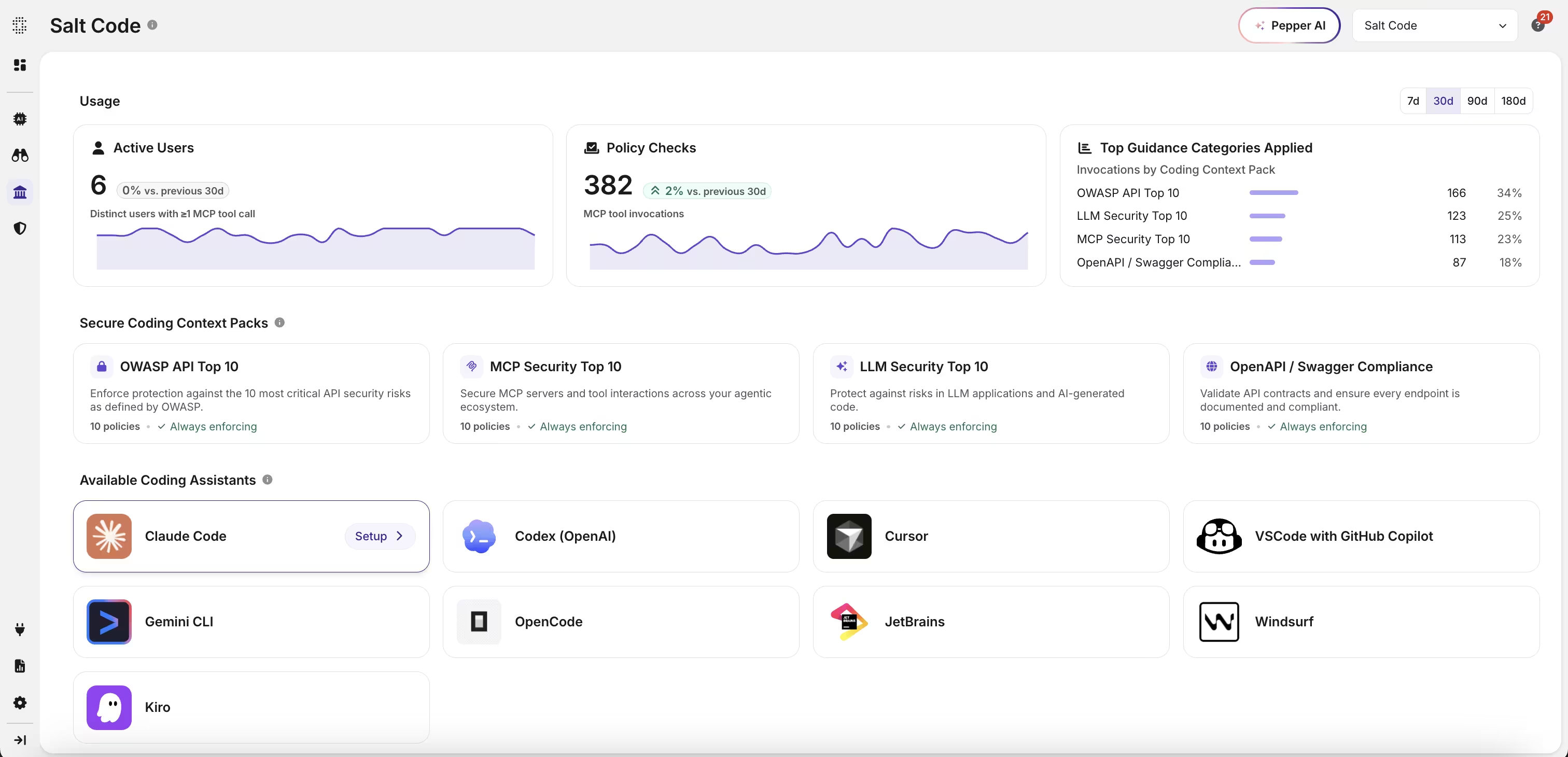
- The product connects security policies to AI coding assistants such as Claude Code, Cursor, GitHub Copilot, Windsurf, Codex, and Gemini CLI.
- Product angle: Salt is pitching
code generation enforcementbefore the usual PR or CI scan.- The company says Salt Code can attach to assistants or code review workflows that support MCP server configuration.
- Developer impact: Security teams now need to ask whether policy reaches prompts, MCP, CI/CD, and runtime telemetry.
- Watch: Policy injection is not vulnerability removal. It moves the verification point earlier in the workflow.
Salt Security announced Salt Code on June 1, 2026. The product description is direct: connect organizational security policy to the AI coding assistants developers already use. Salt names Claude Code, Cursor, GitHub Copilot, Windsurf, Kiro, Codex, Gemini CLI, Antigravity, VS Code, OpenCode, JetBrains, and MCP-compatible clients as the target surface. The product claim is that security policy can be applied while code is being generated, not only after a developer opens a pull request.
That placement is what makes the release more than another security scanner announcement. SAST, DAST, secret scanning, reviewer checklists, and deployment gates usually warn after code exists. Salt Code's product page says assistants such as Cursor, Copilot, and Claude can be guided in real time as they generate code. The control point moves from "the AI wrote code, now a person or scanner must catch the issue" toward "the AI receives the organization's policy context before it writes the endpoint, MCP server, auth flow, OpenAPI schema, or database query."
The problem Salt is targeting is already inside development teams. Sonar's 2026 State of Code Developer Survey covered more than 1,100 professional developers and found that 42% of committed code is AI-generated or AI-assisted, according to the company's report. The same write-up says 72% of developers who have used AI coding tools use them daily, while 96% do not fully trust AI-generated code. Only 48% said they always verify AI-assisted code.
Salt's launch post summarizes that gap as security policy living in PDFs, wikis, and tribal knowledge. The standards may exist, but the coding assistant creating an API endpoint, MCP integration, auth flow, OpenAPI specification, or database query does not automatically know them. Unless a developer repeats "follow our internal security standard" in every prompt, the assistant falls back to public code patterns, generic best practices, and whatever context the tool has already collected from the workspace.
Salt Code is described as a six-part flow. First, it discovers APIs, MCP servers, and AI agent integrations across repositories and cloud environments. Second, it inserts security policy into the assistant's context during generation. Third, it validates policy in CI/CD and pull requests. Fourth, it observes APIs, MCP servers, and agent behavior at runtime. Fifth, it sends runtime findings back into the development workflow and AI assistant. Sixth, it keeps the same policy model across code, control plane configuration, and runtime behavior.
The difference from existing approaches is the location of the check. Before and after code generation, developers often add security requirements manually through prompts. Salt Code says it connects policy packs to assistant context and MCP configuration. At the pull request stage, SAST, secret scanning, and reviewer checklists detect issues after the code has already taken shape. Salt says CI/CD validation can use the same standards that guided generation. At runtime, API gateways, WAFs, and observability systems are often separate tools. Salt says APIs, MCP servers, and agent behavior can be observed through the same policy model.
MCP is the technical hinge in the announcement. Salt says Salt Code can attach when an AI coding assistant or code review workflow supports MCP server configuration. MCP is the channel through which assistants call external tools and retrieve context. For a security team, that channel is both risk and leverage. It is risk because assistants gain more ways to act. It is leverage because the same channel can deliver policies, schemas, validation rules, and organization-specific prohibited patterns.
Salt's pre-built policy library is aimed at that point of leverage. The announcement mentions OWASP API Top 10, MCP Security Top 10, LLM Security Top 10, OpenAPI and Swagger compliance, common regulatory frameworks, and custom organizational policies. An assistant generating an API endpoint needs authentication, rate limiting, PII handling, TLS, and OpenAPI shape to be reflected in the output. An assistant generating an MCP server needs tool permissions, credential boundaries, prompt injection handling, and audit logging to be part of the design rather than added as a separate cleanup task.
The product screenshot uses a registration service and an api.yaml file as the example. The right side lists items such as "Authentication via HTTPS," "JWT bearer auth required on external APIs," "Rate limiting enforced on auth endpoints," and "No shadow APIs introduced in this PR" as compliant. A demo image cannot prove enforcement mechanics, false-positive rates, or bypass resistance. It does show the object Salt wants to govern: the match between generated API contracts and security requirements, not just a generic file-level lint result.
This approach lines up with recent AI coding security research. Cloud Security Alliance's April 2026 research note, "AI Coding Assistants as Attack Surface," divides assistant risk into code, skills, and secrets. It collects Cursor, GitHub Copilot, OpenAI Codex CLI, and Claude Code CVE examples and describes attacks such as configuration rewrite, command injection, path restriction bypass, malicious hooks, and API key exfiltration. The note labels itself as unofficial AI-assisted research, so its numbers should be treated conservatively. Its attack categories still work as a practical review checklist for products that touch assistant context and tool execution.
Salt Code's strongest practical argument is that policy should not live only in developer memory. In teams using AI coding tools, the weak link is often not model quality. One project may require a particular security header, another internal API may require mTLS, one repository may ban a specific ORM pattern, and one customer data class may never be logged. These constraints differ by organization and repository. A model vendor cannot infer them from general training data. Salt's approach moves those local rules into assistant context and policy packs.
Three numbers frame the bottleneck. Sonar reports that 42% of committed code is AI-generated or AI-assisted. The same report says 48% of developers always verify AI-assisted code. Salt Code's Early Access program is limited to the first 100 organizations, with current Salt Security customers receiving it as part of their existing license. Together, those numbers describe high AI code volume, inconsistent human verification, and a governance product that is still early in market validation.
Generation-time policy enforcement is not a complete defense. The first limitation is policy freshness. Public standards such as OWASP API Top 10 and LLM Security Top 10 are useful starting points. Real incidents often involve a specific cloud account, private package registry, legacy authentication service, internal data classification rule, or exception process. If no one owns policy writing, approval, rotation, and repository scoping, the assistant only receives more context. More context does not automatically mean stronger control.
The second limitation is the gap between enforcement and suggestion. An assistant may read a rule that says "external APIs require JWT bearer authentication" and modify a file accordingly. A separate system still has to verify whether the resulting PR satisfies that rule. Salt says CI/CD validation and runtime validation are part of the product flow. The operational questions are concrete: does a violation block assistant output, fail a PR check, open a ticket, or only produce a recommendation? Who triages false positives? Can a developer override a policy, and does that override create an audit trail?
The third limitation is prompt injection. MCP and assistant context are the path for adding policy, but they are also paths where attackers can introduce instructions. The CSA note's examples around configuration files, hidden Unicode, GitHub Issue context, and workspace settings all rely on assistants trusting inputs they should not fully trust. A product like Salt Code cannot stop at "policy text exists." Teams still need to test which instruction sources win, where tool-call approval stops, and whether repository files can override higher-priority policy.
The fourth limitation is vendor coverage. Salt lists Claude Code, Cursor, GitHub Copilot, Windsurf, Kiro, Codex, Gemini CLI, Antigravity, VS Code, OpenCode, JetBrains, and any MCP client. That list is broad, but each assistant has a different execution model, enterprise policy API, workspace permission model, local or remote runtime boundary, and MCP maturity. Claude Code's local file access, Copilot's IDE integration, Codex CLI's shell command path, and Cursor's workspace context are not the same risk surface. Security teams should not read "supported" as "controlled in the same way."
Community discussion around the exact Salt Code launch is still limited, but adjacent security conversations are already visible. A June 2, 2026 r/grc thread about evaluating AI coding tools in finance listed SOC 2 Type 2, GDPR documentation, zero data retention, on-premises deployment, exportable audit logs, and model training transparency as review criteria. One comment argued that in regulated environments, the best coding assistant is not simply the one with the strongest autocomplete, but the one that can pass legal, security, audit, and procurement review.
Another r/vibecoding security audit post claimed that AI-generated SaaS boilerplate often contained hardcoded secrets, tenant isolation failures, and misconfigured security headers. Some commenters criticized the post as promotional, while others focused on the underlying point: passing tests does not prove that injection, broken authentication, or insecure defaults are gone. That reaction matches Salt's market hypothesis. AI coding security is not solved by choosing a better model alone. It breaks down into what the organization enforces during generation, testing, review, deployment, and runtime.
Development teams can turn the Salt Code announcement into five checks. First, classify what AI coding assistants generate. UI components, internal scripts, customer-facing APIs, auth middleware, payment integrations, and MCP servers should not share one review rule. Second, convert security policy into machine-readable packs that assistants and CI can use. A natural-language wiki is not enough when enforcement depends on repository scope and fail conditions.
Third, make PR checks and runtime findings share policy IDs. If API-AUTH-003 is delivered to the assistant during generation, validated in the PR, and later associated with an anonymous-access anomaly at runtime, triage becomes faster. Fourth, define an override process. If every exception is blocked, developers will look for another path. Exceptions need an approver, expiration, justification, and linked ticket.
Fifth, document permission differences between assistants. A CLI agent that can run a local shell has a different boundary from an IDE assistant that edits files. A cloud sandbox that opens pull requests differs from a chat agent calling MCP tools. Salt's claim that it supports many assistants is a starting point. In production, teams still need assistant-specific decisions for allowed tools, network access, credential scope, audit export, and data retention.
Salt Code's Early Access is limited to the first 100 organizations, and current Salt Security customers receive it under their existing license. That means the public materials are not enough to evaluate false-positive rates, policy authoring workflow, latency overhead in each assistant, CI/CD integration effort, or how much of the runtime feedback loop is actually automated. Those details will determine whether the product feels like a useful control plane or another source of developer friction.
The practical signal is still clear. As AI coding assistants generate more APIs, MCP servers, agent tools, and configuration, security teams cannot rely only on "humans will review AI-written code more carefully." Sonar's survey already shows a verification bottleneck, and assistant output is moving beyond isolated functions into deployable infrastructure surfaces. Salt Code productizes that bottleneck. Security policy is no longer only a PDF, wiki page, or PR checklist. It is becoming something distributed through assistant context, MCP configuration, PR checks, and runtime telemetry.
The best adoption question is not "should we buy Salt Code?" It is "where is our AI-generated code policy actually enforced?" If policy is absent during generation, developers have to remember it in prompts. If policy is absent from PR checks, reviewers can miss it. If policy is absent at runtime, teams cannot see drift after deployment. Salt Code is one sign that the AI coding security market is trying to connect those stages into a single policy path. In that workflow, the assistant name matters less than the route policy takes from security team intent to generated code and deployed behavior.