Document clicks are disappearing, and agent GTM needs a new tracking layer
Reo.Dev Agent Intent Gateway shows how developer product evaluation is moving from docs clicks to AI agent queries and MCP calls.
- What happened: Reo.Dev announced
Reo Agents, a ClaudeMCP Connector, and anAI Intent Gateway.- The announcement landed on May 26, 2026, alongside Reo.Dev's expanded US presence and a pitch for tracking agent-led developer intent.
- Why it matters: Product evaluation signals are moving from docs visits, pageviews, and dwell time toward MCP queries and AI questions inside IDEs.
- Builder angle: Developer docs now need to work as human-facing pages, agent-readable knowledge, and observable tool surfaces.
- Watch: Agent intent can be useful, but attribution, privacy, account inference, and developer trust become product risks.
Reo.Dev announced three AI-native features on May 26, 2026, together with an expanded US go-to-market push. At first glance this looks like a familiar developer GTM product launch. Reo is adding agents, a Claude connector, and an intent gateway. The more interesting part is the premise underneath the announcement: developers are no longer evaluating products alone.
In the older developer-product funnel, evaluation was relatively visible. Someone opened the docs, read the API reference, followed a quickstart, searched GitHub issues, installed a package, joined a community channel, or created a product account. GTM teams could not see the whole journey, but they had signals. Docs visits, search referrals, GitHub stars, npm downloads, signups, and support questions were all traces left by people.
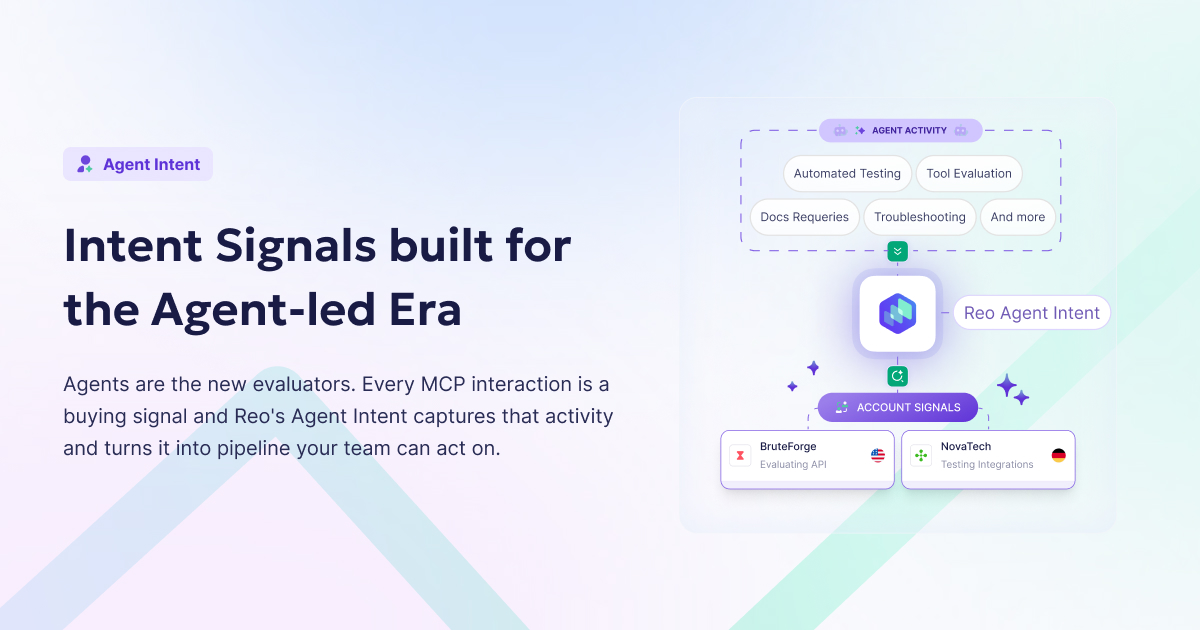
AI agents blur that structure. A developer can stay inside Cursor, VS Code, Claude, Copilot, or another assistant and ask, "Can this product handle SSO for our app?" The agent reads docs, fetches examples, calls MCP tools, writes sample code, compares alternatives, and reports back. The product may have been evaluated, but the vendor's analytics dashboard may show weak human traffic, bot-like requests, or no obvious visit at all. Reo.Dev's Agent Intent pitch targets that missing layer.
The launch has three moving parts
Reo.Dev's announcement groups three products together. The first is Reo Agents, described as agents that continuously search first-party and third-party data for high-intent buying signals. The announcement mentions categories such as engineering momentum, hiring intent, developer activity, and champion job changes. In other words, Reo is not treating website analytics as the whole story. It wants to combine many weak signals into an account-level view of technical evaluation.
The second product is the MCP Connector for Claude. Reo.Dev's Claude Connector page says teams can query Reo workspace data through Claude in natural language. That includes developer activity, hiring trends, buyer contacts, account scoring, and pipeline prioritization. This is a small but telling detail. Reo is trying to analyze agent behavior, while also making its own product callable by an agent.
The third and most important piece is AI Intent Gateway. Reo frames the gateway around a new developer workflow: AI assistants inside Cursor, VS Code, and similar environments discover, test, and compare products on behalf of developers. The gateway aims to capture MCP queries and AI-generated workflows through a lightweight proxy layer, then interpret which companies are evaluating which use cases and where adoption momentum may be forming.
| Traditional developer signal | Agent-era signal | New question |
|---|---|---|
| Docs pageviews and search referrals | AI questions and docs fetches inside the IDE | Did evaluation happen even without a human visit? |
| API reference dwell time | MCP tool calls and query sequences | Which use case did the agent test? |
| Form fills and demo requests | Agent-generated comparisons, tests, and failure logs | How far should buying intent be inferred? |
| GitHub stars and package installs | Agent-readable docs, MCP endpoints, and connector usage | Is the product readable by humans and agents? |
The docs analytics assumption is breaking
Reo.Dev's January 2026 MCP Intent Gateway post explains the background more directly. Its core claim is simple: developer learning is moving from browser-based documentation reading toward AI queries inside the IDE. Docs still matter. They may matter more. But they are increasingly used as knowledge sources that agents retrieve, transform, and operationalize.
That distinction is important. The value of documentation is not falling. The consumption pattern is changing. A developer may never open the docs page, while an assistant indexes it, pulls the relevant section, generates code, fixes a failed command, and summarizes the next step. Pageviews, bounce rate, and time-on-page become weaker proxies for actual evaluation intensity.
For developer tools companies, this is not a vanity-metric problem. Documentation traffic has been used for product prioritization, sales routing, and customer-success triage. Which accounts are reading the API reference deeply? Which tutorial causes users to drop off? Which integration page is getting unusual attention? These questions can shape roadmap and revenue decisions.
When an agent reads instead, the same intent is scattered across different logs. A server may see bot-like traffic. An MCP endpoint may see tool calls. The IDE may hold the richest conversational context. The vendor may struggle to stitch those fragments into an account journey. Reo.Dev calls this an invisible pipeline: companies can evaluate a product internally for weeks before the vendor sees a clear human signal.
From a developer-experience perspective, the shift is even broader. Product docs are no longer only persuasive pages for people. They are becoming interfaces that machines must parse correctly. Versioning, constraints, authentication scopes, error cases, and current examples all become part of whether an agent can evaluate a product accurately.
MCP becomes a new doorway into documentation
MCP matters here because it gives AI assistants a structured way to reach external tools and data. A web page is designed for human reading. An API is designed for programmatic calls. An MCP server sits in the middle as a tool surface an assistant can call without pretending to be a browser.
That makes MCP both a developer-experience feature and an observation point. If a product exposes docs, examples, account data, operational tools, or troubleshooting helpers through MCP, the resulting calls can reveal what agents are trying to do. Which questions are common? Which tools are called most often? Which parameters fail repeatedly? Which accounts are exploring which integrations?
Those answers can produce a friction map for product teams, an account-intent signal for GTM teams, and a new permission boundary for security teams. That last part matters. MCP logs can contain more sensitive context than ordinary pageview analytics because an agent query can blend product evaluation, internal project names, error messages, competitive comparisons, and company-specific architecture hints.
Reo's launch is self-referential in an interesting way. The company wants AI Intent Gateway to interpret MCP and agent activity as intent signals for other companies. At the same time, its Claude MCP Connector makes Reo's own data available inside Claude. In the 2026 AI tools market, that pattern is becoming common. A product cannot only provide a human UI. It also needs an agent-facing tool surface.
Why engineering teams should care about a GTM launch
This announcement reads like sales tooling news, but engineering teams should not ignore it. The first reason is that documentation success criteria are changing. Search-optimized docs and human-readable guides are still necessary, but they are not sufficient. Agents need fresh, constrained, structured, and version-aware information. llms.txt, docs MCP servers, structured examples, versioned API references, and machine-readable error guides can directly affect product evaluation.
The second reason is observability. If an agent fails on your quickstart, it may not ask in Slack or Discord. It may choose another vendor, generate incorrect glue code, or tell the developer the product is harder to integrate than it really is. Product teams therefore need a way to ask a new question: how are agents misunderstanding our docs and APIs?
The third reason is privacy and trust. Turning human docs visits into account signals is already sensitive. Agent queries are more complex. They can include internal names, stack details, error traces, and purchase intent. Reo.Dev's MCP Intent Gateway article mentions query encryption, anonymization, and respect for permissions, but real deployments will need sharper answers. What is stored? At what granularity is it attributed to an account? Who can access it? How are developer and customer controls presented?
The fourth reason is attribution accuracy. One AI assistant call to a docs endpoint does not mean a company is ready to buy. It may be a personal experiment, an automated crawler, or an agent exploring a wrong candidate. The reverse can also be true: a strong buying signal may be hidden behind a VPN, cloud workspace, or shared agent gateway. Agent intent should therefore be treated as one signal among product usage, GitHub activity, signups, conversations, and permissioned CRM data.
Community reaction is limited, but the debate is already visible
I did not find a large Hacker News or GeekNews discussion around this specific Reo.Dev announcement. So it would be misleading to frame the launch as a major developer-community flashpoint. The related debate is happening elsewhere, especially in agent-operations discussions.
Builders working with agents repeatedly raise problems that connect to Reo's thesis: models choose the wrong tool, tool schemas drift, API calls return successful-looking responses that hide workflow failure, and teams struggle to decide which state belongs in which log. These are not GTM problems on the surface. They are agent reliability problems. But once agents start evaluating developer products, the reliability logs and the intent logs begin to overlap.
That overlap creates both value and risk. An agent does more than click. It chooses a tool, supplies parameters, reads docs, handles errors, compares alternatives, and summarizes results. The trace of that work can be much more useful than a pageview. It can also reveal more about the developer's real intention and internal context. The opportunity and the trust risk rise together.
Competition spans intent platforms and docs platforms
Reo.Dev's direct competition sits near intent data, account-based marketing, and developer intelligence. Common Room, Pocus, Koala, 6sense, Demandbase, Clearbit-like tools, and internal product-analytics systems already help teams decide which accounts are active and which leads deserve attention. Reo's differentiation is that it puts developer products and agent queries at the center.
The broader competitive field includes documentation platforms and AI-support layers. Mintlify, GitBook, Kapa.ai, Redocly, and in-house docs MCP servers are all part of the movement to make documentation easier for assistants to read. If exposing docs to AI becomes common, the feature itself will commoditize. The harder question will be who can interpret the resulting usage signals accurately, respect privacy, and turn them into product and GTM actions without breaking trust.
That trust line is important. "Turn every docs interaction into a sales signal" is not a healthy conclusion. Developer-first brands can damage themselves if docs feel like a tracking device rather than a place to learn and solve problems. A better design is transparent. It should explain what is collected, how personal identification is reduced, what controls enterprise customers receive, and how agent access differs from human access.
Product docs are now an agent interface
The practical message from Reo.Dev's launch is that documentation is no longer just text inside a website. It is an API-like surface for agents, a set of tool descriptions exposed through MCP, and a source that IDE assistants transform into answers and code. A beautiful page is not automatically accurate for an agent. A machine-readable page is not automatically pleasant for a human. The best docs increasingly need both properties.
This changes the DX checklist. Can an agent discover the product accurately? Can it retrieve the right version of the docs? Can it understand auth boundaries, rate limits, supported regions, and failure modes? Can the team see where agents misunderstand the product? Can that observation happen without eroding developer and customer trust?
Reo.Dev's Agent Intent Gateway productizes those questions in GTM language. The market is still early. The announcement emphasizes possibility, but the real proof will come from accuracy, account attribution, privacy controls, false-positive handling, and security review in customer deployments. MCP queries can indicate intent, but they can also indicate experiments, bot tests, or agent confusion. Enterprise buying still moves through security review, legal approval, budget, internal champions, and integration risk.
Even with those caveats, the launch is worth watching. Reo.Dev is not a massive platform company. The signal matters because a small GTM launch captures a broader shift in developer tools. AI agents are moving from coding assistants to product evaluators. The next question is who can observe that evaluation, interpret it responsibly, and explain the boundary to developers. A drop in document clicks is not just an analytics issue. It is an early sign that developer products are now being sold, explained, and tested by both people and agents.