4 million Codex users, and the on-prem condition for coding agents
OpenAI and Dell’s Codex partnership shows enterprise coding-agent competition moving from model quality to internal context, governance, and deployment boundaries.

- What happened: OpenAI and Dell announced a partnership to bring Codex into hybrid and on-premises enterprise environments.
- The announcement landed on May 18, 2026, and OpenAI says Codex is now used by more than 4 million developers each week.
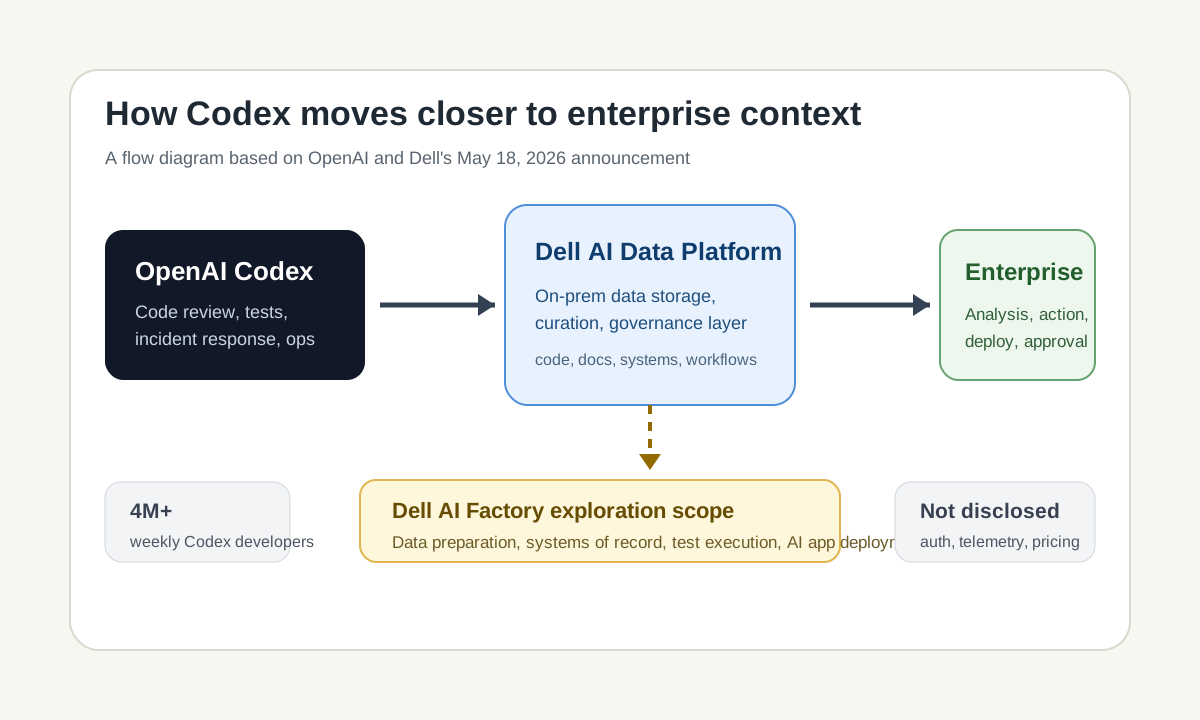
- Core architecture: Codex is being moved closer to on-prem enterprise data through the
Dell AI Data Platform.- Links with Dell AI Factory, ChatGPT Enterprise, and API-based solutions are still described as an exploration, not a fully specified product surface.
- Why it matters: The bottleneck for coding agents is shifting from model calls to internal context, governance, and deployment boundaries.
- Watch: Authentication, telemetry, isolation, pricing, and availability are not yet pinned down in public documentation.
OpenAI and Dell Technologies announced on May 18, 2026 that they are working together to bring Codex into hybrid and on-premises enterprise environments. On the surface, this looks like a partnership story: Codex meets Dell infrastructure. For developers and AI platform teams, the more interesting signal is different. Coding agents are no longer sold only on model quality. In large organizations, the decisive question is how close an agent can get to internal systems while remaining governable, auditable, and constrained.
OpenAI's official announcement says Codex is used by more than 4 million developers every week. It also frames Codex as more than a code-generation tool. The company describes use cases such as code review, test coverage, incident response, and reasoning over large repositories, then extends the list into report preparation, product-feedback routing, lead qualification, follow-up email drafting, and business-system coordination. That shift matters because Codex is being positioned less as an assistant that writes code and more as an agent that can read organizational context and act inside workflows.
Dell's side of the story is not just server sales. Around the same Dell Technologies World 2026 cycle, Dell highlighted AI Data Platform with NVIDIA, Dell PowerRack, PowerEdge XE servers, Exascale Storage, Hugging Face model hub expansion, Google Distributed Cloud with Gemini, and on-premises Palantir Foundry and AIP deployments. Dell's event recap says Dell and OpenAI are building on-premises solutions powered by OpenAI Codex, connecting GPT and GPT-Codex models through Dell AI Data Platform.
So the useful reading is not simply "OpenAI brought Codex on-prem." It is that Codex needs a route into enterprise data boundaries, and Dell wants that route to pass through its AI infrastructure stack.
Why on-prem Codex matters
The best feature of a coding agent is also the part that makes enterprises nervous. An agent becomes useful when it can inspect a whole repository, follow tests, read issues and docs, understand deployment history, and produce a real change. But the context required for that work often includes code, architecture notes, operational logs, customer data, security policies, internal tickets, sales material, and deployment runbooks. Most companies cannot treat those materials as ordinary prompts flowing into an external tool.
Using Codex or Claude Code on a personal project is one category of decision. Connecting the same style of agent to a bank, hospital, manufacturer, or government contractor is another. The former is a productivity tool. The latter is an operating system decision that touches data sovereignty, access control, audit logs, model-risk management, and incident accountability. That is why OpenAI and Dell are talking about hybrid and on-premises environments rather than only another cloud integration.
The most concrete layer in OpenAI's announcement is Dell AI Data Platform. OpenAI describes it as the place many enterprises use to store, organize, and govern on-premises data. If Codex can work closer to that layer, the agent can theoretically reach codebases, documents, business systems, operational knowledge, and team workflows without flattening everything into a generic cloud prompt path.
That phrasing needs a careful read. Public materials do not say every company can now install a fully self-contained Codex stack in its own data center. OpenAI uses exploratory language for links with Dell AI Factory. The exploration includes data preparation, management of systems of record, test execution, and deployment of AI applications integrated with hybrid or on-premises Dell infrastructure. The direction is visible, but the practical details remain sparse: authentication, network boundaries, telemetry, price, support model, and general availability are still not settled in public docs.
The moment context becomes more expensive than the model
Since 2025, coding-agent competition has often been narrated through model names, context windows, benchmark scores, CLI ergonomics, and IDE integration. Enterprise adoption changes the question. "Which model is smarter?" remains important, but it is not the only buying criterion. A buyer also has to ask which data the model can access, under which authority, what gets logged, how failed actions are reversed, and who can prove what happened after the fact.
The claim that Codex is used by more than 4 million developers each week is a scale signal. Enterprise customers, though, will usually care less about raw adoption than about control. Can the agent read internal repositories? Can it avoid using code or customer data for unwanted training? Can unapproved commands be blocked? What policy applies when customer data, source code, and incident logs appear in the same context window?
This is where an infrastructure company like Dell becomes more relevant. A cloud API by itself may struggle to answer where data sits, who operates the boundary, and which physical or logical perimeter it remains inside. A hybrid or on-premises deployment can reuse the network, storage, security, and compliance systems an enterprise already operates. That does not make it automatically safe. An agent inside the data center can still be over-permissioned, and a bad integration with internal systems can enlarge the blast radius. But it moves the conversation from "trust this external service" to "define the operating boundary."
The implication of the Dell partnership is therefore not "security is solved." It is closer to "security is becoming part of the product prerequisite." A coding agent entering a large company needs more than a model endpoint. It needs repository access, document access, ticket access, CI access, deployment controls, permissions, and audit trails. Dell AI Data Platform and Dell AI Factory are Dell's attempt to package that operational layer as infrastructure.
Why Dell wants to be OpenAI's enterprise route
For Dell, the move is straightforward. Selling servers and storage into the enterprise AI market is not enough if customers still have to assemble every useful workload themselves. What customers want to know is which AI work runs on the hardware, which model providers it connects to, and how data governance remains intact. That is why Dell grouped OpenAI with NVIDIA, Google, Palantir, Hugging Face, and its own storage and server portfolio in the same event narrative.
OpenAI Codex is a strong example because it touches a practical workflow rather than a generic "AI transformation" promise. Development organizations already live across GitHub, GitLab, Jira, Linear, ServiceNow, Slack, Notion, Confluence, internal wikis, deployment systems, and observability tools. For an agent to be useful, it has to do more than call those tools one by one. It needs to accumulate context inside the organization's data boundary and act with permissions that match the user's role.
The path matters to OpenAI as well. Codex can grow quickly among individual developers and still hit a ceiling in regulated industries if the unresolved question is whether code can leave the enterprise boundary. Dell gives OpenAI a more plausible enterprise channel. OpenAI brings the model and agent experience. Dell brings the data-center and hybrid-infrastructure trust path.
There is also tension in that distribution model. If enterprises consume Codex through Dell infrastructure, they are not evaluating only OpenAI's service. They are evaluating Dell's stack, storage, networking, support, and operating model. That may lower adoption friction for some customers, but it can also make lock-in and responsibility harder to reason about. Where does Codex run? Which layer sees which data? Who is responsible when a cost spike, outage, or security event crosses provider boundaries? The announcement does not yet provide enough architecture detail to answer those questions cleanly.
What the announcement leaves open
The first missing piece is a reference architecture. Public materials do not explain how Codex authenticates to a customer's internal repositories, whether authority is delegated per user or through service accounts, or where the agent execution environment is isolated.
The second gap is telemetry and logs. Agent products emit many events for debugging, safety, product improvement, and security monitoring. Enterprises will need to know which prompts, file paths, command outputs, test logs, approval events, and generated patches travel to OpenAI, remain inside Dell-managed infrastructure, or can be retained under a customer policy.
The third unknown is model execution location. "On-premises Codex" can mean several different things. It could mean model weights running in the customer's data center. It could mean retrieval, context preparation, and governance run on-prem while inference happens in a remote or dedicated environment. It could mean a hybrid routing model. Those choices change the security model and the cost model. Dell's post says GPT and GPT-Codex models connect through Dell AI Data Platform, but that statement alone does not define the execution boundary.
The fourth issue is pricing and operations. On-prem AI can make some cloud API costs more predictable, but it introduces hardware depreciation, GPU utilization, storage, networking, staffing, upgrades, and security validation. Coding-agent usage is also bursty. A team may use many agent runs during a deadline, incident, or large refactor and much less at other times. An on-prem design has to absorb those peaks without turning idle capacity into a permanent tax.
Questions development teams should ask now
This news does not need to change every team's tool choice today. It does, however, give enterprise teams a more precise checklist.
First, define the context the agent actually needs. Is repository access enough, or does the agent need architecture docs, issue trackers, CI logs, runbooks, incident records, and customer-support traces? If Codex is only a code-editing tool, IDE integration may be the main surface. If it handles incident response, feedback routing, or workflow coordination, the data platform and permission model become central.
Second, define the boundary between suggestion, approval, and execution. Running tests may be relatively low risk. Installing packages, modifying deployment scripts, accessing production databases, or writing follow-up emails to customers is a different level of authority. If a team accepts the broader workflow scope in OpenAI's announcement, it should design the permission model before it scales the agent.
Third, decide what must be auditable. A coding agent should be able to explain why it made a change. Prompts, searched files, commands, failed tests, user approvals, and generated patches need to connect into a reviewable chain. A chat transcript alone is not enough for enterprise accountability.
Fourth, assume multi-agent and multi-vendor reality. OpenAI Codex, Claude Code, GitHub Copilot, Cursor, Google Antigravity, and other tools may enter the same organization at the same time. Each touches repositories, terminals, browsers, and documentation systems differently. On-prem Codex may solve one deployment path, but it does not solve agent governance across the whole toolchain.
The competitive frame widens beyond coding tools
This partnership is difficult to explain only as an OpenAI-versus-Anthropic coding-agent contest. GitHub Copilot moves inside Microsoft's developer platform. Google connects Gemini, AI Studio, Antigravity, and Google Cloud. AWS pushes Bedrock and agent services. Cursor and other independent IDE tools compete through developer experience and model routing. Dell enters with data-center and hybrid infrastructure.
In that market, the best coding model still matters, but it is not sufficient. Enterprises already run CI/CD, security scanners, secret management, access control, data catalogs, audit logs, and ticketing systems. If an agent collides with those systems, adoption stalls no matter how capable the model is. Conversely, a slightly slower model with stronger approval, isolation, traceability, and cost controls may win more quickly in large organizations.
OpenAI and Dell's announcement is a sign that both companies understand this. For Codex to move beyond 4 million weekly developers and deeper into enterprise workflows, cloud-service convenience is not enough. It has to approach the places where the customer's context already lives: repositories, documents, systems of record, tickets, and operational knowledge.
The next bottleneck sits between racks and policy
The OpenAI-Dell Codex partnership is not a flashy model launch. There is no new benchmark score and no CLI feature for developers to install today. Its importance is that it identifies the next bottleneck for coding agents. The bottleneck is context. More precisely, it is the location, authority, logging, cost, and responsibility design required to bring that context safely to an agent.
There is still a lot to verify before this becomes a mature product path: reference architecture, execution boundary, telemetry policy, pricing, supported regions, regulated-industry validation, and the relationship with existing ChatGPT Enterprise and API agreements. Still, the direction is clear. Coding agents started in individual developers' terminals. In enterprises, they will survive only when they fit on top of data platforms and infrastructure operating models.
The core of the story is therefore not that Codex has arrived on-premises. It is that Codex is using Dell's infrastructure route to reach enterprise context. The AI development-tool race is no longer contained inside IDEs. Racks, storage, data governance, approval policy, and audit logs are now part of the same field. The question for development teams is also changing: not which agent writes the best code in isolation, but which agent can be useful enough and controlled enough inside the organization's data boundary.