GPT Models Leave Cursor on November 12, and Your Own API Key Will Not Cover It
OpenAI served SpaceX a termination notice on August 28, closing direct access to GPT models inside Cursor on November 12. Cursor says those models are 5% of its traffic, and the bring-your-own-key workaround only reaches non-reasoning chat models.
- OpenAI cuts GPT models off inside Cursor on November 12.
- A change-of-control clause fired two weeks after SpaceX bought Cursor's parent company.
- Bringing your own API key does not bring the GPT reasoning models back.
OpenAI sent SpaceX a contract termination notice on August 28, 2026. The path that lets you pick a GPT-5.6 model from inside the Cursor editor closes on November 12, 2026, 76 days after the announcement.
The trigger was a deal two weeks earlier. On August 14, 2026, SpaceX acquired Cursor's parent company Anysphere in an all-stock transaction valued at $60 billion, the same acquisition covered in the piece on a ransomware crew using Cursor's agent. The contract between OpenAI and Anysphere carried a change-of-control clause: if the company changes owners, the agreement can be terminated within a set window. OpenAI pulled that clause before the window closed.
SpaceX closes its $60 billion all-stock acquisition of Anysphere
OpenAI terminates under the change-of-control clause and excludes its next model, Astra, from the deal
Cursor's CEO answers with "about 5% of traffic," and Anthropic pledges more compute for Cursor
Direct OpenAI model access inside Cursor ends
The stated reason is contract history, not model performance
OpenAI framed the decision as a trust problem rather than a performance or revenue one. The core sentence in its post is that it cannot be confident SpaceX will use its technology within the terms of service. As support, it cited two contract disputes involving companies Elon Musk owns.
The first is Twitter. OpenAI wrote that after Musk acquired it, the company breached contract terms. The second is xAI: OpenAI wrote that in sworn testimony earlier this year, Musk acknowledged xAI had violated OpenAI's terms of service. Both companies now sit under SpaceX. Since August 14, so does Cursor.
OpenAI attached a safety argument as well. Referring to its next model, Astra, it wrote that as AI capability rises, so does the level of responsibility for confirming its models are used as the terms require. The consequence: Astra never ships to Cursor at all. What remains in Cursor until November 12 is only the already-connected GPT-5.6 line. No new model arrives before then either.
The notice period is worth reading closely. OpenAI wrote that it gave the maximum notice the contract allows, to preserve as much time as possible for developers using its models in Cursor. Those 76 days are not a grace period OpenAI chose to grant, they are the ceiling written into the agreement. Absent a negotiated settlement, nothing moves that date earlier or later.
Cursor's answer was "about 5% of traffic"
Cursor co-founder and CEO Michael Truell posted a rebuttal on X on August 29.
Disappointed to see OpenAI's post about cutting off Cursor users' access to OpenAI models in three months. OpenAI models serve roughly 5% of Cursor user traffic, and we're in touch with the OpenAI team to work through this. Cursor was one of OpenAI's earliest users, we've worked closely with that team for years, and we trusted that their platform would be neutral infrastructure for our business.
The post passed 4.16 million views. Many replies read the 5% figure itself as a counterpunch. That same number reads very differently depending on who you are. Across the whole user base, GPT models are already a minority pick, and switching is a settings change. For a team that standardized on GPT, 5% is no comfort at all: when prompts, evaluation criteria, and internal rules files have been tuned to one model's output habits, swapping models is a re-tuning project, not a dropdown.
Anthropic took the opposite side the same day. Co-founder Tom Brown said Cursor had been a trusted Anthropic partner since Sonnet 3.5 and that Anthropic would keep adding compute to support Claude models inside Cursor. That does not make Anthropic an especially open supplier. In June 2025 it cut off Windsurf's Claude access while OpenAI was reportedly pursuing an acquisition of that company. In August 2025 it cut off OpenAI's own API access over benchmark usage of Claude. All three companies in this market have pulled model supply at least once.
Three paths after November 12, each with different conditions
Cursor users have three options left, and the conditions differ sharply.
| Path | Requirements | Limits |
|---|---|---|
| Pick another model inside Cursor | None. Any paid plan can switch in settings | Prompts and evaluation criteria need re-tuning |
| Register your own OpenAI API key | An OpenAI platform account and a payment method | Non-reasoning chat models only, no Tab completion, no zero-data-retention coverage |
| Install the Codex extension | A paid ChatGPT subscription or an API key with credits | Runs as a separate tool, not as Cursor's agent |
The second path is the one most often misread. The line coming from OpenAI's side was that users can continue to use their own OpenAI API keys. Read alone, that sounds like registering a key restores what you have today. Open Cursor's bring-your-own-key documentation and three conditions appear.
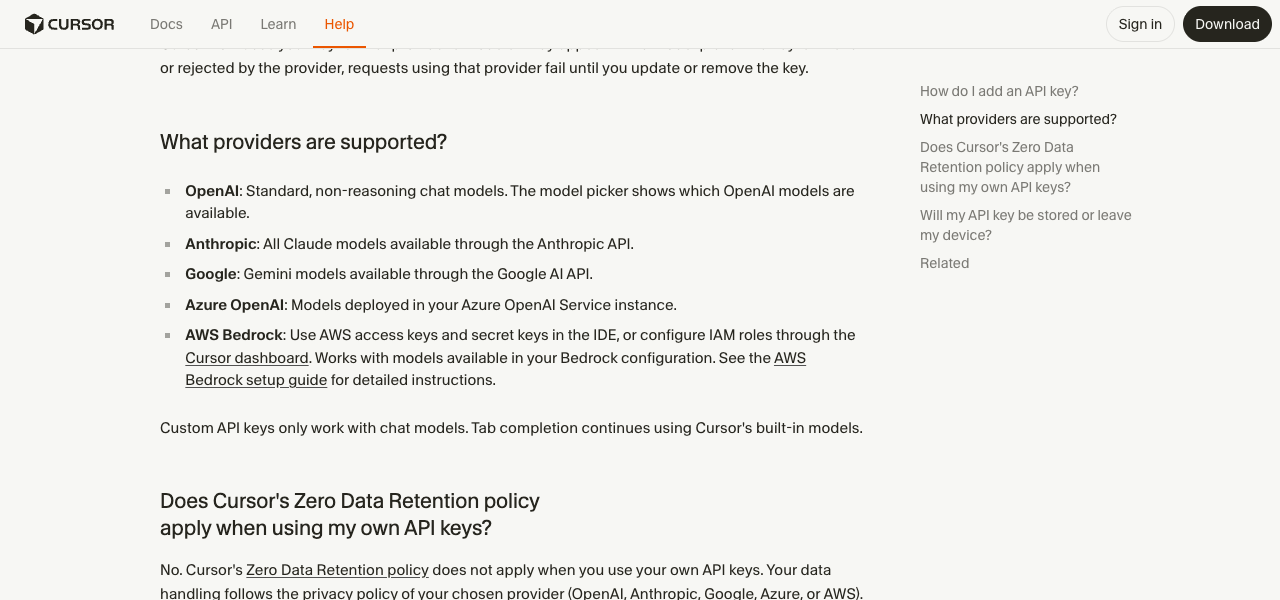
The docs pin the OpenAI entry to "standard, non-reasoning chat models." Compare that with the Anthropic entry, which covers all Claude models available through the Anthropic API. A developer reaching for GPT-5.6 Sol on hard tasks today and switching to their own key does not get the same model, they get a chat model with the reasoning capability removed. The second condition is Tab autocomplete: the docs state that a custom key works only for chat models and that Tab completion keeps using Cursor's built-in model. The third matters most to enterprise teams. Using your own key means Cursor's Zero Data Retention policy does not apply, and data handling follows the privacy policy of the provider you chose. For a team with zero-data-retention written into internal rules, this path is not an option at all.
The third path, the Codex extension, is a different animal. Codex is OpenAI's own coding agent, distributed as an extension for VS Code family editors. Cursor is in that family, so you can search the extension marketplace for "OpenAI Codex" and install it. Because that path talks to OpenAI directly rather than going through Cursor's model list, it is unaffected by this cutoff. In exchange, it runs separately from Cursor's agent features, its usage pool, and things like Bugbot. You keep the editor and end up running two coding agents side by side.
Pricing is worth checking too. Cursor's paid plans are Pro at $20/month, Pro Plus at $60, and Ultra at $200, with team plans at $40 (Standard) and $120 (Premium) per seat per month. Within those plans, external models draw down the usage pool at their own API rates. Per million tokens, GPT-5.6 Luna runs $0.2 input and $1.2 output, Sol $4 and $20, Terra $2 and $12. Among the replacements, Claude Sonnet 5 is $2 and $10, and Gemini 3.1 Pro is $2 and $12. Cursor's own Composer 2.5 is $0.5 and $2.5, and it comes from a separate, far more generous pool. On price alone, moving work from Sol to Claude Sonnet 5 halves the output rate.
Regional availability does not change anything here. Cursor's paid plans are sold worldwide, including across APAC, and the cutoff applies everywhere on November 12 with no regional carve-outs. The one exception is the low-cost Start plan Cursor opened recently, which is restricted to developers residing in India. The paid ChatGPT subscription that the Codex extension needs is also purchasable from outside the US.
What actually changes here is one thing: whether you can select a GPT model inside Cursor. Everything else holds. Composer 2.5, the product of Cursor training its own coding models, stays in the first-party pool alongside Grok 4.6 and Grok 4.5, which came along under the SpaceX umbrella. Claude and Gemini stay too. European developers hoping the EU Data Act's cloud switching rules apply will not find help there either: those provisions protect a customer leaving a provider on two months' notice, not the case where the provider leaves first.
The cheapest check to run today is Cursor's usage dashboard. Look at what share of this month's Other Models usage the GPT-5.6 entries account for. If it lands near the 5% Truell cited, November 12 is just news. If it lands well above that, spend part of the remaining 76 days running the same work through Composer 2.5 and Claude Sonnet 5 for a week each and measuring token cost and failure rate. That beats swapping models under pressure in November, and if a settlement is announced, the comparison table still holds.