Anthropic Dropped git at 30,000 Merges a Day, and Published Scion as Design Only
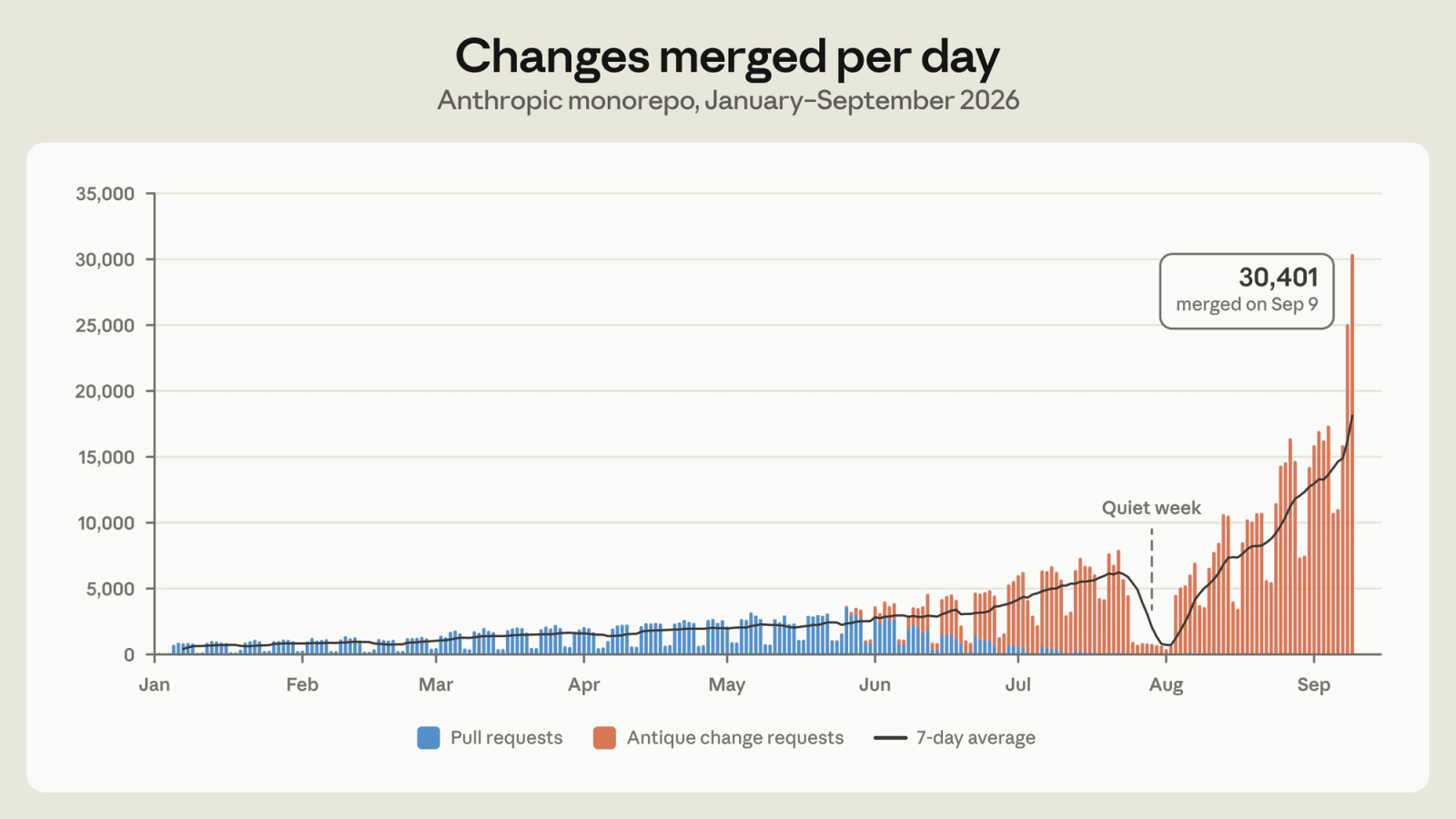
Anthropic described on October 13 how it moved its monorepo off git onto an in-house version control system called Scion. Daily merges went from about 2,500 in May to 30,000 in September, hundreds of mirrors stopped holding, and the code is not being open sourced.
- Anthropic moved its monorepo off git onto an in-house system called Scion.
- Daily merges had risen from about 2,500 in May to 30,401 on September 9.
- Scion is not shipping as open source. What was published is the design.
Anthropic posted on its engineering blog on October 13, 2026 that it had moved version control for its internal monorepo from git to an in-house system called Scion. Seven people finished the migration in five months. Version control is the software that records when and how code changed and merges several people's edits into one line of history, and for the past fifteen years that slot has belonged to git alone.
What changed is who writes the code. Changes merged per day in Anthropic's monorepo went from about 2,500 in May 2026 to more than 30,000 in September. The annotation on the official chart records 30,401 merges on September 9 alone. Over the same period the bars for human-authored pull requests barely grew. The growth came from change requests created by Claude.
Where git stopped holding
The repository size is not ordinary to begin with. The main branch history is close to 100GB, and a compressed working copy alone exceeds 25GB. On top of that, CI jobs check out roughly 25 million times a day. Anthropic calculated that serving all of this the way git does would come to more than 600PB of traffic per day.
The workaround was internal git mirrors, several hundred of them at peak. A mirror is a relay server that pre-fetches a copy of the repository and hands it out to CI jobs. As the merge rate climbed, the seed each mirror held drifted further behind the tip of main. For a job to get current code it has to fetch whatever the mirror does not have, and that gap widens with every additional merge.
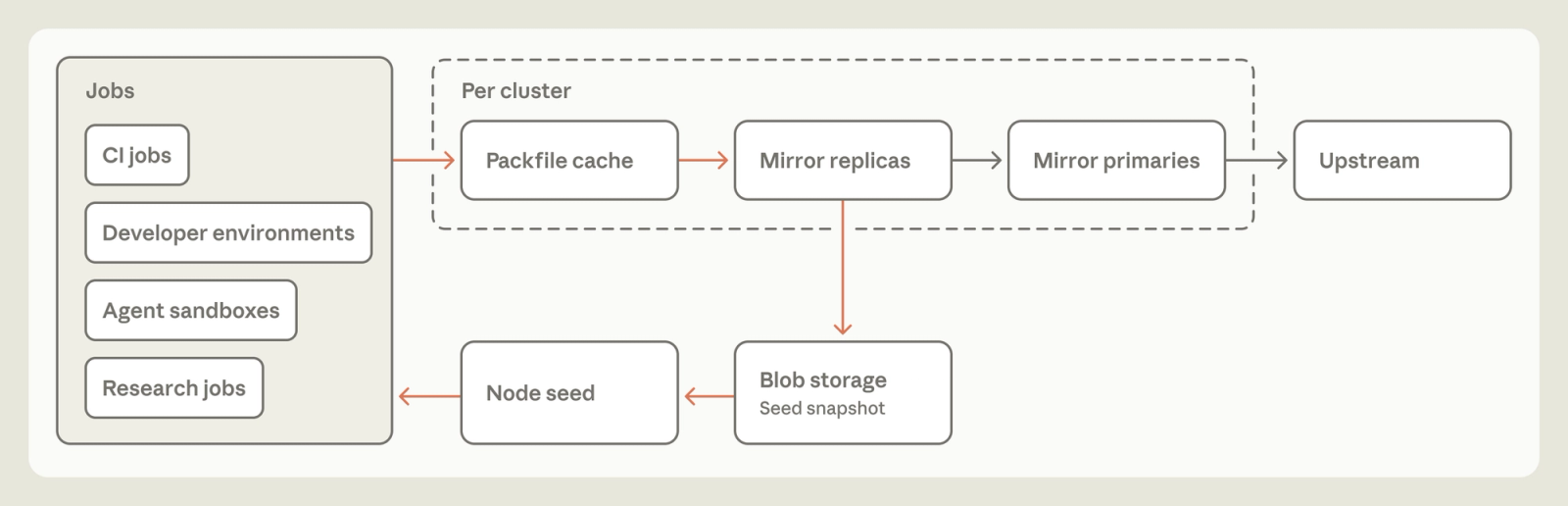
The root cause was not capacity but one of git's premises. git is a distributed design, so every clone holds a complete copy usable offline. That was an advantage back when the client was a person with a laptop on an airplane. The clients hitting Anthropic's repository now are mostly always-online agents and CI jobs. The sentence in the post reads: "The bottleneck, now, is all of the developer infrastructure built for human scale."
What Scion took out of git
Scion keeps no complete copy of the repository anywhere. Anthropic wrote that "there is no fully materialized copy of the repo anywhere, even on the server." History queries, blame, commits, merges, and rebases all run on the server, and the client holds only a bounded local cache. A working copy is optional, and it fetches only the directories you need.
The storage unit is the changeset: a record holding the files changed relative to the first parent plus content-addressed pointers to the actual contents, created by the server rather than the client. Moving a branch pointer is a compare-and-swap on a single Spanner row. The client starts at the root tree and requests only the pieces it is missing, with no negotiation with the server about what to exchange. Because no single large packfile is built, an interrupted transfer resumes.
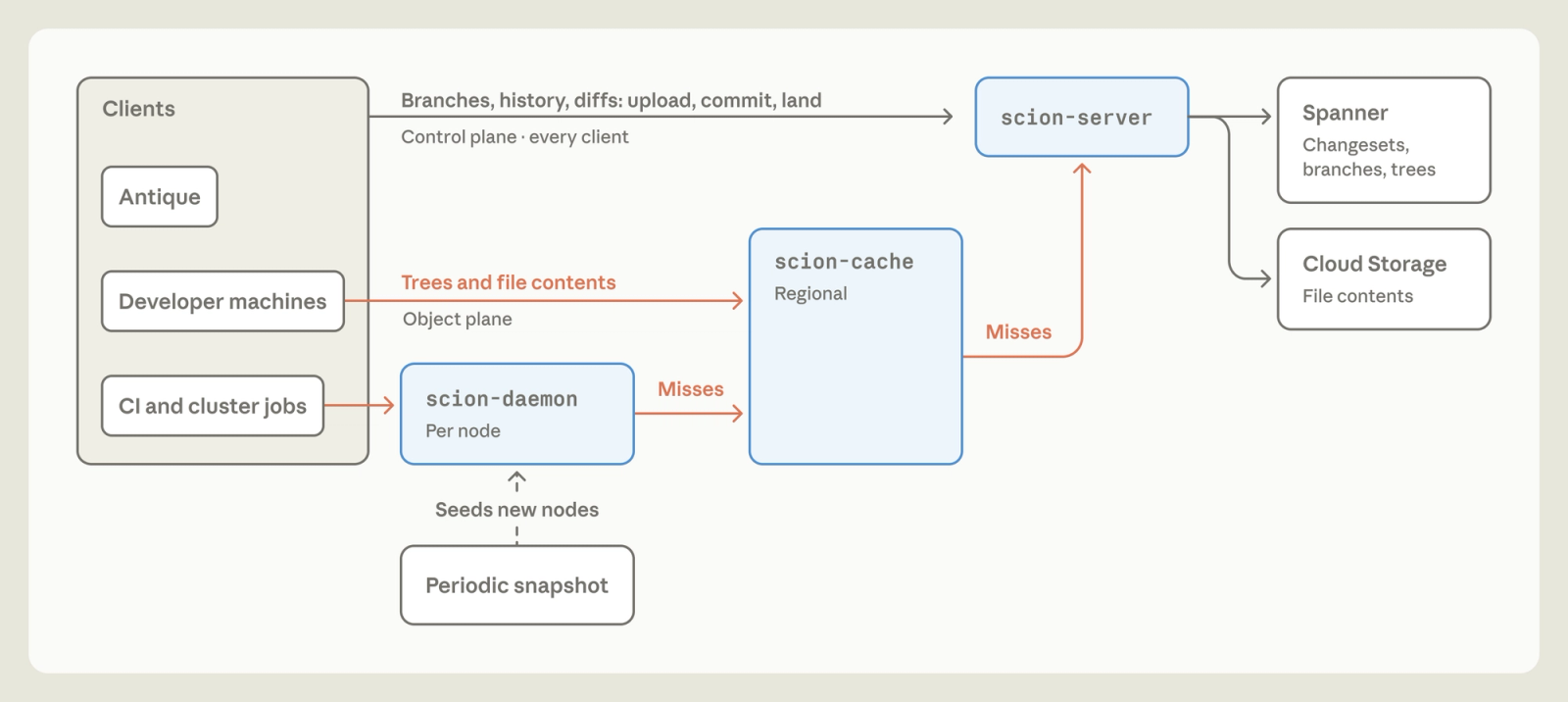
Reads pass through three tiers: a scion-daemon on each node, a per-region scion-cache, and the authoritative scion-server that reads Spanner and cloud storage. Hit rates at each tier exceed 99%.
On the merge queue, Anthropic declined the industry standard. A merge queue normally takes a repository-wide lock and admits one change at a time. Anthropic skipped that lock and spent the effort on automated testing after merge and before deploy instead. Concurrent changes can conflict, but the team judged it acceptable because Claude typically fixes the conflict before a human notices it.
They built a code review tool, Antique, alongside it. Approval rules can tell a comment-only change apart from a change to sensitive logic, so human reviewers look at a change's intent rather than reading every line. Automated review alone is still short of sufficient, as the 26% recall of first-place Copilot on GitHub ReviewBench showed, and Anthropic's response was to shrink what a human looks at rather than remove the human.
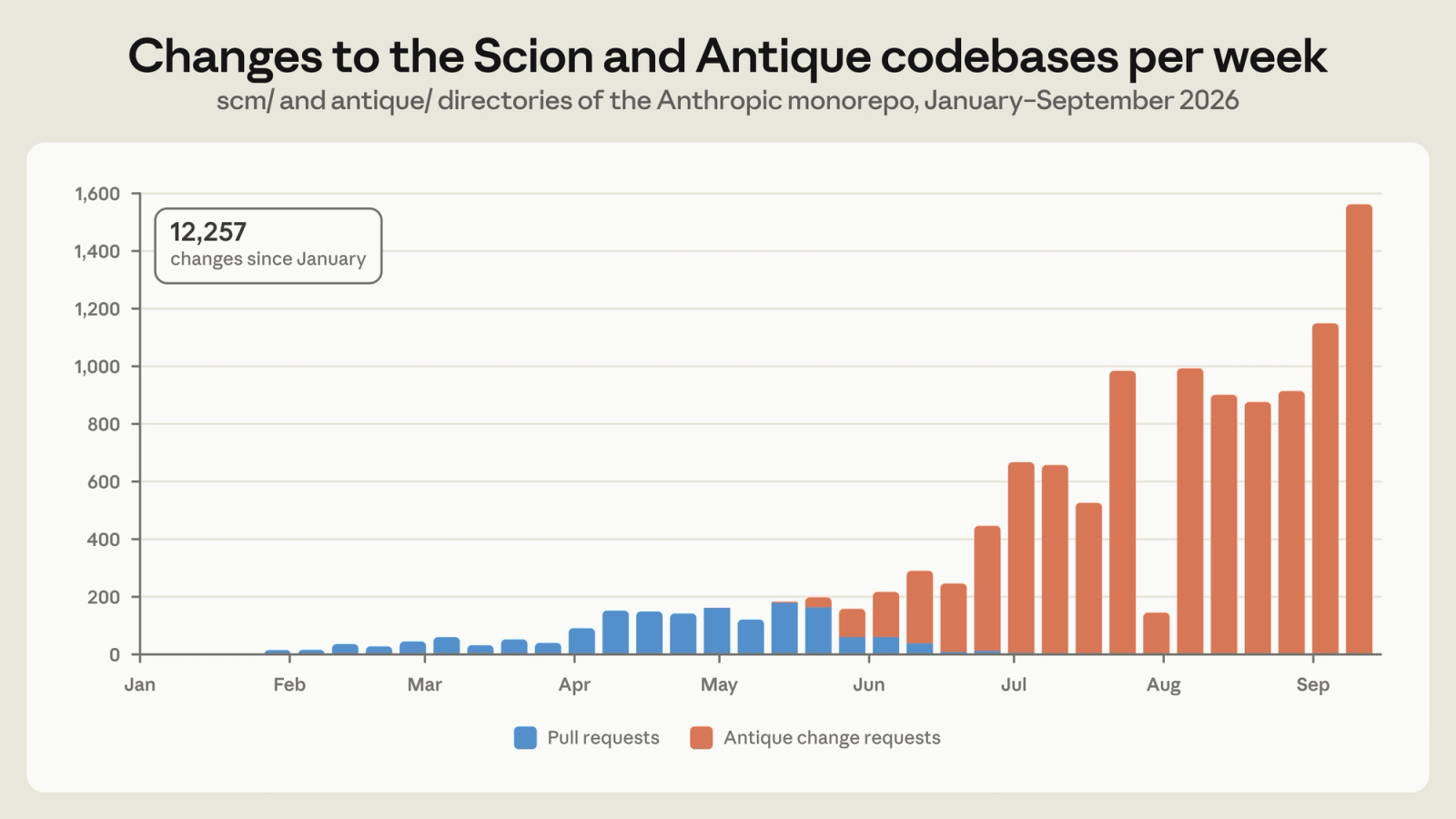
Scion and Antique were themselves built the same way. The two directories took 12,257 changes since January. Through April most were human pull requests; from June on almost all are Antique change requests. Claude Mythos Preview rewrote the pipeline that moves data from git into Scion, and the rewrite ran 4x faster on one twentieth of the memory. The post also carries this line: "Very often, we found that the role of the engineers was to tell Claude 'no.'"
CPU and memory use versus the old git mirror infrastructure
Checkout time for CI and research jobs
CPU headroom recovered in CI alone
What they gave up is offline work. Scion has no story for committing on a plane. Anthropic explained that its heaviest user, Claude, is always online, so offline support came off the priority list.
What was published is the design
Scion is not a product. Anthropic announced no open source plan and stated flatly in the post that Scion is "by no means a suitable replacement for git for general use." The design only makes sense for a single genuinely enormous monorepo, and adopting it means moving the whole development lifecycle, code review and code search and CI included.
| Item | Detail |
|---|---|
| Who can use it | Anthropic internal only. No plan to offer it to outside organizations |
| Plan and price | Not sold |
| Regional availability | Not applicable. Nobody can run it, in APAC or anywhere else |
| Requirements | None. What exists publicly is a design write-up and diagrams |
One product solving the same problem is already out. Origin, which Cursor announced in August 2026, is a repository service that stays git-compatible, pushing to an immutable write-ahead log on S3 and using local NVMe storage as cache. It is in beta and included with paid Cursor plans, though which plans is not stated in public material. The two companies answered the same pressure in opposite directions, so the choice between them splits on a clear line. Anthropic broke with git on the premise of one giant monorepo; Cursor preserved git compatibility on the premise of countless small throwaway repositories created by agents.
GitHub also carries a Rust implementation called openscion that describes itself as following Anthropic's design. It is GPL-3.0 with 118 commits and 39 stars, and says nothing about whether Anthropic was involved. Its benchmarks are self-measured on synthetic repositories, so there is no basis for comparing them against Anthropic's published figures.
The "so, SVN?" objection
The Hacker News thread on the original post reached 858 points and 953 comments. The most common reaction was that this is a return to centralization. One user wrote "So... Anthropic reinvents SVN?" and another replied that it is closer to Perforce than to SVN. Simon Willison also wrote that it sounds like a rebuild of Subversion-style centralized source control. That is the readers' assessment, not Anthropic's claim.
The sharpest technical objection targeted server-side commit creation. Local history is what lets you rewrite and discard work, and the argument is not to throw that benefit away along with the rest. For a human developer the point stands, and Anthropic's answer is the fact that its primary user is not a human.
Attribution came up too. Rain, who built the Mononoke source control server at Meta, posted on October 14 that Scion's separation of derived data, its blame and path history indexes, its asynchronous computation, and its hiding of internal structure from the client all overlap with Mononoke. Sapling appears in the post only as "hard-won lessons," and Mononoke is never mentioned. Rain used the phrase "borders on plagiarism" while stating outright that copying the design itself is not the problem. That post drew 67 points on Hacker News.
Nobody can run Scion, but one of the bottlenecks Anthropic quantified is measurable on your own git setup today. If your CI jobs are still fetching full history, switch them to a --filter=blob:none partial clone with sparse checkout and time the checkout. That per-job fetch of the entire repository is exactly what turns 25 million daily checkouts into a 600PB estimate.