Mistral Relaunches Le Chat as Vibe With Remote Coding Agents
Mistral relaunched Le Chat as Vibe, bundling remote coding agents, a VS Code extension, Medium 3.5, and a planned 10MW inference facility.
- What happened: Mistral relaunched
Le ChatasVibeon May 28, 2026, turning its chat product into a broader workspace for work and coding agents.- The launch grouped
Work Mode,Code Mode, a VS Code extension, CLI/teleport, and remote sandbox sessions under the same product surface.
- The launch grouped
- Model and cost: The remote agent stack is anchored on
Mistral Medium 3.5, priced at $1.50 per million input tokens and $7.50 per million output tokens for API use. - Developer impact: The contest is moving from chat quality toward remote execution, approvals, PR creation, IDE integration, session observability, and control over inference capacity.
Mistral AI used its May 28, 2026 AI Now Summit to repackage Le Chat as Vibe. This was not just a new name on the same assistant. Mistral's launch post describes Vibe as a single agent for long-running, multi-step work: reading email and calendars, running research, drafting documents, and pushing code changes all the way to a pull request.
The more concrete developer surface is Code Mode and its remote coding sessions. From the Vibe web app, a user can connect a GitHub project, start a session, let the agent modify files in an isolated sandbox, install dependencies, produce a diff, and open a GitHub PR when the work is ready for review. Mistral also announced /teleport, a Vibe CLI command that moves a local terminal session into the cloud while preserving history and approvals.
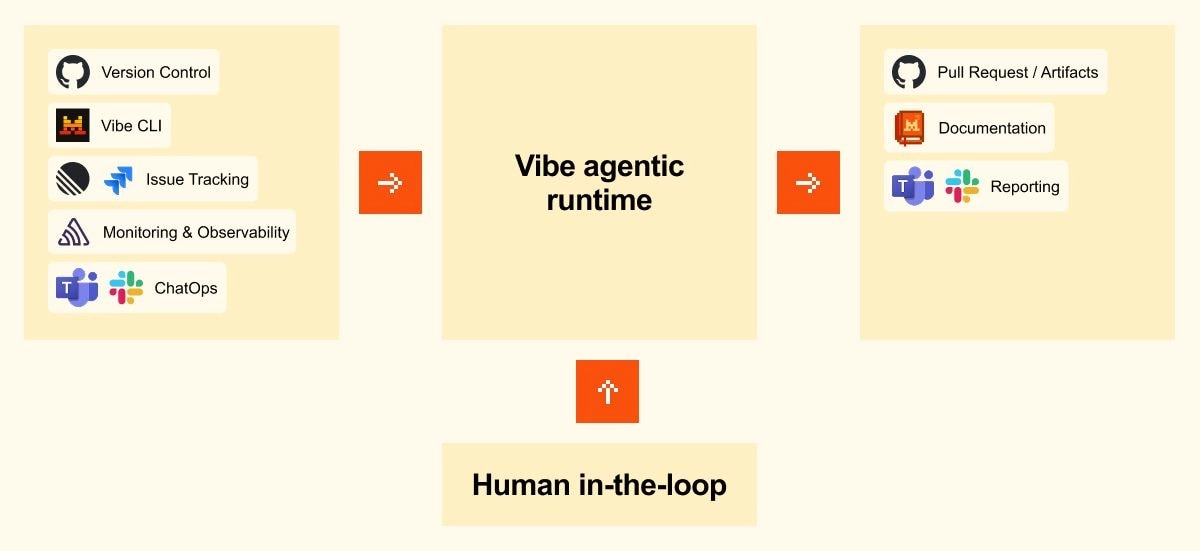
The launch answers a recurring question in the coding-agent market from Mistral's angle. The difference between products is less about which model is smarter in a chat box and more about where the agent runs, what permissions it receives, where a human approves risky actions, and how the finished work can be inspected. GitHub Copilot cloud agent, OpenAI Codex, Claude Code, and Cursor Cloud Agents are all answering that execution question with different defaults. Mistral is positioning Vibe as the shared surface for workplace agents and coding agents.
At the same summit, Mistral said it plans to open a dedicated 10MW inference facility in Les Ulis, Essonne, in Q3 2026. The AI Now Summit post frames the site as a way to reduce compute supply-chain risk and directly control capacity, security, and transparency as training and inference hardware converge. Vibe is the product story and Les Ulis is the infrastructure story, but both point to the same operating reality: long-running agents consume sandbox time, logs, state, approval flows, and GPU capacity in addition to model tokens.
From Le Chat to Vibe
Mistral's Vibe announcement connects productivity work and coding work from the first paragraphs. The product is presented as a way to catch up on missed emails and meetings, extract numbers, write update documents, and schedule repeated tasks. The same agent is then described as capable of implementing features, fixing bugs, refactoring code, writing tests, and creating reviewable pull requests.
Work Mode emphasizes knowledge retrieval across Google Workspace, Outlook, SharePoint, Slack, GitHub, custom connectors, and libraries. The user sees a plan first, approves it, and can expand tool calls and the reasoning chain while the task runs. Mistral says Vibe requests explicit approval before sensitive actions such as sending messages, creating documents, or modifying data.
Code Mode is more specific for engineering teams. According to the official post, Code Mode is a new coding surface inside the Vibe web app that covers GitHub connection, project management, session launch, and the PR flow. Sessions can continue after a user's laptop is offline, and multiple sessions can run in parallel. Mistral listed third-party app launches, including Slack, as planned for June.
The relevant product move is not simply that a coding agent now lives inside a chat app. By renaming Le Chat to Vibe, Mistral is tying workplace connectors, coding sandboxes, IDE extensions, CLI sessions, and web-based remote execution to one license and history. GitHub Copilot starts from GitHub artifacts. Claude Code is strongest in terminal and harness workflows. Mistral is trying to bridge chat, web, editor, and terminal under one product name.
Medium 3.5 Sits Under the Remote Agent
Mistral described Medium 3.5 and Vibe remote agents in a separate May 22 announcement. Medium 3.5 is a 128B dense model with a 256k context window, and Mistral says it handles instruction following, reasoning, and coding with one set of weights. The weights are published under a modified MIT license.
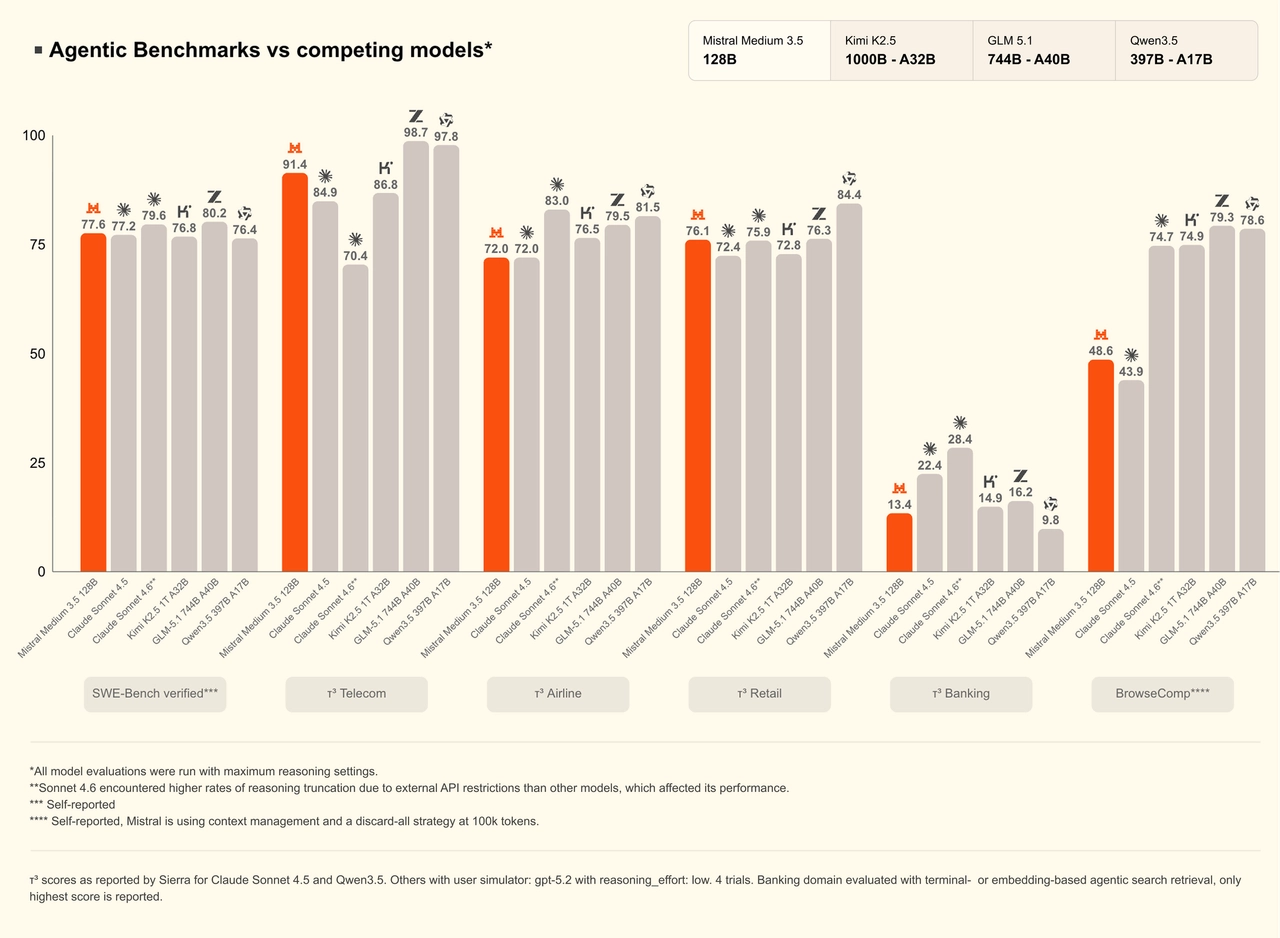
Two benchmark claims matter for developers evaluating the product. Mistral says Medium 3.5 reaches 77.6% on SWE-Bench Verified. It also highlights a 91.4 score on τ³-Telecom, a benchmark Mistral uses to emphasize tool use and agentic behavior. Those numbers are useful for orientation, but they are still vendor-reported launch metrics. Real adoption will depend on merge rate, the amount of reviewer correction, CI pass rate, and behavior on private codebases.
Pricing is part of the strategy. Mistral's announcement and pricing page list Medium 3.5 API use at $1.50 per million input tokens and $7.50 per million output tokens. Vibe Pro is listed at $14.99 per month, and Team at $24.99 per user per month. The pricing page attaches "all-day coding" to Pro, 30GB of storage per user to Team, and audit logs, SAML SSO, and private deployment to Enterprise.
Those prices should not be compared one-to-one with high-end OpenAI or Anthropic model prices. A Vibe subscription includes fair-usage limits, while API access is token-billed. Coding-agent cost also extends beyond token usage. Remote sandboxes install packages, check out repositories, run tests, store logs, create PRs, handle approvals, and resume sessions. Mistral's emphasis on Medium 3.5 running on four GPUs matters because some enterprises will care more about self-hosting and cost predictability than about a subscription UI.
/teleport Makes Session Movement a Product Feature
The most memorable name in the Vibe CLI update is /teleport. Mistral says the command moves a live session between the terminal and the cloud while keeping history and approvals intact. A developer can begin locally where repository context is familiar, then move the job to a remote environment before stepping away or before a long test run.
Mistral also described the permission model. Vibe CLI supports session-scoped permission overrides for files, commands, and directories, with "always," "never," and "ask" style decisions. A coding agent becomes dangerous not only when the model gives a wrong answer. It can cause a more direct incident by running a destructive command in the wrong directory, reading a file that contains secrets, or changing dependencies without approval. Putting permissions at the session level reflects a baseline requirement for modern agent products.
The VS Code extension follows the same direction. The Visual Studio Marketplace listing for "Mistral Vibe VS Code" showed 2,058 installs, a free label, and Mistral AI as publisher when the Korean article was researched. The description includes project-wide context, repository navigation, file editing, command execution, change previews, and approval. That install count is an early-launch snapshot rather than evidence of maturity, but the design pattern matters: Mistral is trying to replicate one harness across web app, CLI, and IDE.
Teams testing Vibe should ask operational questions before they ask whether the model "feels smart." How are generated diffs grouped for review? Are test logs and tool-call traces attached to the PR? Is approval policy a personal preference or an organization policy? Can a failed session be replayed from a checkpoint? If a vendor changes later, can the team preserve issues, branches, PRs, and audit logs? Mistral's launch sets a direction, while the operating details still need documentation and hands-on testing.
Work Mode Is Really About Agent Observability
Vibe Work Mode can read like another email summarizer or document drafter. The launch post repeatedly emphasizes a more specific set of mechanisms: connectors, plan approval, tool-call visibility, and reasoning-chain expansion. That suggests Mistral is trying to build a UI for long-running task traces, not just a place where users toss a request into a black box.
Mistral says Work Mode searches across Google Workspace, Outlook, SharePoint, Slack, GitHub, and custom connectors. It can connect to spreadsheets or databases to find patterns, anomalies, and signals. Its Canvas tool can draft reports, RFP responses, and board decks. It can also schedule prompts on a daily, weekly, or monthly cadence. Once this type of system enters a company, the central question is less whether it can draft a document and more how it inherits permissions and preserves data boundaries.
An agent that reads GitHub issues, Slack threads, customer email, and a product spec in one run gets better context. It also creates a sharper access-control problem. If an agent includes a document in a report that the user was not supposed to see, the output becomes a compliance issue. Mistral's Enterprise tier lists audit logs, SAML SSO, and private deployment, but connector-level permission propagation and output redaction remain items each organization has to validate.
This is where Vibe competes directly with Microsoft Copilot and ChatGPT workspace agents. Microsoft can lean on Microsoft 365 data, Entra, Purview, and Defender. OpenAI is tying team workflows and custom skills into ChatGPT. Mistral is talking about European enterprise buyers, open weights, private deployment, and direct inference capacity. The label "work agent" is shared, but the procurement argument is different.
Les Ulis Exposes the Cost Behind Agent Products
The Les Ulis data center was a short part of the AI Now Summit announcement, but it may matter longer than the product rename. Mistral described the Essonne site as a dedicated 10MW inference facility planned for Q3 2026. The post says the site is meant to provide direct control over capacity, security, and transparency.
Inference capacity is not just a backend cost in agent products. A remote coding agent runs longer than a chatbot answer. It reads a repository, runs tests, reads failure logs, modifies code, and opens a PR through repeated model calls. Parallel sessions increase peak demand. If organizations start leaving multiple agents running overnight, capacity planning becomes a product-quality issue.
The Les Ulis announcement also signals that Mistral does not want to be read only as a company building products on top of American hyperscalers. The same summit mentioned Airbus, BMW Group, and ASML. Aerospace, automotive, and semiconductor equipment companies cannot pick an AI vendor on model quality alone. Data sovereignty, private deployment, inference location, audit controls, and IP protection become procurement requirements.
The 10MW figure is not a performance guarantee. Mistral has not disclosed which GPUs will be deployed, what latency and throughput the serving stack will produce, whether Vibe consumer traffic and enterprise private deployments share a capacity pool, or how outages will be handled. The announcement defines the direction; operating metrics are still missing.
Early Reaction Mixes Interest and Naming Fatigue
A May 28, 2026 post in Reddit's r/MistralAI community sharing the Vibe launch reached roughly 89 upvotes when the Korean article was researched. Some comments repeated the announcement summary, while others showed fatigue with the Vibe name and preferred that Mistral keep using its own brand. Nearby community posts mixed reports that the Vibe app felt better with complaints about service stability.
That is a small sample, but it captures a common problem for early coding-agent products. Developers react quickly to model quality, but they also care about product naming, uptime, local-to-remote handoff, and billing limits. Vibe will need evidence that sessions stay alive, approval records remain inspectable, and PRs reduce reviewer time. Medium 3.5 benchmark numbers alone will not settle that question.
For engineering teams outside the launch hype cycle, the experiment list is straightforward. Check what file permissions the Vibe CLI and VS Code extension request on an existing repository. Inspect how the remote sandbox handles package installation and secrets. Compare the Mistral Medium 3.5 API path with the Vibe subscription path for team cost. Assign the same issue to Vibe, GitHub Copilot, and Claude Code, then measure review time and CI outcomes rather than subjective fluency.
Mistral Is Moving From Model Company to Execution Company
Since 2023, Mistral has often been framed around open models and European AI sovereignty. The May 2026 announcements shift that image. Vibe bundles a chat app, coding agent, workplace agent, IDE extension, CLI, and remote sandbox. Medium 3.5 becomes the default model for that product family. AI Now Summit added industrial engineering AI and an inference facility to the same story.
The practical question for developers is narrower than whether they should "use Mistral." How far can a remote coding agent automate work inside a team's workflow? Will security teams accept the approval and audit model? Do open weights and private deployment create real advantages in cost and data control? When a remote session opens a PR, what evidence does the reviewer receive before merging?
There is not enough evidence yet to say Mistral Vibe replaces Copilot, Codex, or Claude Code. The launch does confirm that coding-agent competition no longer ends at IDE autocomplete. The next comparison table will likely use execution location, permissions, observability, and infrastructure control as columns, not just model names.
| Comparison axis | What Vibe disclosed | What teams should verify |
|---|---|---|
| Execution location | Local CLI, web Code Mode, remote sandbox, VS Code extension | Network isolation, dependency-install policy, secret blocking |
| Permissions | Session-scoped approval for files, commands, and directories | Organization policy, audit export, approval-retention period |
| Cost | Pro at $14.99, Team at $24.99, API at $1.50 input and $7.50 output per million tokens | Fair-usage limits, remote-run costs, token consumption in long sessions |
| Infrastructure | Planned Q3 2026 Les Ulis 10MW inference facility | GPU configuration, region control, connection to enterprise deployment |
The operational takeaway is direct: in 2026, a coding agent is becoming closer to an execution environment than a model selector. Mistral expanded that environment under the Vibe name and paired it with a plan to control more of the compute behind it. The next evaluation will come from PR quality, failure recovery, cost predictability, and auditable permissions, not from launch benchmarks alone.