Microsoft launched three MAI models in one day, and OpenAI dependence is no longer the default
Microsoft released MAI-Transcribe-1, MAI-Voice-1, and MAI-Image-2 across speech transcription, voice generation, and image generation, turning its OpenAI backup plan into a product stack.
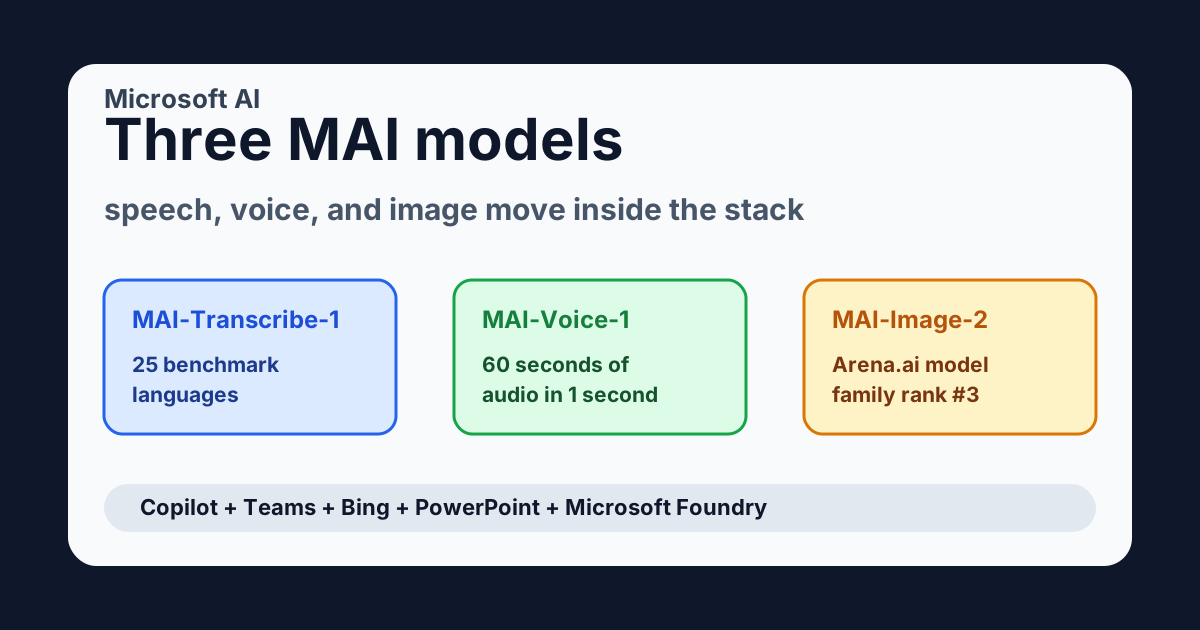
- What happened: Microsoft released MAI-Transcribe-1, MAI-Voice-1, and MAI-Image-2 on April 2, covering transcription, speech generation, and image generation with in-house models.
- The launch puts three commercial AI modalities inside Microsoft Foundry, Copilot, Teams, Bing, and PowerPoint rather than leaving them as OpenAI-only surfaces.
- Why it matters: Microsoft is still OpenAI's largest strategic partner, but the product dependency is now being narrowed model by model.
- Developer impact: Azure and Foundry teams get native alternatives to Whisper-style transcription, hosted TTS, and image generation without leaving Microsoft's deployment stack.
- The open question is independent benchmarking: Microsoft compares
MAI-Transcribe-1mainly against its own Azure Fast service, not directly against Whisper v3 or GPT-4o Transcribe.
- The open question is independent benchmarking: Microsoft compares
- Watch: Text models remain the harder frontier. The moment a future
MAI-1reaches GPT or Claude class, Microsoft's leverage changes again.
Microsoft released three in-house AI models on April 2: MAI-Transcribe-1 for speech transcription, MAI-Voice-1 for speech generation, and MAI-Image-2 for text-to-image generation. Those are not side projects. They cover three of the most commercially useful modalities in enterprise AI: meetings, voice interfaces, generated media, presentations, search, and customer-facing assistants.
The launch is more than a normal product update because Microsoft is also OpenAI's biggest strategic partner, with more than $13B invested. The company is now shipping models in areas that overlap with OpenAI's strongest product surfaces: Whisper-style transcription, image generation, and multimodal assistants. Mustafa Suleyman's February statement about "true self-sufficiency" has moved from strategy language into product routing.
How Microsoft Gets Out From Under One Dependency
Microsoft and OpenAI restructured their partnership in October 2025. OpenAI's operating entity moved toward a public benefit corporation structure, Microsoft's IP rights were extended through 2032, and Microsoft was explicitly allowed to develop AGI independently or work with other partners. That legal permission matters because it lets Microsoft treat OpenAI as one provider inside a broader portfolio instead of the only path for frontier AI.
The activity after that restructuring has been fast. Microsoft began integrating Anthropic models as subprocessors for Microsoft 365 scenarios, announced MAI-Voice-1 and MAI-1-preview, and then brought Claude-based long-running agents into Copilot Cowork with a higher Microsoft 365 licensing tier. The April 2 release adds the missing piece: Microsoft is not only adding alternate partner models, it is replacing some modality-specific workloads with its own models.
The six-month pattern is clear: Microsoft is reducing the ability of any single model supplier to set product margins, release schedules, or roadmap priorities. The company can still use OpenAI frontier models when they are best. It can also use Anthropic for agentic work and its own MAI models for workloads where cost, latency, and integration matter more than a single leaderboard score.
MAI-Transcribe-1 Points at Whisper
The most direct OpenAI overlap is MAI-Transcribe-1. Whisper has been the default reference point for automatic speech recognition: trained on large multilingual audio data, widely used by developers, and available as an open-source model family. Microsoft is now offering its own speech transcription model inside the Azure and Copilot stack.
Microsoft says MAI-Transcribe-1 beats the existing Azure Fast transcription service across all 25 benchmark languages and runs batch transcription 2.5x faster. It supports MP3, WAV, and FLAC files up to 200MB. The model is already being tested in Copilot Voice mode and Microsoft Teams meeting transcription, which is the part that changes the business meaning. Teams is a massive enterprise distribution surface; replacing a transcription backend there can move real workload volume.
The caveat is just as concrete. The public comparison is mostly against Microsoft's own Azure Fast baseline, not Whisper v3 or GPT-4o Transcribe under independent third-party evaluation. Developers deciding between OpenAI and MAI should treat the launch as a serious new option, not as proof that Whisper has already been displaced.
MAI-Voice-1 Turns Speed Into Product Margin
MAI-Voice-1 is Microsoft's text-to-speech model. The headline number is speed: Microsoft says it can generate 60 seconds of high-quality audio in one second on a single GPU. In real-time-factor terms, that is roughly 60x. For a product team, that number affects serving cost, queueing delay, and whether generated speech can be used at scale in daily summaries, podcasts, and assistant workflows.
The model is already used in Copilot Daily, which reads news summaries, and Copilot Podcasts, which turns documents into audio. Microsoft Foundry also supports custom voice generation from a short audio sample. The published price is $22 per 1M characters, giving enterprise buyers a cost anchor rather than forcing every TTS choice through a separate vendor negotiation.
Microsoft has not published a formal benchmark suite for MAI-Voice-1. The current public comparison path is closer to LM Arena-style blind listening, which is useful for perceived quality but weaker than a reproducible technical evaluation. Voice generation has subjective dimensions, including accent, prosody, speaker identity, and long-form consistency. That makes production pilots more important than a single score.
MAI-Image-2 Debuts Near the Top of the Image Stack
MAI-Image-2 is Microsoft's text-to-image model. It debuted at number three by model family on the Arena.ai leaderboard, and Microsoft says generation in Foundry and Copilot is at least 2x faster than the previous generation. The rollout is already touching Bing Image Creator, Copilot, and PowerPoint.
| Item | MAI-Image-2 | GPT-Image | Imagen 3 |
|---|---|---|---|
| Arena.ai rank | #3 by model family | Top tier | Top tier |
| Text rendering | Stable for posters, diagrams, and slides | Strong | Mixed |
| Emphasis | Natural light, skin tone, living environments | General image quality | Photorealism |
| Price | $5 input / $33 output per 1M tokens | Not directly comparable | Not directly comparable |
Microsoft's image pitch is less about novelty and more about production fit: realistic lighting, skin tone accuracy, environments that do not feel empty, and more reliable text rendering for posters, slides, infographics, and diagrams. The Korean source also cites a Decrypt hands-on review that preferred MAI-Image-2 over GPT-Image on image quality and text rendering in that evaluation. That is not the same as a universal benchmark win, but it explains why the model is useful inside PowerPoint and marketing workflows.
MAI-Image-2 is available in the MAI Playground for experimentation, rolling into Bing Image Creator and Copilot, and expected to reach broader developer access through Microsoft Foundry after early customer availability. WPP is one of the early commercial customers named in the original reporting.
The Real Move Is Vertical Integration
Each model can be evaluated on its own. Together, they show Microsoft filling the full AI stack from chips to products.
This is not simply "Microsoft has an OpenAI alternative." It is a structure where Microsoft can choose where to use OpenAI, where to use Anthropic, and where to route demand to its own models. That matters for gross margin, latency, enterprise compliance, and product control. CFO-level concern about expensive AI infrastructure is also easier to understand in this context: if the servers are built for AI demand, Microsoft needs more ways to monetize them than one partner's roadmap.
The remaining gap is text. MAI-1-preview was reportedly trained on about 15,000 NVIDIA H100 GPUs and sits around the middle of the top ten range on LMArena's text leaderboard, behind the strongest GPT and Claude systems. The April 2 models show that Microsoft can reach competitive positions first in commercial multimodal workloads, even if its general-purpose text model is not yet the default frontier choice.
What Developers Should Do With This
For Azure and Foundry users, the practical change is choice. Speech transcription can be tested against MAI-Transcribe-1 without leaving the Microsoft deployment environment. Image generation can move from DALL-E-style dependencies to MAI-Image-2 for some workloads. TTS can be priced against MAI-Voice-1 at $22 per 1M characters. The switching cost is lower when the control plane, billing, compliance, and deployment surface stay inside the same cloud.
For OpenAI API users, this is not an automatic migration signal. Whisper v3 and GPT-4o Transcribe remain strong, and independent benchmarks are still needed before MAI-Transcribe-1 can be treated as a clear replacement. The more immediate effect is negotiating leverage and architecture optionality. If a team already abstracts its transcription, speech, or image layer, MAI becomes another provider to benchmark for cost, latency, and quality.
The pricing signal is worth watching. MAI-Voice-1 lists at $22 per 1M characters. MAI-Image-2 lists at $5 per 1M input tokens and $33 per 1M output tokens. Published pricing forces comparison, and comparison puts pressure on other providers to explain why their modality-specific APIs are faster, cheaper, higher quality, or more reliable.
Microsoft Is Joining the Full-Stack AI Pattern
Microsoft is not alone in moving from model access to stack ownership. Google already owns Gemini, TPUs, and the cloud products around them. Meta ships Llama and is investing in its own AI silicon. Amazon has Trainium and Nova. Apple is using its own silicon to push on-device LLM work. The recurring pattern is model plus chip plus data center plus product distribution.
The April 2 MAI launch places Microsoft squarely in that pattern. OpenAI remains a core partner and Azure remains a core distribution channel for OpenAI frontier models. But the direction of dependence is changing. Microsoft once needed OpenAI to make its AI products credible. Now Microsoft is building enough internal and partner alternatives that it can choose a model per workload.
The next checkpoint is the next MAI text model. If a future MAI-1 generation reaches GPT- or Claude-class quality, Microsoft's strategy changes from hedging to substitution in more of the stack. For now, the independence is arriving first in speech and images, where cost, latency, and product integration can matter as much as the name on the leaderboard.