MAI-Code-1-Flash shows Microsoft’s Copilot token-cost strategy
Microsoft MAI-Code-1-Flash is rolling into Copilot with 137B MoE, 5B active parameters, 256K context, and new AI Credits economics.

- What happened: Microsoft AI introduced
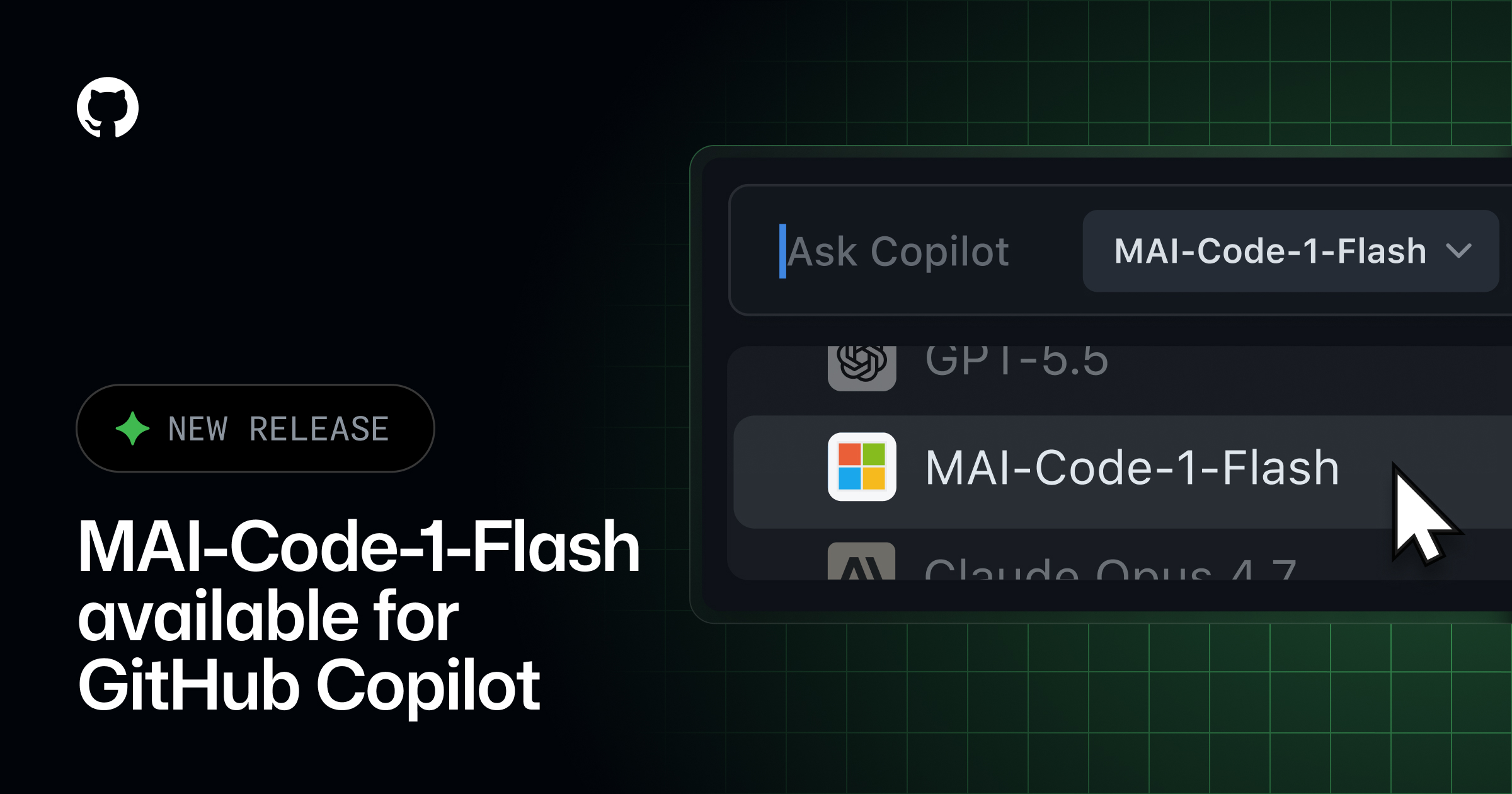
MAI-Code-1-Flash, and GitHub started rolling it into Copilot for VS Code.- GitHub’s June 2, 2026 changelog says availability begins with limited users on Free, Pro, Pro+, and Max individual plans before expanding over several weeks.
- Model shape: The model card lists a sparse MoE with
137B totalparameters,5B activeparameters, and a256Ktoken context window. - Why it matters: Copilot moved to usage-based AI Credits on June 1, so model routing, token volume, and cached input now affect developer budgets directly.
- GitHub’s pricing table puts MAI-Code-1-Flash at $0.75 per million input tokens, $0.075 per million cached input tokens, and $4.50 per million output tokens.
- Watch: Microsoft’s benchmarks are tied to the Copilot production harness, while CLI and enterprise rollout details are still constrained at launch.
Microsoft AI introduced MAI-Code-1-Flash on June 2, 2026. On the same day, the GitHub Changelog said the model would start rolling out inside GitHub Copilot, beginning with VS Code. The timing matters: GitHub Copilot had moved to usage-based AI Credits on June 1. This is not only a new coding model announcement. It is Microsoft placing a cheaper, Copilot-tuned route inside a product where model choice now changes cost, latency, and retry behavior.
GitHub says MAI-Code-1-Flash starts with limited users on Copilot Free, Pro, Pro+, and Max, then expands over several weeks. Users can select it from the VS Code model picker, and Copilot’s Auto picker may route some tasks to it. The launch post does not describe Business or Enterprise availability as part of the initial rollout. Teams that manage Copilot centrally still need to verify whether they can allowlist the model, expose it to specific groups, and see its usage clearly in organization-level reporting.
 .
.
The model card defines MAI-Code-1-Flash as a text-to-text coding model. It uses a self-attention transformer architecture with sparse Mixture-of-Experts layers. Microsoft lists 137B total parameters, 5B active parameters, a 256K token context length, text input, and text output. The training period runs from March to May 2026, and both the release date and EU release date are June 2, 2026.
Those numbers should not be read as a simple "5B model" claim. In an MoE system, total parameters and active parameters are different operating variables. MAI-Code-1-Flash does not activate a full 137B dense model on every request. It routes work through a smaller active slice of experts, aiming to reduce serving cost and latency while retaining specialization. For developers, the visible variables are active parameters, routing overhead, context-window size, tool-call reliability, and how often the model needs to retry. In Copilot, where the product repeatedly attaches repository context, input tokens and cached input can dominate the final cost more than a single generated patch.
Microsoft describes the training target as a production workflow, not a standalone coding leaderboard. Its announcement says the model was trained and evaluated directly in the GitHub Copilot production harness. The model card says MAI-Code-1-Flash went through pretraining, midtraining, supervised fine-tuning, and reinforcement learning, starting from a MAI-Thinking-1 mid-training checkpoint. A later mid2 stage used roughly 2 million synthetic agentic tasks, and the final RL stage ran across more than 150,000 environments. That disclosure positions the model as a Copilot behavior fit: tool use, formatting, edit style, and instruction following matter as much as raw code generation.
| Field | MAI-Code-1-Flash | Source basis |
|---|---|---|
| Parameters | 137B total, 5B active | Microsoft model card |
| Context | 256K tokens | Microsoft model card |
| Training period | March to May 2026 | Microsoft model card |
| Initial distribution | GitHub Copilot in VS Code | GitHub Changelog |
| CLI support | planned for a later rollout | Microsoft model card |
The benchmark claims are aggressive. Microsoft says it evaluated MAI-Code-1-Flash on SWE-Bench Verified, SWE-Bench Pro, SWE-Bench Multilingual, and Terminal Bench 2 in the same Copilot production harness. On SWE-Bench Pro, Microsoft reports MAI-Code-1-Flash ahead of Claude Haiku 4.5 by 51.2% to 35.2%. On SWE-Bench Verified, the company says the model can solve hard problems with up to 60% fewer tokens. Under usage billing, that second claim is as important as pass rate. A model that reaches an acceptable patch with shorter output and fewer retries can be cheaper even when its per-token price is only modestly lower.
The benchmark frame also limits how broadly the result should be generalized. Microsoft emphasizes the same production harness. In that harness, prompt format, repository retrieval, tool invocation, file-edit flow, and automatic context selection are part of the system being measured. The same base model dropped into another IDE agent, a terminal agent, or a self-hosted harness may not produce the same pass rate or token profile. For Copilot users, that is not necessarily a weakness. A model trained around the product’s own prompting and tool chain may be useful precisely because it is optimized for the environment where it runs.
Pricing is the other half of the story. GitHub Docs defines 1 AI credit as $0.01 and publishes model prices per 1 million tokens. MAI-Code-1-Flash is listed as a GA Lightweight model at $0.75 per million input tokens, $0.075 per million cached input tokens, and $4.50 per million output tokens. Claude Haiku 4.5 is listed at $1.00, $0.10, and $5.00. GPT-5.4 mini has the same listed rates as MAI-Code-1-Flash.
| Model | Class | Input | Cached input | Output |
|---|---|---|---|---|
| MAI-Code-1-Flash | Lightweight | $0.75 | $0.075 | $4.50 |
| GPT-5.4 mini | Lightweight | $0.75 | $0.075 | $4.50 |
| Claude Haiku 4.5 | Versatile | $1.00 | $0.10 | $5.00 |
| Gemini 3 Flash | Lightweight | $0.50 | $0.05 | $3.00 |
Prices are dollars per 1 million GitHub Copilot tokens, based on the GitHub Docs pricing table.
MAI-Code-1-Flash is not the cheapest model in that table. Gemini 3 Flash and Raptor mini sit below it on token price. Microsoft’s target looks narrower than "lowest possible price": a lightweight coding model tuned for Copilot’s own workflows. The real bill depends on the Auto picker’s choices, how much repository context Copilot attaches, how much cached input is reused, how many tool calls fail, and how many retry loops a user triggers before accepting a patch.
GitHub’s documentation on code completion keeps the cost picture from becoming too simple. Code completions and next edit suggestions are not charged against AI Credits and remain unlimited on paid Copilot plans. The cost pressure lands more heavily on chat, agentic editing, code review, and large-context work. GitHub also documents that Copilot code review can consume both tokens and GitHub Actions minutes. Because the review model is automatically selected and not disclosed in the same way, teams should track review automation separately from everyday chat and edit sessions.
MAI-Code-1-Flash is likely to be tested first on three kinds of work. The first is small refactoring and repository question answering, both named in the model card’s primary use cases. The second is repetitive work where format following matters: applying a pattern across similar files, writing tests with a known structure, or producing short, constrained diffs. The third is a VS Code session where Copilot already chooses relevant context well. In those cases, Copilot’s harness may contribute as much to the outcome as the model itself.
There are also tasks where teams should be slower to route work to a lightweight model. Cross-service architecture changes, security-sensitive fixes, migration plans, and flaky-test root-cause analysis carry higher failure costs. They still require stronger reasoning models and human review. The model card also lists pricing as To be finalized and the supported language as English, even though GitHub Docs separately publishes Copilot token prices. Teams with Korean comments, multilingual issue specs, localized error logs, or non-English documentation should test actual quality instead of assuming the UI language and model support are identical.
Inside Microsoft’s broader Build 2026 messaging, MAI-Code-1-Flash sits alongside MAI-Thinking-1, MAI-Image-2.5, MAI-Transcribe-1.5, and MAI-Voice-2. Microsoft’s official blog describes MAI-Code-1 as an inference-efficient coding model tailored for GitHub, and says it can be used in Copilot and VS Code. The same broader announcement says MAI models are also available through Fireworks AI, Baseten, and OpenRouter. Those statements should not be collapsed into one claim. "The MAI model family is going to external providers" is different from "this Copilot coding model is available as a general API today." At launch, the model card’s distribution focus is GitHub Copilot in VS Code, with CLI support later.
Early community reaction has leaned toward the cost question. In public r/GithubCopilot threads, some users pointed to MAI-Code-1-Flash’s lower listed rates than Claude Haiku 4.5 and framed it as a useful lightweight model after the AI Credits transition. Others asked when Business and Enterprise plans would receive it, or complained that Auto picker can burn credits by reading too much context for simple questions. One user reported that the model failed on a small Python app connected to a PTZ camera but completed a more ordinary HTML and JavaScript lead-tracker task with low credit usage. The sample is small, but the split is familiar: lightweight coding models often look best on constrained, common tasks and weaker when the environment or domain is unusual.
That reaction creates pressure on Microsoft’s product strategy. GitHub Copilot was long understood by many developers as a monthly coding assistant subscription. Under usage-based billing, users start reading it like an API bill. Model name, context size, cache hit rate, output length, review automation, and failed retries become budget line items. A Microsoft-owned lightweight model helps the company control that equation. Routing every long agentic workflow to OpenAI or Anthropic frontier models may improve capability, but it can also strain Microsoft’s margins and the user’s monthly allowance.
Development teams should start with workload classification rather than leaderboard reproduction. Issue triage, small refactors, unit-test generation, docstring cleanup, and build-error summaries can be routed to a lightweight model first. Architecture plans, security reviews, and multi-repository changes should use a stronger model and a tighter human review loop. Before trusting Auto picker to make those calls, a team can sample 20 to 50 real tickets and record model choice, credits consumed, latency, patch acceptance rate, and reviewer correction time. That data is more useful than a generic benchmark number because it captures the team’s repository shape and review standard.
Individual developers need a smaller version of the same discipline. The Copilot model picker is now part of cost control. For a simple question or a localized edit, start with a lightweight model. If two attempts fail, switch to a stronger model with a narrower prompt and clearer files. Starting with a large model while a whole repository is open, then asking it to "improve everything," is a fast way to spend credits without a reviewable outcome. Even if Microsoft’s "60% fewer tokens" claim holds inside Copilot’s harness, bad task scoping and excessive context can erase that gain.
Enterprise administrators have a separate governance problem. GitHub Docs explains that organization and enterprise AI Credits allowances are pooled at the billing-entity level. A code-review automation policy in one team can affect the allowance available to another team under the same billing entity. Allowing MAI-Code-1-Flash should therefore be tied to repository type, user group, task category, audit logging, and review policy. Code review deserves special attention because it can combine token consumption with GitHub Actions minutes.
Microsoft’s training-data language also belongs in the enterprise review. The announcement says Microsoft built the model end to end and used clean, appropriately licensed data. The model card links to a separate public data summary. For legal and security teams, coding-model adoption questions are not limited to pass rate. They include data provenance, telemetry use, enterprise data residency, output indemnity, auditability, and whether a Microsoft-owned model changes the answers compared with a partner model routed through Copilot.
MAI-Code-1-Flash will not settle the coding-agent market. Anthropic Claude Code, OpenAI Codex, Cursor, Google coding tools, and JetBrains AI surfaces compete on execution environment, review UX, pull-request workflow, sandboxing, policy controls, and model quality. Microsoft’s advantage is distribution: VS Code, GitHub, Azure, and enterprise identity already sit in the same developer account system. MAI-Code-1-Flash is a component inside that distribution network, intended to make repeated coding work cheaper and more predictable.
The practical conclusion is straightforward. Copilot is now a model-selecting development environment. MAI-Code-1-Flash is Microsoft’s own lightweight route inside that environment. Developers should pay more attention to task classification, context control, Auto picker behavior, and code-review costs than to the model name by itself. If Microsoft’s Copilot-harness numbers hold in daily work, this model can become the default route for small, structured changes. If not, it will remain another option in a model picker that developers now have to manage like part of their build budget.