MAI-Thinking-1 35B Shows Microsoft Reducing Its OpenAI Dependence
Microsoft introduced MAI-Thinking-1 and seven in-house MAI models, bringing 35B active reasoning, 256K context, and Foundry private preview into focus.

- What happened: Microsoft AI announced seven in-house MAI models and
MAI-Thinking-1on June 2, 2026.- Microsoft describes
MAI-Thinking-1as a MoE reasoning model with 35B active parameters, roughly 1T total parameters, and a 256K context window.
- Microsoft describes
- Model strategy: Microsoft is placing its own reasoning and coding models inside Foundry next to Sonnet 4.6, Opus 4.6, GPT 5.4, and DeepSeek V4.
- Builder impact: Foundry customers now have to evaluate Microsoft as a model supplier, not only as a broker for OpenAI, Anthropic, Meta, and Mistral models.
- The model is still in private preview, so real pricing, latency, regional availability, routing behavior, and model-card details remain gating checks.
Microsoft AI announced seven new in-house MAI models on June 2, 2026. The center of the announcement is MAI-Thinking-1, which Microsoft describes as a mixture-of-experts reasoning model with 35B active parameters and roughly 1T total parameters. Microsoft's Build 2026 official blog also lists a 256K context window, low-token cost positioning, and Microsoft Foundry private preview access.
The announcement extends the first MAI wave from April 2026, when Microsoft introduced MAI-Transcribe-1, MAI-Voice-1, and MAI-Image-2 for commercial speech and image tasks. The June 2 release is broader. Microsoft is tying together reasoning, agentic coding, image editing, transcription, voice generation, Frontier Tuning, and a healthcare co-development effort with Mayo Clinic under one MAI model family.
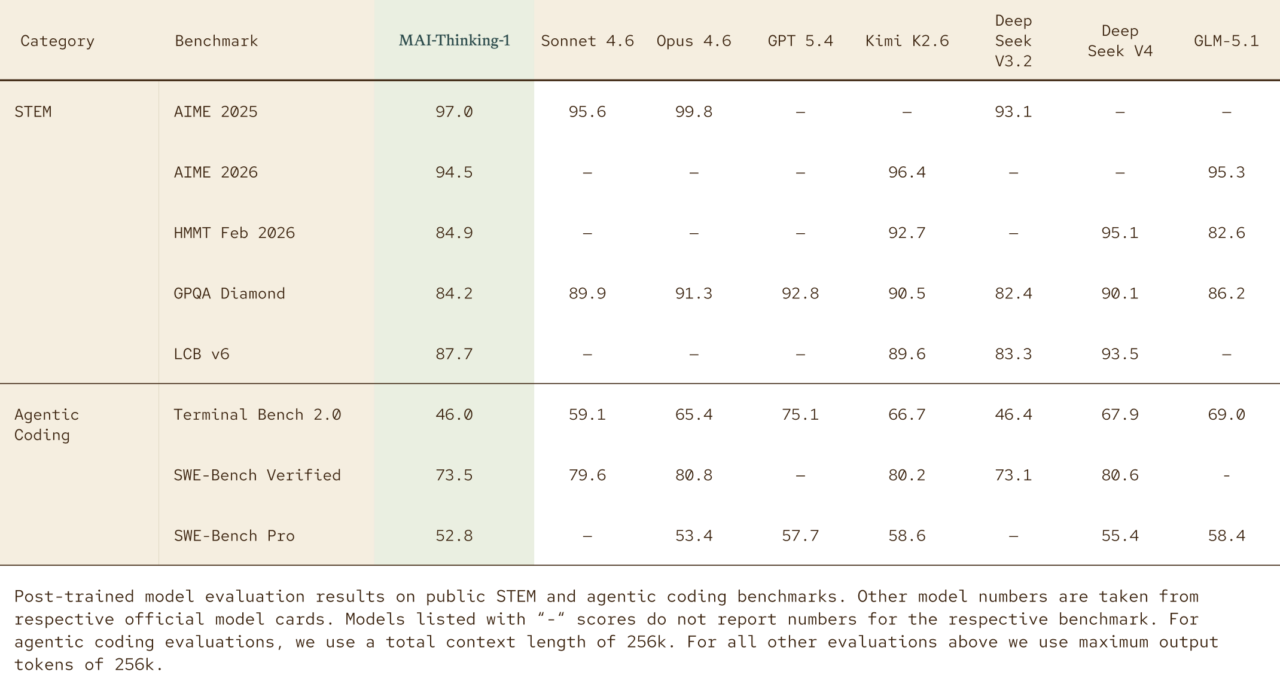
Microsoft's wording around MAI-Thinking-1 is careful, but the competitive target is direct. The official model page says MAI-Thinking-1 is competitive with Claude Opus 4.6 on SWE-Bench Pro. It also says Surge blind side-by-side human ratings preferred MAI-Thinking-1 over Sonnet 4.6 on single-turn and multi-turn tasks. Those are Microsoft-published claims. Independent replication, prompt sets, sampling settings, latency, and cost need to be separated once a Foundry model card and third-party evaluations are available.
Even before independent results arrive, the comparison set is news. Microsoft is no longer acting only as a cloud distributor that lists OpenAI, Anthropic, Meta, and Mistral models inside Azure Foundry. It is putting a Microsoft AI reasoning model in the same table as Sonnet 4.6, Opus 4.6, GPT 5.4, and DeepSeek V4. For developers, the provider-selection question now includes Microsoft as a first-party model candidate inside the same platform where many teams already buy model access.
Microsoft AI says MAI-Thinking-1 was trained "from the ground up" and did not use third-party model distillation. The same announcement emphasizes clean and appropriately licensed datasets, internal work from architecture through post-training, co-design with Maia 200 silicon, and a 1.4x efficiency boost. That language is as much about procurement and legal review as it is about model architecture. Enterprise model selection is not only a question of accuracy. Data provenance, license posture, vendor dependency, auditability, and indemnity often decide whether a model can be adopted.
The Build 2026 framing points in the same direction. Microsoft describes MAI-Thinking-1 as a 35B active-parameter model for complex multi-step instruction following, long-context reasoning, and code generation. The private preview status matters. This is not a general API that every developer can route production traffic to today. It is a Foundry preview model that selected customers and Microsoft product teams can validate first. Treating it as an immediate Opus replacement would overstate what Microsoft has opened; reading it as a sign of how far Microsoft wants to push its own model supply is more precise.
MAI is not just a reasoning launch. Microsoft AI describes MAI-Code-1-Flash as a 5B-parameter, inference-efficient agentic coding model integrated deeply into GitHub Copilot, VS Code, and the Microsoft stack. For developer tools, that model may be more immediately consequential than MAI-Thinking-1. Copilot does not have to send every request to a large frontier model if Microsoft can route some code tasks to a smaller specialized model with lower latency and lower serving cost.
| Component | Official description | What engineering teams should verify |
|---|---|---|
| MAI-Thinking-1 | 35B active, ~1T total, 256K context, Foundry private preview | API pricing, latency, regions, model card, benchmark reproducibility |
| MAI-Code-1-Flash | 5B-parameter agentic coding model integrated into Copilot and VS Code | Copilot routing visibility, fallback behavior, code review quality |
| Frontier Tuning | Workflow-based RL environments inside customer compliance boundaries | Data retention, weight ownership, eval separation, rollback process |
| Mayo Clinic model | Co-developed with de-identified clinical data and clinical expertise | Validation scope, accountability, medical-use approval, external release timing |
Microsoft is also widening the distribution path for MAI models. The Microsoft AI post says MAI models will be available through Foundry and optimized first-party products, and it also names Open Router, Fireworks AI, and Baseten as planned channels. The Build blog separately says Fireworks AI is generally available in Foundry. That means Microsoft does not plan to trap every MAI workload inside Azure-only consumption. Teams already using model routing or OpenAI-compatible inference platforms will evaluate this as a switching-cost question, not just a benchmark question.

Frontier Tuning is as large a part of the announcement as the model list. Microsoft AI describes reinforcement learning environments as "training gyms" for customer workflows. The official post says a MAI tuned model for Excel matched GPT 5.4 while being up to 10 times more efficient. It also says a MAI model tuned to McKinsey enterprise standards achieved the highest win rate among tested models while costing roughly 10 times less. Both are Microsoft claims that need independent confirmation, but the product direction is clear: buy fewer generic frontier calls, then shape smaller frontier-class models around organization-specific workflows.
That direction also reduces dependence on OpenAI. Microsoft still has a deep OpenAI partnership, and Azure Foundry continues to offer external models from Anthropic, Meta, Mistral, xAI, DeepSeek, and others. MAI-Thinking-1 changes the catalog by putting a Microsoft-owned reasoning model into that choice set. For customers, it may look like one more provider. For Microsoft, it connects model development, inference, silicon, tuning, and productivity products inside a single supply chain.
The healthcare partnership shows how Microsoft wants this model supply chain to work in regulated domains. Microsoft AI announced a co-developed healthcare frontier AI model with Mayo Clinic. The official post says the effort combines Mayo Clinic's de-identified clinical data and longitudinal insights with Microsoft's foundational AI capabilities. The model will first be deployed inside Mayo Clinic's environment and, after validation, is planned for availability to other organizations through Azure Foundry. Microsoft also says model ownership will remain with Mayo Clinic. That sentence is important because healthcare AI buyers will scrutinize data rights, model ownership, validation boundaries, and responsibility before they look at generic benchmark charts.
Developers should verify four items before treating MAI-Thinking-1 as a production option. First is Foundry pricing. A 35B active-parameter model suggests a smaller inference footprint, but real cost depends on input and output token prices, context pricing, caching, tool use, and regional surcharges. Second is long-context latency. A 256K context window is useful for repositories and document-heavy workflows only if retrieval, chunking, prompt routing, and response generation stay inside the latency budget of an agent workflow.
Third is Copilot routing. Microsoft says MAI-Code-1-Flash is integrated with GitHub Copilot and VS Code, but users still need to know when the model is selected, whether enterprise administrators can control allowed models, and which fallback model handles failures. GitHub Copilot pricing and model availability have changed repeatedly, so enterprise teams should look for routing logs and budget controls before relying on a model name in a launch post.
Fourth is Frontier Tuning governance. Microsoft says customers can use private data, domain knowledge, and workflows inside their compliance boundaries. The claimed difference from traditional fine-tuning is the emphasis on reinforcement learning environments and workflow-based evaluation. Real adoption will require training-data retention terms, separation of evaluation datasets, regression suites, approval gates, model-version pinning, and rollback procedures. In regulated environments, "more efficient" is less persuasive than a complete audit artifact.
Community reaction is still early. The Microsoft AI post and the MAI-Thinking-1 model page were shared on Reddit's r/singularity and r/GitHubCopilot. Discussion focused on the direct Sonnet 4.6 and Opus 4.6 comparisons and on whether Microsoft is reducing its reliance on OpenAI. As of the June 2, 2026 Korean source review, no dedicated Hacker News or GeekNews discussion for MAI-Thinking-1 had been found. Because the model is in private preview, meaningful user reports probably require broader Foundry access and a public model card.
Microsoft's "zero distillation" and "licensed data" language will likely appear more often in enterprise model launches. Public model competition still starts with tables such as SWE-Bench Pro, AIME, and GPQA. Enterprise procurement adds data licenses, indemnity, audit logs, regions, and fine-tuning ownership beside those tables. Microsoft can pull those questions into the launch document because it owns cloud infrastructure, identity, compliance tooling, silicon work, and productivity apps.
MAI-Thinking-1's first real test will not be a public leaderboard. It will be Foundry customer workloads: long-document reasoning, agent planning, code generation, Excel-tuned workflows, and healthcare model validation. The 35B active-parameter figure is a useful starting point, but engineering teams will decide based on a narrower comparison. Run the same task through Sonnet, Opus, GPT, DeepSeek, and MAI, then compare success rate, cost, latency, security approval, and operational logs.
The news value is that Microsoft has moved another step from "the platform where customers choose models" toward "the platform that builds the models customers choose." OpenAI remains central to Microsoft's AI business, and external models in Foundry remain important. But announcing MAI-Thinking-1, MAI-Code-1-Flash, Frontier Tuning, and the Mayo Clinic model on the same day shows Microsoft tying first-party model supply to actual product surfaces. Developers evaluating Azure Foundry now need to read the provider catalog and Microsoft's own reasoning-model operating terms side by side.