GitHub Copilot automations turn cloud agents into scheduled PR workers
GitHub Copilot cloud agent automations add scheduled and repository-event triggers, with sandboxing, model policy, and AI Credits billing attached.
- What happened: GitHub announced Copilot cloud agent
automationson June 2, 2026.- Triggers include hourly, daily, and weekly intervals, plus issue and pull request events.
- The first rollout supports private and internal repositories. GitHub says public repository support is coming later.
- Why it matters: Copilot is moving from an assistant that waits for a prompt to a repository worker that wakes up on schedule.
- Issue triage, nightly failing-test fixes, and weekly release notes can now return as issue updates or draft pull requests.
- Watch: Token usage is billed to the user who creates the automation at standard usage-based rates.
- Business and Enterprise teams need Copilot cloud agent policy, sandbox policy, model policy, and cost ownership in the same runbook.
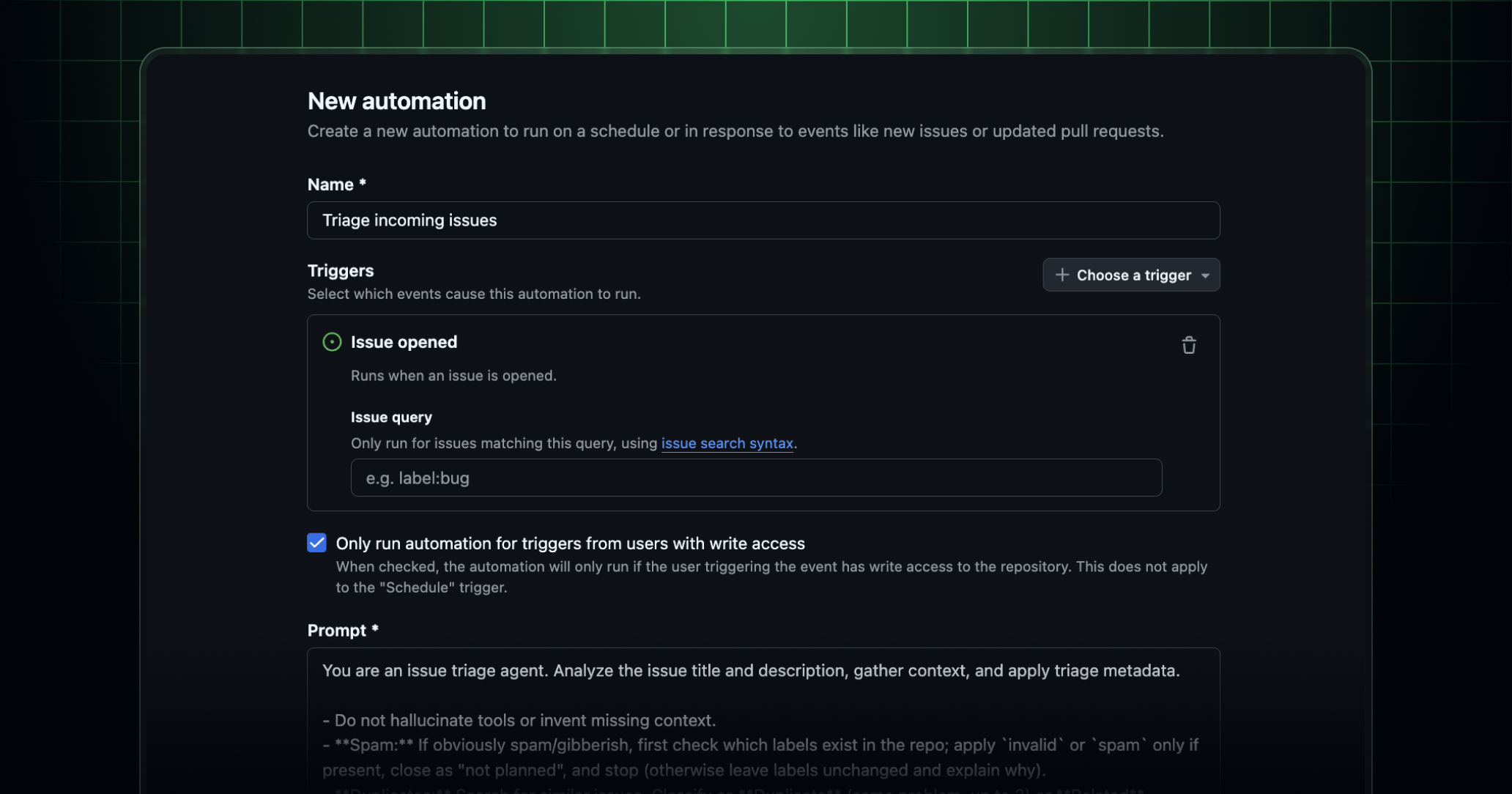
GitHub announced Copilot cloud agent automations in its June 2, 2026 Changelog. A user can create an automation from a repository's Agents tab or the GitHub Copilot app, then configure a prompt, trigger, tools, and model. The agent runs on the selected schedule or repository event and can update issue labels, open draft pull requests, or draft release notes.
The change is larger than another Copilot feature toggle. The existing Copilot cloud agent already handled asynchronous coding tasks after a developer handed it an issue or task. Automations move the invocation point from a human click to a repository clock or repository event. GitHub's own examples are incoming issue triage, nightly failing-test fixes, and weekly release notes. Each task becomes useful only when the agent can read code, write patches, update issues, and create pull requests.
GitHub is starting with a narrow scope. Automations are available for private and internal repositories, with public repository support planned later. Each automation is scoped to a single repository. This is not a free-roaming agent that crosses an organization's codebase. It is a repository-level worker with a fixed prompt, fixed triggers, selected tools, and a selected model. Business and Enterprise customers also need an administrator to enable the Copilot cloud agent policy before users can run it.
The billing line belongs near the top of any operational review. GitHub says automation setup includes model selection and that token usage is charged to the user who creates the automation at standard usage-based rates. A weekly release-note job and an hourly failing-test repair job are both "automations," but their token budgets are not comparable. The timing matters too: GitHub moved Copilot into AI Credits and usage-based billing on June 1, 2026, and announced scheduled cloud-agent work the next day.
| Setting | What GitHub exposes | Operational question |
|---|---|---|
| Trigger | Hourly, daily, weekly, issue event, pull request event | How often should this agent create repository noise and token spend? |
| Tools | Repository read/write actions such as pull request creation or issue label updates | Which write permission is actually required for this job? |
| Model | A selected Copilot model for the automation | What quality, latency, and cost tradeoff is acceptable? |
| Owner | The user who creates the automation is billed for token usage | What happens when that user changes teams or leaves? |
The trigger set is simple on paper: interval, issue event, or pull request event. In practice, the trigger is where teams decide how much AI-generated work enters the repository. A low-risk automation might label new issues. A higher-risk automation might wake up on pull request updates and propose patches. A nightly test-fix job sounds useful, but a repository with flaky tests can produce repeated draft pull requests against the same unstable failure.
Tools are the stronger guardrail than the prompt. GitHub describes tool configuration for actions such as creating pull requests or updating issue labels. A release-note drafting automation does not need broad write access. A failing-test repair automation probably needs patch generation and draft pull request creation, but not issue labeling. If the tool selection is too wide, the prompt becomes the only thing separating a focused worker from a general repository editor.
The closest comparison is GitHub Actions. Actions use workflow files, events, runners, permissions, and billing minutes. Copilot automations use prompts, triggers, tool selection, model selection, and token billing. The output is also different. Actions usually produce logs, artifacts, status checks, or deployments. Copilot automations are closer to issue updates and draft pull requests. The largest technical difference is that a deterministic workflow script is replaced by a model-driven agent whose behavior can vary with repository state, model choice, tool results, and rate limits.
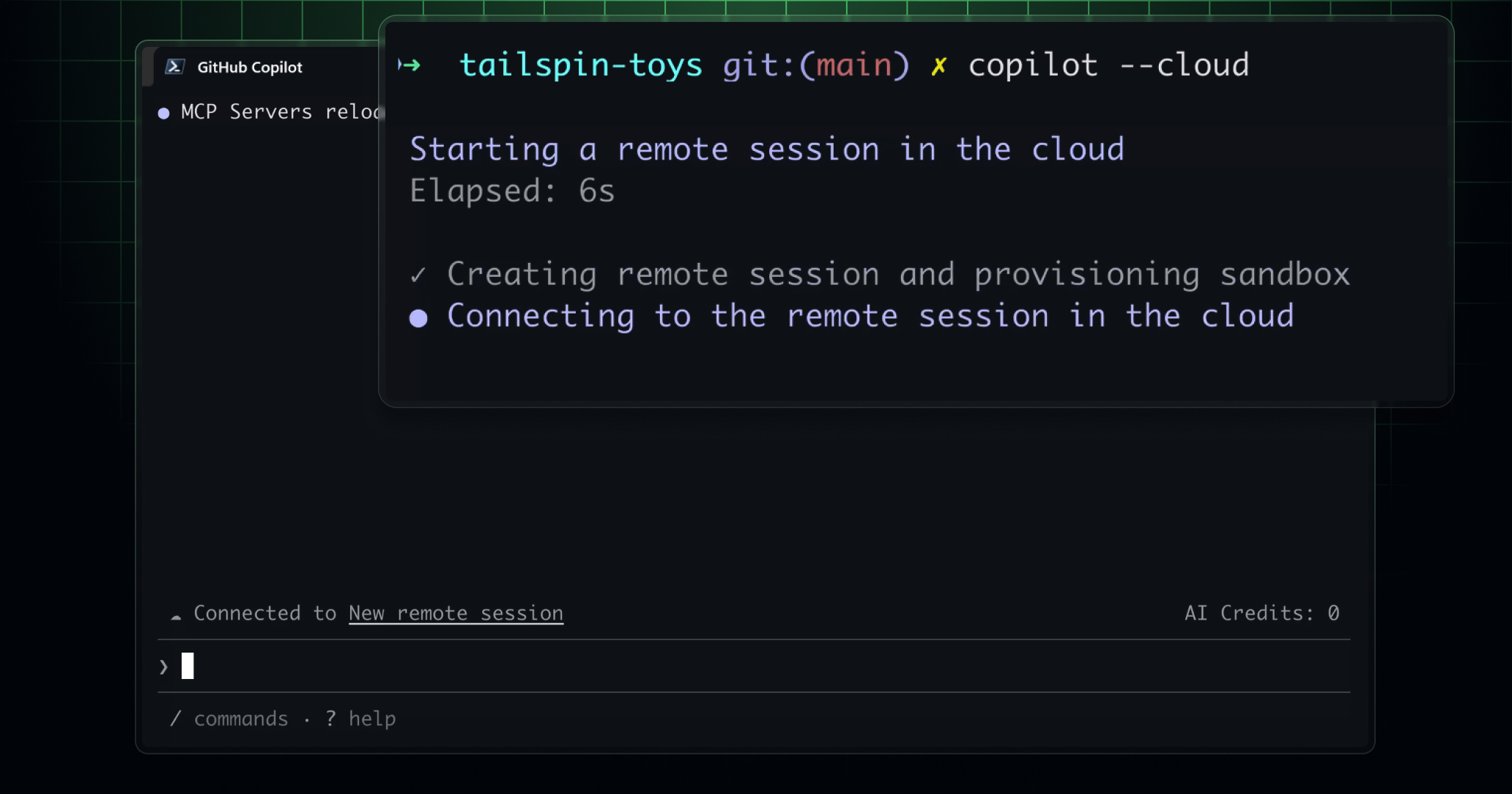
GitHub paired the automation announcement with several other June 2 Copilot updates. The cloud and local sandbox preview defines execution boundaries for Copilot. In local sessions, /sandbox enable runs Copilot-started shell commands inside filesystem, network, and system capability restrictions. In cloud sessions, copilot --cloud starts a GitHub-hosted ephemeral Linux sandbox.
GitHub says the local sandbox is built on Microsoft MXC technology. That connects the Copilot update to Microsoft's Build 2026 Windows developer announcements. The Windows Developer Blog described Microsoft Execution Containers as a policy-driven boundary for safely running agent-generated code, and included comments from OpenAI and Manus. Copilot sandboxing is one product surface for that same direction: agents can execute commands, but execution needs a boundary that can be explained and audited.
 .
.
Once an automation runs on repository events, sandboxing stops being an optional developer comfort feature. A nightly failing-test fix may install dependencies, run shell commands, read test logs, and generate a patch. The team has to decide what the agent can touch while it does that work. GitHub says the local sandbox is included with a standard Copilot seat. The cloud sandbox needs separate pricing documentation, and GitHub says it inherits existing Copilot cloud agent policy.
Model selection changed in the same announcement wave. GitHub said MAI-Code-1-Flash is rolling out to GitHub Copilot. It is Microsoft's small-tier coding model and appears first in the VS Code model picker for a limited set of users. Copilot Free, Pro, Pro+, and Max plans are the initial target. GitHub describes it as the first example of a Microsoft wave of purpose-built coding models designed and tuned for Copilot.
Google models also entered more Copilot surfaces that day. GitHub said Gemini 3.1 Pro Preview and Gemini 3.5 Flash are available in Copilot CLI, Copilot cloud agent, the GitHub Copilot app technical preview, and Copilot SDK. Business and Enterprise administrators must enable the relevant Gemini model policy before users see those options. Two teams can create the same Copilot automation but get different cost, latency, coding style, and verification behavior depending on whether the chosen model is MAI, Gemini, OpenAI, Anthropic, or another Copilot-supported option.
The Copilot SDK general availability announcement belongs in the same frame. The SDK lets developers add Copilot-like agent experiences to TypeScript applications. GitHub is expanding Copilot in two directions at once: deeper into repository operations through cloud-agent automations, and outward into external product surfaces through an SDK.
Microsoft Foundry's Build 2026 recap points in the same direction at the broader platform level. Foundry described hosted agents headed to general availability in early July 2026, with sandboxed sessions, state, filesystem access, and framework flexibility. Toolboxes are in public preview and package MCP clients, skills, and enterprise data into a governed endpoint. Foundry Agent Service memory adds procedural, user, and session memory in public preview. Copilot automations are the developer-repository version of that enterprise agent stack.
For engineering teams, the first checklist item is ownership. GitHub says token usage is charged to the user who creates the automation. If a personal account creates the nightly fix job for a team repository, the cost, permissions, and offboarding problem sit on that person. Business and Enterprise policy can enable or disable cloud agent use, but the team still needs a record of the automation owner, prompt, trigger, tools, and model.
The second checklist item is trigger design. Issue-label automation has a smaller blast radius. Pull request update automation can create review load. Hourly automation can consume AI Credits while producing small changes that humans still need to inspect. GitHub's nightly failing-test example is practical, but it should be attached to repositories with stable test signals and clear rules for closing repeated agent attempts.
The third checklist item is tool scope. The tool menu is the permission boundary the agent cannot talk its way around. A release-note job should not be able to update labels and open arbitrary pull requests unless the workflow explicitly needs that. A test-fix automation without pull request creation may force a human to copy patches manually. Tool selection should match the job, not the broadest set of actions an agent might ever need.
The fourth checklist item is auditability. GitHub says each automation is scoped to one repository, but incident review needs more than repository scope. Operators need to reconstruct which trigger fired, which prompt and model ran, which tools were available, which sandbox policy applied, and which pull request or issue update came out of the run. "Who clicked the button?" becomes less useful than "what woke the agent and what policy constrained it?"
The fifth checklist item is human review. GitHub's examples produce draft pull requests, and that draft state is a useful default. It prevents a repository worker from being mistaken for a merge-ready maintainer. Dependency updates, authentication changes, payment code, and security fixes still need normal pull request review and test gates. Writing "open a draft pull request" into a prompt does not define the review standard.
Community reaction around this product wave attached quickly to billing. After GitHub's June 1 usage-based billing update, Copilot-related Reddit threads included complaints about AI Credits being consumed quickly and concerns about bill increases. Those posts are user reports, not official usage data, so they should not be treated as representative metrics. The structural issue is still real in the official documentation: an automation is a repeating feature, and repeating features create token usage without a person pressing run each time.
Copilot automations differ from OpenAI Codex and Claude Code mostly by how tightly they attach to GitHub repository objects. Codex and Claude Code can work through local workspaces, terminals, cloud tasks, issue assignment, and other surfaces. Copilot automations use GitHub repository events as triggers and GitHub issues and pull requests as outputs. Teams that already treat GitHub as the source of truth for development work get lower adoption friction. They also need tighter GitHub permission, billing, and audit hygiene.
The MAI-Code-1-Flash announcement may draw more attention because it names a new model. The larger operational change on June 2 is the combination of schedulable agents, sandbox boundaries, model policy, and SDK general availability. Smaller coding models can lower unit cost and latency. Gemini support widens model choice. Sandboxes define execution boundaries. Automations connect those pieces to the repository clock.
Teams that want to try the feature should write four short documents before turning on broad usage. The first is an automation inventory: repository, name, owner, trigger, prompt, tools, and model. The second is a cost budget that separates hourly, daily, weekly, issue-event, and pull-request-event jobs. The third is a sandbox policy for local and cloud execution, including network and filesystem access. The fourth is a review rule for who closes, accepts, or escalates draft pull requests created by agents.
GitHub Copilot moved on June 2 from "assistant that suggests code" toward "cloud worker waiting for repository events." That does not make every repository automation dangerous or valuable by default. It makes each automation an operational unit with a prompt, trigger, model, tools, billing owner, and review path. Repositories that manage those six fields can use the feature as a repeatable worker. Repositories that do not may quietly accumulate draft pull requests, review load, and AI Credits spend in the background.