10,000 Developers Say AI Coding Winners Are Being Decided by Satisfaction
JetBrains AI Pulse says Claude Code reached 91% CSAT and an NPS of 54 while GitHub Copilot growth stalled, pushing AI coding toward a best-of-breed market.
- What happened: JetBrains published the second wave of its
AI Pulsesurvey, based on more than 10,000 global developer responses.- Claude Code reached 18% adoption, 91% CSAT, and an NPS of 54, while GitHub Copilot remained the adoption leader at 29%.
- Market signal: JetBrains frames the result as a move toward best-of-breed coding agents rather than default ecosystem lock-in.
- Developer impact: Teams are no longer choosing only between IDE plugins and AI-native editors; terminal-native agents now belong in the tool evaluation set.
- The same data also keeps a warning visible: usage is high, but trust and verification remain the real bottlenecks.
JetBrains published the second wave of its AI Pulse survey after collecting responses from more than 10,000 developers worldwide. The headline is not simply that AI coding tools are popular. The sharper finding is that developers are starting to pick tools by product quality rather than by the ecosystem they already use. Claude Code grew from roughly 3% adoption in the April-June 2025 baseline to 18% in January 2026, while posting 91% customer satisfaction and an NPS of 54. GitHub Copilot still led the market at 29% adoption, but JetBrains described its growth as stalled.
JetBrains' research team summarized the change as a move toward best-of-breed agents, where product superiority matters more than ecosystem lock-in. That sentence captures a major 2026 coding-tools shift. When about 90% of developers now use AI tools regularly, the question is no longer whether AI enters software work. The question is which interface earns repeated trust after the novelty wears off.
Why This Survey Carries Weight
AI Pulse is more useful than a simple social-media poll because JetBrains tried to reduce AI-topic bias in its recruitment. The survey promotion and explanation did not mention AI, which limited overrepresentation from developers who are either highly enthusiastic about AI or strongly opposed to it. JetBrains ran the survey in eight languages, recruited through Instagram developer ads and its research panel, and used Zhihu for respondents in China. It also applied raking weights for region, coding experience, and familiarity with JetBrains products.
The second wave can also be compared against earlier waves. JetBrains tracked the same topic across a baseline wave in April-June 2025, a September 2025 wave, and the January 2026 wave. That makes the numbers a trend line rather than a one-time snapshot. About 90% of respondents were developers, programmers, or software engineers, with the rest coming from adjacent roles such as AI/ML engineering, DevOps, architecture, and data science.
Claude Code Grew Sixfold in Six Months
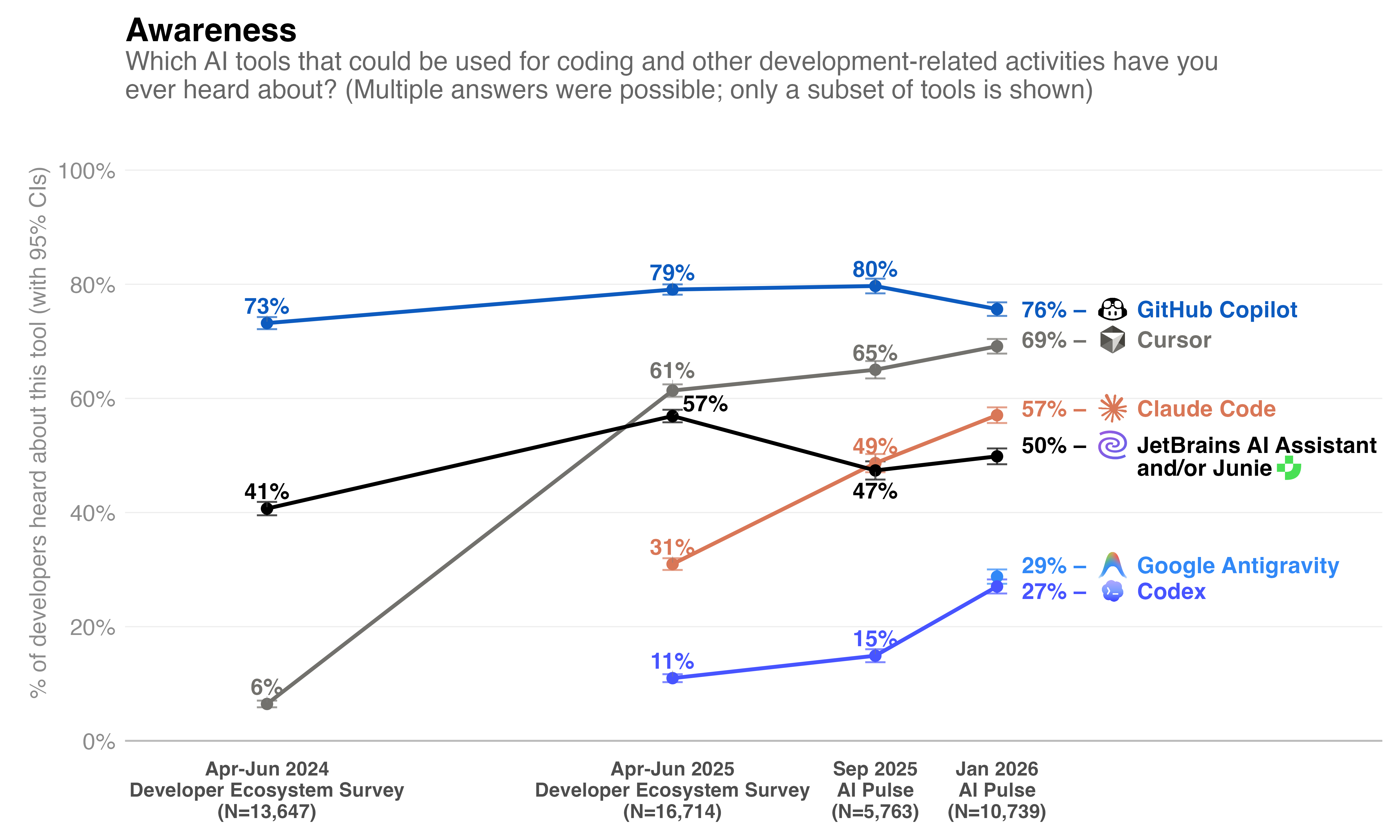
Claude Code's adoption curve is the striking number in the survey. In the April-June 2025 baseline, the terminal-based tool had 31% awareness and roughly 3% adoption. By January 2026, awareness had reached 57% and adoption had reached 18%. In the United States and Canada, adoption was even higher at 24%.
The stronger signal is not adoption alone. Claude Code reached 91% CSAT and an NPS of 54. On the NPS scale from -100 to +100, a score above 50 is commonly treated as excellent. JetBrains called it the highest product loyalty in the market.
| Metric | Claude Code | GitHub Copilot | Cursor |
|---|---|---|---|
| Awareness | 57% | 76% | 69% |
| Adoption | 18% | 29% | 18% |
| Six-month growth | 3% -> 18% (6x) | Stalled | Slowed |
| CSAT | 91% | - | - |
| NPS | 54 · Excellent | - | - |
Source: JetBrains AI Pulse, second wave, January 2026, 10,000+ responses.
Copilot Still Leads, but Growth Has Stalled
GitHub Copilot remained the most adopted coding assistant in the survey, with 29% adoption and 76% awareness. In large enterprises with more than 5,000 employees, adoption reached 40%. That remains a meaningful distribution advantage, especially where GitHub Enterprise, Microsoft procurement, and centralized licensing already exist.
JetBrains' wording was still blunt: Copilot's growth has stalled since last year. In a market where overall AI coding usage is rising quickly, a flat leader means many new or expanding users are choosing something else. Copilot's enterprise strength may also be partially subsidy-driven. When a company pays the license bill, the employee's choice is not the same as an independent buyer's choice.
Cursor Is Strong, but Its Growth Is Slowing
Cursor also remained central to the market. JetBrains measured it at 69% awareness and 18% adoption, putting it level with Claude Code on adoption. The important part is the slope. JetBrains said Cursor's growth had slowed in both awareness and adoption.
That slowdown does not mean Cursor is weak. Around the same period, Cursor crossed $2 billion in ARR and was reportedly being discussed at a much higher valuation. It does mean AI-native IDEs are no longer the only challenger story. Terminal-native coding agents now compete for the same high-intent developers.
Google Antigravity showed that the market is still open to new entrants. After launching in November 2025 alongside Gemini 3, it reached 6% adoption in about two months. Its agent-first IDE approach, based on a VS Code fork and a Manager View that can run up to five AI agents in parallel, made enough of an impression while still in free public preview.
OpenAI Codex appeared earlier in the curve, with 27% awareness and 3% adoption. JetBrains collected this wave before the public desktop app launch, so the next wave may show a different Codex line.
General chat interfaces also remained part of coding work. ChatGPT was used for coding by 28% of respondents, followed by JetBrains AI Assistant plus Junie at 11%, Gemini at 8%, and the Claude chatbot at 7%. Dedicated coding tools and general assistants are coexisting rather than replacing each other in a clean sequence.
Three Product Philosophies Are Competing
The survey data sits on top of a product-design split in AI coding tools. GitHub Copilot represents a plugin-extension model. Cursor represents an AI-native IDE model. Claude Code represents a terminal-native agent model.
- · Supports VS Code and JetBrains IDEs
- · Low entry price at $10/month
- · Strong enterprise volume licensing
- · Minimal workflow disruption
- · Editor redesigned around AI collaboration
- · Parallel agent execution
- · Local-to-cloud handoff
- · Multi-repository work
- · Not tied to a single IDE
- · Direct filesystem access
- · Suited to complex multi-file work
- · Fits existing terminal workflows
Cursor's bet is that AI should reshape the editing environment itself. The boundary between writing code and collaborating with the agent becomes part of the workspace. Copilot's bet is that developers want AI inserted into tools they already know, with low switching cost and procurement-friendly licensing. Claude Code's bet is that serious agent work belongs closer to the shell, repository, and filesystem, with less dependence on a specific GUI.
The survey also suggests that productive developers are not choosing only one of those models. Developers reported using an average of 2.3 tools. A common pattern is to use Cursor for regular editing and Claude Code for complex multi-file refactors or large tasks. Staff-plus engineers also had the highest agent usage rate at 63.5%, which points toward strategic tool mixing rather than one universal winner.
Independent Signals Point in the Same Direction
The JetBrains survey is not the only data source supporting Claude Code's rise. SemiAnalysis estimated in February 2026 that Claude Code accounted for about 4% of all public GitHub commits, more than 135,000 commits per day, and projected that it could pass 20% of daily commits by the end of 2026.
Pragmatic Engineer's February 2026 survey of more than 900 developers found Claude Code leading the "most loved" category at 46%, compared with 19% for Cursor and 9% for GitHub Copilot. In that survey, Claude Code adoption reached 75% among startups, while GitHub Copilot led at 56% in companies with more than 10,000 employees.
Claude Code Growth Signals Across Independent Sources
JetBrains · SemiAnalysis · Pragmatic Engineer · revenue data
Revenue reports point in the same direction. Claude Code's annualized run rate rose from $500 million in September 2025 to $2.5 billion in February 2026. Cursor crossed $2 billion ARR around the same period, doubling in three months. The total AI coding market is expanding quickly, but the gains are not being distributed evenly.
The Trust Gap Still Defines the Work
The uncomfortable pairing is that AI coding usage is high while trust remains low. JetBrains measured regular AI tool use near 90%. Stack Overflow's 2025 survey found that only 29% of developers trusted AI, down 11 percentage points from 2024. Forty-five percent said their biggest frustration was AI output that is almost right but not quite right, and 66% said they spent more time fixing AI-generated code.
That contradiction is the operational reality for engineering teams. Developers accept the productivity benefit, but they do not treat the output as self-verifying. When they do not trust an AI answer, 75% still ask another person for help. The coding-agent market is therefore competing on more than generation speed. Reviewability, traceability, and a manageable failure mode matter as much as raw capability.
JetBrains' workflow research adds another practical caution. More than 80% of developers report productivity gains from AI, but AI users also delete about 100 more code blocks per month. They switch context more often too, with six additional IDE activations per month. Perceived productivity and behavioral telemetry are not identical signals.
For tech leads and CTOs, the adoption question should not stop at whether a tool helps engineers write faster. The better question is how much generated code survives review, whether context switching rises, which defects escape, and whether the organization can audit agent decisions after the fact.
Startups and Enterprises Are Buying Different Things
Pragmatic Engineer's organization-size split helps explain why Copilot can still lead adoption while Claude Code leads satisfaction. Startups showed 75% Claude Code adoption, while enterprises with more than 10,000 employees favored GitHub Copilot at 56%. That is not just taste. Enterprises value GitHub Enterprise integration, Microsoft procurement, volume licensing, admin tooling, and policy controls. Startups can evaluate products more directly on what helps the team ship.
JetBrains' best-of-breed claim is therefore strongest in contexts where the buyer and the user are close together. When budgets tighten or centralized procurement takes over, the default contract can still beat the best-liked tool. That is the counterargument to the best-of-breed narrative: if employer subsidies disappear or standardization pressure rises, developers may be pulled back toward bundled tools.
JetBrains' own platform response is to emphasize an open ecosystem. Through the Agent Client Protocol and support for many agents, including Cursor, JetBrains is trying to make the IDE a host for choice rather than a walled garden for one assistant. That strategy matches the survey's 2.3-tools-per-developer pattern.
Community Reaction: Productivity Panic and Tool Wars
The broader community reaction to agentic coding is split between excitement and fatigue. Hacker News discussions around "Claude Code and the Great Productivity Panic of 2026" described some AI-tool usage as cognitively fragmenting, even comparable to scrolling short-form feeds. One quoted concern was that the pace could lead to burnout and substance abuse.
There was also a more pragmatic counterpoint: Claude Code can be effective when used for bounded loops such as compilation, debugging, and repetitive code changes. Many developers now argue that reusable workflows and skills are the difference between sustainable productivity and constant agent babysitting.
The 10x-productivity claim also remains contested. Faster code production does not automatically mean better software. JetBrains' figure about AI users deleting more code gives that criticism empirical backing. A tool can increase throughput while also increasing the amount of cleanup.
What This Points Toward
JetBrains AI Pulse points to a market that is moving from one dominant assistant toward differentiated tool categories. In 2024, it was easy to describe AI coding as GitHub Copilot plus a few challengers. By early 2026, the data showed a three-way market: Copilot at 29% adoption, Claude Code at 18%, and Cursor at 18%, with Antigravity and Codex entering from different directions.
The driver is low switching cost. Moving from Copilot to Claude Code does not require the kind of multi-month migration associated with changing programming languages or enterprise IDE platforms. Developers can keep several tools installed and use each one where it fits. That means quality differences show up quickly in satisfaction and usage.
There are three near-term lines to watch. First, OpenAI Codex may look different in the next AI Pulse wave because the January data predates the broader desktop release. Second, agent adoption can rise fast if more companies follow through on 12-month agent plans. Third, the trust gap can cap the market if generated code keeps increasing review burden faster than teams improve verification.
JetBrains' conclusion was direct: developers will move to the individual components that actually deliver the best results. The 10,000-response survey does not prove one permanent winner. It does show that the winner in AI coding is no longer decided only by ecosystem size, default installation, or price. For now, the highest satisfaction score belongs to a terminal-native agent that began with a shell prompt and a repository.