Idea tournaments: the research bottleneck Co-Scientist changes
Google DeepMind Co-Scientist reached Nature with a multi-agent design that shifts scientific AI from idea generation toward verification loops.
- What happened: Google DeepMind put
Co-Scientistback in the spotlight with a Nature paper and a staged experimental release for researchers.- The Gemini-based system uses multiple agents to generate, debate, rank, and refine scientific hypotheses instead of returning one answer.
- Core design: The real news is the idea tournament, where compute is spent on verification as much as generation.
- Reflection, Ranking, and Meta-review agents keep pressure on novelty, correctness, testability, and the next search direction.
- Watch: Lab validation still belongs to humans, and misuse risks such as CBRN work make safety controls part of the product architecture.
Google DeepMind has put its multi-agent scientific research system Co-Scientist back at the center of the AI-science conversation. This time it is not just a demo. The package includes a Nature paper published on May 19, 2026, a Google DeepMind announcement, and a Google Labs experimental tool called Hypothesis Generation.
The official language is careful: Co-Scientist is an AI partner for researchers. But for builders, the more important point is architectural. Co-Scientist is not simply a chatbot that knows a lot of scientific literature. It is closer to a verification-oriented runtime. It generates hypotheses, lets specialized agents criticize and compare them, ranks the candidates, recombines stronger ideas, and feeds what it learned back into the next round.
That distinction matters. If an AI science tool is framed as "a model that reads papers faster," the product center of gravity is search, summarization, long context, and citations. If it is framed as "a system that decides where scarce verification budget should go," the center of gravity becomes orchestration, evaluation, tool use, safety classification, auditability, and the interface where a human scientist takes over. The most interesting part of this announcement is that Google appears to see the scientific bottleneck not only as a shortage of ideas, but as the loop that separates useful ideas from familiar, fragile, or dangerous ones.
Why the Nature paper matters
The Nature abstract describes Co-Scientist as a Gemini-based multi-agent system for structured scientific thinking and hypothesis generation. It takes research goals and prior evidence as context, then tries to produce novel hypotheses that can be experimentally tested. The paper also argues that the system benefits from test-time compute scaling: spending more computation during inference can keep improving hypothesis quality.
Many AI research assistants have been strongest at literature search, note synthesis, and draft writing. Those are useful, but reading a lot of papers and proposing a good scientific hypothesis are not the same problem. A good hypothesis has to be more than plausible. It should be novel, consistent with existing evidence, testable in the real world, and safe enough to pursue. Co-Scientist splits those constraints across agent roles and repeated loops instead of leaving them inside one prompt.
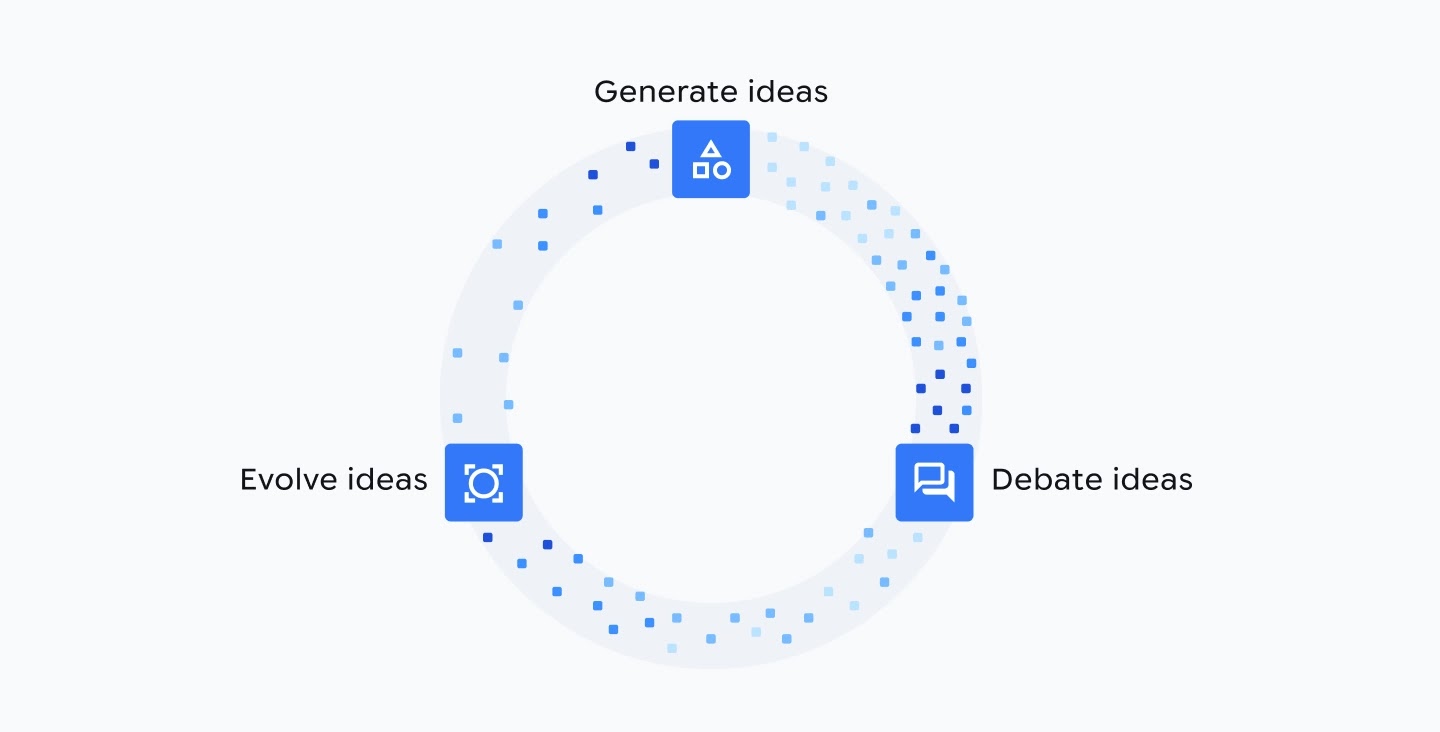
According to DeepMind's announcement, the system can be read in three broad phases: generation, debate, and evolution. A Generation agent proposes initial hypotheses and focus areas based on literature and data. A Proximity agent maps and clusters hypotheses so the search space does not collapse too quickly around one family of ideas. A Reflection agent acts like a simulated peer reviewer, criticizing accuracy, quality, and novelty. A Ranking agent runs pairwise comparisons and simulated scientific debates as an idea tournament. An Evolution agent combines and improves higher-ranked hypotheses. A Meta-review agent summarizes lessons from the debate and tournament, then feeds them back into future planning. A Supervisor agent coordinates the overall process.
| Phase | Agents | Core question |
|---|---|---|
| Generate | Generation, Proximity | Which hypothesis candidates should the system explore broadly? |
| Debate | Reflection, Ranking | Which ideas are novel, correct, and experimentally testable? |
| Evolve | Evolution, Meta-review | How should stronger ideas be recombined and used to guide the next search? |
| Coordinate | Supervisor | Which work should run in parallel, and when should a person take over? |
The real news is hypothesis verification
The most important sentence in DeepMind's framing is not that Co-Scientist can explore thousands of research directions. The more useful signal is that much of the system's computation goes into hypothesis verification. Scientific agents usually do not fail because they cannot produce enough ideas. They fail because they can produce too many plausible ideas. Once a researcher receives a pile of candidates that all sound reasonable, automation can turn into selection cost.
That is why the idea tournament is more than a ranking UI. It brings the competition-and-evaluation logic familiar from AlphaGo and AlphaStar into scientific hypothesis search. Games have a clearer feedback loop: a move can be played, and winning or losing provides a measurable signal. Science does not usually offer that immediate result. Co-Scientist has to approximate the pressure by using literature, data, testability, specialized databases, and external tools to make hypotheses compete against each other.
DeepMind says the system can use web search and domain databases such as ChEMBL and UniProt, and in some collaborations it tested specialized models such as AlphaFold as tools. That makes Co-Scientist less like a single model and more like an orchestrated research environment.
For AI developers, the pattern should feel familiar. A coding agent that generates many patches is not automatically useful. The stronger question is whether those patches pass tests, avoid regressions, satisfy the user's intent, and leave a coherent diff. Scientific agents face the same product problem. "It generated many ideas" is a weak metric. "It narrowed the set to testable candidates" is much stronger. Co-Scientist points toward a future where the product value sits around the model: evaluation, debate, tool calls, ranking, and human review.
What the biomedical examples show
The Nature paper evaluates Co-Scientist mainly through three biomedical applications: drug repurposing, new target discovery, and explanation of antibiotic resistance mechanisms. The abstract says the system identified new drug-repurposing candidates and combination therapies for acute myeloid leukemia, then validated them in vitro. A Nature Portfolio press release also summarizes work around liver fibrosis targets and genetic mechanisms of antibiotic resistance.
DeepMind's own blog describes the examples in more product-facing terms. In a Stanford collaboration with Gary Peltz, Co-Scientist suggested overlooked drug-repurposing candidates for liver fibrosis. DeepMind says one candidate blocked a scar-formation-related response by 91% in experiments. The announcement also discusses work with MIT, Calico, the University of Edinburgh, and the University of Cambridge. One researcher describes the experience as having a team of about 50 experts work on the problem for a day. That line can sound like launch copy, but it captures the intended unit of automation: not a single answer, but team-scale scanning of literature and hypothesis space.
Those examples should not be read as proof that drug discovery is now automated end to end. The Nature Portfolio release stresses that Co-Scientist and FutureHouse's Robin are systems that help with parts of the research process, not replacements for researchers. Candidate treatments still require rigorous preclinical and clinical evaluation. "The system can help produce a stronger hypothesis faster" and "the hypothesis becomes a therapy" are very different claims.
Gemini for Science is the product door
This announcement does not stop at the paper. DeepMind says Co-Scientist will be available to individual researchers through a Google Labs experimental tool called Hypothesis Generation. It was built by Google DeepMind, Google Research, Google Cloud, and Google Labs, with staged access over the following weeks and an interest form for researchers. DeepMind also says enterprise-oriented previews involve Daiichi Sankyo, Bayer Crop Science, and work connected to the U.S. National Laboratories' Genesis Mission.
That moves scientific agents from a research paper toward platform strategy. Researchers may not choose a model directly. They may enter a research goal, receive generated hypotheses, inspect debates and ranked candidates, and decide which experiments deserve attention. Companies and research institutions will want to connect internal data, literature access, lab protocols, permission systems, and safety policies. At that point, the competitive surface is not only model quality. It includes data connectors, audit logs, access control, safety classifiers, collaboration history, and feedback loops from lab results.
For developers, that is the part worth watching outside science. The same pattern applies to finance analysis, security investigation, legal review, and large code changes. In all of those domains, candidate generation is becoming easier while verification cost is rising. A single "smart agent" is often harder to control than a system where generation, critique, ranking, and meta-review are separated into visible roles.
Safety is now part of the feature set
The safety section of the Co-Scientist announcement can look like an appendix, but it is part of the product design. DeepMind says the system's capabilities in life sciences and physical sciences required independent evaluation for CBRN misuse risks. It also says the team built custom safety classifiers to flag unethical research goals and reduce exposure to hazardous information.
That is one reason scientific agents differ from ordinary productivity tools. A hypothesis generator can accelerate useful discovery, but it can also move users toward dangerous experimental designs or biological misuse information. Quality cannot be defined only as "the model answers well." Some goals should be refused at the start. Some responses should be abstracted. Some work should require approval or expert review. In institutional settings, policies also have to govern which databases and tools the agent can access.
This connects directly to the broader security conversation around AI agents. Coding agents need filesystem permissions, network boundaries, approval flows, sandboxing, and log review. Scientific agents need those controls plus risk evaluation of the research goal itself. The system must classify not only what it can do, but what the user is trying to study.
What the community noticed
The community reaction is still relatively narrow, but one discussion in r/aiagents highlighted the right engineering point. The post focused on the meta-review agent feeding debate and tournament results back to the supervisor or planner, and on DeepMind's claim that much of the compute goes into verification rather than generation. Comments pointed in the same direction: pairwise ranking and planner feedback loops are often missing from production multi-agent stacks.
That is a useful interpretation beyond the science domain. Many multi-agent systems have several role names, but in practice they behave like a chain of prompts. Co-Scientist is interesting because the roles are supposed to influence future planning. Ranking and meta-review are not decorative labels. They are meant to change the search path. To make that work in production, teams need agent-to-agent message formats, evaluation rubrics, persistent intermediate artifacts, and reproducible execution logs. The paper is scientific, but the implementation problem is deeply engineering-oriented.
Why FutureHouse Robin belongs in the same story
Nature Portfolio did not discuss Co-Scientist alone. It also covered FutureHouse's Robin, a system described as using OpenAI o4-mini and Anthropic Claude 3.7 to support experimental biology discovery. The release says Robin contributed to identifying candidate treatments for dry age-related macular degeneration and later proposed new potential targets.
That comparison matters because AI science automation is not simply a contest between one company's model and another's. It is becoming a contest between research workflows and verification structures. Google is pushing a broadly framed scientific hypothesis system backed by Gemini and DeepMind's science brand. FutureHouse emphasizes a narrower loop around experimental biology. Both avoid the simple claim that AI replaces scientists. Both keep researchers in the loop, partly because the technology still needs it and partly because trust and accountability require it.
What product teams can learn
Co-Scientist cannot be copied directly into ordinary software products, but its design lessons are clear. First, generation and verification should be separated. If the same model checks its own output under the same conditions, plausible errors can reinforce themselves. Second, ranking should not be only a score. Pairwise comparison and explicit counterarguments can reveal why one candidate is better. Third, meta-review should be a separate step that records why the system preferred certain candidates and how that should change the next round. Fourth, tool use is both a capability feature and a safety surface. The databases and models an agent can call determine both result quality and risk.
The same pattern can be applied to coding agents. A large refactoring system could separate patch generation, test-failure analysis, regression-risk ranking, and change-plan meta-review. A customer support agent could separate answer generation, policy validation, similar-case retrieval, risk flags, and human handoff. The important concept is not "many agents." It is whether the verification loop has real authority over the system's decisions.
Are scientists being replaced?
The easiest headline is that an AI scientist has arrived. DeepMind and Nature are more restrained. Co-Scientist is presented as a collaborator for researchers, with experimental validation and final judgment still handled by people. Nature Portfolio also frames both Co-Scientist and Robin as tools that assist parts of scientific discovery rather than replacing researchers.
That caution is not just public-relations language. Co-Scientist does not run lab equipment by itself, conduct clinical validation, or decide the social legitimacy of a research goal. But "not replacing scientists" does not mean the impact is small. Time and attention are among the scarcest resources in research. As literature, databases, and candidate combinations keep expanding, the work of forming and narrowing hypothesis lists becomes a serious bottleneck. If Co-Scientist reduces that bottleneck, lab workflows can change even while humans stay responsible for the final call.
The risk is that a system like this becomes a recommendation engine for research attention. A missed paper, a weak biological link, or a poorly framed candidate can steer real lab time and funding. Scientific automation is therefore not only an answer-quality problem. It is an institutional decision-shaping problem. Co-Scientist's idea tournament is an attempt to make that recommendation layer more disciplined.
What to watch next
First, watch how broadly Hypothesis Generation becomes available to working researchers. An invite-only experiment and a tool embedded in large research institutions have very different impact. Second, watch whether Co-Scientist performs outside biomedical examples. The announcement talks about natural science and engineering more broadly, but the public validation is still centered on biomedicine. Third, watch the transparency of the safety classifiers. In scientific research, overblocking and underblocking are both serious problems.
Fourth, watch the competitive benchmarks. The fact that FutureHouse Robin appeared in the same Nature Portfolio story suggests that scientific agent benchmarks may need to diverge from model benchmarks. The useful question is not only which LLM scores higher. It is which system proposes more valid experimental candidates, at lower cost, with lower risk, and with clearer accountability.
Co-Scientist's most realistic meaning is not that the scientist disappears. It is that the shape of the material on the scientist's desk changes. Instead of one answer, the researcher receives a set of hypotheses that have competed, been criticized, and evolved through a visible loop. Developers are moving toward the same world. The next stage of agents is not only producing more output. It is putting verification at the center of the product. Google's Nature-backed Co-Scientist is one of the clearest signals of that shift.